How to Solve Competency-Based Maths Questions Step by Step
Sitting in front of an examination paper and encountering a long, scenario-based problem can feel quite overwhelming for students. Traditional memorisation techniques often fail when faced with practical evaluation patterns.
This article addresses that exact challenge directly. By reading through this systematic breakdown, you will learn how to approach Class 10 maths competency questions calmly, extract vital numerical data quickly, and construct logical solutions that secure maximum marks in board assessments.
What Are Class 10 Maths Competency Questions?
Class 10 maths competency questions test a student's real understanding rather than their ability to recall formulas. Aligned with the latest NEP 2020 guidelines, these problems require candidates to apply core mathematical principles to practical situations.
Rather than presenting plain numerical equations, questions present practical context across four primary formats:
-
Multiple-Choice Questions (MCQs): Designed to test quick analytical thinking and immediate concept application.
-
Assertion & Reason Questions: Formats that evaluate logical clarity and underlying theoretical connections.
-
Case-Based Questions: Practical scenarios featuring real-life application-based questions that test problem-solving skills.
-
Subjective Questions: Short and long answer types requiring clear mathematical derivation.
Understanding these formats helps students transition away from memorising steps and move toward active problem-solving skills.
Why Do Class 10 Maths Competency Questions Need a Different Approach?
Traditional board exam preparation relied heavily on memorising standard proofs and repeating template calculations. Modern board-focused preparation demands a complete shift in study habits. Knowing a mathematical formula is only the first step; knowing when, why, and how to deploy that formula within an unfamiliar context determines your final score.
Here are the key reasons why students must adopt a fresh methodology:
-
Moving Beyond Rote Learning: Questions eliminate simple memory-based scoring to foster analytical thinking development beyond rote learning.
-
Contextual Interpretation Skills: Problems model actual situations, making competency maths practice essential for interpreting word problems effectively.
-
Value of Step-Wise Marking Schemes: Evaluators use a step-wise marking scheme to improve answer presentation and assign marks for logical progression. Logical structure yields high scores even if a minor calculation error occurs late in the process.
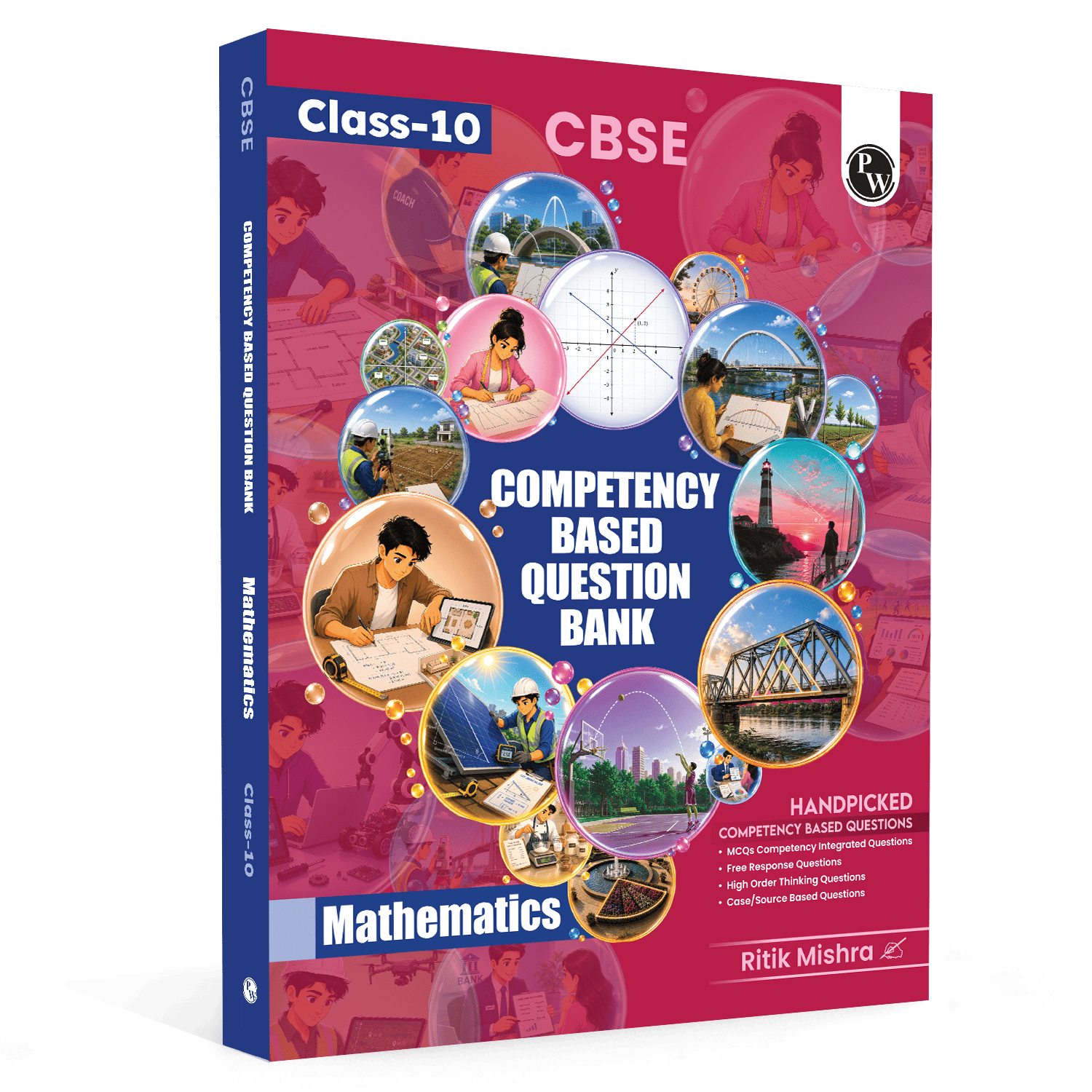
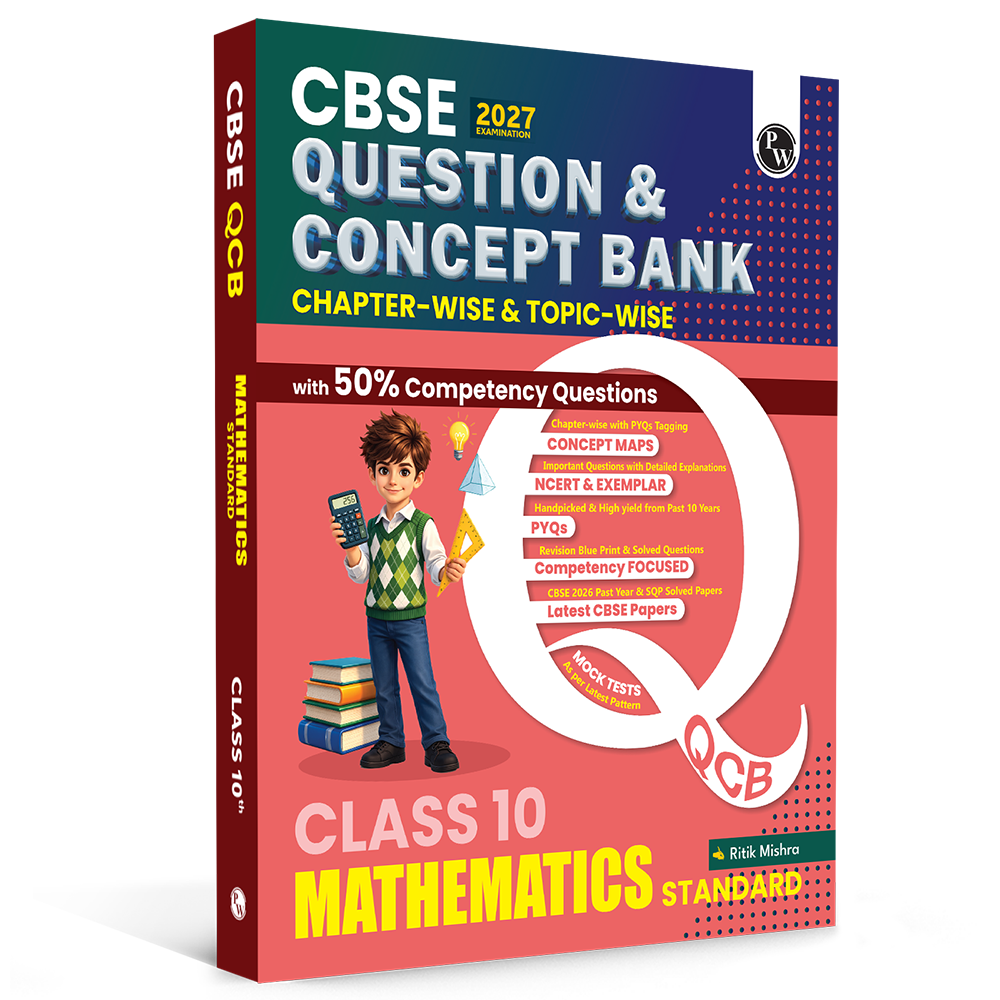
Adopting a structured solution workflow ensures consistency during board assessments. Regular practice with a CBSE Class 10 Question Bank can help students understand different question types, follow step-by-step solutions, identify common mistakes, and improve accuracy and answer presentation for the board examination.
What are the Methods to Solve Class 10 Maths Competency Questions?
To tackle complex Class 10 maths competency questions systematically during tests, follow this strategy:
Step 1: Read and Deconstruct the Scenario
Read through the paragraph prompt carefully. Focus on understanding the story context, then highlight the specific numbers given and circle the precise question being asked. Filter out descriptive sentences so that only mathematical facts remain.
Step 2: Map the Situation to Core Concepts
Connect the situation to your syllabus topics. Determine whether the scenario involves quadratic equations, trigonometry, or surface areas. Identifying the underlying concept narrows down the applicable formulas immediately.
Step 3: Translate Words into Mathematical Equations
Assign variables to unknown quantities. Translate text statements directly into algebraic equations, geometric figures, or statistical tables. Setting up clean algebraic equations forms the foundation of successful CBSE Maths preparation.
Step 4: Execute Calculations Methodically
Work through the mathematical equations step by step. Write out intermediate working clearly rather than doing calculations mentally. Maintaining clean line-by-line working minimizes calculation mistakes and ensures you earn full credit under step-wise marking schemes.
Step 5: Validate Your Final Answer Against Practical Reality
Always check whether your numerical solution makes practical sense within the real-world context of the problem. If a problem asks for the speed of a vehicle or the dimensions of a park, a negative value indicates a calculation mistake. Confirming units ensures complete solution accuracy.
Practice Sheet for Class 10 Maths Competency Questions
Structured practice across multiple question formats builds speed and exam confidence. Combining daily solving sessions with a dedicated maths practice book reinforces textbook learning and complements NCERT exemplar support.
The table below outlines the core question categories, target skills, and optimal solving approaches:
|
Question Category |
Core Analytical Focus |
Primary Objective |
Strategic Solving Approach |
|
Case-Based Scenarios |
Real-life application-based questions |
Extract numerical data from passages |
Isolate numerical data before reading sub-questions |
|
Assertion & Reason |
Theoretical logic |
Validate conceptual truth |
Verify both statements independently before linking |
|
Analytical MCQs |
Quick calculation |
Improve speed and accuracy |
Test extreme values or eliminate invalid options |
|
Subjective Questions |
Step-wise derivations |
Follow step-wise marking presentation |
Write out clear formulas and line-by-line working |
Working through collections featuring 400+ competency-based questions ensures complete exposure to modern board examination trends. A CBSE Class 10 Maths Question Bank can further support this practice with chapter-wise questions, application-based problems, and exam-oriented exercises, helping students strengthen concepts and prepare confidently for the board examination.
How to Check Your Answers in Class 10 Maths Competency Questions?
Validating your working systematically during examinations prevents easy mark deductions:
-
Perform Reverse Calculation: Insert your calculated numerical values back into the original algebraic equations to verify whether both sides remain equal.
-
Confirm Measurement Units: Double-check that your final result includes proper units such as square centimetres, metres per second, or rupees.
-
Review Logical Constraints: Ensure answers respect natural boundaries (for example, probability values must sit strictly between zero and one, and geometric lengths must remain positive).
-
Audit Step-Wise Presentation: Verify that mandatory intermediate steps, formula statements, and final conclusion lines are written out clearly in accordance with official step-wise marking schemes.
Tips to Score Better in Class 10 Maths Competency Questions
Consistently scoring high marks in Class 10 Maths competency-based questions requires smart preparation techniques. Using CBSE Class 10 Books alongside regular practice can help strengthen fundamental concepts, improve problem-solving skills, and build confidence in handling application-based questions during the board examination.
-
Build Concept Clarity: Ensure thorough mastery over basic concepts before attempting complex real-life application-based questions.
-
Practice Structured Answer Presentation: Write clear given statements, formulas, and steps to secure full marks under step-wise marking rules.
-
Solve Dedicated Reasoning Problems: Work through regular maths reasoning questions to sharpen your ability to connect abstract formulas with practical conditions.
-
Maintain Curriculum-Aligned Revision: Keep study plans strictly updated with current curriculum-aligned revision guidelines and sample paper layouts.
Common Mistakes to Avoid While Solving Class 10 Maths Competency Questions
Avoid these common traps during practice sessions and final examinations:
-
Misinterpreting Long Text Passages: Rushing through the opening paragraph often leads to choosing the wrong variables or missing key conditions.
-
Skipping Intermediate Derivation Steps: Jumping straight to final values risks point deductions under step-wise marking criteria.
-
Ignoring Unit Conversions: Forgetting to convert mixed units ruins otherwise accurate setups.
-
Guessing MCQ Options Early: Selecting MCQ answers without working through rapid elimination leads to avoidable errors.
Read More: CBSE Class 10 Maths Questions with Answers
Class 10 Maths FAQs
1. What are class 10 maths competency questions?
They are application-focused assessment problems—including MCQs, assertion and reason, case-based, and subjective questions—designed to evaluate practical conceptual understanding and analytical problem-solving skills rather than rote memory.
2. How can students prepare effectively for Class 10 maths competency questions?
Students should combine standard textbook learning with regular practice using structured question banks that feature 400+ competency-based questions with detailed solutions and step-wise marking schemes.
3. Are competency-based questions harder than standard textbook problems?
They are not necessarily harder, but they require strong concept clarity, logical reasoning, and the ability to translate real-world scenarios into mathematical equations.
4. Do board examinations use step-wise marking for competency problems?
Yes, board exams strictly follow a step-wise marking scheme to improve answer presentation, awarding partial marks for correct data extraction, setting up equations, and intermediate logical steps.
5. Is studying NCERT sufficient for competency-based mathematics preparation?
NCERT builds essential foundational knowledge, but students should supplement it with NCERT exemplar support and targeted application practice banks to complement textbook learning.