Maths Preparation with CBSE Class 10 Previous Year Papers
The mid-term season often brings a wave of anxiety for students, especially when facing a subject like Mathematics. You might find yourself staring at complex theorems or confusing algebra problems, wondering if your preparation is enough to tackle the upcoming board exams.
Many students struggle to manage their time during the test or fail to understand which chapters carry the most weight. This is where a structured approach using CBSE Class 10 PYQ Maths becomes essential.
By practising with authentic past questions, you can bridge the gap between textbook learning and actual exam performance, ensuring you are ready for any challenge the paper throws at you.
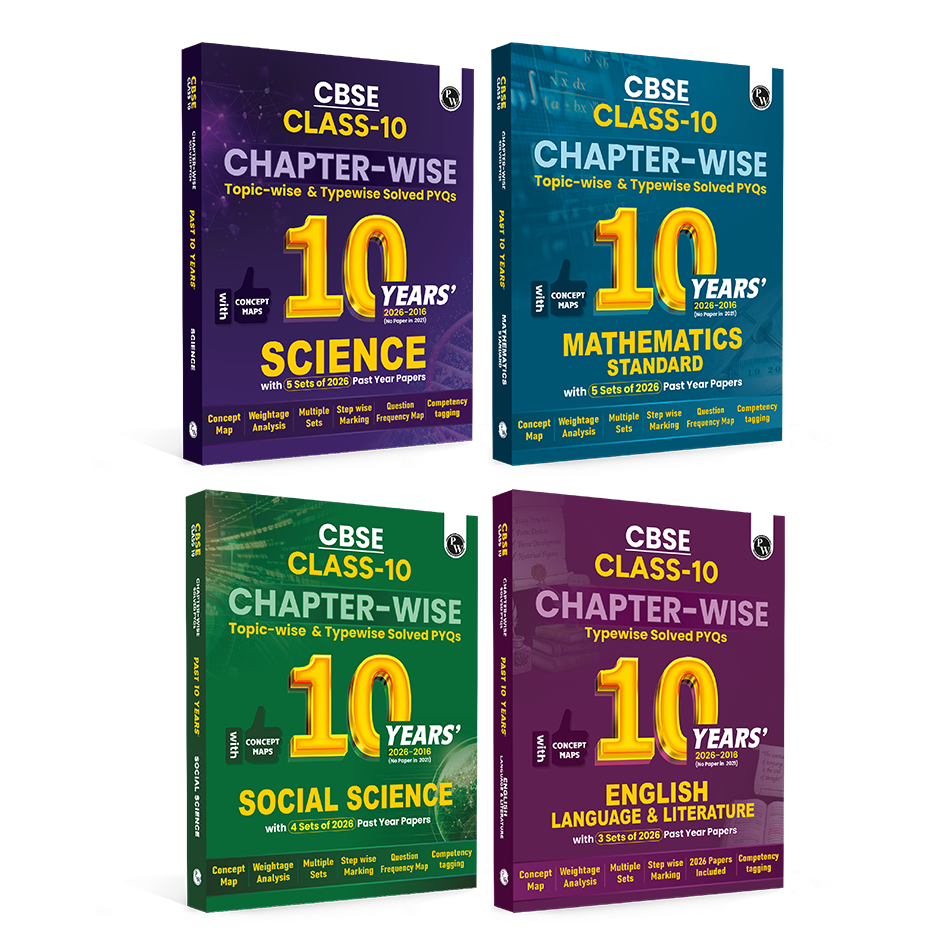
Check out - CBSE Class 10 Books
Overview of CBSE Class 10 PYQ Maths
Integrating CBSE Class 10 PYQ Maths into your daily routine is perhaps the most effective way to understand the mind of the examiner. It moves you beyond simple rote memorisation and pushes you towards application-based learning.
-
Understanding Question Typology: You get direct exposure to various question formats, from multiple-choice questions to long-form subjective answers.
-
Weightage Clarity: Previous years' papers reveal which topics are frequently tested, allowing you to prioritise chapters that offer the most marks.
-
Exam Pattern Familiarity: Regular practice helps you get used to the structure of the CBSE Class 10 Maths previous year paper, reducing exam-day stress.
-
Step-wise Marking Awareness: Seeing solved papers teaches you how to present your answers to earn maximum marks for each step.
How to Use CBSE Class 10 PYQ Maths for Preparation
To make the most of CBSE Class 10 PYQ Maths, you need more than just a collection of papers; you need a system. Start by finishing a chapter from your NCERT textbook and then immediately solve the related questions from the CBSE 10th Class Maths previous year question papers.
Another great method is to use papers that offer NCERT Concept Mapping. This allows you to link every previous year's question back to a specific paragraph or exercise in your textbook, ensuring your fundamentals are rock solid.
Benefits of Solving Class 10 PYQs Maths
The consistent use of CBSE Class 10 PYQs Maths offers benefits that go beyond just scoring marks. It builds a psychological edge.
-
Boosts Confidence: When you realise you can solve actual board questions from 2026 or earlier, your fear of the subject diminishes.
-
Refines Time Management: You learn exactly how much time to allocate to 1-mark questions versus 5-mark questions.
-
Identifies Weak Spots: Repeatedly getting a specific type of Trigonometry question wrong tells you exactly where you need to go back to the NCERT basics.
-
Updated Exposure: Using the latest sets, including Delhi and Outside Delhi papers, ensures you are prepared for varying levels of difficulty.
Tips to Prepare with CBSE Class 10 PYQ Maths
To achieve a top score, treat every session with CBSE Class 10 PYQ Maths as a real exam. Keep your workspace clean and avoid looking at the solutions until you have finished the entire section.
Focus heavily on the detailed explanations provided in your solved paper books. These explanations often show you "topper-style" presentation techniques, such as drawing clear diagrams and highlighting final answers.
Additionally, pay attention to the Chapter-wise Trend Analysis to predict which sections might be more challenging this year.
Mistakes to Avoid While Solving CBSE 10th Maths PYQs
Even with the best CBSE Class 10 PYQ Maths resources, students often fall into traps that hinder their progress.
-
Ignoring Rationalised Content: CBSE often updates the syllabus. Ensure you are not wasting time on "Out of Syllabus" (OS) topics that have been removed from the current year's curriculum.
-
Reading Instead of Writing: Maths is a "doing" subject. Simply reading the solutions in CBSE board previous year question papers in Class 10 Maths will not help you solve them under pressure.
-
Overlooking Competency Questions: Newer papers include more application-based scenarios. If you only practice old-style direct questions, you might struggle with the latest 2026 paper sets.
-
Neglecting Self-Evaluation: After solving a paper, you must check your work against detailed step-by-step explanations to find where you lost marks.
Check Out: CBSE Class 10 Previous Year Papers
Study Strategy with CBSE Class 10 PYQ Maths
A successful mid-term and final strategy involves a mix of topical revision and full-length mock tests. Using CBSE Class 10 PYQ Maths effectively requires a phased approach:
-
Chapter-wise Analysis: Use resources that provide a chapter-wise breakdown of the last 10 years. This helps you identify "hot topics" within Algebra, Geometry, or Trigonometry.
-
Trend Insights: Look for patterns in how questions have evolved over the past 5 years. Modern exams focus more on competency-based questions that test your real-world application.
-
Timed Practice: Once you have covered 50-60% of the syllabus, start solving a full CBSE 10th math previous year question papers within a strict three-hour limit. This builds the stamina needed for the actual board hall.
Read More: CBSE Previous Year Question Papers Class 10 PDF with Solutions
CBSE Class 10 PYQ Maths FAQs
Q1: Where can I find the latest CBSE Class 10 PYQ Maths for 2026?
You can find updated collections that include the 2026 Delhi and Outside Delhi sets with detailed step-wise marking and rationalised content.
Q2: Are CBSE Class 10 Maths previous year paper sets enough for mid-terms?
Yes, practising these papers helps you understand the difficulty level and question distribution, which is perfect for mid-term preparation.
Q3: Why should I use CBSE 10th Class Maths previous year question papers instead of just sample papers?
Past year papers provide authentic questions actually asked by the board, giving you a more realistic idea of the exam than some unofficial sample papers.
Q4: Do these CBSE 10th math previous year question papers include deleted topics?
High-quality resources clearly mark "Out of Syllabus" (OS) questions to ensure you only study what is relevant for the current year.
Q5: How many years of Class 10 PYQs Maths should I solve?
Solving the past 10 years of papers is generally recommended to cover all possible question variations and trends.