NCERT Solutions for Class 6 Social Science Chapter 9 Family and Community
The family and the community are the two most important groups of people that a child interacts with as they grow up. Chapter 9 of the NCERT Class 6 Social Science book, "Family and Community," is an important chapter that teaches pupils about the basic parts of society. It talks about how we are not alone, but are part of a bigger web of ties that are all connected.
At PW Store, we aim to provide the most comprehensive family and community class 6 ncert solutions to help students master these concepts. This guide includes a detailed class 6 civics chapter 9 summary, solved question answers, and important practice questions to ensure academic excellence.
Check Out: Class 6th Books
Class 6 Civics Chapter 9 Summary: An Overview
The chapter "Family and Community" talks about how people in India and around the world live together. It starts by saying that the family is the most important part of society and that a child learns their first lessons about love, discipline, and working together there. The chapter then talks about the idea of a community, which is a group of individuals who live in the same place or have the same aims and interests.
Key Concepts Covered:
-
The Role of Family: Family is where we get help with our feelings and our bodies. This is our first school.
-
Types of Families: The chapter discusses nuclear families (parents and children) and joint families (grandparents, uncles, aunts, and cousins living together).
-
The Concept of Community: How families come together to form a neighborhood, and neighborhoods form a community.
-
Interdependence: Every family needs help from other families to get everything it needs. We depend on people in the community, like doctors, farmers, teachers, and shopkeepers, for our daily life.
-
Civic Sense: The importance of following the rules and keeping our town clean for the welfare of everyone.
Family and Community NCERT Solutions Class 6th SST Chapter 9 Question Answer
Here are the solutions for NCERT Class 6 Social Science Chapter 9 Family and Community. These solutions cover all the questions and exercises from the chapter to help students understand the concepts clearly and prepare effectively for exams.
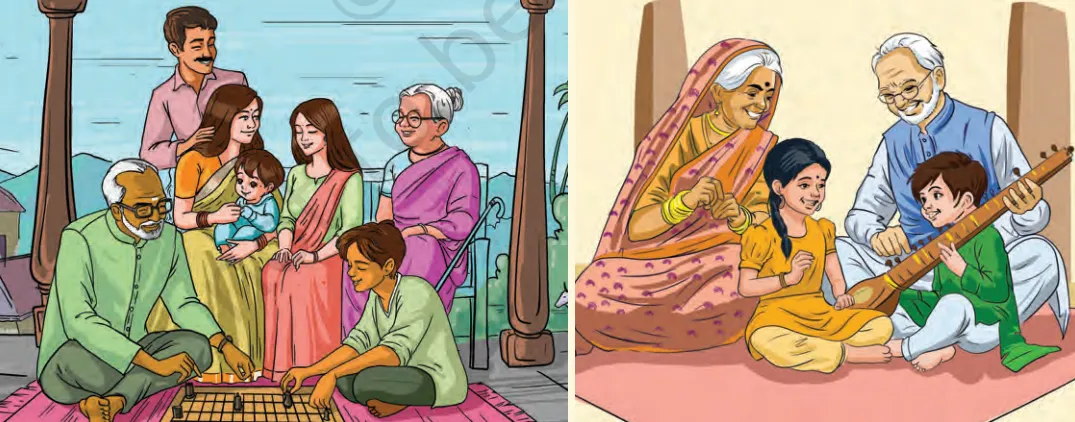
Q1. Why is the family unit important?
A: Family gives love, support, care, teaches values, and helps personal growth and social development.
Q2. What is a community and what is its role?
A: A community is people living together who support each other and share resources to improve life quality.
LET’S EXPLORE
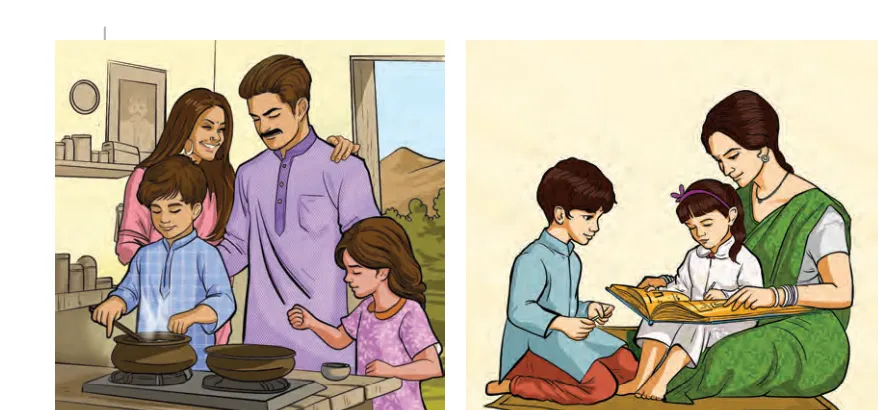
Q1. What types of families do you see in your neighbourhood?
A: Families with both parents, single parents, with grandparents, and extended families including relatives.
Q.2. What types are more frequent? Why do you think this is so?
A: Nuclear families are more frequent. This is because most people work in cities and prefer living in smaller families with just parents and children. Also, space in cities is limited, so small families are easier to manage.
Q.3. As a class activity, compare with your classmates’ findings and discuss.
A: Do IT YOURSELF.
Answer these questions and compare your answers with a few classmates:
Q.4: Who in your family decides what is to be bought from the market?
A: In my family, my parents usually decide what is to be bought from the market.
Q.5. Who cooks food in your home?
Ans: My mother mostly cooks food at home. Sometimes my father also helps.
Q.6. Who is the oldest person in your family?
Ans: My grandfather is the oldest person in my family.
Q.7. Who cleans the floor in your home?
Ans: We have a helper who cleans the floor. Sometimes, my mother also does it.
Q.8. Who washes utensils in your house?
Ans: Our helper washes the utensils, but during holidays, we all help together.
Q.9. Who helps you to do your homework?
Ans: My elder sister and sometimes my father help me with my homework.
Read More: NCERT Solutions for Chapter 10 of Class 6 Social Science Grassroots Democracy
LET’S EXPLORE
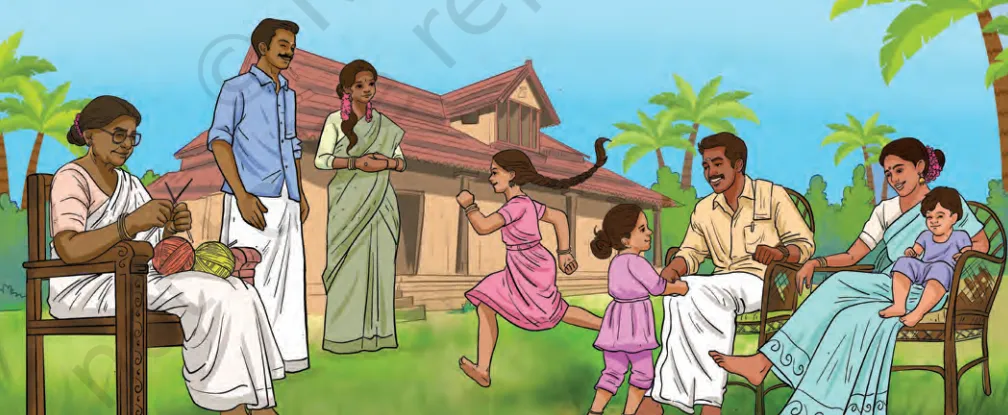
Q.1. Draw a simple tree of this family of seven members.
A: Grandmother
│
┌──────────┴──────────┐
Father Aunt (or Father's Sister/Wife)
│ │
Mother Uncle (or Aunt's Husband)
│
┌─────┴─────┐
Daughter Younger Child
Q2. Why did Shalini’s parents buy clothes for everyone?
A: To show love and care, supporting all family members equally.
Q3: What would you have done if you were in Shalini’s place?
A: If I were in Shalini’s place, I would feel happy and grateful that everyone in my family got new clothes for the festival of Onam. Even if I had to wear a simple cotton cloth instead of a silk one, I would still be content because the important thing is that family members support and care for each other. Seeing everyone happy together is what really matters in a family.
Think About It -
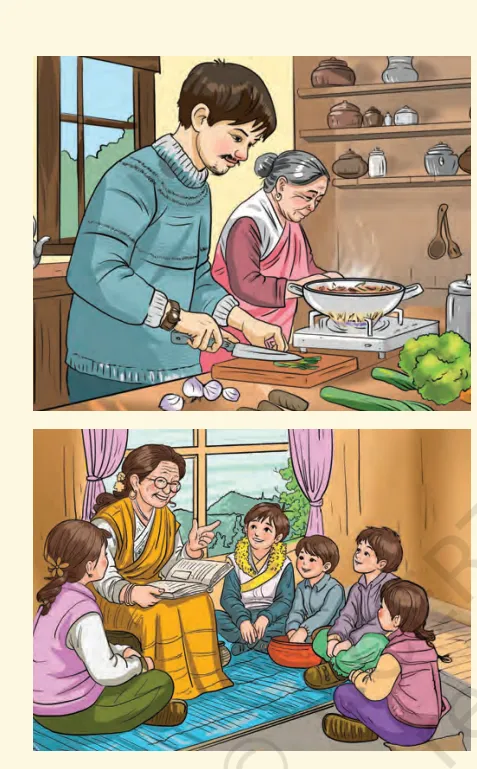
Q1: Why does Tenzing’s father consult his wife for special expenses?
A: Tenzing’s father consults his wife before making special expenses because, in many families, important financial decisions are made together. This shows respect for each other’s opinions and ensures that both partners are involved in managing the household budget. Consulting his wife helps them plan their money wisely and make sure the family’s needs are met responsibly. It also strengthens their partnership by making decisions as a team.
Q.2. How do you feel about his participation in household chores?
A: I feel very happy and inspired by Tenzing’s father's participation in household chores. It shows that all family members should help each other, no matter their role. It makes the family stronger and teaches us that housework is everyone’s responsibility.
Q.3. What roles do the grandparents fulfil?
A: The grandparents in Tenzing’s family play very important roles. His grandmother cooks food, tells stories, and shares wisdom. His grandfather helps with homework, takes him to the bus stop, and helps people in the colony. They are caring, supportive, and active members of the family and community.
LET’S EXPLORE
Q1: Create a story of a family somewhere in India, where family values are practiced.A: Ramesh, his wife Sita, and their children Ravi and Priya lived in a small Indian village with Ramesh’s mother.
A: One day, the grandmother fell ill, and the whole family became worried. Sita took care of her by cooking her favorite meals and giving her medicine. Ravi and Priya helped their mother with household chores. Ramesh worked hard at a construction site to pay for the treatment. When the grandmother recovered, the family sat together, shared a meal, and thanked each other for the support. Ramesh said, “We are strong because we are together.” Sita added, “Family is about helping each other.” Ravi and Priya learned that love, care, respect, teamwork, and gratitude are the key values that keep a family strong.
Questions, Activities And Projects (Page 148)
Q1: What are some rules you follow in your family and neighbourhood? Why are they important?
A: In my family, I follow rules like sharing household chores, respecting elders, waking up and sleeping early, and keeping the house clean. In my neighbourhood, people throw garbage in designated places, avoid unnecessary noise, respect elders, and follow traffic and parking rules. These rules help maintain peace, cleanliness, and good relationships in both family and community.
Q2: Do you think some rules are unfair to a few people in the family or community? Why?
A: Yes, some rules can seem unfair, such as strict curfews for teenagers or uneven distribution of chores. To be fair, rules should consider everyone’s needs and situations so no one feels unfairly treated or overburdened.
Q3: Describe situations where community support makes a difference.
A:
-
Disaster Relief: Communities help during floods or earthquakes by donating, volunteering, and rebuilding homes.
-
Health Crises: During pandemics, people organize food drives, provide masks, and support healthcare workers emotionally.
-
Educational Support: Communities offer tutoring and scholarships to help poor students succeed.
-
Elderly Care: Neighborhoods set up programs to assist and socialize with elderly residents, improving their wellbeing.
Check Out: PW School Books
Class 6 Social Science Important Questions: Extra Practice
To score higher marks, students should practice these class 6 social science important questions:
Q1. What is meant by 'Civic Sense'? Give two examples.
Answer: Civic sensibility is the moral and social duties that a person has to their community.
-
Example 1: Don't throw trash on the ground in locations like parks or roadways.
-
Example 2: Following the regulations of the road to keep everyone safe.
Q2. How has the way Indian families are set up evolved throughout time?
Answer: Traditionally, the joint family system was very common in India, especially in rural areas. However, with urbanization and the search for better job opportunities, people are moving to cities, leading to a rise in the nuclear family system.
Q3. Name some community helpers and explain their roles.
Answer:
-
Farmers: They grow the food we eat.
-
Teachers: They provide education and shape the future of the nation.
-
Police: They maintain law and order and keep us safe.
-
Sanitation Workers: They keep our surroundings clean and prevent diseases.
Class 6 Family and Community Explanation: Visualizing the Lesson
When studying class 6 social science chapter 9 solutions, it is helpful to visualize the relationship between an individual and the world:
-
The Individual: The center of the circle.
-
The Family: The immediate circle providing primary care.
-
The Neighborhood: Families living close to each other.
-
The Community: The larger group sharing language, culture, or geography.
-
The Nation: The collection of all communities.
Study Tips for Class 6 SST Chapter 9
-
Real-life Correlation: Look at your own neighborhood. Identify your community helpers. This makes the class 6 family and community explanation much easier to remember.
-
Keywords: Memorize terms like interdependence, nuclear family, joint family, and civic sense.
-
NCERT Solutions PDF: Students often look for a ncert class 6 sst solutions pdf. While digital copies are great for quick reference, writing the answers down in your notebook helps with long-term memory.
-
Diagrams: Draw a simple flow chart showing the "Individual $\rightarrow$ Family $\rightarrow$ Community $\rightarrow$ Nation" chain.
Check Out: School Stationery Items
NCERT Solutions Class 6 Social Science Chapter 9 FAQs
Q1. Where can I obtain all the answers to chapter 9 of class 6 social science?
You may obtain full and verified answers on the PW Store website or app. We give you step-by-step answers that are based on the most recent NCERT syllabus.
Q2. Are these class 6 NCERT solutions for family and community good for CBSE tests?
Yes, these answers are based only on the NCERT textbook, which is the main book used for CBSE and most state board tests in India.
Q3. Is Chapter 9 of Class 6 Civics hard to understand?
No, not at all! Because it talks about things you see every day, including your parents, friends, and neighbours, this is one of the most relatable chapters.
Q4. How many types of families are mentioned in the NCERT text?
The textbook primarily focuses on two types: Nuclear Families and Joint Families.
Q5. Can I get these class 6 sst chapter 9 question answers in a short format?
Yes, we have provided class 6 social science short answers chapter 9 in the "Short Answer Questions" section above for quick revision.