Subject-Wise Preparation Strategy Using CBSE Class 10 Question Bank

Scoring high in the board exams is less about how many hours you sit at your desk and more about the quality of the resources you use. Many students feel overwhelmed by the vast syllabus, often wondering which chapters to prioritise. This is where a CBSE class 10 question bank becomes your most valuable asset. You can turn your preparation from messy to clinical by focusing on subject-specific tactics and practicing with the Question Bank.
Preparation Tips Using CBSE Class 10 Question Bank
CBSE Class 10 Mathematics
Mathematics is often the most feared subject, but it is also the most rewarding. The secret lies in repetitive practice of diverse problems rather than just reading through solved examples.
Focus on High-Weightage Chapters
When using resources like the CBSE class 10 maths question bank , you should start with chapters like algebra, trigonometry, and statistics. These are worth a lot of points, and you need to know the formulas well.
Strategy for Maths:
-
Solve by topic: Don't start with full-length papers right away. To increase your confidence, start by answering 20 to 30 questions from your question bank for one chapter.
-
Mark Hard Questions: While you practise, go through the questions and circle the ones you couldn't answer the first time. Go back to them every week until the logic comes naturally.
-
Awareness of Step-Marking: Even if the final answer is wrong, board examiners still assign points for steps. Write down every formula you use, as shown in the solutions.
-
Routine for Revising Formulas: Keep a separate notebook for formulas and go over them every day to get better at taking tests quickly and accurately.
-
Timed Practice Sets: Solve mixed questions within a fixed time limit to improve calculation speed and build exam temperament.
CBSE Class 10 Science
Science requires a blend of memorisation and conceptual clarity. The CBSE Class 10 Science question bank 2026 editions are specifically designed to handle the new competency-based questions which test how well you can apply science to real-life scenarios.
Strategy for Physics, Chemistry, and Biology
-
Physics: Focus on numerical problems from 'Light' and 'Electricity'. Practise ray diagrams until they are neat and accurate. Find different numbers in the question bank.
-
Chemistry: Write down every chemical reaction. Use the cbse question bank class 10 to find various ways a single reaction, such as the chlor-alkali process, can be asked.
-
Biology: Diagrams are your most valuable tool. You can get extra points for drawing a tidy, named picture of a neurone, even if the question doesn't ask for one.
-
NCERT Line-by-Line Revision: A lot of board questions are dependent on NCERT lines, especially in Biology and Chemistry. So, make sure to study the book carefully.
-
Practice Assertion-Reason Questions: Use the question bank to focus on assertion-reason questions, which are often on tests.
CBSE Class 10 Social Science
Many students know the historical facts but fail to present them well, leading to lower marks. CBSE Class 10 Social science is where your writing style and structure truly matter.
Strategy for History and Civics:
-
Bullet Points: Never write long, chunky paragraphs. Use the CBSE Class 10 social science question bank to see how toppers break down a 5-mark answer into five distinct, impactful points.
-
Map Work: Allocate 10 minutes daily to map practice. A question bank usually contains a dedicated section for all repeated map locations.
-
Keyword Emphasis: Bold important dates, names, and events to make it easy for the examiner to spot your knowledge. Clearly highlight terms like Satyagraha.
-
Use Mnemonics for Retention: Create short tricks or acronyms to remember lists such as causes, features, or impacts.
-
Practice Previous Year Questions: Many questions are repeated in different formats, so solving PYQs from the question bank can significantly boost your score.
CBSE Class 10 English
English is often neglected until the last month, which is a mistake. The Reading and Writing sections require consistent practice to master the tone expected by CBSE.
-
Unseen Passages: In 2026, use the CBSE class 10 english question bank to practise at least two passages per week. This makes you read faster.
-
Formal Letters: Stick to the format religiously. Even if your content is average, a perfect format ensures you get marks for structure.
-
Literature: Don't just read the summary. Look at the character sketches provided in the PW question bank.
-
Vocabulary Building: Learn 5–10 new words daily to improve writing quality and comprehension skills.
-
Practice Writing Section Weekly: Attempt essays, letters, and notices regularly to improve clarity, tone, and time management.
Why CBSE Class 10 Question Bank is Important?
Most students only use NCERT, which is good for developing a foundation but doesn't have as many different kinds of questions as real boards do. A CBSE question bank has many benefits that textbooks alone do not provide.
-
Familiarity with Exam Patterns: It introduces you to Case-Based, Assertion-Reason, and Very Short Answer questions that are now standard.
-
Finding Important Topics: You can easily see which ideas come up every year, which helps you plan your study time.
-
Time Management: Practicing with a question bank, PDF or physical book helps you track how long you take per section.
-
Self-Assessment: It helps you find out what you need to work on, including how to use certain theorems or chemical equations, before the test day.
-
Full Coverage of the Syllabus: A question bank is organised by chapter, so you can make sure you cover all of the material without missing any crucial themes. This makes it easier to study and less stressful.
-
Seeing all kinds of questions: Question banks get you ready for all the many types of questions that are asked in CBSE exams, including the newest competency-based questions. These include MCQs, case-based questions, assertion-reason questions, and extended responses.
-
Built-in revision tools: Good question banks offer summaries, key ideas and quick revision notes. This means you may use them to practise and study at the last minute.
-
Mock Tests and Exam Stimulation: Question banks often include full-length questions and sample papers that are like the real test. This will help you get better, faster, and more sure of yourself.
-
Application-Based Learning: Because CBSE is going toward competency-based questions, question banks let you practise questions that are more like real-life circumstances instead of just learning theory.
Check out: CBSE Class 10th Previous Year Papers
How to Use the PW CBSE Class 10 Question Bank?
The PW question bank for class 10 is curated by experts who understand the pulse of the CBSE board. Here is how to integrate it into your daily timetable:
-
The 70-30 Rule: Spend 70% of your time reading the textbook and 30% solving the CBSE Class 10 question bank. As exams approach, flip this ratio.
-
Active Recall: After finishing a chapter, try to solve the "Short Answer" questions from the question bank without looking at the solutions.
-
Analyse Topper Answers: Most high-quality banks, include handwritten topper sheets. Study how they use margins and headings.
Common Mistakes to Avoid with Class 10 Question Bank
Even with the best question bank 2026, you might fail to see results if you fall into these common traps:
-
Ignoring the Marking Scheme: Always check how marks are distributed. Don't write a full page for a 2-mark question.
-
Inconsistency: Aim for 10-15 high-quality questions every single day rather than a marathon session once a week.
-
Over-Reliance on Solutions: Try solving the question yourself for at least 5 minutes before looking at the answer key in your question bank for class 10 pdf.
Read More: Topper Answer Sheet Class 10 CBSE PDF Download
Preparation Strategy Using CBSE Class 10 Question Bank FAQs
Is a question bank enough to get a 90%?
A question bank is important for practice, but you should also study NCERT textbooks to make sure you really understand the basic ideas.
Where can I get a free PDF of a question bank?
There are many PDF versions available on educational blogs and websites, but actual books are better for long-term practice because they don't make you tired of looking at screens.
How does the question bank help in science?
It provides specialised practice for assertion-reasoning questions and helps students master complex diagrams and chemical equations through repetitive drills.
When should I start using the CBSE Class 10 question bank?
It is best to start using the CBSE Class 10 question bank 2026 early in the academic year, ideally immediately after finishing a chapter in school to reinforce learning.
What are the right books for Class 10?
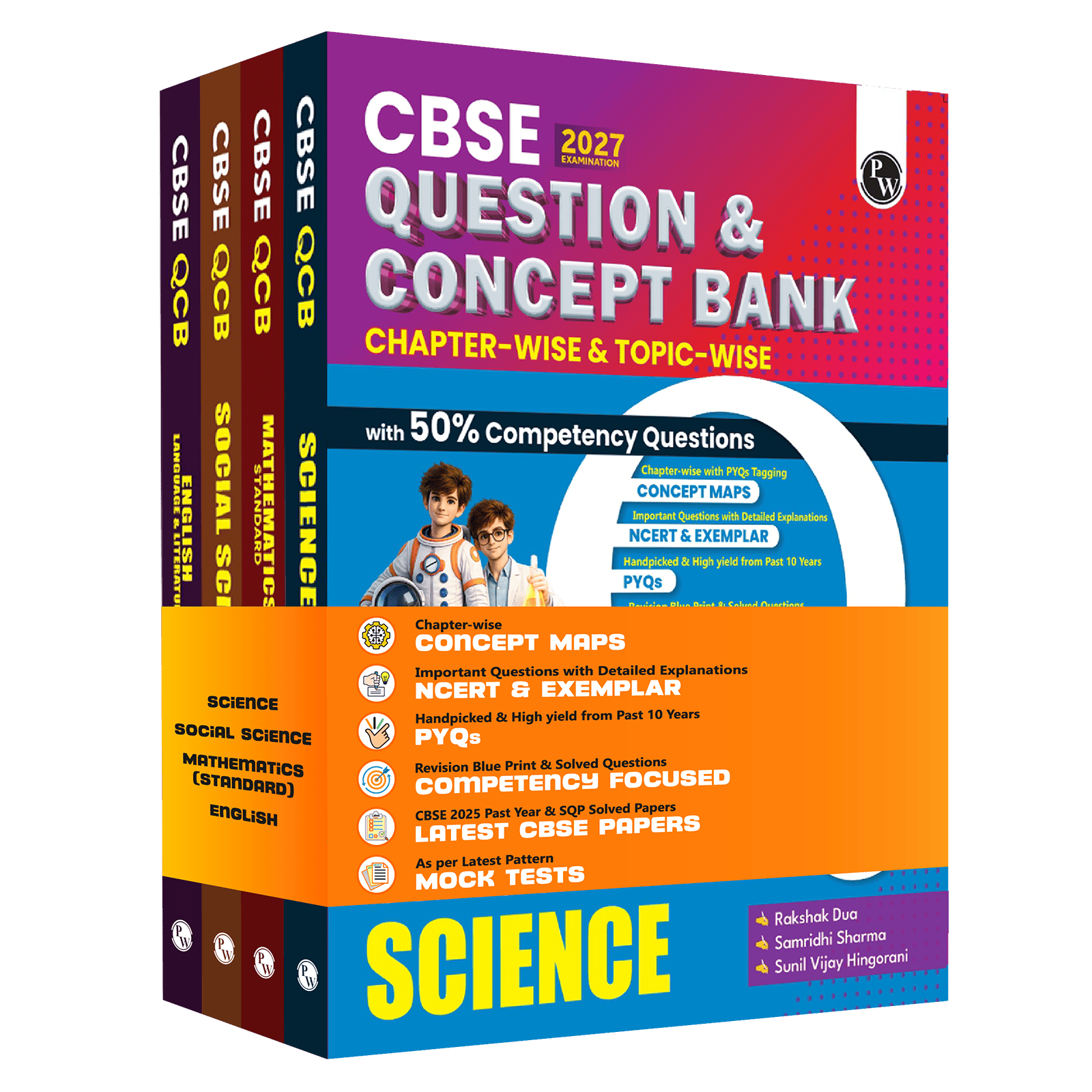
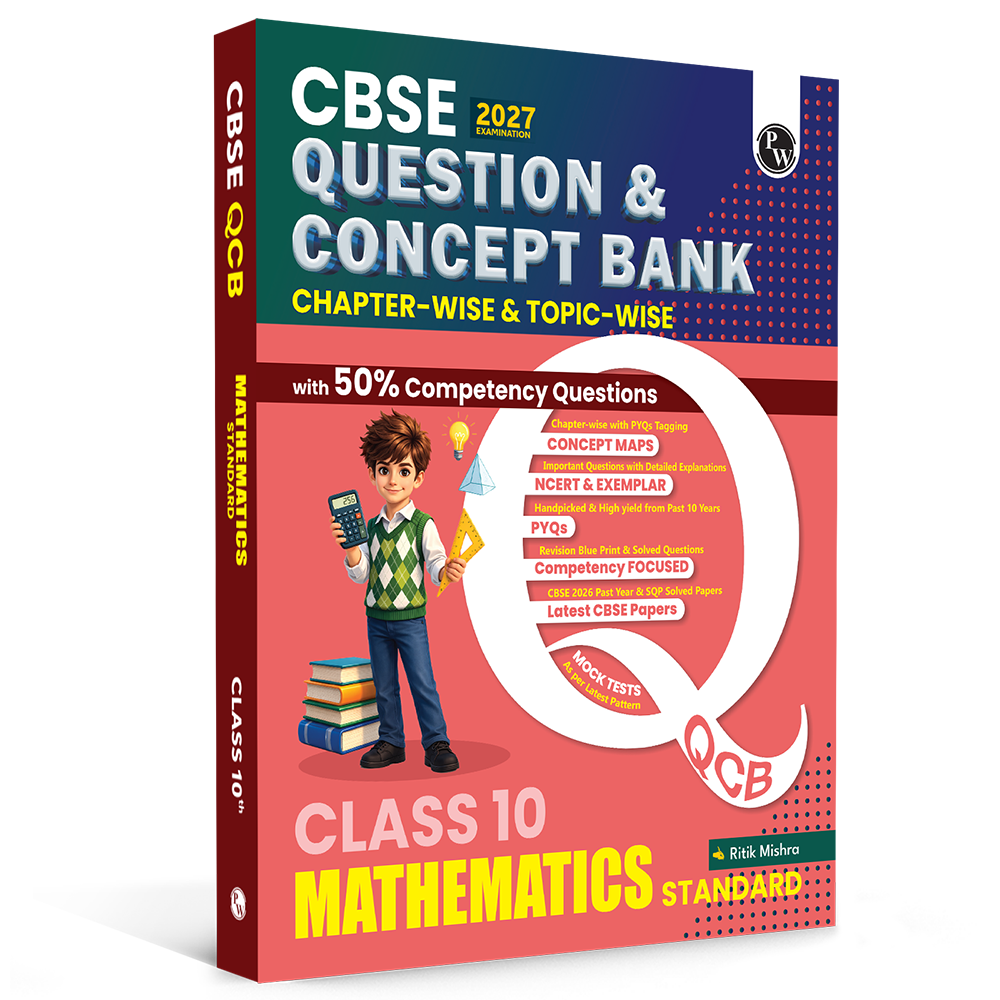
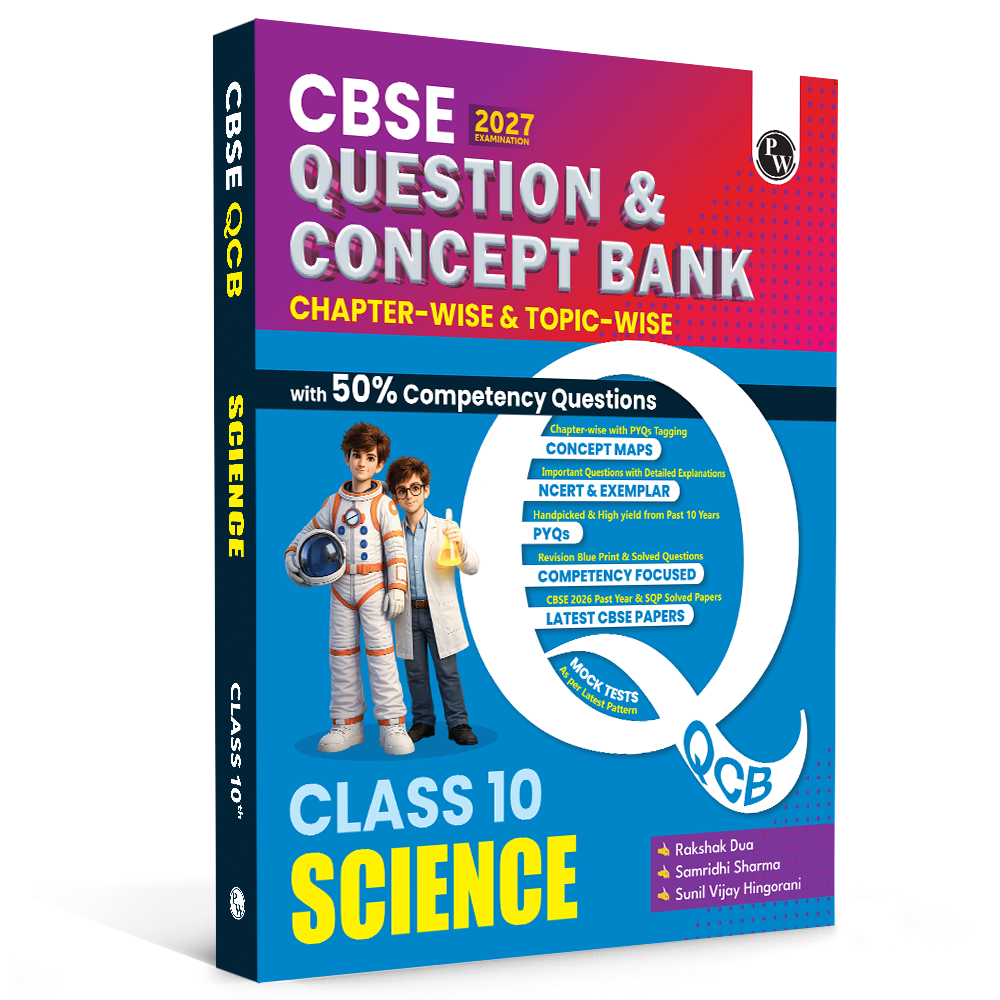
The PW books for class 10 is a strong option. It is designed according to the latest CBSE pattern, includes competency-based questions, detailed solutions, and mock tests, making it ideal for structured preparation.