Common Mistakes Students Make While Solving Class 10 Maths Question Bank
You might spend hours revising formulas, only to lose precious marks due to careless calculation errors, misreading question stems, or failing to present step-by-step proofs clearly. Relying solely on passive reading makes it difficult to pinpoint where your problem-solving process breaks down under strict exam conditions.
Integrating a targeted Class 10 Maths question bank into daily study sessions helps identify specific conceptual gaps early, ensuring you transform mid-term assessment feedback into a structured path toward complete board examination readiness.
Overview of Class 10 Maths Question Bank
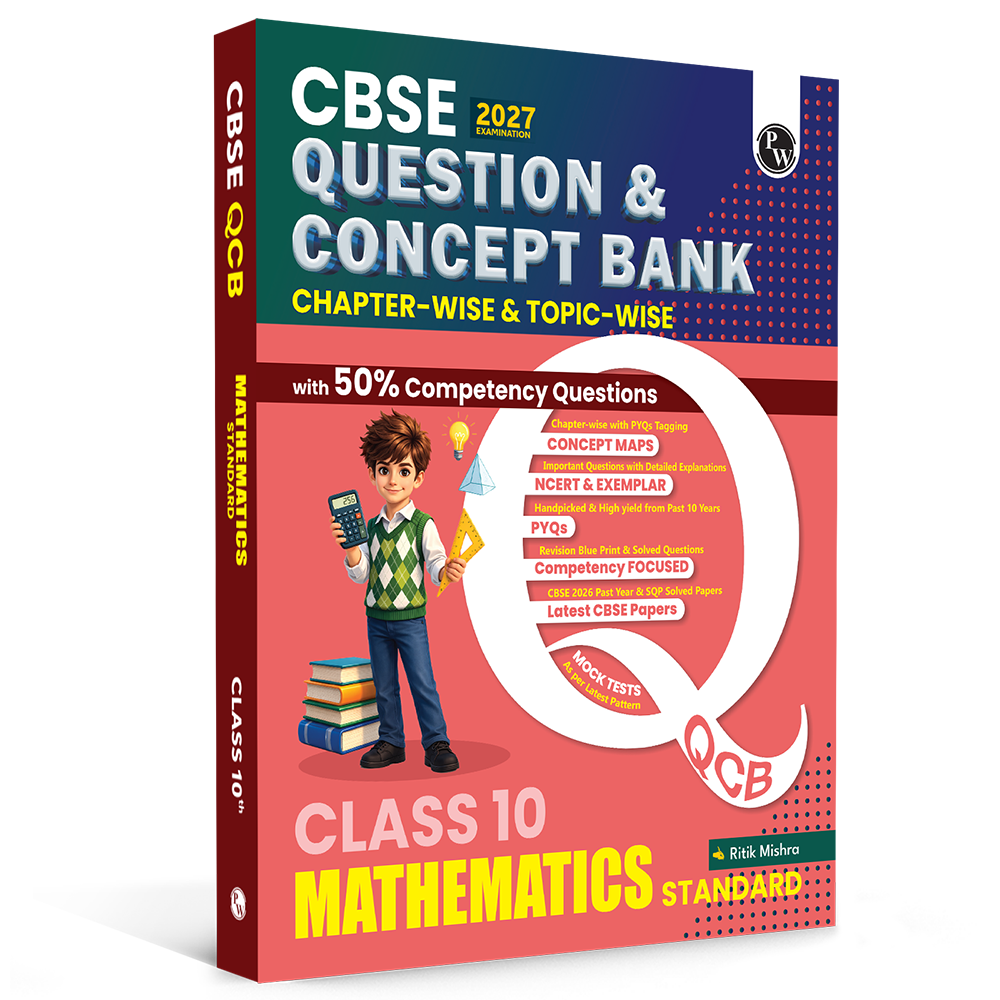
A comprehensive practice resource provides a structured collection of problems designed around the latest curriculum guidelines. It serves as a vital bridge between basic room learning and high-stakes examination requirements.
Rather than offering unstructured problem sets, it organizes revision into logical modules that mirror actual testing patterns.
-
Chapter-Wise Concept Maps: Visual revision tools simplify complex topics and aid structured retention before tests.
-
NCERT Intext and PYQ Integration: A balanced blend of NCERT exercises and previous 10-year board questions builds a reliable foundation.
-
Competency-Focused Blueprints: Real-world case study problems are designed to test analytical skills rather than simple rote memorisation.
-
Sample Question Papers: Fully solved board-pattern papers reveal exact marking schemes and step-wise credit distribution.
Why Is Class 10 Maths Question Bank Important for Board Preparation?
Mid-term results often reveal a stark truth: knowing a formula is entirely different from applying it correctly under pressure. Board examinations test not only your theoretical memory but also your logical application, speed, and precision
-
Exposure to Varied Question Formats: Board papers feature multiple-choice questions, assertion-reasoning problems, short-answer steps, and lengthy structured proofs. A structured 10 Maths question bank ensures you encounter every variation well in advance.
-
Understanding Step-Marking Rules: Solved CBSE class 10 previous year papers demonstrate exactly how examiners award marks for intermediate steps, diagram labels, and final unit statements.
-
Building Exam Stamina: Working through full-length mock papers helps you build the mental endurance needed to sit through exams without losing focus.
-
Targeting Weak Areas: Analyzing performance on chapter-wise sets highlights specific topics that require immediate revision.
What are the Mistakes Students Make While Solving Class 10 Maths Question Bank?
Even with access to quality preparation materials, many students fall into repetitive traps that hinder their score potential. Recognizing these errors during mid-term revision is the first step toward building flawless execution habits.
1. Skipping Step-by-Step Written Practice
A frequent mistake is reading through solved solutions as if reading a narrative book. When you simply look at a step and assume you understand it, you miss the cognitive work needed to execute that operation manually. During actual exams, this habit leads to sudden mental blocks mid-calculation.
2. Ignoring Marking Schemes and Final Units
Students regularly calculate the correct numerical value but forget to append required units. Skipping intermediate statement writing—like stating applied geometric theorems explicitly—results in unnecessary deduction of step marks.
3. Mismanaging Time Across Different Sections
Spending twenty minutes on a two-mark question leaves insufficient time for complex four-mark proofs or multi-part case studies. Without timed conditions, students fail to develop an internal clock for pacing.
4. Avoiding Tricky Competency Questions
Many learners stick comfortably to standard direct questions and skip analytical, real-world case studies. Since modern evaluation heavily features Maths competency questions, ignoring these sections limits top-tier scoring opportunities.
5. Neglecting Systematic Error Analysis
Solving fifty problems is useless if you do not review the ones you got wrong. Failing to analyze your mistakes leads to repeating identical algebraic signs or fraction inversion mistakes in subsequent tests.
How to Avoid Mistakes While Solving Class 10 Maths Question Bank?
Preventing routine mistakes requires a deliberate, structured approach to daily problem-solving. By adjusting your revision habits, you can eliminate avoidable errors and maximise mark retention. Using a CBSE Class 10 Question Bank alongside regular practice can further help you identify common mistakes, strengthen weak concepts, and improve accuracy before the board examinations.
-
Enforce the Written Practice Rule: Never check a solution until you have written down your complete attempt on paper.
-
Annotate Question Stems: Use a pencil to underline key instructions before starting calculations.
-
Utilize Official Solution Keys: Compare your written answers directly against solved sample papers to verify whether your formatting aligns with board expectations.
-
Create an Error Log Book: Record every calculation slip, misapplied formula, or skipped step in a separate notebook. Review this log prior to mid-term assessments.
How to Use Class 10 Maths Question Bank?
To derive maximum benefit from your Class 10 Maths question bank, you must employ it strategically rather than working through pages at random. A structured method guarantees thorough coverage of all topics while preserving critical study time.
-
Phase 1: Concept Review via Visual Maps: Begin each chapter by reviewing chapter-wise concept maps to refresh definitions, formulas, and geometric theorems.
-
Phase 2: Core NCERT & Past Paper Solving: Move directly to NCERT intext problems and high-yield questions from past years. Focus on understanding question patterns and recurrent themes.
-
Phase 3: Real-World Competency Assessment: Address competency-focused blueprints containing real-world scenario questions and case studies.
-
Phase 4: Simulated Testing: Finish the topic by taking a timed mock test from the question bank to evaluate your speed under test conditions.
Study Plan for Using the Class 10 Maths Question Bank
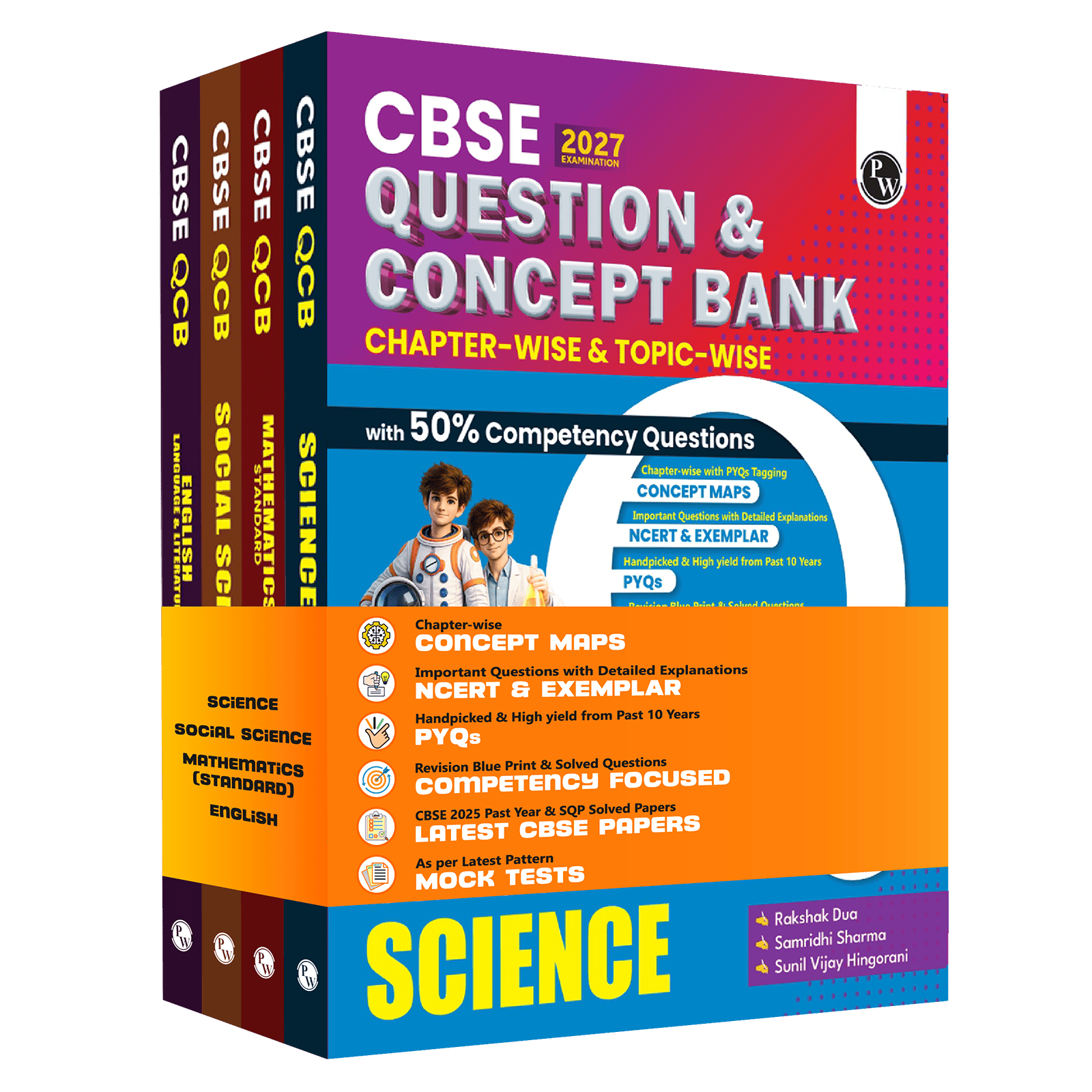
Balancing multiple subjects during the mid-term season can feel overwhelming without a clear schedule. A four-week study plan provides a disciplined framework to systematically complete your mathematical syllabus. Using the CBSE Class 10 Question Bank Combo Set of 4 alongside your study plan can further support chapter-wise practice, concept revision, and regular self-assessment across subjects.
-
Week 1: High-Frequency Algebra & Arithmetic
-
Focus on Number Systems, Polynomials, and a Pair of Linear Equations in Two Variables.
-
Practice fundamental NCERT questions alongside past paper sets.
-
Spend 90 minutes daily: 30 minutes on concept maps and 60 minutes on active problem-solving.
-
Week 2: Advanced Equations and Coordinate Geometry
-
Target Quadratic Equations, Arithmetic Progressions, and Coordinate Geometry.
-
Work through case-study scenarios to build application skills.
-
Dedicate the weekend to reviewing mistakes logged during Week 1.
-
Week 3: Geometry and Trigonometric Proofs
-
Work through Triangles, Circles, and Trigonometry.
-
Focus on writing clean theorem proofs and clearly labeling construction diagrams.
-
Practice step-by-step derivations using solved sample papers as a benchmark.
-
Week 4: Mensuration, Data Analysis, and Full Mock Exams
-
Cover Surface Areas and Volumes, Statistics, and Probability.
-
Complete full-length mock papers under strict examination conditions.
-
Conduct a thorough post-test evaluation using official marking schemes.
Tips for Using Class 10 Maths Question Bank
Small adjustments in how you interact with your CBSE class 10 books can yield substantial improvements in performance.
-
Use a Strict Timer: Set a countdown timer allowing roughly 1.5 minutes per mark.
-
Color-Code Questions: Mark problems during your first pass, green for easy, yellow for moderate, and red for questions requiring a second look. Revisit yellow and red questions before mid-term exams.
-
Practice Neat Rough Work: Maintain a neat, designated margin on your practice sheets for rough calculations. Disorganized rough work leads to simple transcription errors.
-
Verify Steps Backward: When checking calculations, reverse your mathematical operations to catch hidden arithmetic slips.
How to do Last-Minute Preparation with Class 10 Maths Question Bank?
As exam day approaches, studying every problem from scratch becomes impractical. Transitioning into a streamlined last-minute review mode ensures you consolidate core knowledge without causing unnecessary fatigue.
-
Rapid Concept Map Review: Quickly scan visual concept maps to reinforce key formulas, theorems, and identities in your memory.
-
Review Your Mistake Log: Read through past error records to remind yourself of calculation traps you encountered previously.
-
Focus Exclusively on Flagged Problems: Re-solve only those questions previously tagged as challenging, rather than working through easy tasks again.
-
Examine Solved Marking Schemes: Spend 30 minutes reading solved sample papers to memorize exact step presentation formats and standard unit notation.
Maintaining focus on structured, high-yield material during final preparation builds calm confidence, ensuring you deliver your best performance on test day.
Read More: CBSE Class 10 Syllabus
Class 10 Maths Question Bank FAQs
1. How often should I practice with a Class 10 Maths question bank?
Daily practice produces the best results. Allocating 60 to 90 minutes each day to solve questions ensures consistent progress, steady retention, and continuous skill building without causing burnout.
2. Are past 10-year questions sufficient for board preparation?
Practicing 10-year past paper questions offers excellent exposure to core exam trends and recurring problem styles. However, pairing them with competency-based case studies ensures complete readiness for modern paper patterns.
3. How do concept maps aid in revision?
Concept maps summarize key identities, formulas, and geometric properties visually. They allow you to rapidly review an entire chapter's logical structure in minutes, making them highly effective for quick revisions before tests.
4. What is the best way to handle competency-based questions?
Begin by carefully reading the context scenario to identify the underlying mathematical model. Break complex multi-step problems into smaller parts and apply basic concepts systematically rather than trying to guess the final outcome right away.