Why Previous Year Papers Are Essential for Class 10 Maths Revision
Sitting at your study desk late into the evening, staring at lengthy chapters like Quadratic Equations or Triangles can feel overwhelming when you are unsure of where to direct your energy. Simply reading textbook definitions repeatedly does not guarantee top marks when facing application-based questions in an actual exam hall.
Solving authentic Class 10 Maths previous year papers bridges the gap between theoretical understanding and real examination performance, transforming passive reading into targeted, high-yield practice during this crucial mid-term period.
Overview of Class 10 Maths Previous Year Papers
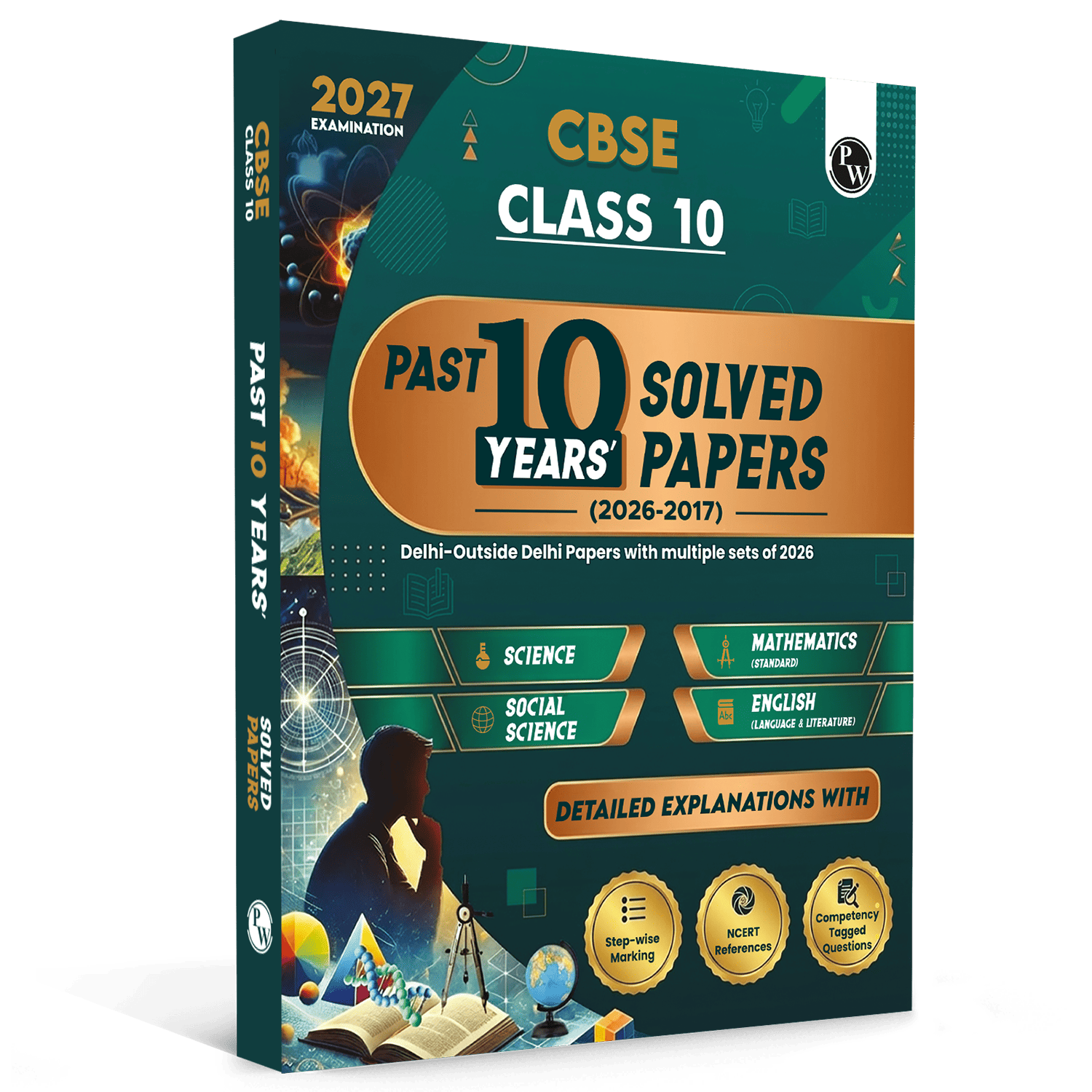
A proper collection of past question sets serves as a direct mirror to board-level assessment standards. These resource sets compile genuine question papers from previous examination cycles, encompassing both Delhi and Outside Delhi regions across multiple exam series.
-
Structured Question Sets: Contains authentic questions from past board examinations, including recent 2026 sets to reflect current testing styles.
-
Detailed Step-by-Step Explanations: Every question includes clear step-wise solutions aligned directly with official marking schemes.
-
NCERT Concept Mapping: Questions link directly back to relevant NCERT textbook sections for immediate foundational review.
-
Rationalised Syllabus Marking: Questions that fall outside current updated syllabus guidelines are explicitly tagged as Out of Syllabus (OS) to prevent confusion.
-
Competency-Based Distribution: Exhibits a clear breakdown of case-based, application-oriented, and analytical questions.
Why Are Class 10 Maths Previous Year Papers Important for Revision?
Mid-term revision requires a sharp focus and a clear direction. Attempting random exercises without a strategic plan makes it difficult to measure whether you can handle timed board-level assessments.
Using CBSE Class 10 previous year papers gives you immediate clarity on question typologies, step-wise marking requirements, and recurring exam patterns.
-
Chapter-Wise Weightage Analysis: Studying past sets helps you identify high-yield chapters using trend analysis from the past 5 to 6 years, allowing you to prioritize chapters with heavy mark allocations.
-
Competency-Based Exposure: Gives direct experience with real-world scenarios, assertion-reason questions, and case-based problems that form a major part of modern question papers.
-
Real Exam Familiarity: Working through Class 10 Maths PYQ materials builds familiarity with actual question paper layout, section distributions, and difficulty progression.
How Class 10 Maths Previous Year Papers Help You Find Important Topics?
Mid-term revision is most effective when you actively target your problem areas instead of re-reading topics you already know well.
|
Revision Feature |
Practical Benefit for Mid-Term Prep |
Impact on Performance |
|
Step-Wise Solutions |
Highlights exact calculation steps where marks are lost. |
Reduces avoidable algebraic errors. |
|
NCERT Concept Mapping |
Guides immediate textbook re-reading for weak topics. |
Strengthens foundational theory. |
|
Out of Syllabus (OS) Tags |
Prevents wasting time on rationalised or deleted topics. |
Keeps revision focused on the valid syllabus. |
|
Competency-Based Tagging |
Identifies weaknesses in real-world application problems. |
Improves performance on case studies. |
When practicing Maths previous year papers, every incorrect answer highlights a gap in conceptual clarity or calculation speed.
-
Identify Calculation Flaws: Detailed step-wise guidance helps pinpoint exact steps where negative signs, algebraic expansions, or arithmetic calculations went wrong.
-
Spot Concept Gaps: Linking missed previous year questions Maths directly back to NCERT units lets you revisit weak theory without searching through entire textbooks.
-
Filter Deleted Content: Clear Out of Syllabus (OS) flags ensure you do not spend precious study hours on obsolete units that are no longer part of the assessment scheme.
When to Use Class 10 Maths Previous Year Papers?
Timing your revision properly ensures maximum retention and avoids last-minute panic before major examinations.
1. During Initial Chapter Completion
-
Solve chapter-specific past questions right after finishing an NCERT chapter.
-
Test your understanding of basic definitions, formulas, and standard numerical problems.
-
Build initial confidence by solving real questions asked in past years.
2. Mid-Term Preparation Phase
-
Shift entirely to timed CBSE Class 10 PYQ book practice 3 to 4 weeks before mid-term exams begin.
-
Solve mixed-chapter question papers to adapt to shifting topics under exam conditions.
-
Refine your time allocation for short-answer and long-answer sections.
3. Final Revision Cycles Before Board Exams
-
Work through complete 3-hour full-length paper sets during the final weeks of preparation.
-
Build mental endurance required to maintain accuracy across long examination sessions.
-
Fine-tune answer presentation, diagram neatness, and final step highlighting.
How to Use Class 10 Maths Previous Year Papers Before Pre-Boards?
Pre-board examinations test your ability to recall concepts across the entire syllabus under strict time constraints.
Using a structured Maths PYQ book during this phase provides a realistic trial run that identifies final gaps before the main board assessment.
Step 1: Simulate Real Examination Conditions
-
Choose a quiet study space free from digital distractions and interruptions.
-
Set a strict 3-hour countdown timer to mimic actual exam hall conditions.
-
Write out complete handwritten solutions using standard answer sheets without referencing notes.
Step 2: Conduct Strict Self-Evaluation
-
Grade your completed paper using step-by-step marking guidelines provided in solved paper collections.
-
Award marks only when complete working, correct formulas, and precise final units are present.
-
Take note of steps where partial marks were lost due to missing reasoning or rough work.
Step 3: Analyze Time Management Across Sections
-
Record the exact time spent on Section A (MCQs), Section B (Short Answers), Section C (Long Answers), and Section D/E (Case Studies).
-
Identify sections that caused time delays or required excessive re-drafting.
-
Adjust your section attempt order for subsequent practice sessions to optimize speed.
Weekly Revision Plan for Solving Class 10 Maths Previous Year Papers
A structured weekly schedule keeps mid-term Maths board revision organized, steady, and manageable without causing burnout.
|
Day |
Primary Focus Area |
Specific Chapter Types |
Recommended Practice Activity |
|
Monday |
High-Weightage Algebra |
Quadratic Equations, Polynomials |
Solve 10-15 short past questions focused on factorization and roots. |
|
Tuesday |
Geometry & Trigonometry |
Triangles, Circles, Heights & Distances |
Practice 5-8 long-answer proof questions and trigonometric identities. |
|
Wednesday |
Application & Competency |
Real-World Context Problems |
Solve 3-4 case-based scenario questions from recent paper sets. |
|
Thursday |
Weak Area Concept Review |
Identified Weak Topics |
Re-read mapped NCERT concepts and solve basic textbook examples. |
|
Friday |
Timed Sectional Practice |
Section C & Section D Sets |
Complete a timed 1-hour practice set containing long numerical problems. |
|
Saturday |
Full-Length Past Paper |
Complete Half-Yearly / Mid-Term Syllabus |
Attempt 1 full past paper under strict 3-hour timing without breaks. |
|
Sunday |
Error Analysis & Strategy |
Review & Self-Correction |
Compare handwritten answers with step-by-step solutions and revise formulas. |
Tips to Score Better with Class 10 Maths Previous Year Papers
Scoring well in Class 10 Maths is not only about practising more questions but also about following the right strategy. These simple tips will help you use Class 10 Maths Previous Year Papers effectively. Along with PYQ practice, CBSE Class 10 Books can help strengthen concepts, revise important topics, and improve your overall performance in the board examination.
-
Structure Your Answer Writing Presentation: Write clear step-by-step calculations, state underlying theorems explicitly, and draw clean geometric figures with proper labels. Always box or underline final numerical answers to help evaluators check results quickly.
-
Prioritise High-Frequency Typologies: Pay close attention to repeated question types identified through 5-year trend insights, such as proving irrationality, finding roots using formulas, or solving surface area combinations.
-
Master Case-Based Scenarios: Spend dedicated time practicing competency-based questions, as these test real-world application skills and carry significant weight in modern question papers.
-
Cross-Check with NCERT References: Whenever a past paper question seems unfamiliar or tricky, refer to its mapped NCERT section immediately to reinforce foundational concepts.
-
Maintain a Dedicated Formula Journal: Write down key formulas, geometric identities, and standard conversion factors in a separate notebook for quick daily review before solving papers.
Read More: CBSE Class 10 Science Chapter Wise Weightage
Class 10 Maths FAQs
How many years of Class 10 Maths previous year papers should I solve?
Solving past 5 to 10 years of solved paper sets ensures thorough coverage of trend insights, question typologies, and board paper patterns across all major syllabus areas.
Are past questions enough for mid-term Maths board revision?
Past papers provide exceptional practice, but pairing them with thorough NCERT textbook reading ensures complete conceptual understanding and syllabus coverage.
How do Class 10 Maths PYQ sets help with competency-based questions?
Quality past paper collections feature detailed distributions of case-based, assertion-reason, and application-focused questions tested in recent board examination cycles.
What is the best way to analyze errors in CBSE Maths solved papers?
Compare your handwritten solutions step-by-step against official marking explanations, note where calculations failed, and revisit mapped NCERT sections for weak theory.
Should I practice Out of Syllabus questions found in older papers?
No, you should skip questions marked as Out of Syllabus (OS) to keep your mid-term revision focused exclusively on current rationalised course content.