Algebra PYQs for SSC Exams with PYQ Book
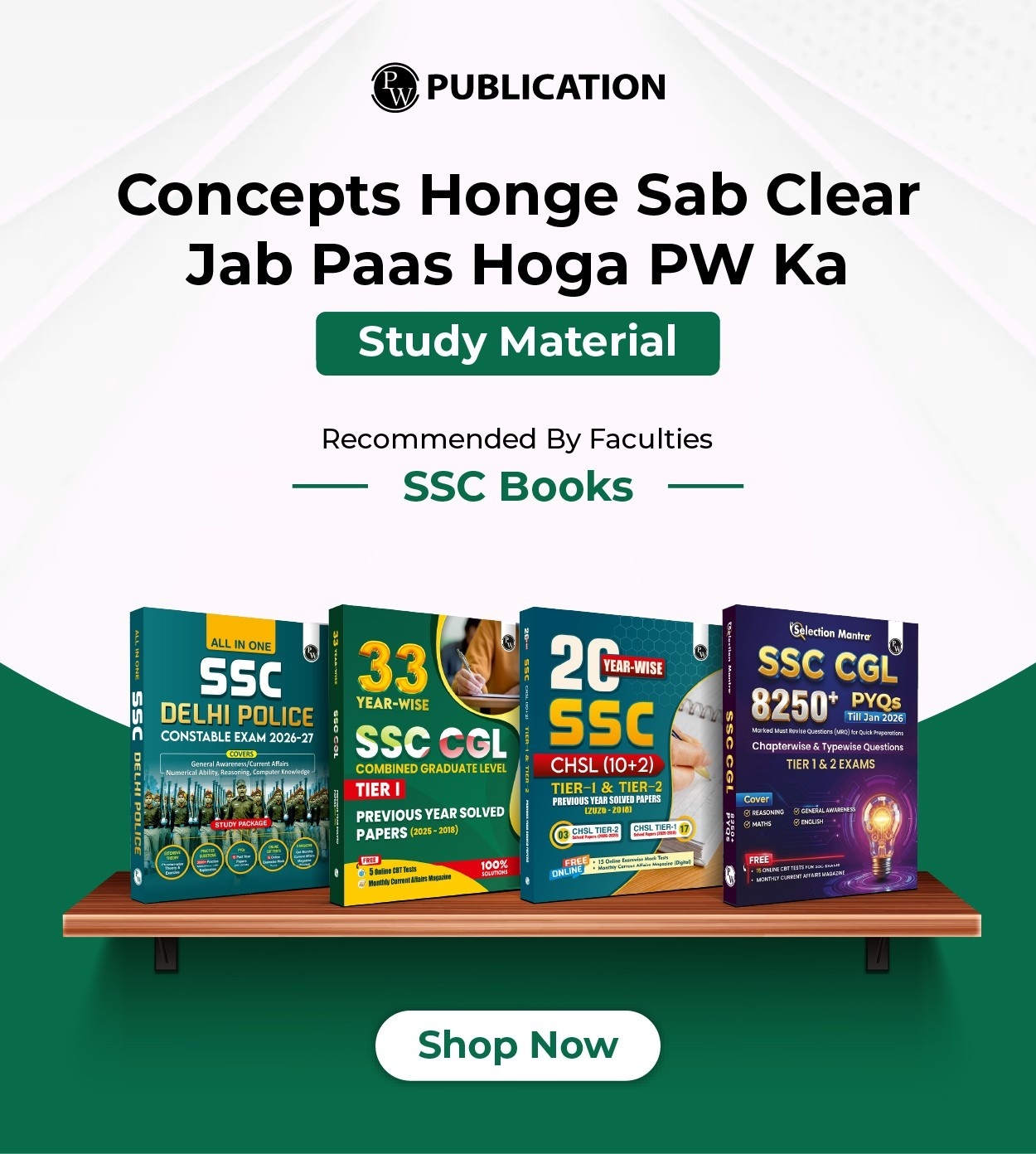
Mastering algebra is critical for securing high scores in SSC exams like CGL, CHSL, and CPO. Solving an authentic Algebra SSC PYQ collection helps students understand repeat question patterns, identify high-yield topics, and build speed. Paired with a structured practice SSC books, previous year questions convert raw mathematical concepts into exam readiness.
Importance of Algebra SSC PYQ
Algebra SSC PYQ is one of the most important resources for preparing the Algebra section of SSC exams such as CGL, CHSL, and CPO. It helps candidates understand the latest exam pattern, identify frequently asked question types, and focus on high-weightage topics like algebraic identities, quadratic equations, and conditional equations.
Regular practice with previous year questions improves calculation speed, accuracy, and problem-solving skills while helping aspirants learn shortcut methods used in real exams. Solving PYQ also builds confidence and enables candidates to manage time more effectively during the examination.
Quantitative aptitude forms the backbone of SSC Tier 1 and Tier 2 selections. Among all topics, algebra carries a major weightage in the advance mathematics section. Practising authentic PYQ provides specific advantages that general textbook exercises cannot match.
Actual Exam Patterns and Difficulty Levels
General mathematics textbooks often focus on academic derivations rather than objective problem-solving. In contrast, previous year questions reflect the exact difficulty curves set by the Staff Selection Commission.
-
Pattern Recognition: Examiners frequently repeat specific structural formats, such as symmetric algebraic identities or conditional equations.
-
Topic Weightage: Solving past papers clarifies whether quadratic equations, algebraic identities, or indices hold higher importance in Tier 1 versus Tier 2.
-
Difficulty Mapping: Candidates learn to distinguish between standard 30-second questions and multi-step calculation traps.
Calculation Speed and Time Management
Time is the ultimate constraint in SSC examinations. You must solve questions within 45 to 60 seconds on average.
Total Exam Time Breakdown (Quantitative Aptitude)
├── Total Questions: 25 to 100 (depending on tier)
├── Ideal Time per Question: 45 - 50 seconds
└── Algebra Allocation: 3 to 5 questions per set
Regular practice with SSC maths PYQs builds mental calculation habits. Instead of expanding long expressions step by step, candidates begin recognising standard expansions like $(a + b)^3$ or $x + (1/x)$ values on sight.
Features of Algebra SSC PYQ
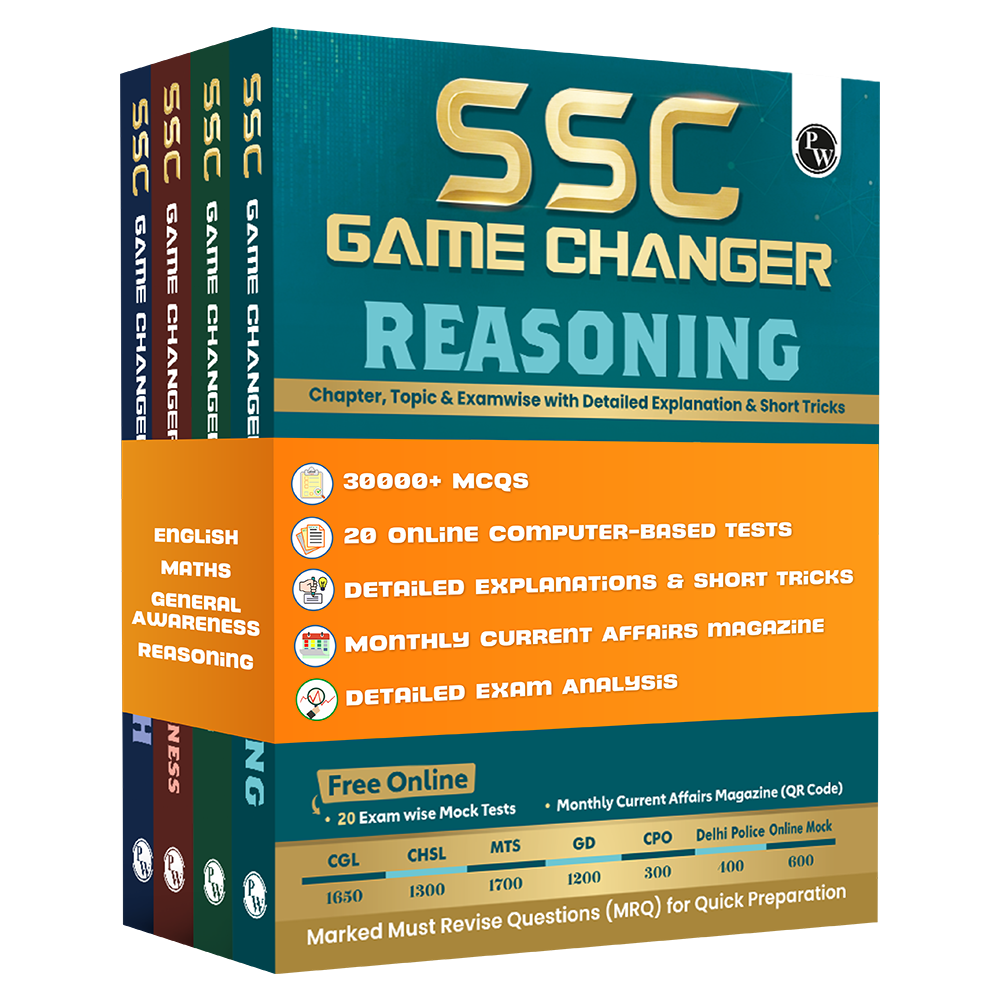
Strengthen your SSC Maths preparation with complete study material based on the latest exam pattern. This SSC previous year papers includes extensive MCQ practice, quick revision notes, online CBT practice sets, and detailed exam analysis to help you improve your speed, accuracy, and overall performance.
-
7750+ MCQs: Practice with more than 7750 SSC Maths MCQs prepared according to the latest exam pattern. The questions cover the complete syllabus and help you build strong concepts through regular practice.
-
Quick Revision Notes: Revise important topics quickly with short tricks, key formulas, and essential concepts. These notes are perfect for fast revision and last-minute exam preparation.
-
20 Online CBT Practice Sets: Experience the real SSC computer-based test with 20 full-length online practice sets. Improve your confidence, speed, accuracy, and time management before the exam.
-
Monthly Current Affairs (QR Access): Access monthly current affairs through a QR code and stay updated with important national and international events useful for SSC General Awareness and Current Affairs preparation in 2026.
-
Detailed Exam Analysis: Understand topic-wise trends, question weightage, and important insights from major SSC exams. This analysis helps you focus on high-scoring topics, improve your preparation strategy, and increase your scoring potential.
Important Formulas Covered in Algebra SSC PYQ
To solve algebra SSC questions efficiently, you must keep foundational algebraic identities on your fingertips. Most questions asked in SSC exams rely on direct application or clever rearrangement of basic identities.
Fundamental Algebraic Identities
Here is a summary of core identities that regularly appear in past papers:
|
Basic Formula |
Expanded Form / Variation |
Frequent Exam Application |
|
$(a + b)^2$ |
$a^2 + 2ab + b^2$ |
Finding $a^2 + b^2$ when $(a+b)$ and $ab$ are given |
|
$(a - b)^2$ |
$a^2 - 2ab + b^2$ |
Evaluating differences of squares |
|
$a^2 - b^2$ |
$(a - b)(a + b)$ |
Simplifying rational expressions |
|
$(a + b + c)^2$ |
$a^2 + b^2 + c^2 + 2(ab + bc + ca)$ |
Conditional evaluation when $a+b+c = 0$ |
|
$a^3 + b^3$ |
$(a + b)(a^2 - ab + b^2)$ |
Factorisation in algebraic fractions |
|
$a^3 - b^3$ |
$(a - b)(a^2 + ab + b^2)$ |
Simplifying cube difference terms |
The Power of Reciprocal Identity Conditions
In SSC MTS PYQs, questions involving the reciprocal form x+x1=k are quite common. The following standard identities are useful for solving them quickly during the exam.
1. If x+x1=k, then:
-
x2+x21=k2−2
-
x3+x31=k3−3k
-
x4+x41=(k2−2)2−2=k4−4k2+2
2. If x−x1=k, then:
-
x2+x21=k2+2
-
x3−x31=k3+3k
3. Special Value Cases
-
If x+x1=2, then x=1.
-
If x+x1=−2, then x=−1.
-
If x+x1=1, then x3=−1.
-
If x+x1=3, then x6=−1.
Additional Useful Cases
-
If x−x1=0, then x=±1.
-
If x+x1=0, then x2=−1.
-
If x−x1=2, then x=1+2.
-
If x−x1=−2, then x=1−2.
What Question Types are Covered in Algebra SSC PYQ?
Analysing past trends reveals that algebra previous year questions fall into a few primary categories. Understanding these categories allows candidates to apply targeted solving strategies.
Category 1: Symmetric and Conditional Equations
In these questions, you are often given conditions such as a+b+c=0 or a2+b2+c2=ab+bc+ca. These standard identities help simplify calculations quickly.
-
Key Identity: If a+b+c=0, then a3+b3+c3=3abc.
-
Important Result: If a2+b2+c2=ab+bc+ca, then a=b=c.
Recognising these conditions immediately eliminates the need for lengthy expansions.
Category 2: Value Substitution Method
Value substitution is one of the fastest techniques in SSC maths practice. When an algebraic equation holds true for all non-zero variables, candidates can substitute simple numbers (like (0, 1, -1)) to find the answer quickly.
-
Rule for Value Pick: Avoid substituting values that lead to division by zero (\left(\frac{1}{0}\right)) or undefined forms.
-
Degree Check: Ensure the degree of the given expression matches the degree of the options before finalizing your answer.
Category 3: Quadratic Equations and Roots
Questions involving linear and quadratic equations regularly feature in CGL Tier 2 sets.
-
Standard form: (ax^2 + bx + c = 0)
-
Sum of roots: (\alpha + \beta = -\frac{b}{a})
-
Product of roots: (\alpha\beta = \frac{c}{a})
-
Discriminant: (D = b^2 - 4ac) (determines the nature of the roots)
Benefits of Using Algebra SSC PYQ Book
For candidates seeking a well-structured resource, the PW SSC maths PYQ offerings provide comprehensive coverage tailored to current exam trends.
-
Exhaustive Question Bank: Contains detailed solutions for past papers spanning multiple years of SSC examinations.
-
Dual-Solution Approach: Offers traditional step-by-step solutions alongside smart shortcut tricks for rapid solving.
-
Structured Classification: Organises problems into chapter-wise maths PYQs, making it easy to isolate weak areas like algebra or geometry.
-
Exam-Oriented Explanations: Explanations focus on time-saving methodologies, helping students improve both accuracy and speed.
How to Solve Algebra SSC PYQ Faster?
Simply knowing formulas is not enough; execution under pressure determines your final percentile. Follow a systematic workflow when approaching PYQ during mock tests or exam practice.
Step-by-Step Problem-Solving Approach
-
Read and Classify: Identify whether the problem is identity-based, conditional, or quadratic.
-
Check for Shortcuts: Determine if value substitution or symmetry applies before attempting traditional algebraic expansion.
-
Apply Formula: Write down only the essential reduction steps to minimize rough sheet usage.
-
Option Elimination: Cross-check unit digits or sign variations in the options to confirm correctness without complete calculation.
Common Pitfalls to Avoid During Practice
-
Neglecting Signs: Misinterpreting negative signs during cube expansions like (a−b)3=a3−3a2b+3ab2−b3 is a frequent source of error.
-
Over-relying on Long Methods: Attempting traditional variable elimination on basic symmetric equations wastes critical time.
-
Ignoring Option Analysis: Many algebraic expressions can be solved in 5 seconds by plugging option values into the original expression.
Read More: SSC Maths Syllabus and Important Topics
SSC PYQ FAQs
What is the best way to start practising Algebra SSC PYQ?
Begin by revising basic algebraic identities and reciprocal rules. Once your fundamentals are clear, solve topic-wise algebra SSC questions from the past 5 years of SSC CGL and CHSL papers using a structured PYQ book.
How many algebra questions appear in SSC CGL exams?
In SSC CGL Tier 1, algebra typically accounts for 3 to 4 questions out of 25 in the Quantitative Aptitude section. In Tier 2, the weightage increases, with algebra forming a core part of the advanced mathematics syllabus.
Is value substitution effective for solving algebra previous year questions?
Yes, value substitution is an effective shortcut method for conditional algebraic expressions. It helps candidates solve complex equations in seconds, provided the substituted values do not lead to undefined mathematical conditions.
Why should I choose chapter-wise maths PYQs over full-length past papers initially?
Chapter-wise practice allows you to master specific concepts like identities or quadratic equations individually. Once you achieve speed and accuracy in each chapter, transitioning to full-length past papers becomes much smoother.
How does the PW SSC maths PYQ book assist in SSC preparation?
The SSC maths PYQ resource offers categorized past questions with dual solutions—detailed derivations for understanding and shortcut tricks for speed—ensuring comprehensive exam readiness.