IB ACIO 2026-27 Study Plan: How to Use PYQs in Your Daily Preparation
A lot of IB ACIO aspirants read a wide range of topics but do not practice enough. They complete chapters on subjects like polity, percentages, and grammar, only to find in the exam that the questions are not like those in the textbook. A good IB ACIO 2026-27 study plan fixes this by making previous year questions a daily part of preparation, not something left for the end.
The Assistant Central Intelligence Officer Grade-II/Executive exam rewards speed and accuracy, and negative marking punishes guesswork. Candidates who start with past papers early get more time to spot patterns and correct weak areas. The plan below shows how to do this day by day and week by week.
Why are PYQs Important in an IB ACIO 2026-27 Study Plan?
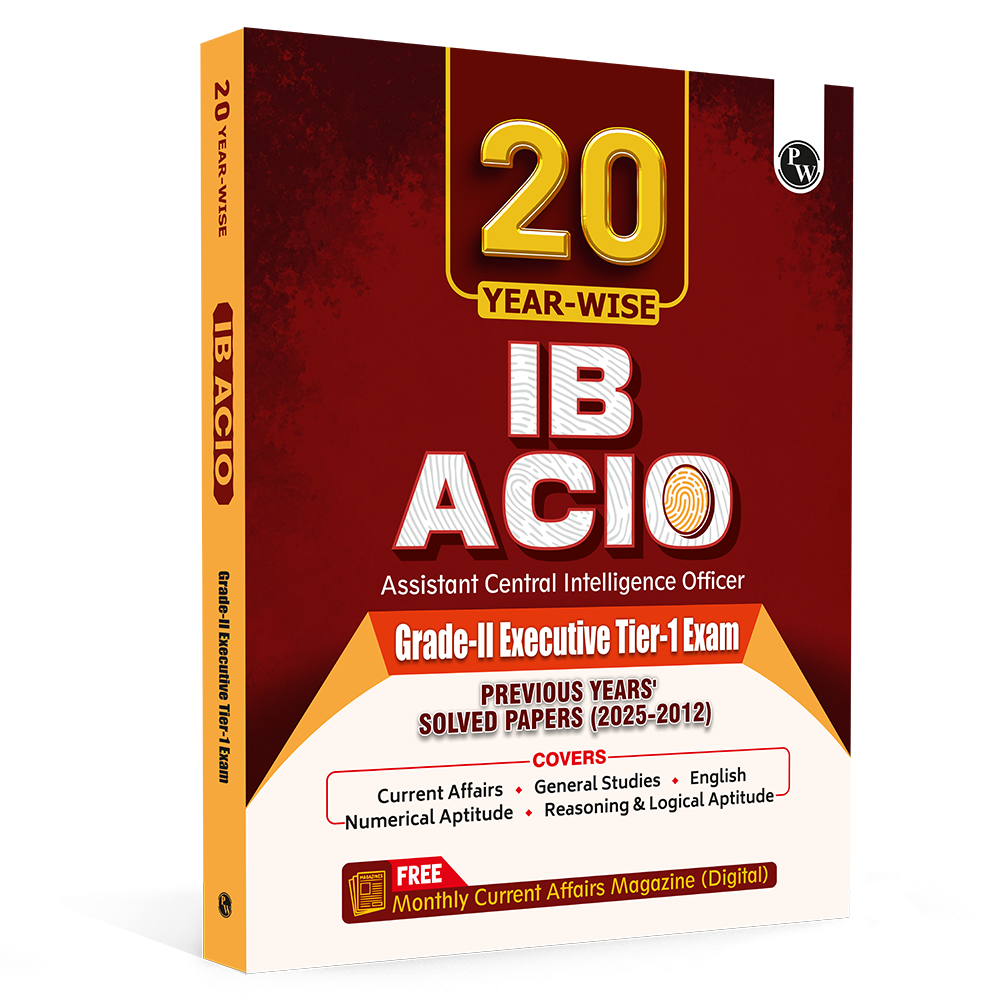
Textbooks explain concepts. Past papers show how those concepts are tested. Working through IB ACIO PYQs gives candidates a realistic picture of question style, difficulty level, and the spread of marks across sections, which is why they form the base of any sound IB ACIO preparation strategy.
- Identifying topics that appear repeatedly across all five Tier 1 sections.
- Understanding how deep General Awareness and Current Affairs questions usually go.
- Building shortcuts for arithmetic and reasoning problems that come up often.
- Doing some option elimination helps to reduce the chance of negative marking.
Past papers also help you see how ready you are. Your score on a real paper, done with a timer, tells you much more than just counting how many chapters you have finished.
What is an Ideal Daily Routine for an IB ACIO 2026-27 Study Plan?
A good daily routine divides your time between learning new topics, revising, and practicing questions from IB ACIO previous year papers. Setting fixed times for question practice helps you avoid the mistake of saving past papers for just the last month.
|
Column 1 |
Column 2 |
Column 3 |
|
Time Slot |
Preparation Focus |
PYQ Practice Activity |
|
Morning (2 Hours) |
Quantitative Aptitude and Reasoning |
Solve 20 to 25 topic-wise past questions and check the methods used |
|
Afternoon (2 Hours) |
General Studies and Current Affairs |
Review past general knowledge questions and note repeated themes |
|
Evening (1.5 Hours) |
English Language |
Practice error spotting and comprehension passages from earlier papers |
|
Night (1 Hour) |
Analysis and Revision |
Re-solve wrong attempts and update the revision notebook |
- Solving questions with a timer to recreate real exam pressure.
- Checking solutions right after each session, while the attempt is still fresh.
- Adjusting slot lengths for working candidates or for subjects that are already strong.
These time slots are just a guide and can be adjusted to fit your own schedule. The important thing is to include past paper practice in your IB ACIO 2026-27 study plan every day.
Read More - IB ACIO Syllabus for Tier 1 and Tier 2 Exam
How to Prepare a Weekly Schedule for an IB ACIO 2026-27 Study Plan?
Setting weekly goals helps keep your IB ACIO Tier 1 preparation balanced. In the last notification, Tier 1 had 100 objective questions divided equally among five sections, so you cannot ignore any section for too long.
- Days 1 and 2: cover quantitative aptitude, including topics such as percentages, ratios, profit and loss, and time and distance, together with previous questions related to these topics.
- Days 3 and 4: focus on topics involving reasoning such as series, analogies, syllogisms, and coding-decoding, with previous questions being solved under time pressure.
- Day 5: prepare general studies covering history, polity, economy, and geography, and also check which topics the previous papers have focused on.
- Day 6: cover current affairs and English grammar, with the section comprising sentence improvement and vocabulary questions from previous exams.
- Day 7: do one full-length past paper, review your scores section by section, and make a list of your weak areas for the following week.
If you keep following this cycle, you will clearly see your progress. If a section still has low scores, you can give it an extra day the next week. This kind of flexibility helps your IB ACIO study plan stay practical over several months.
Read More - IB ACIO Previous Year Paper - Download PDF
How Can Error Analysis Improve Results in an IB ACIO 2026-27 Study Plan?
If you solve papers but do not review them, much of your effort is wasted. Every wrong answer shows a specific gap, and keeping an error log turns these gaps into a short list of things to work on. You only need a notebook or spreadsheet, as long as you update it after each practice session.
- Sorting mistakes into three types: conceptual gaps, calculation slips, and misreading the question.
- Studying the full solution to find a faster method or a direct formula.
- Re-attempting flagged questions after three or four days without looking at the answer.
- Recording the time spent per question to see where skipping would have been the better choice.
After a few weeks, your error log will start to show patterns. Most lost marks come from a few repeated mistakes, and these are much easier to fix once you have written them down.
IB ACIO 2026-27 Study Plan FAQs
1. How many past papers should candidates solve for Tier 1?
Candidates should attempt all available IB ACIO previous year papers at least once, since the exam is not held every year. Topic-wise sets from these papers can then be repeated to build speed in weaker sections.
2. Should past paper practice start before the syllabus is complete?
Yes. Topic-wise past questions can be solved as soon as each chapter is finished. Full-length papers work better once most of the syllabus has been covered. This approach keeps IB ACIO tier 1 preparation linked to the real exam from the very first week.
3. How do past papers help with negative marking?
Regular practice sharpens option elimination and helps candidates recognize questions that are too risky to attempt. Fewer blind guesses lead to fewer deductions, and the overall score becomes more stable from one mock to the next.
4. Are past papers enough for General Awareness?
No. They show which areas of history, polity, and economy are commonly tested, but current affairs change every year. Candidates should add regular coverage of recent news.