No More Fear of Reasoning Questions– SSC PYQs for Beginners
The fear of the Reasoning section is a common hurdle for many government job aspirants. While it appears logical, the pressure of time and the variety of patterns in the SSC Reasoning PYQ can be overwhelming for beginners. Most students struggle not because they lack logic, but because they lack exposure to specific question formats used by the Staff Selection Commission. Mastering this section requires moving beyond basic theory and diving straight into the actual patterns set by the exam conducting authorities. By focusing on previous year questions, you can bridge the gap between basic understanding and exam-day speed.
Check Out: PW SSC Books
Importance of SSC Reasoning PYQ
Starting your preparation with an SSC Reasoning PYQs strategy is the most effective way to understand the exam's DNA. Unlike other subjects where the syllabus is vast, Reasoning follows specific repetitive patterns. When you look at an SSC Reasoning previous year paper, you notice that the logic used in 2021 often reappears in 2023 with slightly different numbers or symbols.
For a beginner, the primary goal is to eliminate the "unknown" factor. Knowing exactly how a syllogism or a coding-decoding question is phrased helps in reducing anxiety. It also allows you to identify high-weightage topics so you do not waste time on obscure logic that rarely appears in the actual exam.
Key Topics Covered in SSC Reasoning PYQ
When you analyse a SSC Reasoning previous year paper, the content usually falls into two broad categories: Verbal and Non-Verbal Reasoning. Understanding the split helps in balanced preparation.
Verbal Reasoning
This includes topics where logic is expressed through words, numbers, or letters.
-
Analogy and Classification: Finding relationships between pairs.
-
Coding-Decoding: Shifting letters based on a specific numerical rule.
-
Syllogism: Determining the validity of conclusions based on given statements.
-
Number Series: Identifying the mathematical pattern in a sequence.
Non-Verbal Reasoning
This section relies on visual patterns and spatial intelligence.
-
Mirror and Water Images: Visualising how an object looks when inverted.
-
Paper Folding and Cutting: Predicting the pattern after a sheet is unfolded.
-
Embedded Figures: Finding a small shape hidden within a complex diagram.
Benefits of Solving SSC Reasoning PYQ
You can prepare in a more targeted manner by practicing SSC Reasoning PYQs. Instead of speculating what could be asked, you work through real questions that follow the rhythm of the exam.
-
Know the Question Types - Once you have solved enough PYQs you will start seeing the general formats of questions in topics such as coding-decoding, series, and syllogism. This eliminates hesitation while taking the exam.
-
Improves speed - Similar logic is used in many reasoning questions. Practicing again and again allows you to answer the questions quickly without overthinking.
-
Better accuracy - Reviewing solutions can help you understand typical mistakes and avoid them in the exam.
-
Clear topic priority - PYQs let you identify which topics are asked more often, so you can focus on high-weightage areas throughout your preparation.
What are the Right SSC Reasoning PYQ books?
Selecting the right study material is the difference between a confused aspirant and a successful candidate. While the market is flooded with options, you need SSC Reasoning books that provide detailed explanations rather than just answer keys.
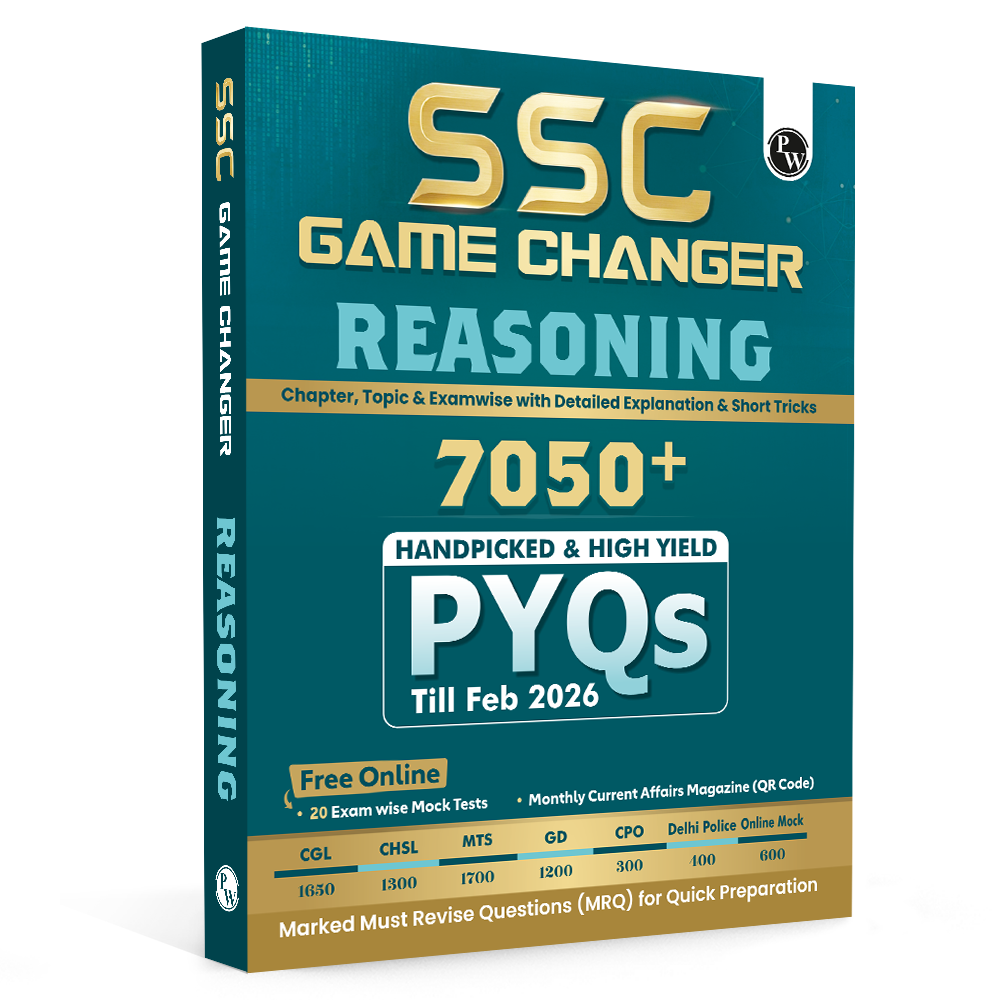
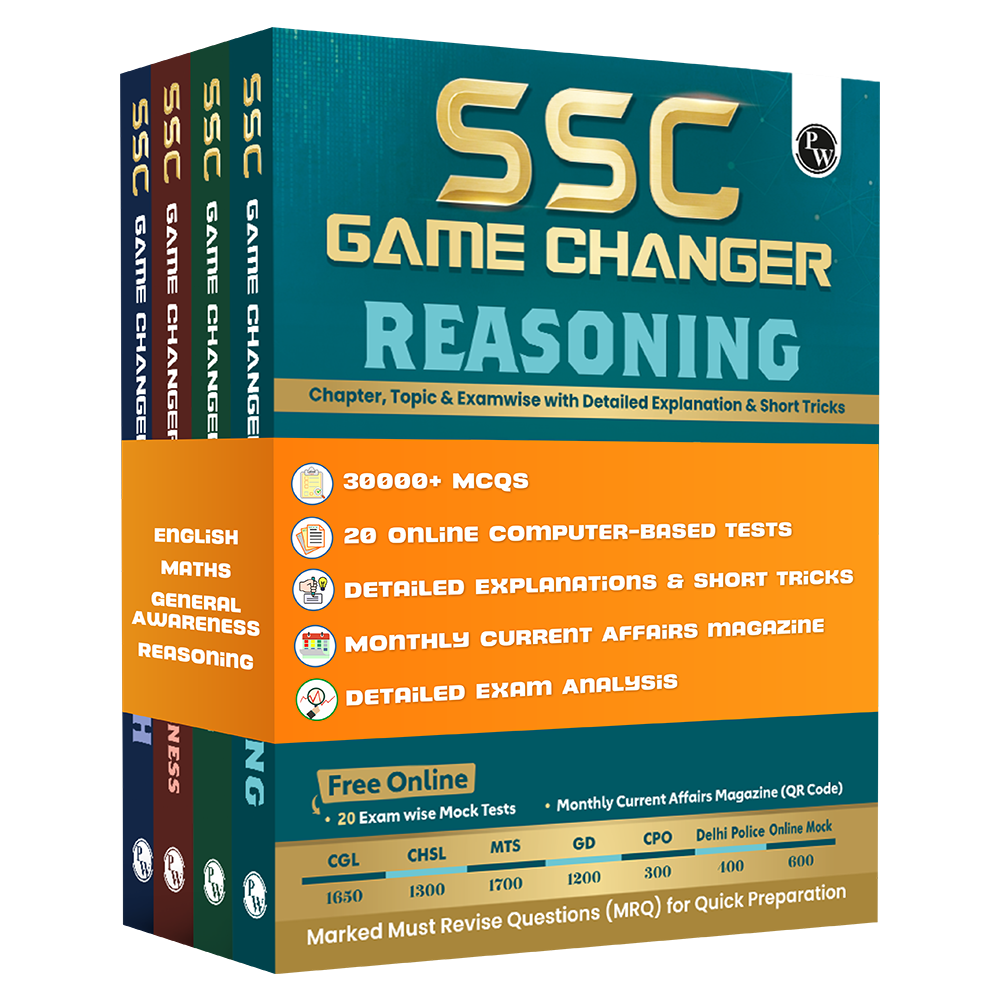
A highly recommended resource is the PW SSC Game Changer series. This series is designed specifically to tackle the TCS-pattern questions that have become the standard for SSC exams recently. If you are looking for a comprehensive bank, the SSC 7000+ TCS PYQ for Reasoning is a top-tier choice. It compiles thousands of questions, ensuring that no pattern is left unexplored.
How to Use SSC Reasoning PYQ Effectively?
Speed is the currency of SSC exams. You might be able to solve a complex blood relation puzzle in five minutes, but in the exam, you only have seconds. Using Reasoning SSC PYQ sets as timed practice is the only way to build this professional pace.
Steps to improve speed with PYQs:
-
Time-bound practice: Do not just solve questions; set a timer for 15-20 minutes for a set of 25 questions.
-
Identify traps: SSC often includes one or two "time-guzzler" questions. Identifying these through previous papers helps you decide which ones to skip.
-
Mental calculations: Use Reasoning PYQ SSC sets to practice solving series and analogy questions without picking up a pen.
Once you have cleared your basics, your daily routine should involve at least one full-length Reasoning section from an SSC Reasoning previous year paper. This builds "exam stamina." You will notice that your brain starts recognising patterns faster. For instance, in a number series, you will immediately start looking for squares, cubes, or prime numbers instead of trying random additions.
Using the PW SSC Game Changer approach, you can categorise questions into "Easy," "Moderate," and "Difficult." Focus on making the moderate ones easy and the difficult ones manageable.
|
Topic Category |
Average Questions |
Difficulty Level |
|
Coding-Decoding |
2-3 |
Moderate |
|
Analogy |
3-4 |
Easy |
|
Series (Number/Alpha) |
2-3 |
Hard |
|
Blood Relations |
1-2 |
Moderate |
|
Non-Verbal |
4-5 |
Easy |
Check Out: SSC Previous year Papers
How to Analyse SSC Reasoning PYQs
Solving an SSC Reasoning PYQ set is only 50% of the work. The remaining 50% is analysis. Look at the questions you got wrong. Was it a calculation error? Did you misunderstand the logic? Or was it a completely new pattern?
If it is a new pattern, note it down in a "Mistake Notebook." This notebook becomes your most valuable tool in the final week before the exam. Most toppers suggest that reviewing their own mistakes from Reasoning SSC PYQ sets helped them more than reading new theory.
Mistakes to Avoid in SSC Reasoning PYQ Practice
Many students pick up a Reasoning PYQ SSC book and start solving randomly. This is a recipe for slow progress. Avoid these common pitfalls:
-
Ignoring the Explanation: If you get a question right by guessing, you haven't learned the logic. Always read the solution to see if there is a faster method.
-
Over-relying on Formulas: Reasoning is about logic, not just rote memorisation. Understand why a pattern works.
-
Skipping Non-Verbal: Many find visual questions "easy" and skip them during practice, only to lose marks on silly mistakes during the actual test.
-
Not tracking progress: Keep a log of which topics in the SSC Reasoning PYQs are taking you the most time.
SSC Reasoning PYQ Strategy for Beginners
To conquer your fear, follow this simple cycle:
-
Study: Learn the basic concept of a topic.
-
Solve: Practice 50-100 questions from an SSC Reasoning previous year paper specifically for that topic.
-
Speed: Take a timed quiz using Reasoning SSC PYQ sources.
-
Support: Refer to SSC Reasoning books like those from some reputed platforms to clarify doubts.
Consistency is better than intensity. Solving 20 questions a day for a month is far more effective than solving 500 questions in two days. The brain needs time to internalise the logical structures found in SSC Reasoning PYQ.
Read More: Logical Reasoning Topics for Competitive Exams
SSC Reasoning PYQ FAQs
Q1: How many years of SSC Reasoning PYQ should I solve?
It is generally recommended to solve the last 5 years of questions. Focus especially on the papers from 2018 onwards, as the pattern shifted significantly when TCS started conducting the exams.
Q2: Which are the right SSC Reasoning books for beginners?
For beginners, books that offer step-by-step explanations are right. The PW SSC Game Changer and the SSC 7000+ TCS PYQ are excellent choices for building a strong foundation and practicing high volumes of questions.
Q3: Can I score 50/50 by only solving Reasoning SSC PYQ?
Yes, many students achieve a perfect score by mastering SSC PYQ. Since the logic is often repetitive, familiarity with previous patterns allows you to solve the paper quickly and accurately.
Q4: How much time should I spend on an SSC Reasoning previous year paper daily?
Ideally, spend 45 minutes to 1 hour. Use 20 minutes for solving a 25-question set and the remaining time for analysing your mistakes and learning better methods.
Q5: Is the Reasoning PYQ SSC enough for CGL and CHSL both?
The core logic for both exams is very similar. Practicing Reasoning PYQ SSC from CGL, CHSL, and even MTS will provide a comprehensive understanding that covers all possible difficulty levels.