SSC CGL Maths PYQs – Latest Pattern Questions with Solutions
Solving the SSC CGL Maths PYQ is the most effective way to understand the evolving exam pattern and difficulty level. Many aspirants struggle to finish the quantitative aptitude section on time because they lack practice with actual exam-grade questions. By focusing on SSC Maths previous year paper trends, you can identify repeated concepts and learn the shortcuts required to improve your speed.
This article provides a detailed breakdown of the latest math questions, helping you bridge the gap between basic concepts and exam-day performance.
Check Out: PW SSC Books
Importance of SSC CGL Maths PYQ
Preparing for the Staff Selection Commission exams requires more than just knowing formulas. The SSC CGL PYQs serve as a roadmap for your preparation. Since the TCS era began, the nature of questions has shifted towards more calculation-intensive and logic-based problems.
-
Understanding Weightage: By reviewing an SSC Maths previous year paper, you can see which chapters, like Algebra, Geometry, or Trigonometry, carry the most marks.
-
Time Management: Practising with a timer using SSC PYQ Maths sets helps you track how many seconds you spend per question.
-
Pattern Recognition: Many types of questions in Profit and Loss or Time and Distance follow a specific template that repeats every year.
-
Confidence Building: Solving real exam questions reduces anxiety and builds the mental stamina needed for the two-hour grind.
Latest SSC CGL Maths Pattern and Trends
The recent shift in the SSC CGL Tier 1 and Tier 2 exams shows a clear preference for arithmetic and advanced Maths in a 60:40 ratio. Most students look for an SSC Maths PYQ PDF to practice offline, but understanding the logic behind the solution is what actually improves scores.
Arithmetic Ability Trends
Arithmetic remains the backbone of the quantitative section. In recent years, questions on Compound Interest and Data Interpretation have become more "calculator-heavy."
-
Ratio and Proportion: Questions often involve three or four variables where you need to find a mean proportional or a third proportional.
-
Percentage and Profit/Loss: Look out for "Dishonest Shopkeeper" problems and "Successive Discount" types, as these are frequently found in any SSC Maths PYQ book.
-
Average: The "Inclusion/Exclusion" of a new member in a group is a classic pattern that appears in almost every shift.
Advanced Maths Focus
Advanced mathematics often intimidates students, but the SSC PYQ data shows that most questions are formula-based rather than deeply theoretical.
-
Geometry: Circles (tangents and chords) and Triangles (similarity and congruence) are high-priority areas.
-
Algebra: Identities like (a + b + c) squared or cubic identities are common.
-
Trigonometry: Height and Distance questions are now more frequent in Tier 2, while basic identity-based questions dominate Tier 1.
Check Out: SSC Previous year Papers
Topic-wise Weightage in SSC CGL Maths PYQ
Understanding the distribution of questions helps in prioritizing your study schedule. Based on the PYQ from the last three years, here is a general breakdown:
|
Topic |
Number of Questions (Approx) |
Difficulty Level |
|
Number System |
1-2 |
Easy to Moderate |
|
Simplification |
1 |
Easy |
|
Percentage / Profit & Loss |
3-4 |
Moderate |
|
Average / Ratio |
2-3 |
Easy |
|
Time, Speed & Distance |
2 |
Moderate |
|
Algebra |
2-3 |
Moderate to Hard |
|
Geometry |
3-4 |
Hard |
|
Trigonometry |
2-3 |
Moderate |
|
Data Interpretation |
4 |
Calculation Intensive |
Solved SSC CGL Maths PYQ Examples
To give you a better idea of the current standards, let us look at some solved examples based on recent SSC PYQ Maths trends.
Example 1: Ratio and Proportion
Question: If A:B = 2:3 and B:C = 4:5, what is the value of A:B:C?
Solution:
To find the combined ratio, we must make the value of B common in both ratios.
-
Multiply (2:3) by 4 = 8:12
-
Multiply (4:5) by 3 = 12:15
-
The combined ratio A:B:C is 8:12:15.
Example 2: Time and Work
Question: A can complete a work in 15 days and B in 20 days. If they work together for 4 days, what fraction of work is left?
Solution:
-
Total work (LCM of 15 and 20) = 60 units.
-
A's efficiency = 60/15 = 4 units/day.
-
B's efficiency = 60/20 = 3 units/day.
-
Combined efficiency = 7 units/day.
-
Work done in 4 days = 7 * 4 = 28 units.
-
Remaining work = 60 - 28 = 32 units.
-
Fraction left = 32/60 = 8/15.
Right Resources for SSC CGL Maths PYQ
Digital resources have made it easier to access study materials. You can find various versions of an SSC CGL PYQ PDF online that categorize questions by year or by topic.
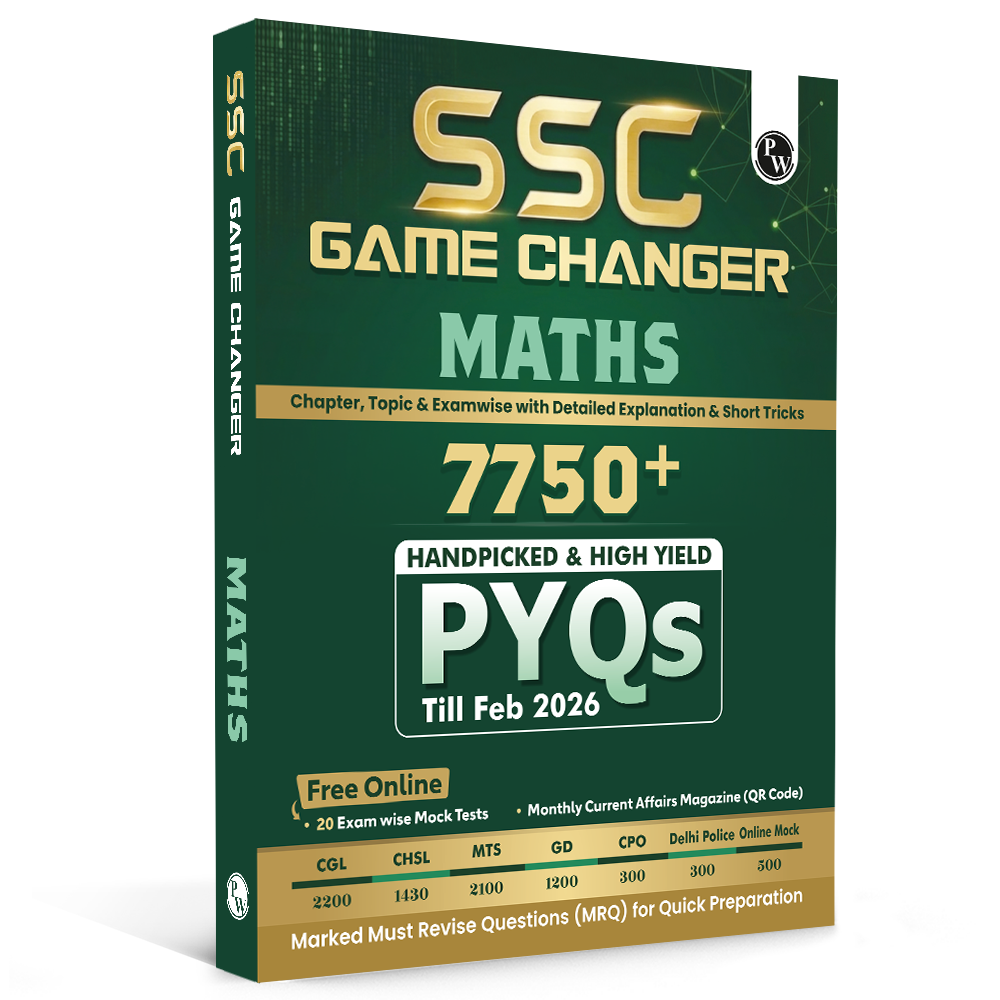
For those who prefer physical books, the SSC 7000 plus TCS MCQ for Quant is a comprehensive resource. It covers questions from various SSC exams like CGL, CHSL, and MTS, ensuring you are prepared for every possible variation of a concept. Using a dedicated SSC Maths PYQ book allows you to make notes in the margins and track your progress systematically.
How to Practise for Exams with SSC CGL Maths PYQ?
Simply buying an SSC Maths PYQ book is not enough. You must have a strategy to extract the maximum value from it.
-
Chapter-wise Practice: Don't jump straight to full-length mocks. Start by solving SSC PYQ Maths chapter by chapter to strengthen individual topics.
-
Mark Tough Questions: During your first pass through an SSC Maths previous year paper, circle the questions that took more than 60 seconds.
-
Review Solutions: Don't just check the answer key. Look at the explanation to see if there is a shorter method or a formula you missed.
-
Repeat: Go back to the marked questions after two weeks to see if you can solve them faster.
Frequent revision of formulas found in SSC Maths previous year paper sets is also mandatory.
-
Algebra: (a + b) cubed = a cubed + b cubed + 3ab(a + b).
-
Geometry: Area of an equilateral triangle = (root 3 / 4) * side squared.
-
Mensuration: Volume of a cone = (1/3) * pi * r squared * h.
-
Interest: Difference between CI and SI for 2 years = P * (R/100) squared.
Mistakes to Avoid While Solving SSC CGL Maths PYQ
Many students fail to see improvement despite solving multiple SSC PYQ PDF files. This usually happens due to:
-
Ignoring the Basics: Trying to learn shortcuts without understanding the underlying concept.
-
Not Timing the Practice: Solving 25 questions in 60 minutes at home will not help you solve them in 20 minutes during the exam.
-
Skipping Geometry: Many avoid advanced Maths, but these questions are often the most scoring if you know the theorems.
-
Lack of Revision: Solving a PYQ once is not enough; you need to revisit the logic at least thrice.
Check Out: SSC Game Changer Combo Set of 4 Books
Strategy to Solve SSC CGL Maths PYQ
When you are sitting in the exam hall, the pressure is different from home practice. Using the SSC CGL Maths PYQ sets for mock practice helps you develop a "skipping" instinct.
-
The First Pass: Go through all 25 questions and solve only the "one-liner" ones. These are usually from chapters like Ratio, Average, and basic Algebra.
-
The Second Pass: Tackle the questions that require a bit of calculation or geometry diagrams.
-
The Third Pass: Only attempt the extremely lengthy or complex questions if time permits.
-
Avoid Guesswork: Since there is negative marking, using SSC PYQ Maths practice to improve accuracy is better than increasing the number of attempts blindly.
Read More: SSC CGL Maths Questions With Solutions
SSC Maths PYQ FAQs
-
Which is the Right SSC Maths PYQ book for beginners?
For beginners, a book that offers chapter-wise solved questions from 2018 onwards is Right. The SSC 7000 plus TCS MCQ book is highly recommended as it covers all recent patterns.
-
How many years of SSC CGL Maths PYQ should I solve?
It is ideal to solve the last 5 years of papers. Focus specifically on questions from 2018 onwards, as this is when the TCS pattern was introduced.
-
Where can I find an SSC Maths PYQ PDF for free?
Many educational platforms and Telegram channels provide the SSC PYQ PDF for various shifts. However, ensure the source is reliable and provides accurate solutions.
-
Is solving SSC Maths previous year paper enough to score 50/50?
While PYQs are essential, you must also work on your calculation speed. PYQs help you know the "what," but regular practice helps with the "how fast."
-
Does SSC repeat questions in the SSC PYQ Maths section?
SSC rarely repeats the exact values, but the logic and question templates are repeated almost 80 percent of the time.