SSC MTS 2026 Study Material: Subject-Wise Preparation Strategy
Use targeted SSC MTS study material to pass the SSC MTS 2026 exam. For merit, focus on Session 2 (English and GA), and for qualification, focus on Session 1 (Maths and Reasoning) without negative marking.
The Staff Selection Commission Multi-Tasking Staff (SSC MTS) exam is one of the most popular ways for Class 10 graduates to get a secure job with the government. But there are a lot of candidates, so the competition is tough. The right SSC MTS study material will help you do better.
Check Out: SSC Books
SSC MTS 2026 Exam Pattern
You need to know how the test is set up before you start reading the books. There are two parts to the 2026 test, and they are both held on the same day.
-
Session 1: Tests your reasoning, math, and numbers skills. There is no negative marking here, and it is qualifying in nature.
-
Session 2: Covers General Awareness and English Language. This is the merit-deciding section. Every wrong answer results in a 1-mark deduction.
Here is a Breakdown :
|
Session |
Subject |
Questions |
Total Marks |
Duration |
|
Session 1 |
Numerical & Mathematical Ability |
20 |
60 |
45 Mins |
|
Reasoning Ability & Problem Solving |
20 |
60 |
||
|
Session 2 |
General Awareness |
25 |
75 |
45 Mins |
|
English Language & Comprehension |
25 |
75 |
||
|
Total |
90 |
270 |
90 Mins |
Subject-Wise SSC MTS Exam Preparation Strategy
1. Numerical and Mathematical Ability
The maths section for MTS is based on the matriculation level. Your SSC MTS study material should focus on building speed for basic arithmetic.
-
Key Topics: LCM & HCF, Percentages, Profit & Loss, Time & Work, and BODMAS.
-
Strategy: Since there is no negative marking in Session 1, focus on accuracy first, then speed.
-
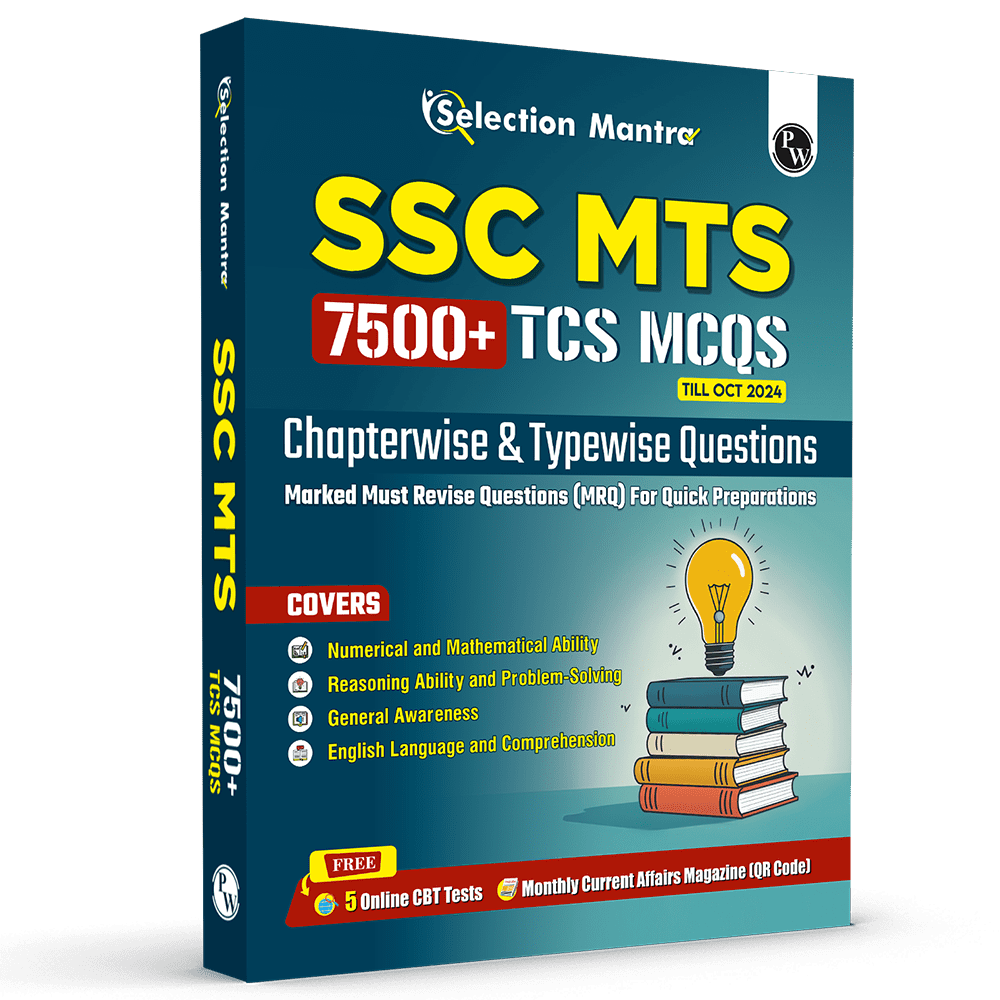
Right Resource: Use the PW Maths Game Changer with 7500+ TCS MCQs to practice chapter-wise problems.
2. Reasoning Ability and Problem Solving
Reasoning is often the most scoring part of the study material. It tests your logic rather than your memory.
-
Key Topics: Coding-Decoding, Alpha-Numeric Series, Analogies, and Syllogism.
-
Strategy: Practice non-verbal reasoning (diagram-based) as these are quick to solve.
-
Right Resource: Selection Mantra for SSC MTS provides a simplified breakdown of complex puzzles.
3. General Awareness (The Merit Maker)
This section determines your rank. Because the syllabus is vast, your SSC MTS exam study resources must be highly specific.
-
Key Topics: History (Delhi Sultanate, Mughal Empire), Geography (Rivers, Climate), and Art & Culture.
-
Current Affairs: Focus on the last 6 to 8 months of events, including sports, awards, and new government schemes.
-
Right Resource: The PW Half-Yearly Current Affairs Magazine by Krati Singh is essential for staying updated.
4. English Language and Comprehension
English is not just about grammar; it is about usage. Many students lose marks here due to negative marking.
-
Key Topics: Cloze Test, Synonyms/Antonyms, Idioms, and Error Spotting.
-
Strategy: Read a simple English newspaper daily and maintain a "vocabulary diary" for 20 new words every day.
-
Right Resource: PW SSC Game Changer English offers extensive practice for TCS-pattern questions.
Check Out: SSC Previous year Papers
SSC MTS Study Material
Instead of buying generic books, look for those that include Previous Year Questions (PYQs).
Top PW Books for SSC MTS Preparation
Choosing the right books can save you months of wasted effort. The PW Store offers curated resources that align specifically with the latest exam requirements.
|
PW SSC Book / Set |
Core Purpose |
|
To understand recurring patterns and trends over three decades. |
|
|
A 4-book set (Maths, English, GA, Reasoning) for comprehensive practice. |
|
|
Specifically by Krati Singh for high-yield GA preparation. |
|
|
A specialized guide for focused Tier 1 and Tier 2 preparation. |
Proven SSC MTS Preparation Strategy for 2026
Success in the MTS exam requires more than just reading; it requires a tactical preparation strategy.
Phase 1: Concept Building (Months 1-2)
Start by clearing your basics. Don't jump to mock tests immediately. Pick one chapter from the SSC MTS study material (e.g., Percentages) and solve 50 questions to master the logic.
Phase 2: Practice & Speed (Month 3)
Once the syllabus is 70% complete, start using these study resources like the "Level 1" and "Level 2" exercises in study materials. This builds the stamina needed for the 90-minute exam.
Phase 3: Mock Tests & Revision (Final 30 Days)
Attempt at least one full-length mock test every alternate day. Analyze your mistakes in Session 2 specifically, as the 1-mark negative marking can be brutal. Use test series to track your performance against other aspirants.
Subject Weightage Breakdown
Below is a simplified breakdown of where you should spend your maximum time based on recent trends.
|
Subject |
High-Weightage Focus Area |
Why it Matters |
|
General Awareness |
Static GK & Art/Culture |
Usually 40% of the GA section often comes from these two areas. |
|
English |
Vocabulary & Cloze Test |
These are "binary" marks; you either know them or you don't. |
|
Maths |
Arithmetic (Profit/Loss, Ratio) |
MTS rarely asks advanced geometry or algebra. |
|
Reasoning |
Coding-Decoding & Series |
These are the fastest questions to solve usually. |
Read More: SSC MTS Selection Process
SSC MTS Study Material FAQs
Which is the right SSC MTS study material for beginners?
Beginners should start with the Selection Mantra for SSC MTS and the 30 Years PYQ Book. These provide a clear idea of the exam level without overwhelming the student with complex theories.
Are previous year questions enough for ssc mts preparation?
The SSC Game Changer series and other concept-building books are also important for dealing with new types of questions that TCS has added.
Is there negative marking in the SSC MTS 2026 exam?
Yes, but only in Session 2 (General Awareness and English). There is a negative marking of 1 mark for every wrong answer. Session 1 has no negative marking.
Can I prepare for SSC MTS at home without coaching?
Absolutely. By using structured books and following a disciplined study plan of 6-7 hours daily, many students clear the exam through self-study.