SSC Reasoning Revision Made Easy with Previous Papers
Revision can make or break your success in Staff Selection Commission exams. Many students study all the topics but struggle to manage time during the actual exam. Solving an SSC Reasoning PYQ helps you understand the actual exam pattern, speed up your calculation, and improve your overall score.
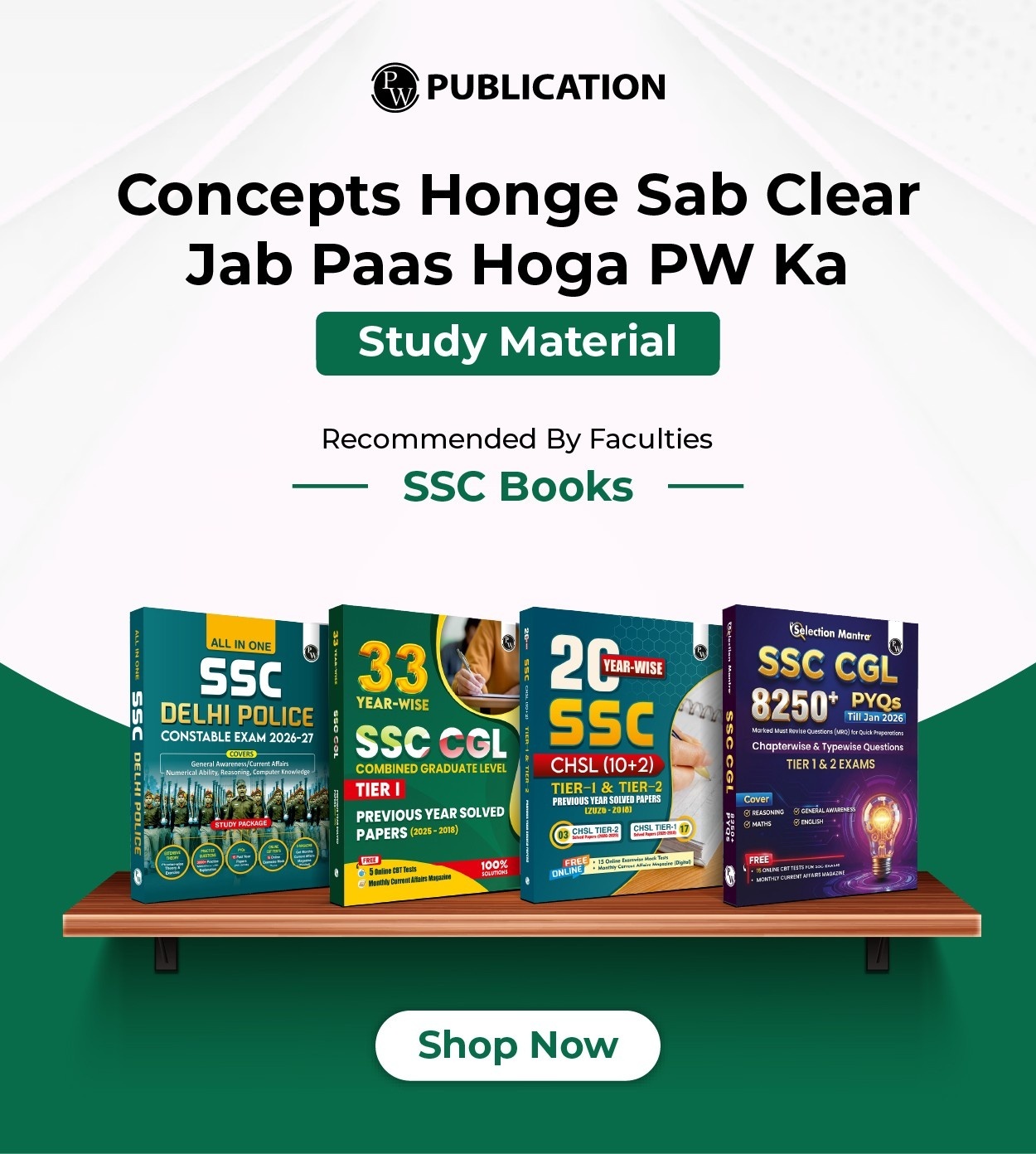
Check out: PW SSC Books!
Importance of SSC Reasoning PYQ
Logical Reasoning is a scoring section for many competitive exams. To get a perfect score, you have to be able to combine quick thinking with accuracy, and this can only be done through structured practice.
Finding High-Scoring Chapters
The testing bodies always follow a certain structural framework for the problems. Learn the exact way complex logic puzzles are presented by mastering this Reasoning PYQ. This takes away the element of surprise on exam day.
Improving Time Management
Aspirants work under strict time constraints for each section. Practising official questions regularly trains your brain to quickly identify scoring questions and complex traps. You learn to decide when you should commit to a puzzle and when you should skip it to save time.
Finding High-Scoring Chapters
Some topics are worth more marks than others every single year. By looking at past papers from official sources, you will be sure that your valuable revision hours are spent on chapters that are important, and you don’t waste time on study material that is unnecessary.
Topics Covered in SSC Reasoning PYQ
The complete syllabus requires command over two major parts, i.e. verbal and non-verbal Reasoning. A glance at a standard Reasoning SSC PYQ reveals a definite pattern of recurring question types that determine the final cut-off marks.
Verbal Reasoning Content
Verbal Reasoning measures your overall ability to logically reason using language patterns, number sequences and relational structures. The most prominent focus areas are:
-
Analogy and General Classification: Finding the basic relationship between pairs of words, certain sequences of letters or numbers.
-
Coding and Decoding Frameworks: Discovering hidden cryptology rules used on phrases, numbers or specific alphabets.
-
Logical Series Completion: Determining the missing elements in complex mathematical series or alternating alphabetical series.
-
Blood Relations and Direction Traversal: Drawing accurate family diagrams and calculating precise spatial paths based on compass movements.
Non-Verbal Reasoning Content
Non-verbal Reasoning utilises spatial diagrams, symbols, and geometric shapes to measure abstract fluid intelligence. Core topics consist of:
-
Mirror and Water Reflections: Mentally flipping multi-axis images to find the exact inverted configuration.
-
Embedded Figures Identification: Locating a concealed geometric template within a complex composite image.
-
Paper Folding and Precision Cutting: Predicting the final structural layout of a multi-folded sheet after specific incisions are made.
Check Out - SSC Previous Year Papers
Topic-Wise Weightage in SSC Reasoning PYQ Exams
Evaluating a standard Reasoning PYQ SSC collection helps map out the regular question distribution across important chapters:
|
Core Topic Name |
Approximate Number of Questions |
General Difficulty Level |
|
Analogy & Advanced Classification |
Around 4-5 Questions |
Easy to Moderate |
|
Coding-Decoding Formats |
Approximately 2-3 Questions |
Moderate |
|
Mathematical & Letter Series |
Around 3-4 Questions |
Moderate to Difficult |
|
Syllogism & Venn Structural Diagrams |
Approximately 2 Questions |
Relatively Easy |
|
Non-Verbal Spatial Images |
Around 4-5 Questions |
Easy |
|
Direction Sense & Blood Relations |
Approximately 2 Questions |
Moderate |
How to Prepare for Exams with SSC Reasoning PYQ
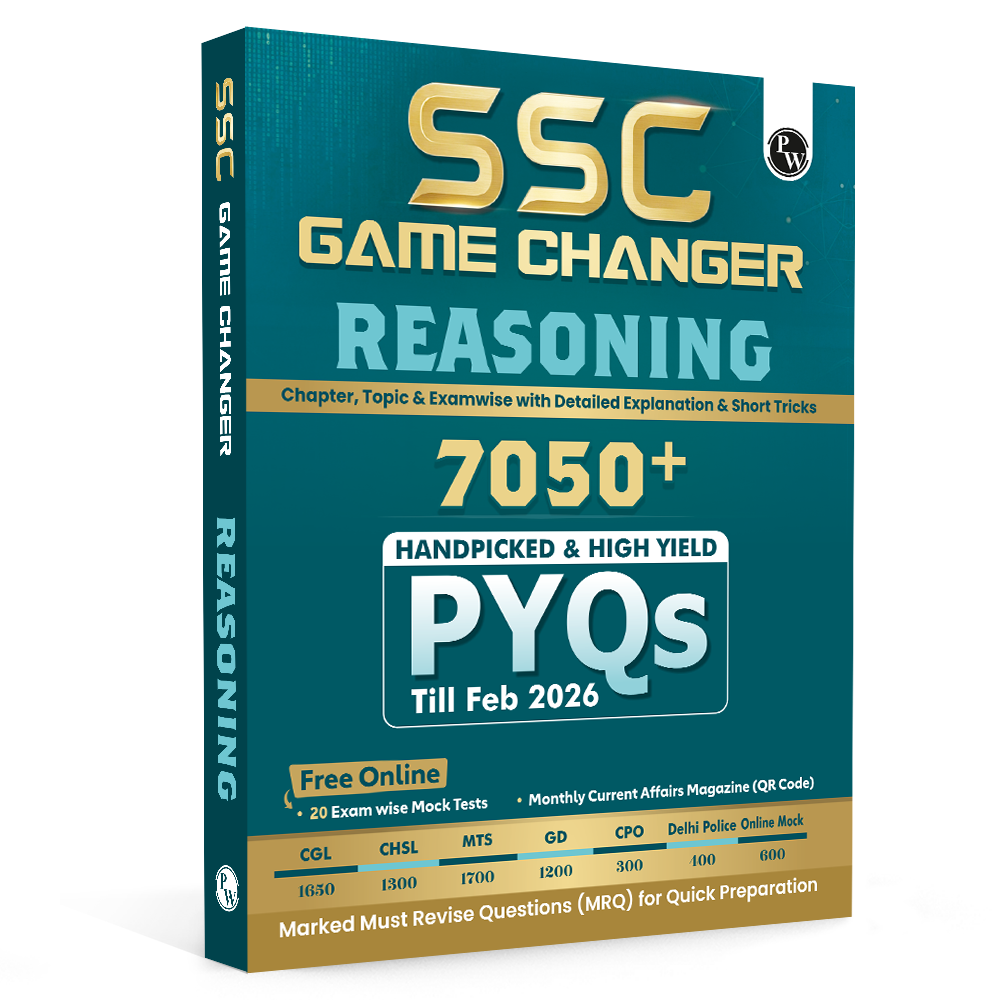
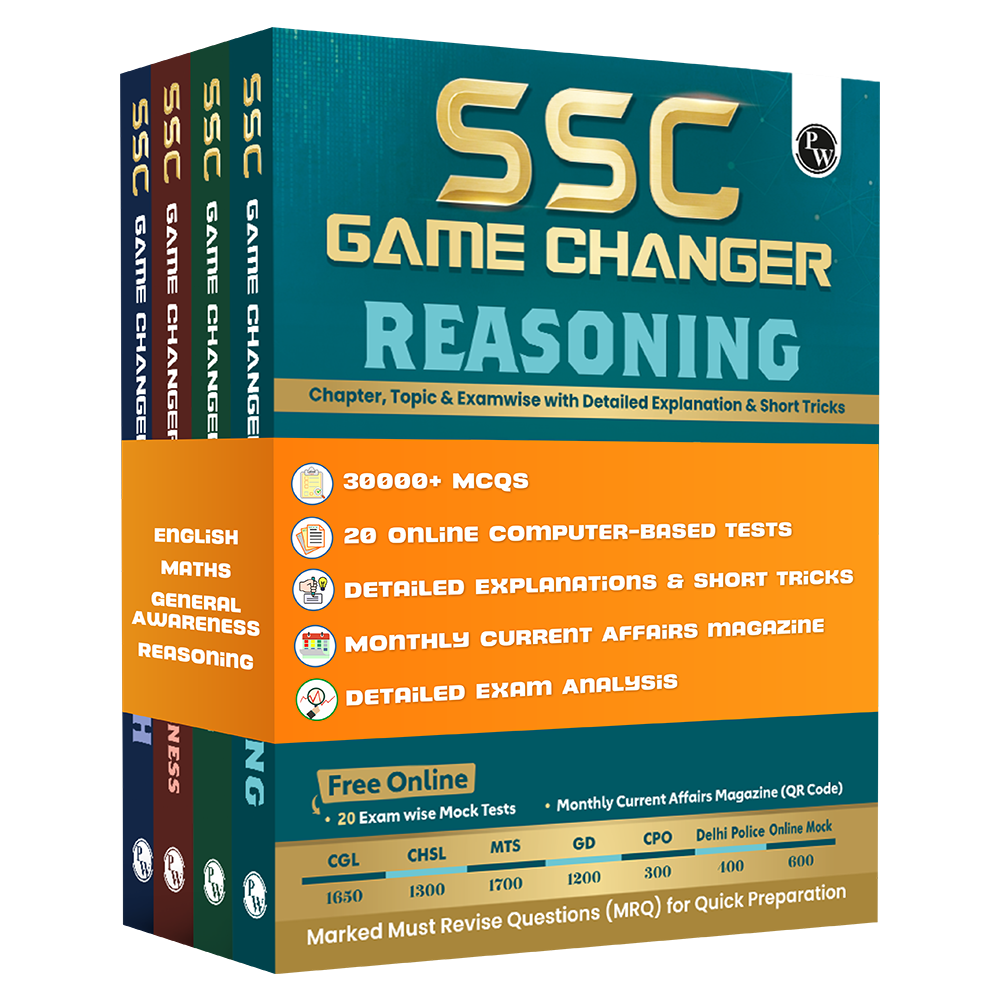
Choosing the right book for your preparation will save you from confusion and from using the wrong methods. Serious aspirants need systematic SSC Reasoning books that provide complete test coverage and error-free explanations. One of the best resources you can have in this journey is the PW SSC game changer. It will help you with your revision by providing structured question pools.
The specialised textbook provides a large inventory of 7050+ MCQs, thus creating an extensive Reasoning question bank for the upcoming exams. It is a complete practice kit for various exams like CGL, CHSL, MTS, CPO, GD, Delhi Police, and Stenographer posts.
Quick Revision Notes
The text includes tailored short tricks and critical concept summaries to facilitate accelerated revision cycles before exam week. This helps you quickly brush up on formulas without reading bulky chapters.
Computer-Based Test (CBT) Simulation
Aspirants gain exclusive access to around 20 online CBT practice sets, simulating the real computer-based examination environment to reduce interface anxiety. This ensures you are entirely comfortable with the digital layout before exam day.
Comprehensive Trend Insights
The book breaks down topic-wise trends, detailed exam weightage charts, and critical insights drawn from previous testing cycles, allowing you to prioritize your schedule effectively.
Bonus General Awareness Support
Beyond core logical Reasoning, the resource incorporates monthly current affairs coverage accessible via QR codes, strengthening your general knowledge base alongside your Reasoning practice.
Revision Strategy Using SSC Reasoning PYQ
Randomly browsing through past solutions yields negligible advantages. Candidates must implement a highly systematic framework to harness the true potential of their preparation cycle.
Step 1: Chapter-Wise Evaluation
Instead of jumping straight into large mixed papers, break down questions by individual topics. Use the first few days to perfect your method of coding-decoding. Then begin working on conditional syllogisms. This sequence helps to build structural understanding before moving on to full papers.
Step 2: Timed Sectional Evaluations
When you are conceptually clear , start a countdown timer , restricted to about twenty minutes. The full Reasoning section under pressure simulates the same stress levels as in the real examination centre.
Step 3: Deep-Dive Error Tracking
Do not close a practice paper right after you calculate your raw score. Spend a LOT of time going over each wrong answer. "Try to distinguish between basic calculation errors and deep conceptual errors. You don't want to keep making the same mistakes."
Tips for SSC Reasoning PYQ Practice
As the official test day draws near, switch your mindset from heavy concept learning to ultra-speed execution. You just need to concentrate on getting faster and more accurate.
Address Consistent Vulnerabilities Early
In the final weeks, only do practice questions of the types that you tend to lose marks on during practice sessions. Targeted removal of weak areas leads to the fastest score gains.
Master the Art of Option Elimination
Sometimes it takes precious seconds to arrive at a direct logical answer. Mathematically eliminating three impossible answers often makes the answer much quicker and saves vital energy for the harder questions.
Preserve Your Cognitive Energy
High mental fatigue totally destroys the ability to process logically. Ensure that you are well rested before you enter the exam centre so that your analytical mind is at its absolute best during the test.
Common Mistakes to Avoid While Solving SSC Reasoning PYQ
Students routinely commit predictable blunders when organising their studies around an SSC Reasoning previous year paper. Recognising these errors early safeguards your study path:
-
Using Pure Rote Memorisation: Logical Reasoning evaluates processing ability rather than historical data recall. Never try to memorise specific problem answers; analyse the underlying logical mechanism instead.
-
Practising Without an Active Clock: Solving fifty complicated puzzles over two hours provides zero utility. Speed is everything, meaning every practice session must happen with an active timer to build exam-level pacing.
-
Avoiding Difficult Problem Sets: It remains human nature to neglect complex number matrices or heavy seating arrangements. However, these specific high-difficulty questions ultimately decide your position on the merit rank list.
Read More: SSC CGL Reasoning Exam Preparation with PYQs
SSC Reasoning PYQ FAQs
-
How many years of SSC Reasoning PYQ should I solve?
Candidates must practice systematically for at least the last 5 to 7 years of official papers. This gives a complete exposure to the evolving trends of questions, updated patterns and modern difficulty scales.
-
Can I clear the Reasoning section by only studying SSC Reasoning books?
Reasoning books provide the basic rules and question banks. However, only consistent practice with real question pools under timed conditions will help you develop competitive speed.
-
Is the Reasoning syllabus different for various SSC exams?
The essential chapters remain largely identical across major exams like CGL, CHSL, and MTS. However, the overall complexity of questions changes depending on the minimum educational requirement of the target post.
-
How many questions does this SSC Reasoning book contain?
The book contains an extensive bank of over 7050+ MCQs. It provides detailed topic-wise explanations, 20 online CBT practice sets, and short tricks tailored for all major Staff Selection Commission exams.
-
Where can I get an authentic collection of SSC Reasoning previous-year papers?
A structured, error-free compilation of previous papers can be found via specialised preparation resources like the PW SSC game changer book, which organises past questions by topic and difficulty level.