How Many Previous Year Papers Are Enough for UGC NET Paper 1?
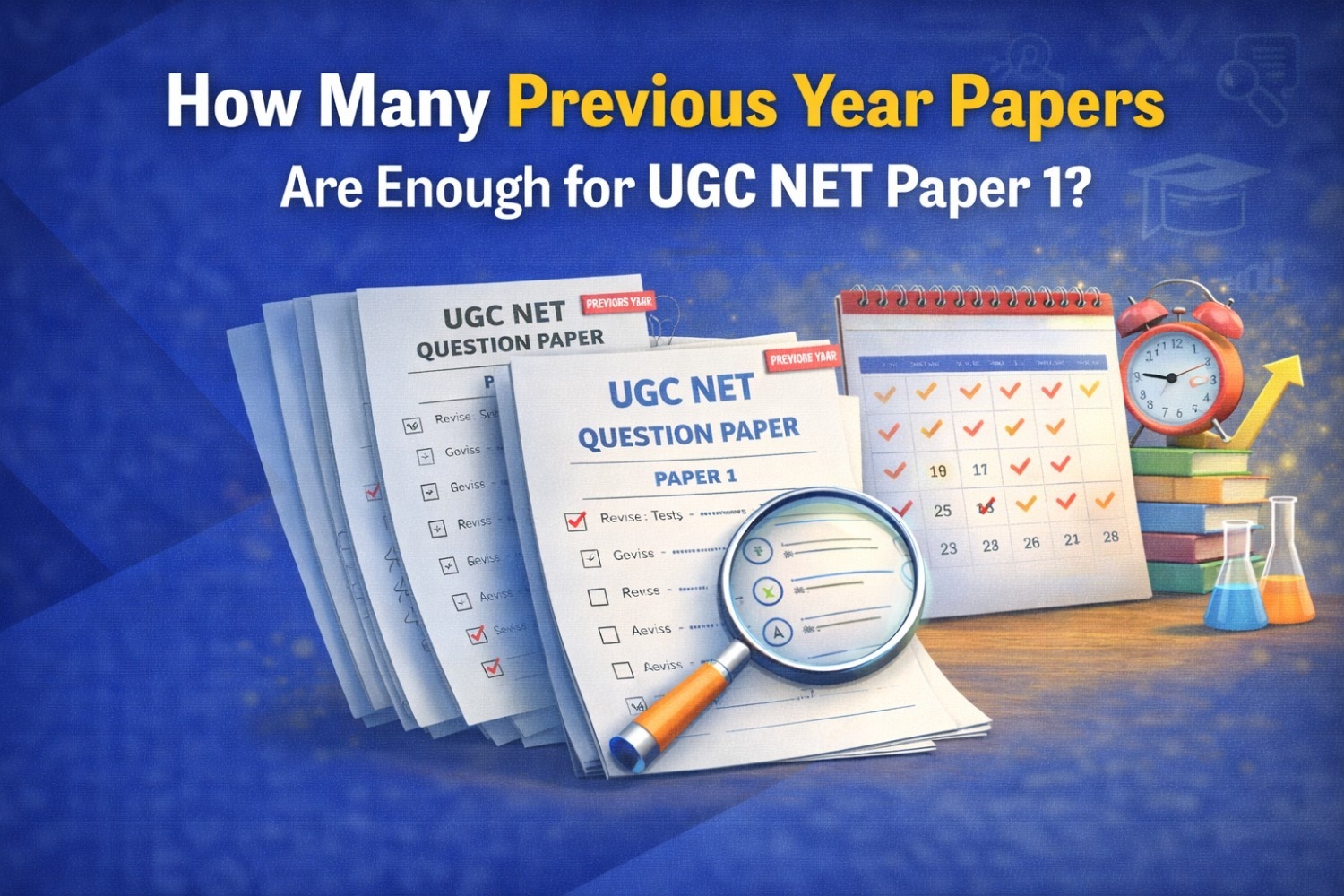
Experts and top students say that the best way to prepare for UGC NET Paper 1 in 2026 is to work through the last five to ten years of prior papers. Specifically, it's important to focus on papers from 2019/2020 and later because the exam pattern changed a lot to include more conceptual, statement-based, and assertion-reasoning problems. Try to solve at least 50 to 70 full-length sets so that you can cover all the different shifts and themes that the NTA tests.
The ugc net paper 1 is generally the "X-factor" that decides whether a candidate makes it beyond the Assistant Professorship cut-off or gets the highly sought-after Junior Research Fellowship (JRF). Paper 1 assesses your general skills, research ethics, and logical reasoning, while Paper 2 is about a specific subject. While textbooks provide the theory, your ugc net paper 1 preparation using previous papers provides the tactical edge.
Check out: UGC NET Books
How Many Last Years Papers are Enough For UGC Net?
The National Testing Agency (NTA) has evolved the difficulty level of the exam. Therefore, not all "old" papers are equally valuable.
-
The Golden Bracket (Last 5-7 Years): Solving papers from 2019 to 2025 is mandatory. This period reflects the current "CBT" (Computer Based Test) mode and the shift toward more analytical questions.
-
The Safety Net (Last 10 Years): If you have more time, extending your practice to the ugc net paper 1 last 10 years question papers helps you identify long-term trends and static topics in Higher Education and People & Environment.
-
The Quantitative Goal: Since there are multiple shifts in each cycle, the last 5 years actually provide nearly 50+ unique question papers. Mastering these is more than enough to score 80+ marks.
UGC NET Paper 1 PYQ Importance
Why is the ugc net paper 1 pyq importance so highly stressed? It’s not just about the questions; it’s about the "logic" behind them.
-
Pattern Recognition: NTA loves to repeat concepts, not necessarily the exact questions. For instance, the "Square of Opposition" or "Types of Sampling" appear in almost every shift with different values.
-
Trend Analysis: Modern papers show an increased focus on the National Education Policy (NEP) 2020, Sustainable Development Goals (SDGs), and ICT tools like Swayam/Prabha.
-
Time Management: Paper 1 is a race against time. Practicing PYQs helps you learn to solve Data Interpretation (DI) and Reading Comprehension (RC) in under 10–12 minutes each.
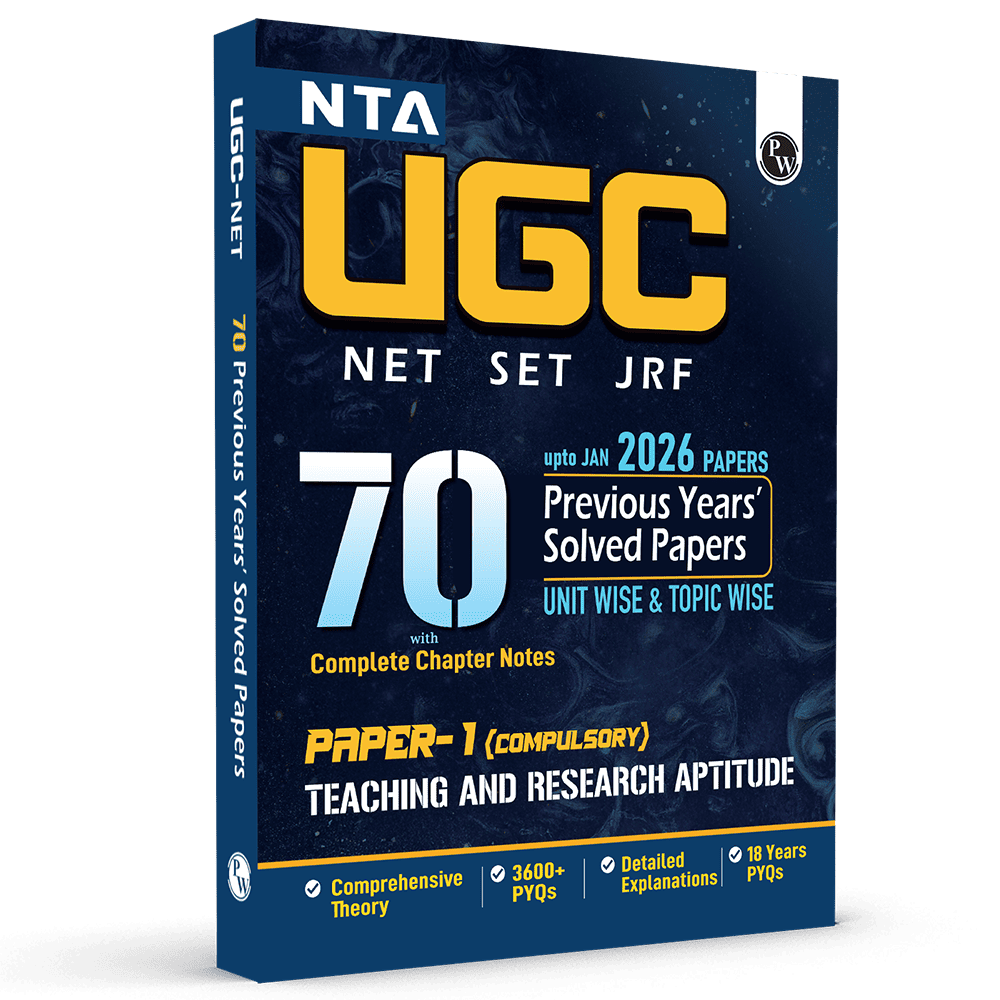
Check Out: NTA 70 UGC NET Paper 1 Previous Year Solved Papers
UGC NET Paper 1 PYQ Analysis Plan (2026)
Don't just solve papers; analyze them. A successful ugc net paper 1 pyq analysis plan follows the "Option-Elimination" strategy.
The 1:4 Rule
When you solve one PYQ, you are actually dealing with four concepts.
-
Example: If a question asks about "Formative Assessment," the other three options might be "Summative," "Diagnostic," and "Ipsative" assessment.
-
Strategy: Even if you know the answer is "Formative," take 2 minutes to define the other three in your notes. This effectively prepares you for four potential future questions.
UGC NET Paper 1 Exam Strategy 2026
To reach the target of 40-45 correct questions (90 marks), your ugc net paper 1 exam strategy 2026 should be divided into phases:
|
Phase |
Duration |
Focus Area |
|
Phase 1 |
Month 1-2 |
Concept Building: Unit-wise study + solving 5 PYQs per unit. |
|
Phase 2 |
Month 3-4 |
Intensive Practice: Solve last 5 years' papers (Shift-wise) as mocks. |
|
Phase 3 |
Month 5-6 |
Revision & Speed: Focus on weak areas (usually LR/DI) and current affairs. |
Top Units to Prioritize via PYQs
According to recent UGC NET paper 1 trends, some units are more "repetitive" than others:
-
Logical Reasoning: It follows the same patterns as Syllogisms and Fallacies a lot.
-
Teaching & Research Aptitude: Ideas like "Levels of Teaching" and "Research Ethics" are very similar.
-
ICT: Pay attention to memory units (RAM/ROM), full forms, and new digital efforts from the government.
Check Out: NTA 68 UGC NET Paper 1 Hindi Previous Year Solved Papers
Unit-Wise PYQ Weightage and High-Frequency Topics
While the official NTA guidelines suggest an equal distribution of 5 questions per unit, a deep dive into the ugc net paper 1 previous year papers strategy reveals that certain units are "scoring powerhouses" due to their predictable nature. In the 2024-2025 cycles, units like Mathematical Reasoning and Data Interpretation often saw a slight uptick to 6–7 questions per shift, making them critical for a high score.
High-Priority Units (Master These First)
-
Teaching Aptitude: Focus on "Levels of Teaching" (Memory, Understanding, Reflective) and "Evaluation Systems" (Formative vs. Summative). These appear in nearly 90% of all shifts.
-
Research Aptitude: Master "Sampling Techniques" and "Research Ethics." PYQ analysis shows that NTA frequently tests the difference between Probability and Non-Probability sampling.
-
Logical Reasoning: This is the most consistent unit. Focus on the "Square of Opposition" and "Indian Logic" (Pramanas). These are fixed-pattern questions that offer "easy marks" once the logic is understood.
Moderate-Priority Units (Concept Heavy)
-
ICT: Beyond basic abbreviations, focus on digital initiatives like SWAYAM, MOOCs, and National Digital Library.
-
Higher Education: The NEP 2020 is now the backbone of this unit. Use ugc net paper 1 last 10 years question papers to see how questions shifted from pre-independence commissions to modern digital governance.
-
People & Environment: Prioritize the 17 Sustainable Development Goals (SDGs) and International Agreements (Paris Agreement, Montreal Protocol).
Conclusion
To get a 99+ percentile in ugc net paper 1, you don't need to memorise thousands of new MCQs. Instead, you need to carefully study the last 5–7 years of PYQs. You get ready for the next time an option is the proper response by knowing why it is wrong.
We have handpicked materials at PW Store, such the 70+ UGC Paper 1 PYQ Solved Book, which saves you hundreds of hours of manual research by giving you year-by-year and chapter-by-chapter analysis. Start your quest today, use a timer to solve, and make your Paper 1 your best scoring tool!
Read More: How to Crack UGC NET in First Attempt Tips and Tricks
UGC NET Paper 1 Previous Year Papers FAQs
1. Is solving last 2 years' papers enough?
No. Two years only cover a narrow range of topics. At least 5 years (approx. 40-50 sets) are needed to see the full variety of questions NTA can ask.
2. Can I skip a unit if I am strong in PYQs?
Never skip a unit entirely. Each of the 10 units carries an equal weightage of approx. 5 questions. Use ugc net paper 1 previous year papers strategy to at least master the "most repeated" topics of your weak units.
3. Are the older papers (before 2018) useful?
They are good for basic concept practice in Math and Grammar, but they are "too easy" compared to the current level. Use them only after you finish the 2019-2025 sets.
4. How many hours should I spend on Paper 1 PYQs?
Ideally, 1 hour daily for solving and 30 minutes for deep analysis of the options.