UGC NET Syllabus 2026 for Paper 1 and Paper 2
Studying the UGC NET syllabus is the first step for any aspirant looking to secure a Junior Research Fellowship (JRF) or an Assistant Professor role.
The National Testing Agency (NTA) has kept a strict structure that examines both broad cognitive skills and deep domain knowledge, even as the academic world moves toward more application-based learning.
The challenge for most students isn't just the volume of the syllabus, but understanding the weightage of various units.
This guide explains the UGC NET exam pattern and the specific requirements of both papers that are essential to avoid wasted effort and ensure a high percentile.
Check Out- UGC NET Books
UGC NET Exam Pattern 2026
Before getting into the subjects, it's important to know how the marks are given out. The 2026 exam continues the trend of a single, continuous session without any breaks between the two papers.
|
Feature |
Paper 1 Details |
Paper 2 Details |
|
Number of Questions |
50 MCQs |
100 MCQs |
|
Total Marks |
100 Marks |
200 Marks |
|
Marking Scheme |
+2 for Correct; 0 for Wrong |
+2 for Correct; 0 for Wrong |
|
Duration |
Combined 3 Hours |
Combined 3 Hours |
|
Negative Marking |
None |
None |
UGC NET Paper 1 Syllabus
The UGC NET Paper 1 syllabus is common for all 85+ subjects. It is designed to evaluate your teaching skills, research ethics, and logical reasoning. The UGC NET syllabus 2026 paper 1 is divided into 10 distinct units, with approximately 5 questions per unit.
Units of Paper 1
-
Teaching Aptitude: Focuses on levels of teaching (memory, understanding, and reflective), learner characteristics, and modern evaluation systems, such as the Choice-Based Credit System (CBCS).
-
Research Aptitude: This includes positivism, post-positivism, and the moral issues that come up in research. It also covers how to write a thesis and how to use ICT in research.
-
Mathematical Reasoning & Aptitude: This includes number and letter series, codes, and basic math concepts like ratio, proportion, and percentage.
-
This unit evaluates how well you know arguments, Venn diagrams, and Indian logic (Pramanas and Hetvabhasa).
-
Information and Communication Technology (ICT): This includes basic internet terms, digital projects in higher education (such SWAYAM and MOOCs), and common abbreviations.
-
People Development and Environment: This section talks about sustainable development goals, how people and the environment interact, pollution and climate change, natural resources, disaster management, and important environmental legislation and international agreements.
-
Higher Education System: This course looks at how higher education in India has changed over time, the different types of learning programs, the importance of skill-based education, and the rules, laws, and structure of the education system.
UGC NET Paper 2 Syllabus
The UGC NET syllabus paper 2 is entirely dependent on the subject you chose during your post-graduation. Since paper 2 carries double the weightage (200 marks), preparing this section thoroughly is non-negotiable for JRF aspirants.
What Does Paper 2 Contain?
-
In-Depth Analysis: Unlike paper 1, which is broad, the UGC NET syllabus 2026 paper 2 requires a deep dive into theories, historical developments, and advanced concepts of your specific field.
-
85 Subjects: NTA conducts the exam for over 80 subjects, including political science, history, commerce, English, and sociology.
-
Shift Towards Application: Recent trends in the UGC NET syllabus show that questions are moving away from simple factual recall to case-based and statement-assertion formats.
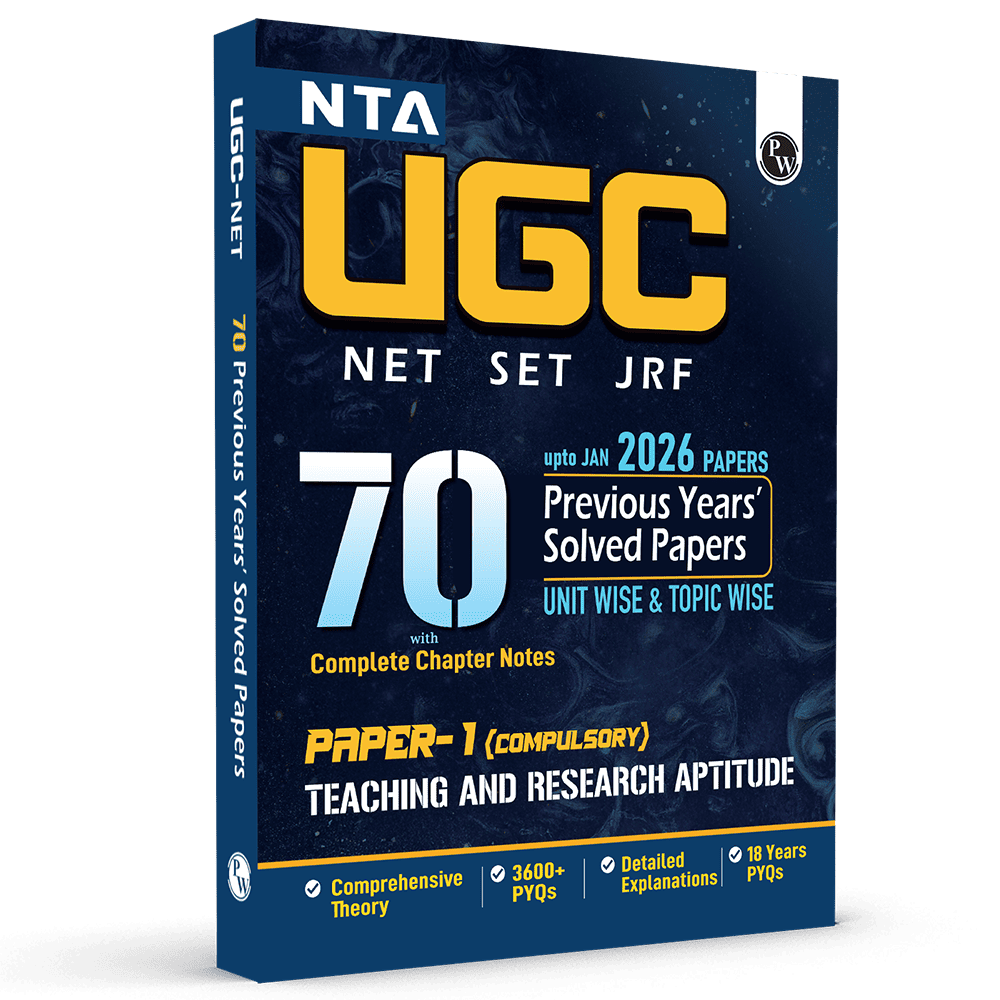
Check Out: NTA 70 UGC NET Paper 1 Previous Year Solved Papers
Important Topics from UGC NET Syllabus 2026
To get a good score, ensure these specific areas within the UGC NET syllabus 2026 paper 1 and paper 2 are on your priority list:
-
Paper 1 - Logic & Data: Focus heavily on Indian Logic (Pramanas) and Square of Opposition. In Data Interpretation, practice "Percentage Change" and "ratio-based" tables, as these appear in almost every other paper.
-
Paper 1 - Digital Pedagogy: With the push for digital education, topics such as OER (Open Educational Resources), LMS (Learning Management Systems), and the specific layers of the NEP 2020 (such as the 5+3+3+4 structure) are essential.
-
Paper 2 - Theory & Thinkers: Regardless of your subject (History, Sociology, or Commerce), questions are shifting toward chronology and matching books to authors.
-
Research Ethics: Expect questions on plagiarism, the role of ICT in research, and the difference between probability and non-probability sampling.
Check Out: Govt Entrance Exams Book
Preparation Tips for Completing UGC NET Syllabus 2026
A data-driven strategy is essential to effectively cover the UGC NET syllabus for paper 1 and paper 2.
-
Prioritise High-Scoring Units: In paper 1, units like Data Interpretation and Logical Reasoning are "mathematical", if you know the logic, you get full marks.
-
NCERT and Standard References: For paper 2, go back to your master's textbooks. Ensure your foundational concepts are clear before attempting advanced mock tests.
-
Time Management: Practice solving 150 questions in 180 minutes. Since there is no sectional time limit, many students spend too much time on paper 1 and rush through paper 2. Aim to finish paper 1 in 50–60 minutes.
-
Stay Updated with Digital Initiatives: Questions on ICT often focus on government portals like NPTEL and e-Pathshala.
Clearing the UGC NET is a marathon, not a sprint. By breaking down the UGC NET syllabus into manageable weekly goals and consistently practising previous year questions, you can significantly reduce exam-day stress. Remember that paper 1 is often the differentiator for JRF; do not neglect it in favour of your core subject. Use the UGC NET syllabus 2026 as your roadmap, stay consistent with your revisions, and focus on conceptual clarity to succeed.
Read More: UGC NET Previous Year Question Paper with Solution PDFs
UGC NET Syllabus FAQs
Q1. Is there any change in the UGC NET syllabus 2026 compared to 2025?
While the core topics remain consistent, the UGC NET syllabus 2026 paper 1 places greater emphasis on the implementation of NEP 2020 and updated environmental protocols.
Q2. How should I prepare for the UGC NET paper 1 syllabus?
Focus on understanding teaching and research methodologies. Practise at least 10–15 years of previous papers to identify repeating patterns in logical reasoning and data interpretation.
Q3. Can I choose any subject for the UGC NET paper 2?
Generally, you must choose the subject you studied in your post-graduation. However, if your specific subject is not on the list of 85, you can opt for a related subject.
Q4. What is the total duration and marking scheme for the UGC NET exam pattern?
The exam is 180 minutes long with no breaks. Each of the 150 questions carries 2 marks, and there is no penalty for incorrect answers.
Q5. Is the UGC NET syllabus available in regional languages?
The syllabus is officially released in English and Hindi. The question paper for most subjects is also provided in these two languages.