32 Years of UPSC PYQs: Why They Matter for Prelims Success
Preparing for the Civil Services Examination can feel overwhelming due to the massive syllabus. Aspirants often struggle to filter out high-priority topics from general reading material. This is where solving an authentic UPSC PYQ becomes invaluable.
By evaluating UPSC previous year papers, candidates immediately understand what the Union Public Service Commission values most. Instead of guessing the exam standard, working through authentic past papers establishes a clear benchmark for daily study.
Importance of UPSC PYQ
UPSC Previous Year Questions (PYQs) are one of the most effective resources for Civil Services Examination preparation. They help aspirants understand the exam pattern, identify important topics, and develop the analytical thinking needed to solve complex questions. Instead of studying blindly, practising UPSC PYQ gives a clear direction for preparation and improves overall performance.
The Preliminary examination tests not just memory, but critical thinking, elimination skills, and conceptual clarity. Attempting a PYQ offers direct insight into the exact standard set by the paper setters year after year. Standard textbook reading gives you raw knowledge, but previous paper analysis teaches you how to apply that knowledge under strict time constraints.
Many aspirants spend hundreds of hours reading reference material without testing whether they can solve actual exam items. This disconnect leads to poor time management and anxiety on exam day. Regularly attempting official past questions helps you bridge this gap.
-
Decodes Exam Trends: Reveals shifting focus areas, such as the increased weightage of environmental policy, international groupings, or conceptual economics.
-
Master Elimination Techniques: Helps candidates spot common trap options, extreme statements, and subtle wording variations.
-
Improves Accuracy Under Pressure: Reduces silly mistakes by familiarising aspirants with question framing and multi-statement formats.
-
Identifies Yield Areas: Highlights high-yield topics like Fundamental Rights, Parliamentary procedures, biodiversity hot spots, and monetary policy tools.
When you practice actual exam items, you begin reading textbooks differently. You stop reading passively and start scanning for potential examination questions, conditional statements, and key exceptions.
What are the Features of UPSC PYQ?
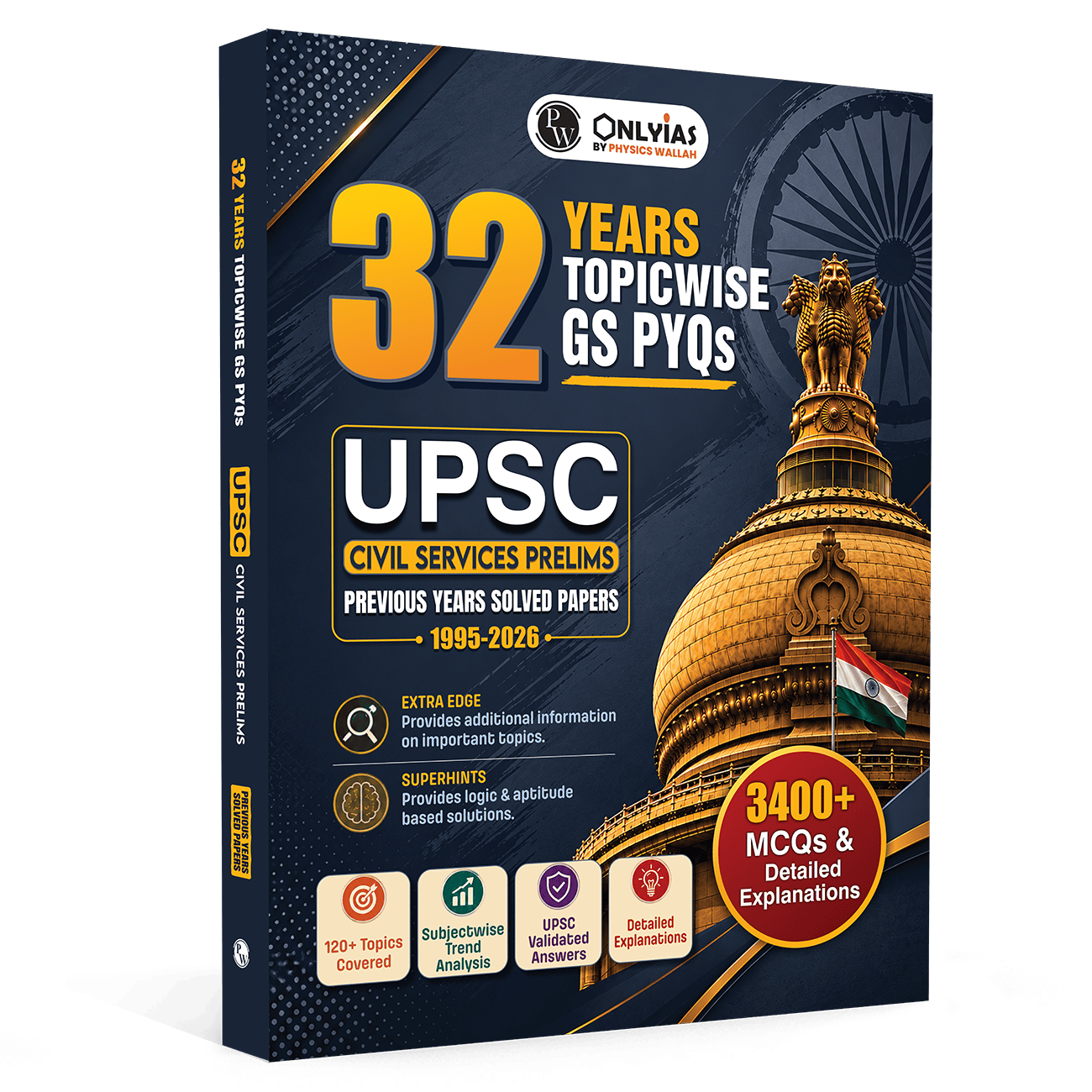
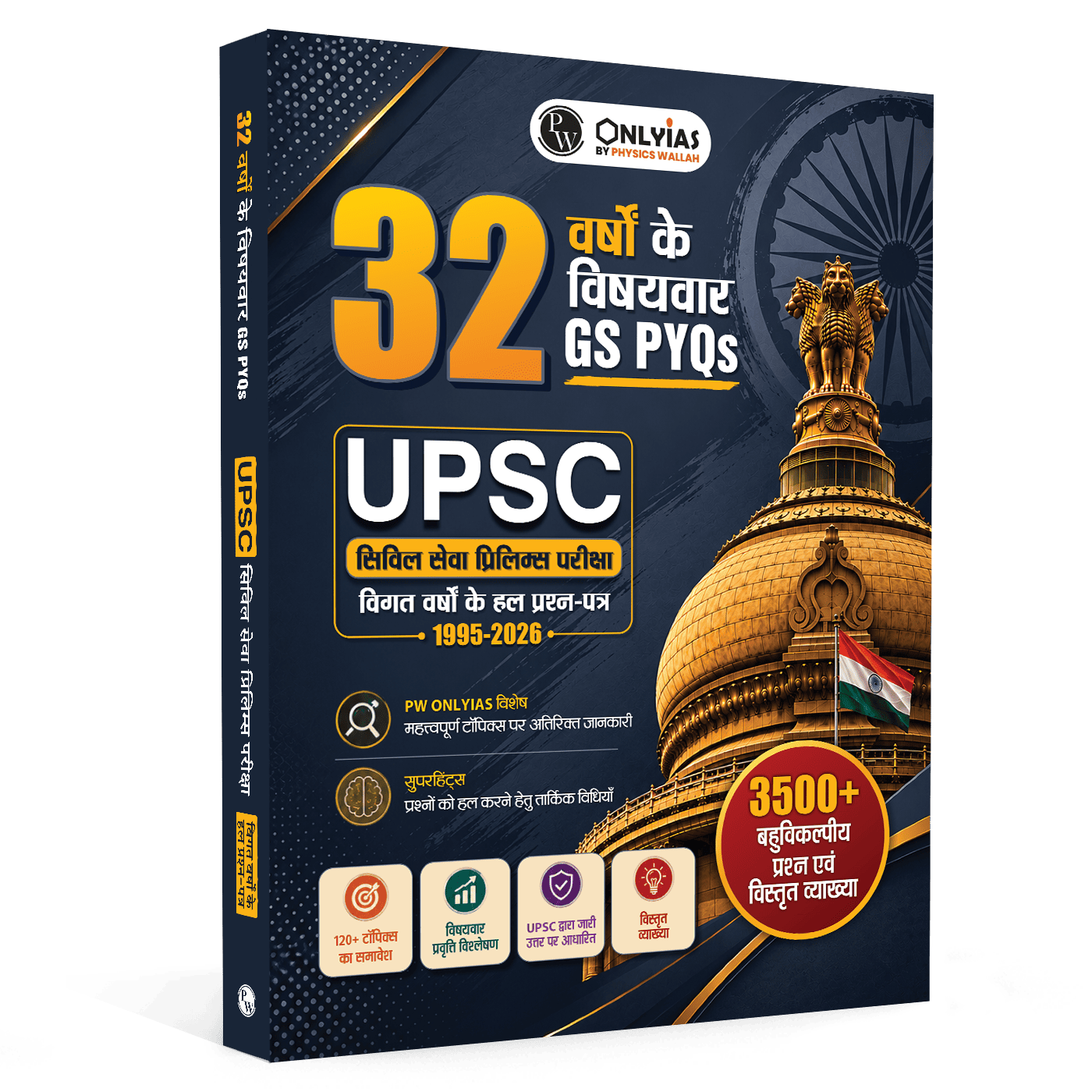
A well-structured UPSC PYQ book helps you understand the UPSC exam pattern, improve conceptual clarity, and practice effectively. With comprehensive coverage, detailed explanations, and topicwise organisation, this book is designed to support your preparation for the UPSC Civil Services Examination.
-
32 Years of UPSC Prelims Papers (1995–2026): Includes General Studies Paper 1 and CSAT Paper 2, providing complete coverage of authentic UPSC Prelims questions from the last 32 years.
-
3400+ Solved MCQs: Practice with a vast collection of solved UPSC questions to strengthen concepts, improve accuracy, and build exam confidence.
-
Topicwise Segregation: Questions are organised across 120+ topics, covering Polity, Economy, History, Geography, Environment, Science & Technology, Current Affairs, and other important subjects.
-
Detailed Option-Wise Solutions: Every question comes with a complete explanation, helping you understand the correct answer and the reasoning behind eliminating incorrect options.
-
Trend & Pattern Analysis: Discover recurring themes, high-weightage topics, and evolving question trends to prepare more strategically.
-
Expert Preparation Tips: Gain practical insights, smart preparation techniques, and exam-focused guidance to improve accuracy and decision-making during the exam.
-
Updated for UPSC 2027: Prepared according to the latest UPSC Prelims syllabus, question pattern, and examination trends.
-
Visual Learning Support: Includes maps, diagrams, charts, and infographics to simplify complex topics and improve retention.
-
Prelims and Mains Integration: Builds conceptual understanding that is valuable for both the Prelims and Mains stages of the UPSC examination.
-
Strategic Study Approach: Helps you identify priority areas through topicwise categorisation and question trend analysis, making your preparation more focused and efficient.
How Does UPSC PYQ Improve Prelims Preparation?
Success in General Studies Paper I requires a strategic mindset. The paper contains a mix of direct factual queries, multi-statement conceptual questions, and assertion-reasoning problems. Working through past papers builds the mental stamina required to parse complex statements without losing accuracy.
Option Engineering
Commission examiners design options carefully. Incorrect options are rarely random; they are intentionally crafted to test common misinterpretations. By examining UPSC gs previous year questions, you learn to spot common patterns in distractor choices:
-
Absolute Words: Terms like always, never, all, or only frequently signal incorrect or overly restrictive options, though candidates must verify context.
-
Interchanged Definitions: Swapping definitions between two related terms, such as fiscal deficit and primary deficit, or two related government schemes.
-
Factual Inversions: Reversing historical dates, geographical positions, or administrative ministries to test detailed recall.
Transitioning from Knowledge to Logic
Not every question in the paper can be answered through direct recall. In fact, most successful candidates rely on logical elimination for at least 30 to 40 questions. Practising authentic prelims PYQs regularly trains your brain to connect scattered facts and eliminate improbable options systematically.
Raw Knowledge ---> Trend Analysis ---> Option Elimination ---> High Accuracy
Developing this logical instinct takes consistent practice over several months. It cannot be learned overnight through quick revision sheets or last-minute summaries.
How to Study Every Subject Using UPSC PYQ?
Each subject in the General Studies syllabus demands a tailored approach when reviewing UPSC books. A one-size-fits-all strategy often misses the subtle nuances of different academic disciplines.
Indian Polity and Governance
Polity remains one of the most predictable and high-scoring sections in the examination. Questions frequently test constitutional provisions, judicial interpretations, and parliamentary rules.
-
Focus Areas: Fundamental Rights, Directive Principles, Constitutional Amendments, Judiciary, and Panchayati Raj.
-
PYQ Pattern: Questions often present subtle variations on constitutional language versus statutory definitions.
-
Actionable Step: Always keep a bare act of the Indian Constitution beside you when solving polity questions to cross-reference articles directly.
History and Indian National Movement
History is divided into Ancient, Medieval, Modern, and Art & Culture. Trends show a strong emphasis on socio-economic aspects during the Ancient and Medieval periods, and institutional developments during the National Movement.
-
Focus Areas: Freedom struggle events from 1857 to 1947, temple architecture, Buddhist and Jain philosophy, and administrative terms from medieval empires.
-
PYQ Pattern: Chronology-based questions and socio-cultural terminology definitions appear consistently.
-
Actionable Step: Create timeline charts for major movements and glossaries for classical terminology encountered in past papers.
Environment, Ecology and Biodiversity
Environment accounts for a significant portion of the paper due to the combined Civil Services and Forest Services Preliminary examination.
-
Focus Areas: Protected area networks, endangered species, national and international conservation legislations, climate change conventions.
-
PYQ Pattern: Testing whether a legal body is statutory or executive, or identifying protected habitats based on flora and fauna descriptions.
-
Actionable Step: Map every national park, wildlife sanctuary, and biosphere reserve mentioned in past papers onto a physical map of India.
Geography and Agriculture
Geography questions range from physical landforms to mapping exercises and agricultural practices.
|
Geography Sub-domain |
Typical Focus Areas |
Past Question Strategy |
|
Physical Geography |
Climatology, Oceanography, Geomorphology |
Focus on fundamental mechanisms (coriolis force, pressure belts). |
|
Indian Mapping |
River systems, mountain passes, border states |
Trace river tributaries and location coordinates from north to south. |
|
World Mapping |
Conflict zones, seas, straits, geopolitical regions |
Link current affairs locations to regional geography. |
|
Agriculture |
Cropping patterns, irrigation, soil types, MSP |
Study government reports and crop requirements. |
Economics and Social Development
Economics questions balance core conceptual framework with practical application of government schemes and financial policies.
-
Focus Areas: Inflation, monetary policy tools, banking systems, balance of payments, international financial institutions.
-
PYQ Pattern: Conceptual scenarios asking how interest rate changes affect currency valuation or inflation levels.
-
Actionable Step: Focus on understanding the mechanisms rather than memorising temporary economic stats.
Science and Technology
Science and Technology trends have shifted from pure textbook science toward applied technologies, space missions, biotechnology, and emerging digital systems.
-
Focus Areas: Gene editing, artificial intelligence, quantum computing, satellite orbits, renewable energy devices.
-
PYQ Pattern: Broad utility-based questions asking what is possible with a technology.
-
Actionable Step: Learn the underlying mechanism of major technologies highlighted in recent years
How to Use a 32 Years UPSC PYQ Book?
Attempting loose question papers without organized thematic grouping can lead to scattered learning. To build deep subject expertise, using a structured collection like a 32 years UPSC PYQ resource is the most efficient pathway.
-
Topic-Wise Categorization: Begin by selecting a specific chapter in your primary textbook (for example, Preamble and Preamble Values in Polity).
-
Initial Reading: Read the textbook chapter carefully to build baseline understanding.
-
Immediate PYQ Solving: Open your UPSC solved papers volume and attempt all questions from that specific chapter across the last 30+ years.
-
Deep Explanation Analysis: Do not simply check whether your answer was right or wrong. Read the detailed explanations for all options—including incorrect choices.
-
Note Integration: Add novel facts, unexpected definitions, or recurring themes discovered in the explanations directly into your short revision notes.
-
Periodic Re-attempt: Re-attempt tricky or incorrect items after 30 days to verify retention and conceptual mastery.
When questions are arranged chronologically year by year, aspirants lose track of subject continuity. A topic-wise UPSC book allows you to see how the Commission's perspective on a single topic has evolved over three decades.
For example, observing how questions on Panchayati Raj evolved from basic 73rd Amendment facts in the 1990s to complex governance queries in recent years gives you a multi-dimensional perspective on the subject.
Check Out: UPSC Informative Atlas Book
What is the 12-Week Revision Plan with UPSC PYQ?
Integrating past papers into your overall study routine requires disciplined planning. Here is a practical 12-week schedule designed to cover three decades of past papers systematically alongside standard reference material.
Weeks 1 to 4: Core Static Subjects
-
Polity and Modern History: Allocate 2 hours daily to solving topic-wise past questions after completing textbook chapters.
-
Goal: Complete all questions from 1995 to the present for Polity and Modern History.
-
Outcome: Secure command over roughly 30-35% of the total Prelims marks.
Weeks 5 to 8: Environment, Geography, and Economy
-
Environment, Physical/Indian Geography, Macroeconomics: Solve past items alongside map work and economic concept building.
-
Goal: Master map-based questions, species lists, economic tools, and environmental treaties.
-
Outcome: Strengthen performance in high-weightage, dynamic sectors.
Weeks 9 to 10: Science & Tech, Art & Culture, Ancient/Medieval History
-
Specialized Subjects: Review past papers to identify recurring cultural terminology, historical dynasties, and core scientific applications.
-
Goal: Filter out niche areas where past paper repetition is common.
-
Outcome: Maximize returns on historically difficult syllabus segments.
Weeks 11 to 12: Year-Wise Full Re-attempts
-
Full-Length Execution: Take the last 5 years of official paper sets as full-length timed tests from 9:30 AM to 11:30 AM.
-
Goal: Fine-tune body clock, test management, and option elimination logic under real test conditions.
-
Outcome: Mental readiness and calm execution on exam day.
Common Mistakes to Avoid While Solving UPSC PYQ
Even with access to quality resources, many candidates fail to get maximum value from their practice sessions because of faulty study habits.
Treating PYQs as Speed Tests
Solving a past paper in a timed mode is fine, but treating it purely as a test misses the real value. The main benefit of past papers comes from post-test analysis. Spending two hours solving a paper requires at least three hours of thorough post-analysis.
Ignoring Incorrect Options
A common mistake is reading the answer key only for the correct option and ignoring options (A), (B), or (C) if (D) was correct. The Commission frequently turns an incorrect distractor option from a previous year's question into a full-fledged question in subsequent years.
Relying on Outdated Current Affairs Solutions
Past papers from 1995 or 2005 contain questions based on current affairs of that era. Trying to memorise outdated current events wastes precious time. Always use an updated resource where older current affairs questions are either updated to reflect modern contexts or clearly marked for static relevance.
Passive Reading Instead of Active Practice
Simply reading solved answers like a textbook creates a false sense of competence. You must hide the answer key, attempt the question yourself, apply your elimination logic, and only then verify your reasoning against the written explanation.
Read More: UPSC Indian Economy Previous Year Papers with Downloaded PDF
UPSC PYQ FAQs
How many years of past questions should I solve for Prelims?
Solving at least 30 to 32 years of past papers provides comprehensive coverage. While older questions show basic conceptual building blocks, papers from the last 10 to 12 years highlight modern multi-statement trends.
Are past questions ever repeated in the examination?
Direct questions are rarely repeated verbatim, but core concepts, underlying themes, and option choices recur frequently. Mastering past options gives you a distinct advantage on several questions each year.
Should I solve past papers before or after completing the syllabus?
You should solve topic-wise past papers alongside your initial textbook reading. Waiting until the entire syllabus is finished creates a backlog and deprives you of learning how to read textbook material effectively.
How do past papers help with negative marking?
Analyzing your accuracy rate on past questions helps you calculate your optimal attempt strategy. You learn whether aggressive attempts yield better net scores or if cautious selection works better for your accuracy level.
Why is a topic-wise book better than year-wise papers?
A topic-wise book allows you to focus on one subject at a time, reinforcing chapter concepts immediately after reading theory. Year-wise papers are best saved for final full-length practice close to the exam date.