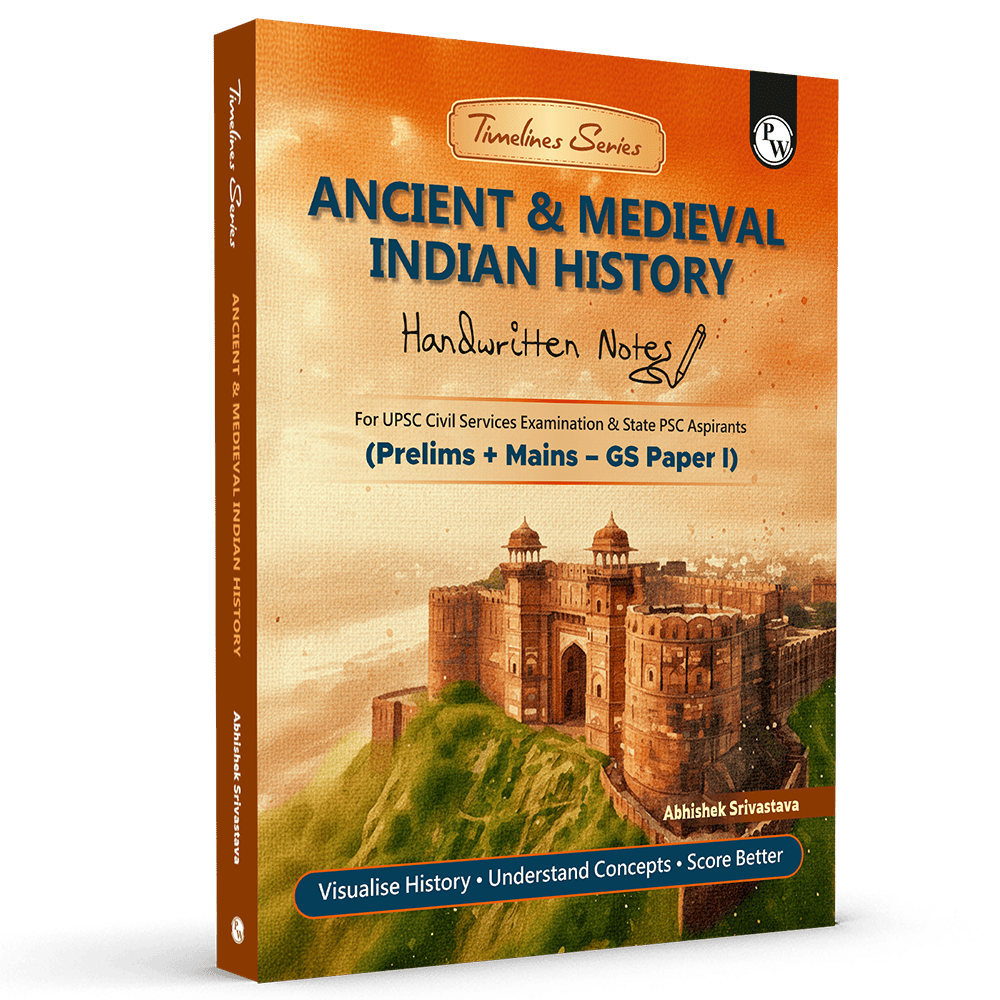
Importance of Handwritten Notes in UPSC GS Paper 1 Ancient & Medieval Indian History

Handwritten notes make it easier for UPSC aspirants to remember complex timelines and cultural details compared to regular textbooks. Well-organized UPSC ancient and medieval history notes visual notes help break down the large GS Paper 1 syllabus. They also make it simpler to recall important facts during the exam.
Check out: UPSC CSE Books
Challenges in Preparing UPSC Ancient and Medieval History Notes
Many students find history challenging because there are so many facts, dates, and dynasties to remember. It can be hard to know what matters for Prelims versus what is important for Mains. GS Paper 1 covers topics from the Stone Age up to the fall of the Mughal Empire.
Without a focused strategy, it is easy to get lost in minor details that rarely appear in the exam. This is where high-quality UPSC history notes become a game-changer. They allow you to focus on high-yield topics like temple architecture, bhakti movements, and administrative reforms, which are frequently tested.
Benefits of Handwritten UPSC Ancient and Medieval History Notes
Handwritten materials are naturally more engaging for the brain. When you read notes that look like they were written by a student, it reduces the mental fatigue associated with formal printed text.
-
Better Retention: Writing or reading handwritten scripts activates different neural pathways, making it easier to remember the succession of kings or the features of Ashokan edicts.
-
Visual Aids: These notes often include rough maps, flowcharts, and diagrams that are crucial for answering geography-linked history questions.
-
Concise Information: Unlike textbooks, UPSC history short notes strip away the fluff, leaving you with only the core arguments and data needed for your answers.
Features of UPSC Ancient and Medieval History Notes
Effective study material must serve two purposes: clarity for the Prelims and depth for the Mains. Quality UPSC ancient history handwritten notes focus heavily on Art and Culture, as this section has seen an increase in weightage over recent years.
Ancient History Important Topics
In the ancient section, the notes should categorise information into socio-economic and cultural headers. This helps in writing balanced answers in the GS Paper 1.
|
Period |
Key Focus Area |
Why it Matters |
|
Indus Valley |
Town Planning |
Frequent Prelims questions on drainage and seals. |
|
Vedic Age |
Social Structure |
Understanding the evolution of the Varna system. |
|
Mauryan |
Administration |
Crucial for understanding ancient governance. |
|
Gupta Era |
Literature & Art |
Known as the 'Golden Age' of Indian culture. |
Medieval History Important Topics
For medieval history handwritten notes UPSC, the emphasis shifts toward the administrative machinery of the Delhi Sultanate and the Mughals, along with the socio-religious reforms of the time.
-
Land Revenue Systems: Detailed breakdowns of Zabti and Dahshala systems.
-
Architecture: Evolution of Indo-Islamic styles, including domes and minarets.
-
Bhakti and Sufi Movements: Key saints, their philosophies, and their impact on regional languages.
Check Out: UPSC Textbooks
How Short UPSC Ancient and Medieval History Notes Help in Revision
Revision is the most critical part of the UPSC journey. In the final weeks before the exam, you cannot afford to go through thousands of pages. This is the stage where handwritten notes for UPSC prelims provide the most value.
These notes often use bullet points and shorthand to explain complex events. For example, rather than a five-page chapter on the Tripartite Struggle, a simple flowchart showing the conflict between the Palas, Pratiharas, and Rashtrakutas is far more effective.
UPSC GS Paper 1 Preparation with History Notes
The General Studies Paper 1 requires a candidate to link history with culture. When you use UPSC GS paper 1 history notes, you are not just learning about a king's reign. You are learning about the coins they minted, the temples they built, and the travelers who visited their court.
Using curated notes ensures that you have all these dimensions in one place. Everything is organized in one place, making preparation more manageable and revision-friendly.
How to Choose UPSC Ancient and Medieval History Notes
Finding the right resources is essential for a streamlined preparation process. You can find comprehensive sets that cover these sections in detail. For instance, you can explore specialized collections to ensure your preparation aligns with the latest exam patterns.
These resources are designed to help students revise the syllabus in a more organized way. They are particularly useful for students who find it difficult to make their own notes from scratch while managing other GS papers.
Choosing the Right UPSC Ancient and Medieval History Notes
Simply owning the notes is not enough; you must know how to use them. Start by reading the primary source once to understand the story. Then, switch to ancient and medieval history notes PDF versions or hard copies for repeated revisions.
-
Active Recall: After reading a section on the Vijayanagara Empire, close the notes and try to list the four dynasties that ruled it.
-
Map Practice: Use the maps provided in the notes to mark important archaeological sites like Burzahom or Lothal.
-
Linkage: Try to link the decline of the Mughals with the rise of regional powers as described in your medieval notes.
Check Out - UPSC Previous Year Papers
How UPSC History Notes Improve Answer Writing
In the Mains exam, your presentation matters as much as your knowledge. Handwritten notes act as a template for how you should structure your answers. They use headings, subheadings, and points, which is exactly what the examiners look for in a high-scoring script.
By studying UPSC history notes, you subconsciously learn how to present data clearly. You learn to put the most important point first and support it with historical evidence or the name of a contemporary historian or chronicler.
Time Management with UPSC Ancient and Medieval History Notes
Time management is often the biggest hurdle for aspirants. History is a subject that can consume months if not handled carefully. Using structured notes helps students complete revisions in a more structured and time-efficient manner.
This efficiency frees up time for other subjects like Geography and Society within the GS Paper 1. It ensures that you are a "Jack of all trades," which is exactly what the UPSC expects from a future administrator.
Tips for UPSC Ancient and Medieval History Preparation
Always keep your notes updated with any recent archaeological findings or UNESCO world heritage site announcements. History is static, but the way questions are framed can be contemporary. Ensure your history notes are your constant companion during your mock test series.
Read More: Important Economy Topics for UPSC Prelims
UPSC Ancient and Medieval History Notes FAQs
Are UPSC history notes enough for Prelims?
While notes provide a solid foundation and cover around approximately 80-90% of the core syllabus, it is always recommended to have a basic understanding of NCERTs first. Notes are best for consolidation and rapid revision.
Why should I prefer UPSC ancient history handwritten notes over printed books?
Handwritten notes are often more concise and use visual layouts like flowcharts. This makes it easier to memorize chronologies and architectural styles compared to dense paragraphs in printed books.
How do medieval history handwritten notes UPSC help in Mains?
These notes provide structured points on administration, land revenue, and culture. This helps you write organized answers quickly, which is essential given the strict time limits of the Mains exam.
Where can I find an ancient and medieval history notes PDF?
Many educational platforms provide these in digital format. However, having a physical copy of handwritten notes is often better for reducing screen fatigue during long study sessions.
Can I rely on UPSC history short notes for the Art and Culture section?
Yes, most high-quality short notes integrate Art and Culture within the historical timeline. This is the most effective way to study the subject as culture does not exist in a vacuum; it is shaped by the politics of its time.