How Analysing 3 Decades of UPSC PYQs Sharpens Your UPSC Strategy
As mid-term assessments approach, an underlying anxiety remains: how do you know if your knowledge aligns with what the examiner actually wants? This is the exact dilemma that thousands of civil services aspirants face when trying to gauge their readiness.
Without a concrete benchmark, revision can feel like shooting in the dark. The most dependable tool to fix this problem is a thorough study of UPSC PYQs. Looking closely at past papers helps you understand how questions are framed and bridges the gap between raw theory and actual exam requirements.
What Are UPSC PYQs?
The term UPSC PYQs refers to the official previous-year questions compiled from the Civil Services Examination. These questions are the actual papers set by the Union Public Service Commission over the preceding years, covering both General Studies Paper 1 and the Civil Services Aptitude Test (CSAT) Paper 2. Rather than just a bank of old questions, they serve as an official blueprint of the examination standard.
A complete collection generally spans over three decades, capturing test trends from 1995 to 2026.
This historical data includes more than 3,400 high-quality multiple-choice questions. By studying this comprehensive dataset, you gain direct exposure to real problems rather than mock scenarios created by external parties.
Why Are UPSC PYQs Necessary for Cracking the Exam?
Relying entirely on standard guides can leave your preparation disjointed. Incorporating a rigorous UPSC PYQ analysis into your schedule alters how you read regular textbooks.
Instead of passively memorising pages, you begin reading with an analytical mindset, constantly predicting how a paragraph could be turned into a complex question.
1. Decoding the Mindset of the Examiner
The main reason to study UPSC PYQ Book is to understand the logic behind question design. The commission rarely tests simple memorisation; instead, it focuses on deep conceptual clarity and application. Reviewing older questions shows how simple static facts are combined with dynamic current events to build multi-statement problems.
2. Understanding Evolving Standards
The examination environment does not remain static. By assessing trends over thirty years, you can see how the focus shifts between factual queries and analytical concepts. A smart UPSC preparation strategy adapts to these changes, ensuring you spend less time on outdated styles and focus your energy on modern testing patterns.
How do UPSC PYQs Help Identify High-Weightage Topics?
Not all chapters in your syllabus carry the same importance. A common issue during the mid-term phase is spending too much time on low-yield topics. Historical papers offer an objective way to see which areas demand your absolute focus.
When you look at more than 120 subtopics systematically, clear patterns emerge. You notice that while specific current occurrences change every year, the foundational subjects they relate to remain remarkably consistent. This allows you to streamline your subject lists and avoid wasting time on peripheral themes.
1. Key Focus Areas in Indian Polity and Economy
Historical trends show that specific segments consistently command more questions. In Polity, areas like Fundamental Rights, Parliament, the Judiciary, and Constitutional Amendments are heavily featured.
For the economy, the focus remains on Banking, Inflation, Fiscal Policy, and Balance of Payments. Knowing these high-yield zones allows you to allocate your daily study hours much more effectively.
2. High-Yield Themes in History, Geography, and Environment
History questions frequently target the Modern Freedom Struggle, Bhakti-Sufi movements, and Indus Valley Civilization. Meanwhile, Geography and Environment papers heavily test Climate Systems, River Systems, Biomes, and Wildlife Protection Acts.
Identifying these recurring themes prevents you from getting lost in the massive syllabus and helps you prioritise content that actually yields marks.
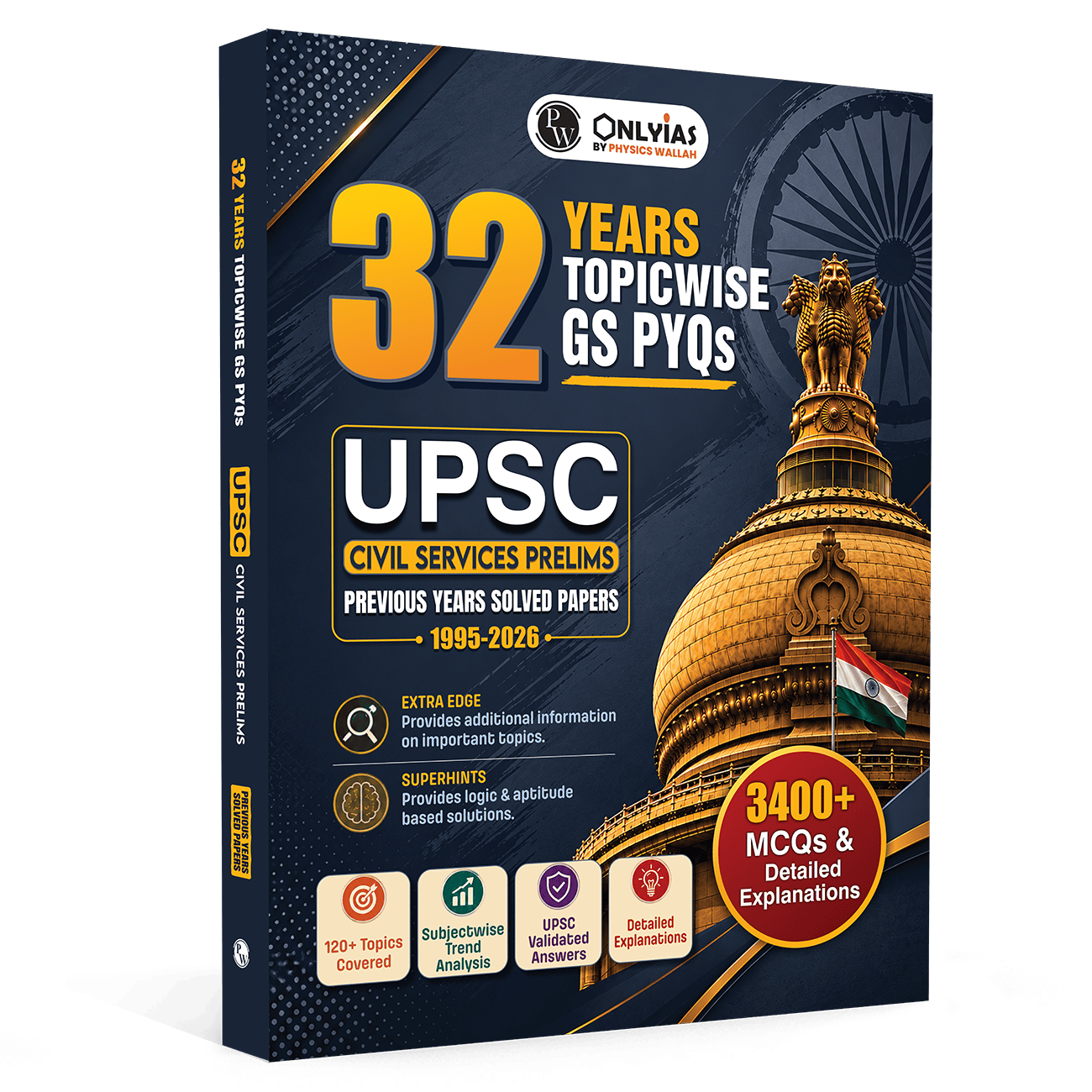
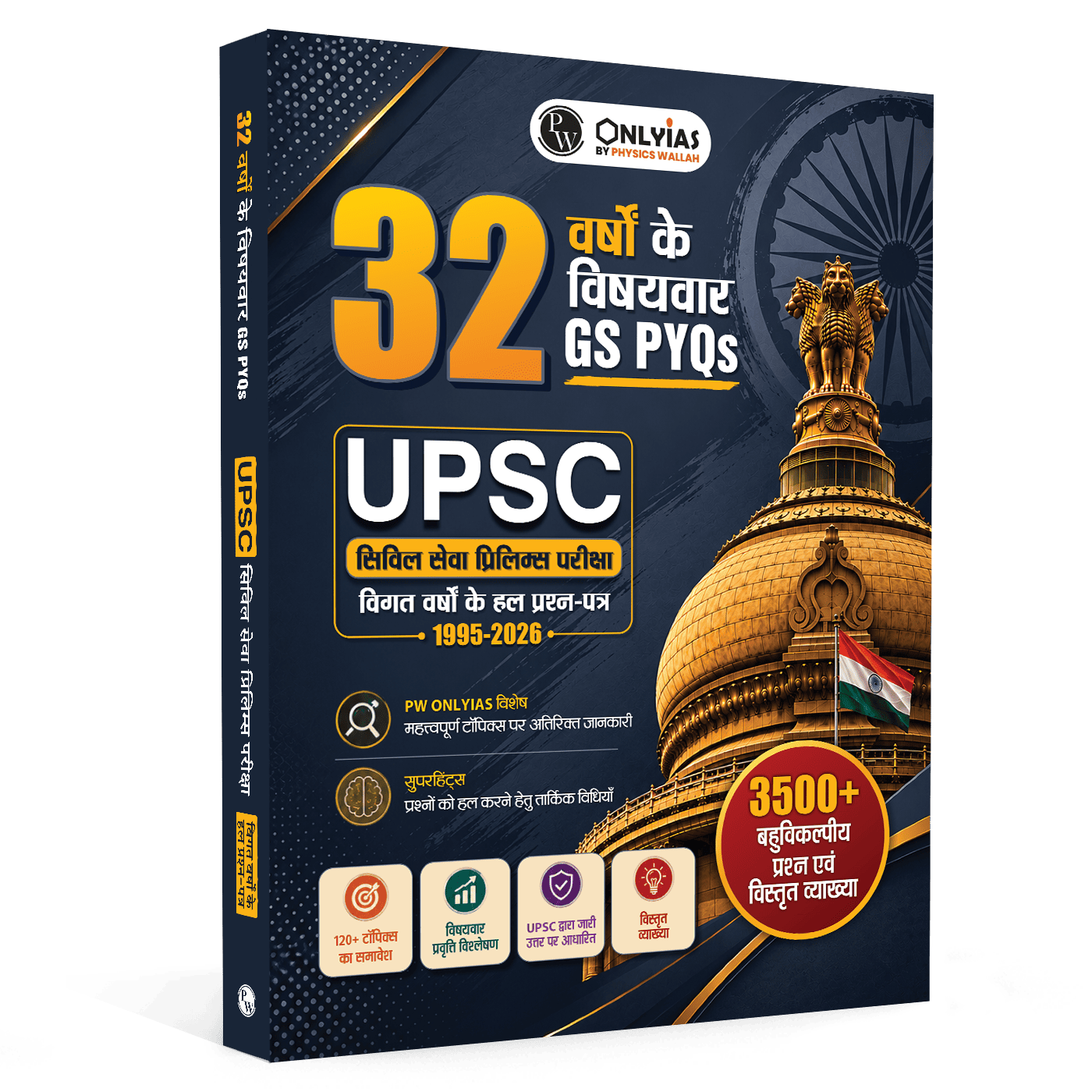
PWOnlyIAS UPSC Prelims Hindi PYQ Book offers 32 years of topic-wise GS questions from 1995–2026, with 3500+ MCQs and detailed explanations to support thorough preparation for UPSC 2027.
Benefits of Using UPSC PYQs
Studying historical papers gives you distinct practical advantages that standard test papers cannot replicate. It alters how you approach options and improves your speed under pressure.
-
Better Option Elimination: Real questions feature choices that are carefully designed to confuse. Practising with genuine papers helps you understand the logic needed to rule out incorrect choices safely.
-
Integrated Preparation: Reviewing past items helps build a unified understanding that bridges both prelims preparation and mains answer writing. It teaches you to view facts as building blocks for detailed arguments.
-
Accurate Trend Analysis: Tracking three decades of question history reveals clear UPSC exam trends, showing you exactly how the weightage of sectors like Environment or Science & Technology has grown over time.
-
Visual Conceptual Memory: Combining text solutions with visual tools like maps, charts, and diagrams helps reinforce complex geographic locations and historical timelines.
-
Intelligent Guessing Skills: Real practice exposes you to context clues and expert insights, allowing you to develop structured guessing techniques for situations where you can only rule out two options.
How to Integrate UPSC PYQs into Your Daily Study Plan?
o get the full value out of past papers, you should not save them for the very end of your preparation cycle. They should be used consistently alongside your daily reading and revision to reinforce concepts and improve analytical thinking. Combining previous year paper practice with comprehensive UPSC Books including standard textbooks, current affairs resources, notes, and revision guides—helps build a strong conceptual foundation, improves answer-writing skills, and ensures balanced preparation for both the UPSC Prelims and Mains examinations.
Step 1: Topic-Wise Study
Do not try to solve a full 2-hour paper when you are only halfway through the syllabus. Instead, use a segregated resource that groups questions by topic. When you finish reading about the Parliament in Polity, immediately open your question bank and solve all the historical questions related to that specific topic.
Step 2: Analyse Explanations Thoroughly
Your work does not finish when you find the right answer. Spend time reading the detailed explanations for every option, including the wrong ones. Understanding why three options are wrong provides three new pieces of information that might form the basis of a future test question.
Step 3: Regular Review Sessions
Dedicate specific days to focused UPSC revision. Revisit the tricky questions you answered incorrectly during your first attempt. This reinforcement fixes conceptual gaps and keeps you familiar with official phrasing.
Common Mistakes to Avoid While Solving UPSC PYQs
Many aspirants use past papers as a simple test score generator rather than an analytical guide. Avoiding common tactical mistakes can save you hundreds of hours of misdirected study.
-
Treating Them Only as a Mock Test: Treating past papers as a one-time test and moving on is a major waste. The real value is in the previous year questions analysis, where you study the structure and language of the prompts.
-
Ignoring the CSAT Paper: Focusing entirely on General Studies while neglecting the CSAT Paper 2 is a frequent point of failure. Use historical aptitude questions to track your calculation and comprehension speeds early on.
-
Relying on Outdated Solutions: Current affairs and economic laws change over time. Ensure you check older questions against updated explanations that reflect modern legal framework modifications and revised data.
-
Memorising Answers Rather Than Methods: Simply memorising that an option is correct will not help you if the commission modifies the underlying condition next year. Focus on the analytical steps used to solve the problem.
Read More: Important Constitutional Amendments in India for UPSC
UPSC PYQs FAQs
Why should I review UPSC PYQs from as far back as thirty years ago?
Reviewing long-term data helps you identify structural changes and enduring static themes that remain unaffected by short-term current affairs shifts.
Can old questions help with current affairs topics?
Yes, older questions show you exactly how the commission links temporary news events back to static constitutional or economic principles.
How often should I include UPSC PYQs in my mid-term schedule?
You should look at them daily, matching your textbook reading with topic-wise questions to check your understanding immediately.
Should I practice CSAT questions alongside General Studies?
Yes, balancing both ensures you maintain required logical speeds and do not face unexpected difficulties on exam day.