From PYQs to Selection: How PW 32 Years UPSC PYQ Book Improves Accuracy
You might understand the core theories perfectly, yet find yourself completely stuck when trying to solve actual mock tests. The gap between reading a textbook chapter and successfully choosing the correct option under pressure is wide, leaving many aspirants vulnerable to negative marking.
Relying on an extensive UPSC PYQ book bridges this exact gap, changing how you evaluate choices and giving your overall civil services exam campaign the direction it desperately needs.
Importance of a Structured UPSC PYQ Book
Succeeding in this competitive exam requires more than just memorising vast amounts of information. It demands that you deeply understand the unique mindset of the paper setters.
A well-organised compilation of previous year questions acts as a direct window into this mindset, showing you exactly how raw data is converted into complex multiple-choice challenges.
-
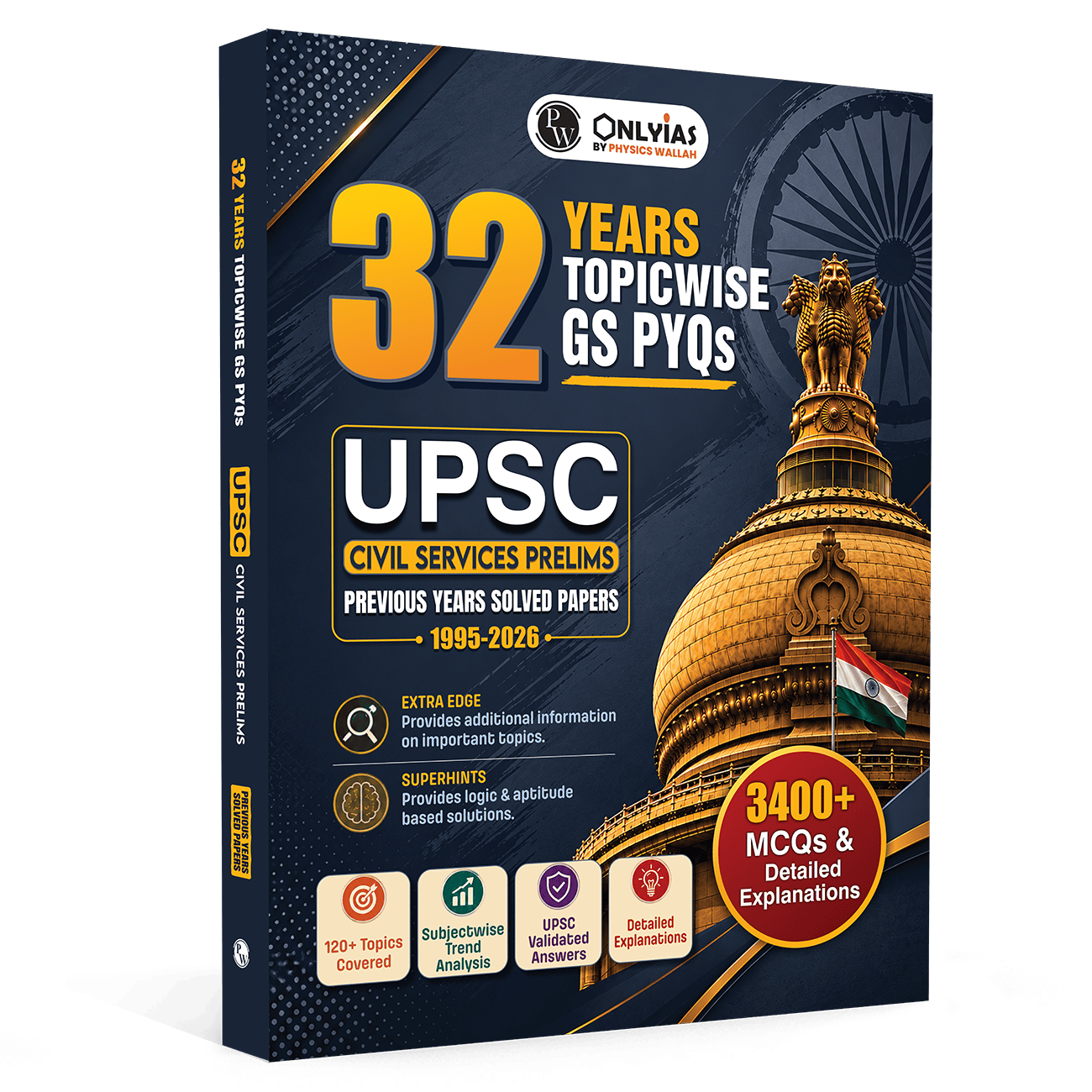
Complete Syllabus Coverage: A reliable resource covers 32 years of prelims papers (1995–2026), giving you a massive library of over 3400+ solved MCQs to practice.
-
Dual Paper Preparation: It ensures you systematically cover both General Studies Paper 1 and CSAT Paper 2 within a single unified framework.
-
Authentic Material Only: Working directly with authentic questions prevents you from wasting valuable energy on unrealistic, poorly drafted mock papers.
-
Expertly Reviewed Content: The entire collection is curated and reviewed by experienced faculty members, ensuring the explanations are highly accurate.
Why Is the UPSC PYQ Book Essential for Improving Accuracy?
The difference between a successful candidate and an unsuccessful one often comes down to just a handful of marks, making UPSC answer accuracy extremely important. Random guessing or relying entirely on intuition can significantly reduce your score because of negative marking. To improve accuracy, aspirants should combine regular practice with reliable UPSC Books, which provide strong conceptual clarity, comprehensive subject coverage, and structured explanations. Studying from quality UPSC books alongside previous year questions helps build analytical thinking, strengthen fundamentals, and minimise mistakes, ultimately improving both confidence and performance in the UPSC Civil Services Examination.
|
Feature |
How It Directly Improves Your Final Marks |
|
Option-Wise Solutions |
Breaks down why the correct choice is right and exactly why the remaining options are false. |
|
Option Elimination |
Teaches you the specific logical steps needed to eliminate incorrect choices confidently. |
|
Superhints Integration |
Provides intelligent guessing techniques and shortcut methods for tough questions. |
|
Smart Trend Analysis |
Highlights evolving patterns so you can adjust your thinking to match the latest styles. |
How the UPSC PYQ Book Helps Build Conceptual Clarity?
True conceptual understanding cannot be achieved by simply reading standard reference books over and over again. You build real depth when you force your mind to apply those concepts to tricky, multi-layered problems.
1. Topicwise Segregation Across Subjects
The compilation separates questions into more than 120 distinct topics. This neat categorization spans Indian Polity, Economy, History, Geography, Environment, Science & Technology, and Current Affairs. Instead of jumping randomly between eras or formulas, you can choose to study a specific topic in your textbook and immediately solve all the relevant historical questions associated with it.
2. Integrated Prelims and Mains Foundation
The deep analytical explanations provided for each question do far more than just help with prelims. By exploring the underlying context of a topic, this thorough method builds an excellent foundation that supports your mains answer writing preparation simultaneously.
3. Visual Learning Support
Complex geographic layouts, historical routes, and intricate scientific processes are reinforced using clear maps, diagrams, and targeted infographics. This strong visual support ensures you retain vital information much better than reading plain text alone.
How Does the UPSC PYQ Book Help Identify Frequently Asked Topics?
The syllabus is notoriously massive, but the actual distribution of marks across topics is never uniform. Certain areas are prioritised year after year, and identifying these high-weightage zones is a foundational part of any smart UPSC preparation strategy.
-
Isolating Core Themes: Reviewing three decades of papers makes it easy to spot recurring themes, such as specific environmental treaties or constitutional articles.
-
Tracking Topic Evolution: You can easily see how a basic factual topic from a decade ago has gradually transformed into a modern, concept-driven dynamic question.
-
Smart Resource Allocation: Knowing which areas are prioritised allows you to focus your limited energy on high-yield sections rather than getting lost in low-weightage details.
How to Use a UPSC PYQ Book for Better Results?
Simply reading through a question bank like a standard novel will not yield real results. You need a highly active, deliberate practice method to truly sharpen your exam-day execution.
-
Read the Chapter First: Finish your standard text or lecture notes for a specific topic completely before opening your question bank.
-
Attempt Independently: Try to solve the past questions without looking at the answers, forcing your brain to recall information under simulated pressure.
-
Analyse Every Wrong Answer: Do not just look at the correct choice; spend time reading the detailed breakdown to understand exactly where your logic failed.
-
Study the Incorrect Options: Research the terms mentioned in the incorrect options, as the exam frequently turns these minor details into primary questions in later years.
-
Log Your Mistakes: Keep a dedicated diary of your recurring errors to ensure you do not repeat the same logical missteps in the actual exam hall.
When to Use a UPSC PYQ Book in Your Study Schedule?
Timing your study routine perfectly is vital to preventing burnout and maintaining momentum during the middle of your timeline. Integrating UPSC PYQ practice seamlessly at the right moments ensures your revision remains highly productive.
1. During First-Phase Learning
As you finish a topic for the very first time, use the past papers to understand how deep your knowledge actually goes. This keeps your early studies grounded in reality and prevents you from over-analysing trivial details.
2. Mid-Term Evaluation Phase
Use the collection mid-way through your yearly plan to test your retention and find your weak spots. It serves as an honest diagnostic tool that reveals which subjects require an immediate change in approach.
3. Final Revision Weeks
In the weeks leading up to the actual exam, pivot to solving full, unbroken papers within the strict two-hour limit. This builds the physical stamina, mental speed, and time-management skills required on the big day.
Also Check: PW UPSC Informative Atlas Book - India & World
Study Plan for Using the UPSC PYQ Book
To get the most out of your 32-year resource, you should follow a highly structured, phase-based preparation framework.
Phase 1: Topic-by-Topic Basics
Focus entirely on establishing a rock-solid foundation. Pair your daily reading directly with the 120+ segregated subtopics to ensure your factual comprehension is completely accurate from the start.
Phase 2: Targeted Trend Analysis
Shift your focus toward understanding the broader patterns of the exam. Use the expert insights to study how options are structured, identify common traps, and learn how to use advanced elimination strategies effectively.
Phase 3: Full-Length Exam Simulation
Treat the papers as complete mock exams. Sit down in a quiet room, set a strict timer, and solve the papers in a single sitting to perfect your pacing for both the morning General Studies paper and the afternoon CSAT paper.
UPSC PYQ Book FAQs
1. How many years of historical papers should I practice for the civil services exam?
You should ideally practice at least 30 to 32 years of previous papers. This extensive range helps you understand long-term trend shifts and covers thousands of high-quality variations across both General Studies and CSAT.
2. Can a 32 years UPSC PYQ book really help me improve my UPSC answer accuracy?
Yes, it improves accuracy by providing detailed option-wise solutions. This teaches you the underlying logic of why options are wrong, helping you build better elimination techniques and avoid negative marks.
3. Is topic-wise segregation better than solving year-wise papers during early UPSC preparation strategy?
Topic-wise segregation is much better during the early phases because it lets you practice questions immediately after studying a specific topic. Year-wise papers are best left for full-length simulations in the final weeks of your revision.