How to Use UPSC Question Bank to Test Your Science & Technology Concepts
Preparing for Civil Services The Preliminary Examination requires a clear plan, especially when the subject is dynamic. Science & Technology is an area where conceptual clarity has to be in tune with the unpredictable nature of multiple choice items. Those who are passive readers can often be stumped by the exam hall. To overcome this gap, you need a specific UPSC science and technology question bank which is directly in line with the current test trends. Targeted practice resources help you analyze your basic concepts, pinpoint areas of weakness and increase the speed and precision you need to succeed.
Why Use a UPSC Science and Technology Question Bank for Preparation
Solving practice items systematically changes how you retain complex information. Reading a textbook gives you factual knowledge, but active testing conditions your mind to analyze options critically. A high-quality UPSC science and technology questions serves as a reality check for your preparation level, ensuring you do not overestimate your readiness.
Hence, regular practice from a dedicated practice book is a must for applicants preparing for the civil services exams:
-
Reduces Conceptual Confusion: Science subjects might seem simple to read, but exam questions tend to examine subtle distinctions.
-
Increases the ability to eliminate options: In UPSC questions, you are rarely required to only recall facts. Practice teaches you to eliminate wrong assertions using logical deduction and scientific principles.
-
Improves Time Management: Practicing time-bound practice sets helps your brain to get trained to digest lengthy or statement heavy items swiftly under duress.
-
Tracks Incremental Progress: Chapter-wise testing allows you to measure performance across specific areas like Biotechnology, Space Technology, and Defence, ensuring uniform readiness.
Key Features of a UPSC Science and Technology Question Bank
Not all practice books have the needed depth for the Civil Services Preliminary Exam. A good source should have a structured content that is similar to the real examination requirements. Identify important structural features in UPSC Books that make learning easier.
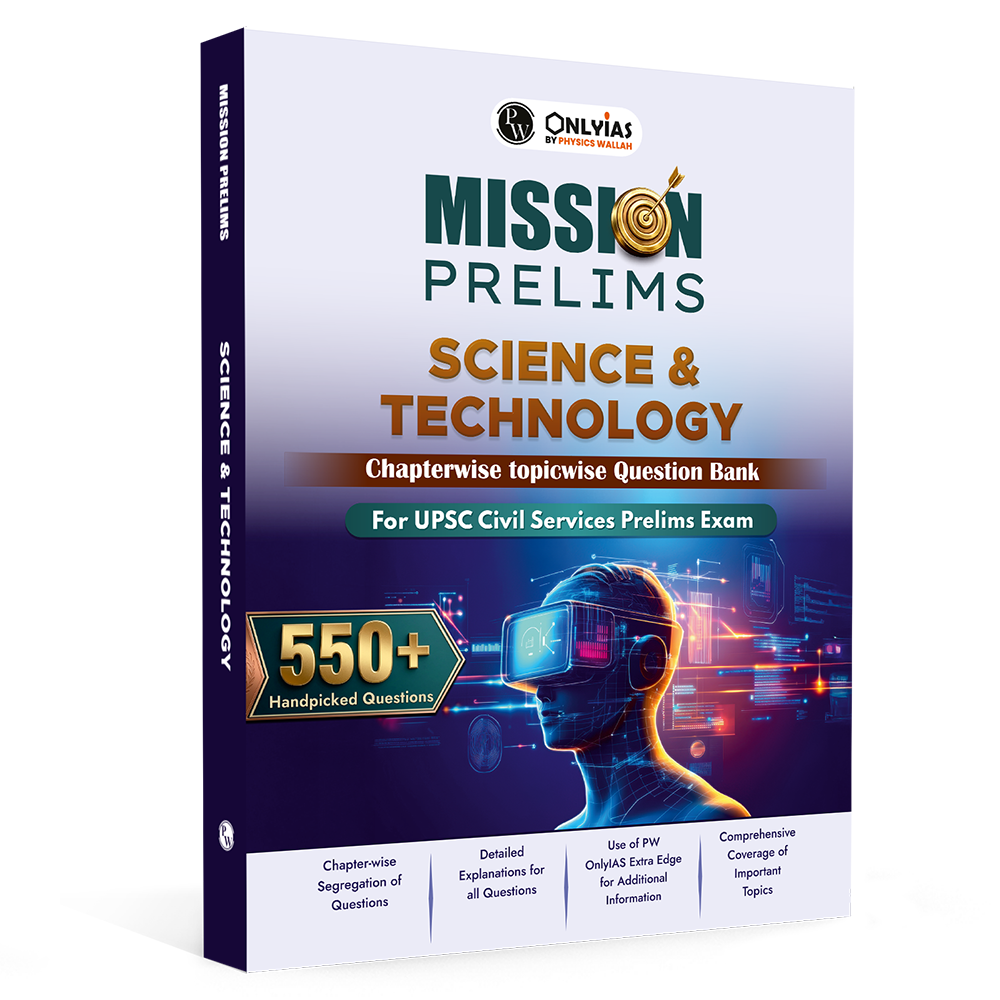
A well-structured UPSC science and technology practice questions resource incorporates these exact standards. Featuring over 550 handpicked items, it combines clear explanations with strategic guidance to refine your preparation.
How to Use a UPSC Science and Technology Question Bank
To maximize your score, avoid opening a workbook and answering items randomly. Follow a structured workflow to get the most value out of every session.
Step 1: Complete Static Reading First
Go back to your basic notes or reference materials before you may tackle any subject. If you test items that you don't have a fundamental conceptual understanding of, you will be guessing wildly and degrading the self-assessment process.
Step 2: Solve Questions in Chapter-Wise Mode
Focus on one specific sub-topic at a time, such as Information and Communication Technology or Health and Diseases. Solving UPSC science technology MCQs topic-wise reinforces the specific concepts you just read.
Step 3: Analyze Explanations Thoroughly
Do not limit your evaluation to checking whether an answer is correct or incorrect. Read the detailed explanations for every item to understand the logic behind each statement.
Step 4: Document Mistakes in an Error Log
Maintain a dedicated notebook to record conceptual errors, missed facts, or wrong logical assumptions. Reviewing this log regularly prevents you from repeating the same mistakes during the actual exam.
How to Combine a UPSC Science and Technology Question Bank With PYQs
Previous years' items provide the framework for understanding the examiner's mindset, while model items expand your range. Combining both methods ensures complete coverage of the syllabus.
Start by analyzing UPSC PYQs to identify high-weightage topics such as Artificial Intelligence, Nanotechnology, Nuclear Energy, and Renewable Energy. Once you understand the trend, test your knowledge using new practice sets to build confidence on fresh topics.
What to Practise With a UPSC Science and Technology Question Bank
The syllabus for Science and Technology spans dynamic real-world applications and foundational science concepts. Categorizing your practice according to core sub-domains ensures balanced preparation across the entire syllabus.
1. Biotechnology and Health Sciences
-
Genetics, DNA technology, and gene-editing tools like CRISPR-Cas9
-
Vaccines, stem cell therapy, and vector-borne diseases
-
Intellectual property rights in biotechnology and pharmaceuticals
2. Space and Defence Technology
-
Satellite orbits (GEO, LEO, MEO, SSO) and launch vehicles (PSLV, GSLV)
-
Deep space exploration missions, observatories, and space telescopes
-
Missile systems, stealth technology, and defence research developments
3. Information and Communication Technology (ICT)
-
Next-generation wireless networks (5G, 6G, Wi-Fi 6)
-
Quantum computing, supercomputers, and semiconductor technology
-
Emerging tech like Artificial Intelligence, Blockchain, and Cyber Security
4. Energy and Material Sciences
-
Nuclear energy plants, fast breeder reactors, and fusion technology
-
Renewable energy systems, hydrogen fuel cells, and battery storage
-
Nanotechnology applications, rare earth elements, and advanced materials
Common Mistakes to Avoid With a UPSC Science and Technology Question Bank
Practicing without a clear strategy can waste time and build false confidence. Using a UPSC Question Bank alongside a structured approach can help candidates practise relevant questions, identify weak areas, and improve their preparation. Avoid these common traps to make your prep more effective:
-
Ignoring the Rationales: Skipping the explanations for correct answers leaves gaps in your understanding, as future items may test those exact details.
-
Passive Guesswork: Avoid guessing answers without a clear rationale. Mark items you feel unsure about so you can review their core concepts later.
-
Focusing Only on Static Theory: Science and Technology items often connect theoretical principles to real-world applications. Ensure your practice reflects current advancements.
-
Delaying Revision: Solving questions once is rarely enough. Revisit difficult items and review your error log to lock in key concepts.
Using a comprehensive UPSC S&T preparation book helps you overcome these mistakes by providing structured practice, clear explanations, and targeted topic coverage.
Read More: How Many Attempts for UPSC?
UPSC FAQs Question Bank
How many questions should I practice daily from a question bank?
Practicing 20 to 30 quality items daily with thorough post-analysis is sufficient. Focus on understanding the explanations rather than rushing through high volumes.
Are UPSC prelims science questions purely current affairs-based?
No. UPSC items mix current scientific developments with core underlying principles. A balanced practice set tests both static concepts and contemporary advancements.
Why are topic-wise questions better than full-length tests initially?
Topic-wise practice helps you learn individual concepts step by step. Full-length tests evaluate overall endurance and strategy, which works best after completing topic-level practice.
How does detailed answer analysis help in science technology PYQs UPSC practice?
Detailed explanations help you understand why incorrect options are wrong. This deepens your conceptual clarity and teaches you how to eliminate wrong choices in future items.
Is a dedicated UPSC science and technology question bank enough for prelims preparation?
A dedicated question bank works best when paired with fundamental readings and current affairs updates. It serves as an evaluation and revision tool to refine your core concepts.