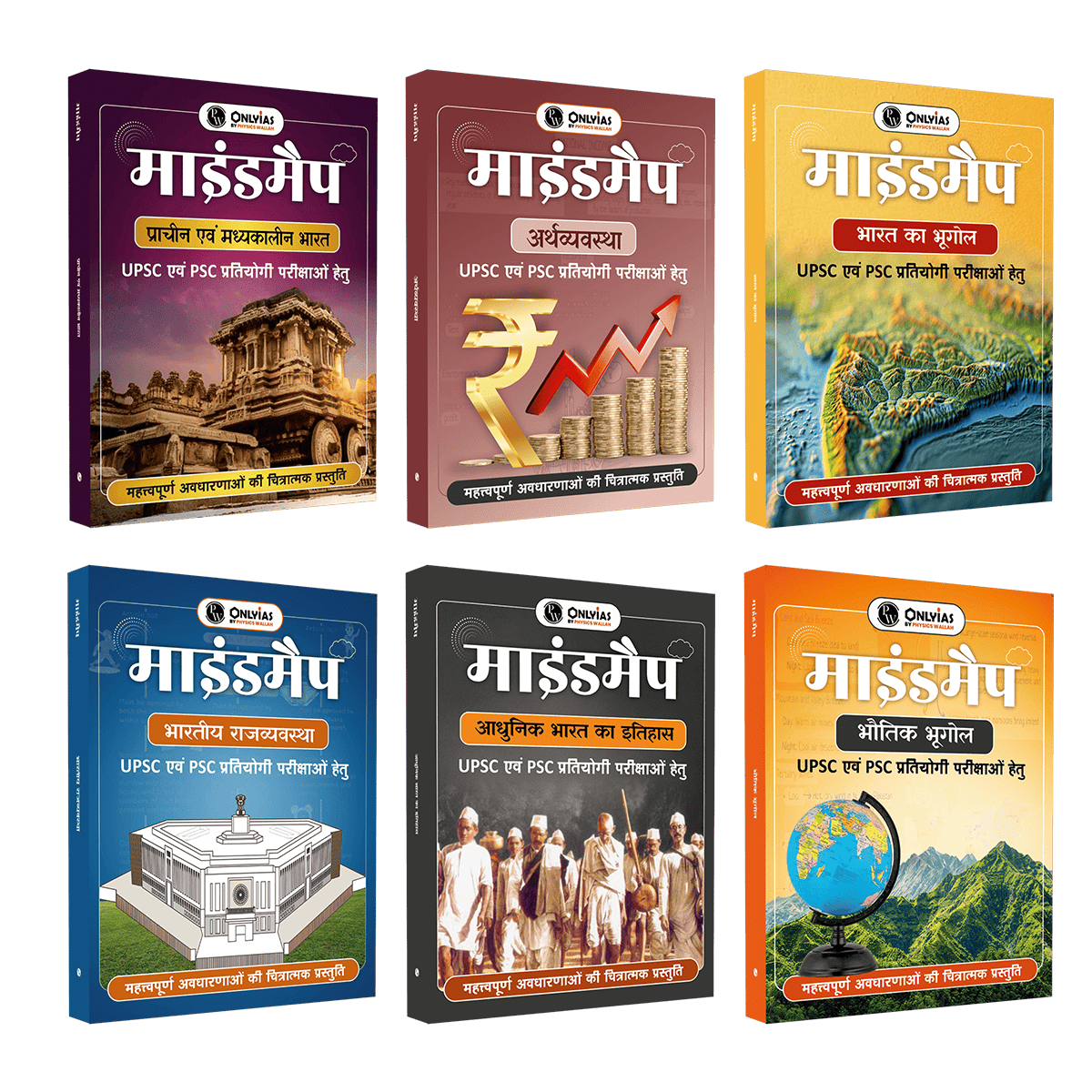
Importance of UPSC Physical Geography Mindmaps
UPSC physical geography mindmaps help aspirants simplify complex geographical concepts by transforming dense paragraphs into visual structures. These maps allow for quicker revision and better retention of spatial data, landforms, and atmospheric patterns, which are crucial for both the Prelims and Mains examinations.
Check Out: UPSC Books for 2026 Preparation
Overview of UPSC Physical Geography Mindmaps
Geography is inherently a visual subject. It involves understanding the Earth’s structure, wind movement, and mountain formation. Traditional linear notes often fail to capture the spatial relationships between these elements. Visual tools like mindmaps allow you to see the "big picture" while still focusing on specific details.
When you use UPSC physical geography notes in a mindmap format, your brain processes the information through dual coding—using both words and images. This method is scientifically proven to enhance long-term memory. Instead of memorising a list of factors affecting climate, a mindmap allows you to see how latitude, altitude, and pressure systems intersect at a single glance.
Components of UPSC Physical Geography Mindmaps
To create or use effective mindmaps, one must understand the core pillars of the syllabus. The physical geography for UPSC syllabus is generally divided into four major segments.
Geomorphology
This section deals with the internal and external forces shaping the Earth. Mindmaps here should focus on:
-
Earth's interior layers (Crust, Mantle, Core).
-
Endogenic and Exogenic forces.
-
The life cycle of landforms (fluvial, glacial, and arid).
Climatology
Climatology is perhaps the most technical part of the syllabus. Using physical geography notes for UPSC in a visual format helps in understanding:
-
Atmospheric composition and layers.
-
Heat budget and temperature inversion.
-
Global wind patterns and jet streams.
-
Cyclones (Tropical vs. Temperate).
Oceanography
Visualising the ocean floor is much easier with diagrams. Your mindmaps should cover:
-
Continental shelf, slope, and deep-sea plains.
-
Salinity and temperature distribution.
-
Tides, waves, and ocean currents.
Biogeography
This involves the study of soils and vegetation. Mindmaps help in categorising:
-
Soil types and their distribution.
-
World biomes and biodiversity.
Check Out: UPSC Revision Books
How to Use UPSC Physical Geography Mindmaps
Digital resources have changed the way students prepare. A physical geography for UPSC PDF containing mindmaps can be stored on tablets or laptops for anytime access. To get the most out of these files, students should:
-
Print for Annotation: While digital is good, printing hard copies allows you to add your own handwritten observations from current affairs.
-
Use as a Template: Use the pre-made maps as a base and expand on them as you read more advanced textbooks.
-
Color Coding: Use different colors for different branches (e.g., blue for water-related topics, brown for landforms) to improve visual memory.
Mindmaps are not a replacement for detailed study but a supplement. You should first read the foundational concepts from standard NCERTs or reference books. Once you have a basic grasp, refer to UPSC physical geography notes to condense that information.
The goal is to move from 500 pages of text to 50 pages of mindmaps. This condensation ensures that you are not overwhelmed during the final months of the examination cycle.
By integrating maps with your standard physical geography notes for UPSC PDF, you create a comprehensive ecosystem of learning.
Benefits of UPSC Physical Geography Mindmaps
Revision is the most critical phase of the preparation journey. Without effective revision, the information gathered over months can fade away. UPSC physical geography mindmaps provide several advantages that standard textbooks cannot offer.
-
Speed: You can scan a single page of a mindmap in minutes, whereas reading the corresponding chapter might take an hour.
-
Clarity: Complex topics like the "Walker Cell" or "Plate Tectonics" are broken down into branches, making them easier to digest.
-
Interconnectivity: Geography requires linking different topics. For instance, a mindmap can easily show the link between ocean currents and the location of deserts.
-
Active Recall: Trying to recreate a mindmap from memory is a powerful way to test your knowledge.
The benefits of UPSC physical geography mindmaps extend to the Mains examination. UPSC rewards candidates who can represent information clearly and concisely.
-
Structure: Mindmaps teach you how to categorise your points into headings and sub-headings.
-
Diagrams: Most mindmap branches can be converted into simple diagrams or flowcharts in the exam hall.
-
Time Management: Because you have practiced the visual flow of a topic, you can draft your answers much faster without having to "think" about the next point.
How to Cover the Syllabus with UPSC Physical Geography Mindmaps
The sheer volume of the UPSC syllabus often leads to "analysis paralysis." Students don't know where to start. A physical geography notes for UPSC PDF structured around mindmaps provides a clear roadmap. It tells you exactly which sub-topics are important and how they are related.
For example, when studying "Volcanism," a mindmap will branch out into types of volcanoes, volcanic landforms, and global distribution. This structured approach ensures that you don't miss out on minor yet high-yield topics that are often tucked away in long paragraphs of traditional books.
Check out: UPSC Previous Year Papers
Topics for UPSC Physical Geography Mindmaps
More students are opting for a physical geography for UPSC pdf because of its portability. Carrying heavy books to libraries or coaching centres is cumbersome. With a PDF, you can carry the entire geography of the world in your pocket.
These digital formats are also easier to search; if you need to find "Salinity," you can simply use the find function rather than flipping through hundreds of pages. Below are the key topics for Mindmaps:
|
Category |
Key Topics for Mindmapping |
|
Geomorphology |
Plate Tectonics, Earthquakes, Rock Cycle, Folding and Faulting. |
|
Climatology |
Insolation, Pressure Belts, Monsoons, Frontogenesis. |
|
Oceanography |
Coral Reefs, El Nino/La Nina, Marine Resources. |
|
Hydrology |
Water Cycle, Groundwater, Drainage Patterns. |
Tips for UPSC Physical Geography Mindmaps
To score high, you must distinguish your answers from thousands of others. Using the logic found in UPSC physical geography mindmaps, you can create multi-dimensional answers. Instead of just writing about the causes of a cyclone, you can draw a flowchart showing the atmospheric conditions, the path of the storm, and the impact on the coast.
The visual clarity provided by these maps ensures that you understand the "Why" and "How" of geographical phenomena, which is exactly what the UPSC examiners are looking for in a future civil servant.
Read More: Important Topics of Geography for Government Exams
UPSC Physical Geography Mindmaps FAQs
Can I rely solely on UPSC physical geography mindmaps for my preparation?
Mindmaps are excellent for revision and conceptual clarity, but they should be used alongside standard textbooks. Use them to summarise your physical geography for UPSC syllabus for quick recall.
How do UPSC physical geography notes help in the Prelims?
The Prelims often ask about the location of landforms or the sequence of layers. Mindmaps help you memorise these sequences and spatial data much more effectively than plain text.
Where can I find a reliable physical geography for UPSC PDF?
Reliable PDFs are usually available through specialized educational platforms that focus on civil services. Ensure the physical geography notes for UPSC PDF you choose cover the updated syllabus.
Is it better to make my own mindmaps or use pre-made ones?
While making your own is great for learning, pre-made UPSC physical geography mindmaps save a significant amount of time, especially for students who are new to the subject or have a limited timeframe.
How often should I revise these physical geography notes for UPSC?
Ideally, you should look at your mindmaps once a week. This constant exposure ensures that the visual triggers stay fresh in your mind until the day of the exam.