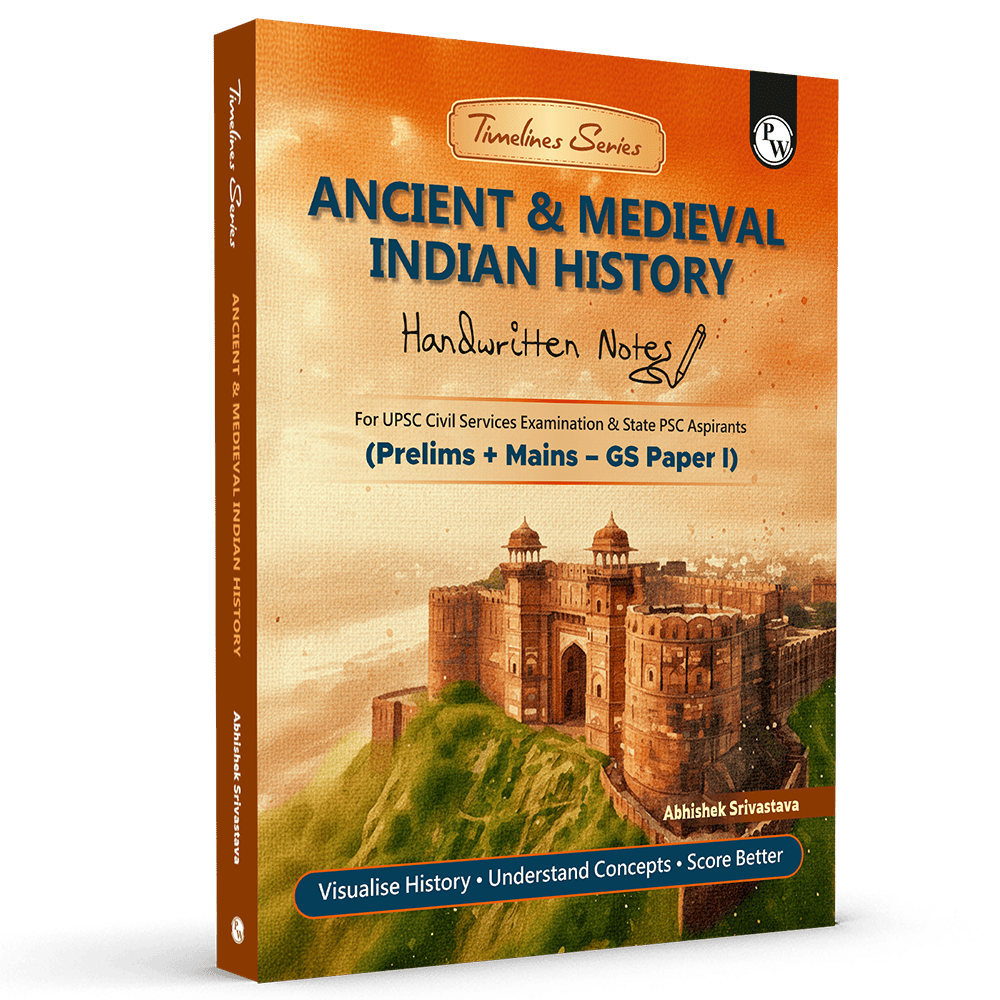
Structured Notes for Ancient & Medieval History UPSC Exam
UPSC ancient and medieval history notes are important because the long timeline of dynasties and cultural changes can feel overwhelming. Well-structured notes break down complex topics into smaller parts, making it easier to remember dates, names, and events. By focusing on key themes and organizing information clearly, you can save time and revise faster before the exam.
Check Out: UPSC CSE Books
Why UPSC Ancient and Medieval History Notes Are Important
Balancing the huge scope of history with the specific needs of the UPSC syllabus is a common challenge. Standard textbooks can be too detailed, making it hard to know what is important for the exam. Good history notes help by focusing on what matters and presenting information in a way that matches current exam trends.
History is a big part of the General Studies syllabus. Having all your notes in one place helps you see important links between different periods. These notes are made to help you move from basic reading to writing strong answers, giving you the clarity to handle both fact-based and analytical questions.
Features of UPSC Ancient and Medieval History Notes
A good preparation plan needs resources that are simple to use. UPSC Ancient and Medieval History notes give you a complete look at the syllabus while focusing on important topics like art, architecture, and administration.
-
Chronological Timeline: Events are arranged in a timeline to help you understand the evolution of societies.
-
Topic Wise Coverage: Focuses on specific themes like the Bhakti movement, temple architecture, and agrarian reforms.
-
Maps and Diagrams: Includes maps and diagrams to illustrate the extent of different empires.
-
Simple Language: Complex historical terms are explained in plain English to ensure better comprehension.
-
Previous Year Question Focus: Content is aligned with the types of questions asked in recent years.
Benefits of Ancient and Medieval History Notes PDF
Using an ancient and medieval history notes PDF allows for flexible learning. Digital notes are easy to carry and can be accessed on multiple devices, making it convenient for students to study while on the move. They also allow for quick keyword searches, which is incredibly useful during last-minute revisions.
Digital notes often have clickable links or indexed chapters, so you can go straight to the topic you want. This saves time compared to searching through many pages in a book. PDF notes are also easier to update with new information or recent discoveries that could be important for the exam.
Check Out: UPSC Textbooks
UPSC Ancient and Medieval History Notes for Prelims
The preliminary stage of the exam demands a high level of factual accuracy. Handwritten notes for UPSC prelims are particularly effective because they often use mnemonics and short-hand techniques to help memorise king lists, battle dates, and specific terminology.
|
Feature |
Why it helps in Prelims |
|
Chronology Tables |
Helps in arranging events in the correct order. |
|
Fact Boxes |
Highlights key terms like "Iqtadari" or "Dhamma". |
|
Map Markings |
Useful for identifying ancient sites and trade routes. |
|
Comparison Charts |
Distinguishes between different schools of art like Gandhara and Mathura. |
The objective nature of the prelims requires you to differentiate between closely related options. Having clear, concise notes helps in eliminating wrong answers by providing a firm grip on specific historical facts.
Check Out - UPSC Previous Year Papers
UPSC Ancient and Medieval History Notes for Mains
For the Mains examination, the focus shifts from pure facts to analysis and interconnections. UPSC history short notes act as a repository of "value-addition" points. These include quotes from historians, specific examples of administrative brilliance, and the impact of cultural exchanges.
Short notes help you build a framework for your answers. Instead of writing long-winded paragraphs, you can use the pointers from your notes to structure your responses with clear introductions, body points, and conclusions. This ensures that you cover all dimensions of a question within the word limit.
Important Topics in UPSC Ancient and Medieval History
When looking through UPSC ancient history handwritten notes, certain topics should always take priority. These are the areas that have historically seen the most questions.
-
Prehistoric Period: Understanding the transition from Stone Age to Metal Age.
-
Indus Valley Civilisation: Town planning, trade, and religious practices.
-
Vedic Period: Social structure and the evolution of political entities.
-
Buddhism and Jainism: Core philosophies, royal patronage, and spread.
-
Mauryan and Gupta Empires: Administration, literature, and the "Golden Age" features.
-
South Indian Dynasties: Focus on Chola administration and Sangam literature.
Whereas, the medieval period is often considered difficult due to the transition from regional kingdoms to large sultanates. Medieval history handwritten notes UPSC aspirants use often focus on the synthesis of cultures.
-
Early Medieval India: The struggle between the Palas, Pratiharas, and Rashtrakutas.
-
Delhi Sultanate: Changes in the ruling elite and the introduction of new architectural styles.
-
Mughal Empire: Centralised administration, land revenue systems, and the peak of Indo-Islamic architecture.
-
Vijayanagara Empire: The socio-economic life and the unique Hampi architecture.
-
Maratha Confederacy: Rise of regional powers and the administrative genius of Shivaji.
Check Out: UPSC Revision Books
How to Use UPSC Ancient and Medieval History Notes
Having the right upsc ancient and medieval history notes is only half the battle. The other half is how you use them. Consistency is key. You should aim to go through your notes multiple times rather than reading a new book every week.
-
Read with Standard Books: Read the notes alongside a standard textbook to build context.
-
Practice Active Recall: Cover a section and try to remember the key points without looking.
-
Link Different Topics: Link ancient trade routes with medieval commercial hubs to see the continuity.
-
Solve Previous Year Questions: Use the notes to solve previous year questions to see if the information is sufficient.
-
Add Personal Notes: Add your own small notes or observations in the margins to make the content stick.
Art and Culture in UPSC Ancient and Medieval History Notes
A large portion of the history syllabus now focuses on "Art and Culture". Your UPSC GS paper 1 history notes must dedicate significant space to this.
-
Architecture: Trace the development from rock-cut caves to grand marble mausoleums.
-
Literature: Keep a list of ancient Sanskrit texts alongside medieval Persian chronicles.
-
Philosophy: Summarise the six schools of Indian philosophy and the impact of Sufism.
-
Paintings: Compare the mural traditions of Ajanta with the miniature styles of the Mughal and Rajput courts.
Revision Tips for UPSC Ancient and Medieval History
As the exam approaches, your focus should shift entirely to your UPSC history short notes. At this stage, you are not looking for new information but reinforcing what you already know. Spend around two hours daily on history revision, focusing on one major era at a time.
Use the maps in your notes to visualise the geography of the empires. Many questions in the prelims are location-based, asking about the proximity of ancient sites to modern cities or rivers. A quick glance at a well-marked map can be more effective than reading several pages of text.
Read More: How Many Attempts for UPSC?
UPSC Ancient and Medieval History Notes FAQs
Which notes are right for UPSC Ancient and Medieval History?
The right notes are those that are structured, snippet-friendly, and aligned with the UPSC syllabus. Resources that combine UPSC ancient and medieval history notes with visual aids like maps and tables are highly recommended for better retention and quick revision.
Are handwritten notes better than typed notes for UPSC?
Many candidates prefer handwritten notes for upsc prelims because the process of writing helps in memorising facts. However, digital notes or PDFs are also beneficial for their portability and the ease with which they can be searched for specific keywords.
How should I cover the Art and Culture section in history?
Art and culture should be studied as a part of your UPSC GS paper 1 history. Focus on the evolution of architecture, literature, and philosophy across both the ancient and medieval periods, as these themes are frequently tested.
How many times should I revise history notes?
You should aim to revise your short notes at least three to four times before the exam. The first revision should be detailed, while the subsequent ones should focus on key terms, dates, and administrative structures.
Can I rely solely on short notes for the Mains exam?
While UPSC ancient history handwritten notes are excellent for building a framework, for the Mains, you should use them to supplement your basic reading. Use the notes to quickly find "value-addition" points like names of scholars or specific examples to enhance your answers.