UPSC 32 Years PYQs: Which Questions Should You Solve First?
Navigating 32 years of past exam papers often leaves Civil Services candidates feeling overwhelmed and lost. With thousands of questions spread across diverse subjects, knowing where to start your revision determines your final score. Practicing every question chronologically wastes time on outdated patterns. You need a structured order of priority that targets high-yield subjects and recent exam trends.
This step-by-step article explains exactly which UPSC PYQ categories to solve first, how to approach different time frames, and how to use a PYQ book effectively to maximize your marks in General Studies and CSAT.
Importance of Solving UPSC PYQ
Solving past paper questions forms the core foundation of Civil Services preparation because textbook theory alone does not give you a realistic picture of how the exam tests conceptual clarity.
UPSC PYQ practice helps you understand exam logic by showing how UPSC uses statement-based questions to test critical thinking, identify high-yield topics such as Fundamental Rights and National Parks, develop elimination skills to handle tricky options, and improve time management and accuracy under exam pressure.
Features of UPSC PYQ Book
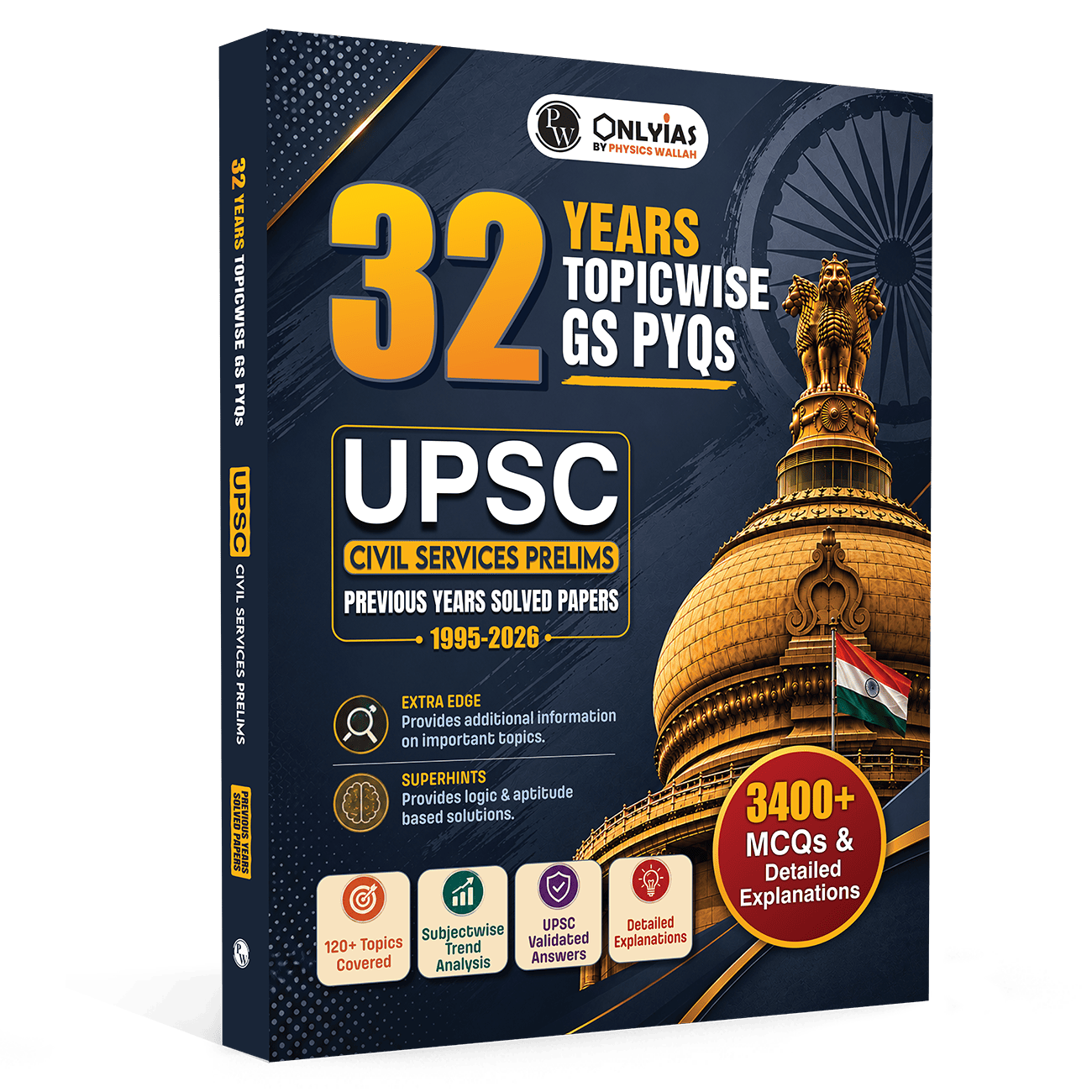
Prepare for UPSC Prelims with more than three decades of UPSC previous year questions, detailed solutions, and topic-wise practice.This resource helps you understand the UPSC exam pattern, identify important topics, and improve your preparation strategy.
-
32 Years of UPSC Prelims Papers (1995–2026): Practice previous year papers from 1995 to 2026, covering both General Studies Paper 1 and CSAT Aptitude Paper 2 for complete Prelims practice.
-
3400+ Solved MCQs: Solve more than 3400 authentic UPSC questions with answers and explanations. Regular practice helps improve your concepts, accuracy, and question-solving skills.
-
Topicwise Segregation: Questions are arranged across 120+ topics, including Polity, Economy, History, Geography, Environment, Science & Technology, Current Affairs, and other important areas.
-
Detailed Option-Wise Solutions: Understand why an answer is correct and learn how to remove wrong options. This helps you develop better elimination skills for the UPSC Prelims exam.
-
Trend & Pattern Analysis: Study past question trends to find repeated themes, important topics, and changes in the way UPSC asks questions. This helps you plan your preparation more effectively.
-
Expert Insights & Superhints: Get useful preparation tips, expert guidance, and special hints to improve accuracy and make better choices when solving difficult questions.
-
Updated for UPSC 2027: Prepare according to the latest UPSC Prelims pattern and syllabus expectations. The updated content helps you stay aligned with current exam requirements.
-
Visual Learning Support: Use maps, diagrams, infographics, and other visual aids to understand difficult topics more easily and remember key information for longer.
-
Prelims + Mains Integration: Build strong concepts that can support both Prelims and Mains preparation. Understanding topics through PYQs can help you develop a broader view of important subjects.
-
Strategic Preparation Framework: Use question trends, topic categories, and past paper analysis to decide which areas need more attention and create a focused UPSC preparation plan.
Which UPSC PYQ Should You Solve First?
To make your preparation efficient, you must prioritize questions based on theme importance and pattern relevance. Instead of starting randomly from 1995, follow this tested sequence.
Phase 1: High-Weightage Core Subjects (Recent 10 Years: 2017–2026)
Always begin with the last ten years of UPSC GS PYQs. The nature of questions changed significantly after 2017, shifting toward multi-statement formats and conceptual depth. Focus on these high-yield core subjects first:
1. Indian Polity
Polity questions carry high accuracy rates and predictable themes.
-
Focus Areas: Fundamental Rights, Directive Principles of State Policy (DPSP), Parliamentary procedures, Constitutional Bodies, and Judiciary powers.
-
Why First: Answers are static and directly linked to standard textbooks, giving you early confidence.
2. Indian Economy
Economy tests basic concepts and their real-world applications.
-
Focus Areas: Banking, Monetary Policy, Inflation, Balance of Payments, Government Schemes, and Budgeting concepts.
-
Why First: Conceptual questions repeat frequently across years.
3. Environment and Ecology
Environment accounts for a large portion of the Preliminary exam.
-
Focus Areas: Protected areas, Biodiversity hotspots, Environmental acts, Climate change initiatives, and International conventions.
-
Why First: High question overlap occurs between Civil Services and Forest Services papers.
4. Modern History
Modern Indian History offers static, fact-based questions.
-
Focus Areas: Freedom movement (1857 to 1947), Socio-religious reform movements, British Acts, and Governors-General.
-
Why First: The syllabus is clearly defined and rarely involves ambiguous options.
5. Science and Technology
Science questions emphasize recent scientific advancements and everyday applications.
-
Focus Areas: Emerging technologies, Space missions, Biotechnology, Public health, and Information Technology.
-
Why First: Studying recent papers reveals recurring areas of interest of the commission.
Weightage Breakdown for Core GS Subjects
Analyzing historical trends helps allocate preparation time effectively across subjects.
|
Subject Category |
Average Questions Per Year |
Priority Rank |
Key Focus Areas |
|
Indian Polity |
12 – 18 |
Priority 1 |
Constitution, Parliament, Judiciary, Rights |
|
Indian Economy |
14 – 20 |
Priority 1 |
Banking, Inflation, Fiscal Policy, Trade |
|
Environment & Ecology |
15 – 22 |
Priority 1 |
National Parks, Acts, Climate Conventions |
|
Modern History |
8 – 12 |
Priority 2 |
Freedom Struggle, British Reforms, Movements |
|
Science & Technology |
10 – 14 |
Priority 2 |
Applied Science, Biotech, Space, Defense |
|
Geography |
8 – 12 |
Priority 3 |
Physical Geography, Map Work, Resources |
|
Art & Culture / Ancient |
6 – 10 |
Priority 3 |
Architecture, Buddhism, Jainism, Literature |
Phase 2: Mastering CSAT Paper 2 Practice
Ignoring CSAT Paper 2 is a common mistake that leads to failing Prelims despite scoring well in General Studies.
-
Quantitative Aptitude: Begin with basic arithmetic, Number Systems, Percentages, and Averages from recent papers.
-
Logical Reasoning: Solve puzzles, direction-based questions, syllogisms, and coding-decoding sets.
-
Reading Comprehension: Practice identifying passages' central messages, assumptions, and inferences.
Working through past CSAT questions systematically ensures you easily clear the qualifying score barrier.
Phase 3: Secondary Subjects and Older PYQs (1995–2016)
Once you master core subjects from 2017–2026, extend your preparation to secondary topics and older question sets.
1. Geography and Mapping
-
Focus Areas: Physical features of India, river systems, world mapping, climate zones, and resource distribution.
-
Method: Always solve mapping questions with an atlas beside you.
2. Ancient, Medieval History, and Art & Culture
-
Focus Areas: Indus Valley Civilization, Bhakti and Sufi movements, Temple architecture, Schools of Philosophy, and Mughal administration terms.
-
Method: Focus on terminology and structural themes rather than memorizing obscure dates.
3. Solving Older Questions (1995–2016)
Questions from 1995 to 2016 tend to be direct and fact-based. Use them as quick revision drills to test static knowledge across Polity, History, and Geography.
How to Use a Topicwise UPSC PYQ Book?
Using a comprehensive book like the 32 Years Topicwise GS PYQ transforms raw past papers into an organized study system. Including UPSC books in your preparation can further strengthen conceptual understanding and provide structured resources for consistent exam practice.
|
Step |
What to Do |
|
1 |
Read the standard textbook chapter, such as Fundamental Rights. |
|
2 |
Solve the corresponding topicwise UPSC prelims PYQs. |
|
3 |
Analyze incorrect answers using detailed option-wise solutions. |
|
4 |
Read the visual aids, diagrams, and extra insights. |
|
5 |
Note recurring concepts in your revision summaries. |
-
Chapterwise Alignment: Read a chapter in your standard textbook and immediately solve the corresponding topicwise UPSC prelims PYQs.
-
Analyze Option Explanations: Read through option-wise solutions. Understanding why wrong options are incorrect helps you prepare for future question variations.
-
Use Visual Supports: Refer to maps, diagrams, and summary charts provided in the book to retain complex geographical and historical facts.
-
Identify Recurring Patterns: Use trend analysis sections to track how question styles evolved across 120+ topic categories.
-
Mark Difficult Questions: Highlight tricky or wrong questions during your first attempt to speed up final revision before the exam.
How to Analyze Wrong Answers and Build Elimination Techniques with UPSC PYQ
Solving past questions is only half the work; analyzing mistakes is where real improvement happens.
|
Error Type |
What to Do |
|
Knowledge Gap |
Revisit standard textbook notes and fill in the missing facts immediately. |
|
Misreading Error |
Read questions slowly and check qualifiers like “always,” “only,” or “incorrect.” |
|
Elimination Trap |
Practice spotting extreme words such as “strictly” and “completely.” |
-
Knowledge Gaps: If you got a question wrong due to a forgotten fact, mark the topic and review standard textbooks immediately.
-
Misreading Errors: If you misread "correct" as "incorrect," train yourself to underline key qualifiers during your initial read.
-
Elimination Traps: Pay attention to extreme words like "always," "never," or "only." While not universally wrong, extreme statements require careful verification.
Read More: UPSC Indian Economy Previous Year Papers
UPSC PYQ FAQs
Which years should I solve first for UPSC PYQ practice?
Start with the last 10 years (2017 to 2026) because they reflect the current exam pattern and statement structure. After mastering these, solve older papers from 1995 to 2016 for extra practice.
Should I solve UPSC GS PYQs subject-wise or year-wise?
Subject-wise practice is best during your first reading phase because it aligns directly with textbook chapters. Year-wise practice works better closer to the exam to test overall retention under timed conditions.
How many total questions are included in a 32-year UPSC PYQ book?
A comprehensive 32-year paper collection contains over 3,400 solved MCQs spanning General Studies Paper 1 and CSAT Paper 2 across 120+ organized topics.
Is solving UPSC PYQ enough to clear UPSC Prelims?
Past questions are essential for understanding patterns and testing concepts, but you must combine them with standard reference textbooks, current affairs revisions, and full-length mock tests.
How should I approach CSAT previous year papers?
Solve CSAT questions in topic-wise blocks focusing on high-weightage topics like Number Systems, Reading Comprehension, and Logical Reasoning. Time yourself to build speed and confidence.