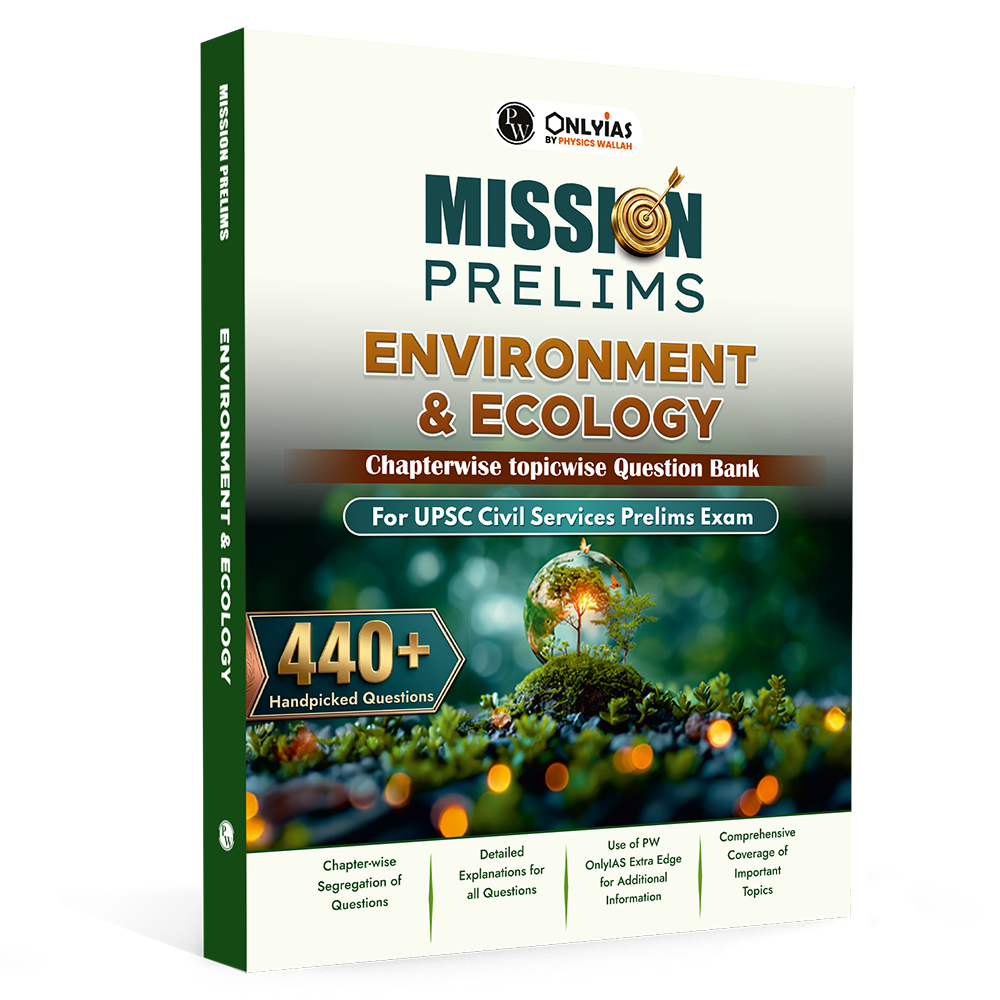
How UPSC Environment Book Helps in Quick Revision

The preparation for civil services involves a lot of reading, but the vast syllabus often poses a challenge for the candidates in retaining the key ecological concepts. If you are drowning in massive reference texts just weeks before the exam, you are not alone.
The only solution to this problem is to have a good UPSC environment book that compiles the extensive content into crisp, high-yield study notes. This article will explore the best resources and revision tactics to help you smash this vital section.
Importance of the UPSC Environment Book
The environment and ecology part is no longer a small part of the Civil Services paper. This section has gained considerable weightage since the Indian Forest Service (IFoS) preliminary exam was merged with the Civil Services Examination in 2011. Candidates typically receive 10 to 20 questions from this domain each year.
The basic difficulty level is moderate, and this section is highly scoring. However, many candidates tend to overlook the basics as they seem straightforward, which often leads to costly mistakes and negative marking.
Reliable books for the environment UPSC offer a balanced framework that links foundational knowledge with dynamic developments. Having one source means you don’t lose marks on direct, conceptual questions.
Features of the UPSC Environment Book
Finding the most appropriate environment book for UPSC prelims means looking beyond the total page count of a textbook. How quickly you can scan and recall facts under strict time conditions depends entirely on the design of the reading UPSC books.
|
Selection Metric |
Ideal Feature to Look For |
Why It Matters for Revision |
|
Data Structure |
Bulleted points and summary tables |
Increases reading speed and visual memory retention |
|
Current Integration |
Dedicated sections for recent treaties and summits |
Saves time spent hunting for updates across different portals |
|
Visual Mapping |
Clear maps of National Parks and Biosphere Reserves |
Simplifies spatial learning for map-based prelims questions |
|
Syllabus Alignment |
General knowledge focus without over-specialisation |
Prevents wasting time on hyper-technical academic details |
Main Topics Covered in the UPSC Environment Book
You can either choose an environment book for UPSC Hindi medium or stick to English books. But the focus should be on high-yield areas. The syllabus is only looking for general awareness, not a master's in environmental science. Your resource should go in-depth on all key pillars.
1. Introduction to Ecology and Ecosystems
You should have a good understanding of food chains, food webs, ecological pyramids and biogeochemical cycles. This is the basis of all ecological reasoning. Knowing how energy flows between trophic levels.
2. Profiles of Biodiversity and Conservation
The source material must be strong and include IUCN classifications of threatened species and important geographical locations. You should also pay particular attention to critical protected zones across the country.
3. Governance Of The International Environment
These include major conventions, protocols, and international organisations. Familiarise yourself with the main mandates of the following global frameworks:
-
UNFCCC & Kyoto Protocol / Paris Agreement Tracking climate mitigation targets and carbon mechanisms.
-
Convention on Biological Diversity (CBD): Focus on Aichi targets and access-sharing protocols.
-
CITES & TRAFFIC: Guidelines for international trade in wildlife.
-
Ramsar Convention: Key facts on significant wetlands and Montreux Record listings.
4. National Environmental Legislation and Institutional Frameworks
National laws provide statutory backing for conservation efforts. You should be able to find clear distinctions between the powers given under domestic acts in your textbook.
-
Wildlife Protection Act, 1972 - Schedules for the protection of various species and definitions of sanctuaries
-
Environment Protection Act, 1986: Umbrella legislation with extensive regulatory powers.
-
National Green Tribunal ( NGT): Structure and Jurisdiction of Environment Courts.
Gain an exam-oriented edge with an UPSC PYQ Book that includes authentic previous year questions, detailed solutions, and chapter-wise analysis based on the latest UPSC trends.
It helps you identify important topics, understand the examiner's approach, strengthen conceptual clarity, and improve your performance in both the UPSC Prelims and Mains.
Study Strategy for Using the UPSC Environment Book
The best books for UPSC environments are half the battle won; knowing how to navigate them during final revisions is what secures a high rank.
Weekly Schedule Plan
If you want to gain speed, don't study topics in absolute isolation. Weekly schedule with club geography & environment. All these things overlap. Studying climate patterns, vegetation, and wildlife distributions one after another keeps you from getting mentally fatigued and shortens your overall study cycle.
Solving & Tracking Practice Material Trend
Always compare your reading with the standard exam trends. Reviewing good practice materials gives you a sense of how conceptual definitions are translated into tricky statement-based questions.
Candidates who are also following other central recruitment or general scientific updates on different platforms and studying previous question banks give excellent clarity on the factual testing pattern.
Current Affairs Monitoring
Ecology is a highly dynamic subject, and static books have to be complemented by up-to-date trackers. The section is full of dynamic questions. So, it is necessary to consult authoritative annual assessment reports and specialised environmental magazines.
Read More: UPSC Previous Year Question Papers PYQ PDF with Downloaded Solutions
UPSC Environment Book FAQs
Q1. How many questions are asked from the UPSC environment book topics every year?
The average number of questions asked about the environment and ecology in the preliminary stage is 10-20. This puts it among the highest-scoring sections in the entire general studies paper.
Q2. Is a standard book for the environment enough for Prelims and Mains?
A standard textbook covers the static basics needed perfectly. However, the paper is highly dynamic, and you will always need to supplement your basic book with current affairs trackers and national reports in order to answer contemporary analytical questions.
Q3. What is the best way to revise for the environment UPSC from a book in a short time?
The best way to do this is to use summary tables, bullet points and visual maps of protected areas extensively. Putting environment and geography together will also help you learn faster.
Q.4 Do I need some scientific knowledge to read an environment book for UPSC Hindi or English?
No. The civil services syllabus clearly states that this section is on General issues and does not require subject specialisation. It is enough to have a good command of the basic principles of ecology and the latest developments.
Q5. Why do I need a dedicated UPSC environment book instead of general science notes?
Such a textbook would provide concentrated coverage of complex international conventions, environmental regulations and conservation indices. Often, these specific legislative and institutional details, which constitute a major portion of the paper, are omitted from general science notes.