UPSC EPFO Syllabus 2025 For EO/AO and APFC

UPSC EPFO Syllabus 2025 for EO/AO and APFC
UPSC EPFO syllabus is an important study resource for all applicants preparing for the upcoming exam. As per the Union Public Service Commission (UPSC), the EPFO and APFC exams are going to have the same syllabus and exam pattern. The UPSC EPFO exam 2025 for the posts of Enforcement Officer (EO)/Accounts Officer (AO) and Assistant Provident Fund Commissioner (APFC) is set to be conducted on 30th November 2025. To crack this exam, it becomes vital to understand the UPSC EPFO exam syllabus and EPFO exam pattern properly.
As per the official notification, the UPSC EPFO exam includes a written test and an interview. The written exam carries 75% weightage, while the interview holds 25% weightage. There are 9 subjects in the EO/AO syllabus and 4 additional subjects in the EPFO APFC syllabus. Knowing the UPSC EPFO syllabus 2025 helps you focus on the most important topics in order to score well in the exam.
Check out: UPSC CSE Books
UPSC EPFO Exam Syllabus For EO/AO and APFC Overview
Questions asked in the exam from the UPSC EPFO syllabus for both EO/AO and APFC aim to test how well you understand different subjects and how you apply your knowledge. UPSC EPFO exam syllabus covers different topics to check an applicant's general awareness, reasoning ability, etc.
UPSC EPFO syllabus 2025 includes subjects like General English, the Indian Freedom Struggle, Current Events and Developmental Issues, Indian Polity and Economy, General Accounting Principles, Industrial Relations and Labour Laws, General Science and Computer Applications, General Mental Ability and Quantitative Aptitude, and Social Security in India.
Similarly, the EPFO APFC syllabus also includes these topics, but with a few additional sections related to the post. Understanding the complete UPSC EPFO exam syllabus helps applicants make a proper study plan and start their UPSC EPFO preparation with the right focus. Check the detailed UPSC EPFO Exam Syllabus for EO/AO and APFC given below.
Check out: UPSC Previous Year Papers
Subject-Wise UPSC EPFO Syllabus 2025
For effective UPSC EPFO preparation, check the detailed subject-wise syllabus here to understand what topics are most important for the exam. Understanding key topics deeply from each subject will help you improve your overall preparation in both EO/AO and APFC exams.
|
Subject-Wise UPSC EPFO Syllabus 2025 |
|
|
Subjects |
Topics |
|
General English |
Knowledge of Vocabulary and Grammar, One Word Substitution, Rearrangement (Para Jumbles), Active-Passive Voice, Synonyms, Antonyms, Parts of Speech, Structure of Sentence, Subject–Verb Agreement, Nouns and Pronouns, Verbs, Tenses and Modals, Prepositions, Conjunctions, Articles, Adjectives, Adverbs, Determiners, Reading Comprehension, Idioms and Phrases |
|
Indian Culture, Heritage & Freedom Movements |
Decline of the Mughal Empire and Rise of Regional Powers, Advent of Europeans, Rise of the British in India, Early Reforms During British Rule, Revolt of 1857, Rise of Nationalism & Formation of INC, Swadeshi Movement and Rise of Extremism, Important Events (1908–1918, 1919–1929, 1929–1939, 1940–1947), Socio–Religious Reform Movements, Miscellaneous Topics of Modern, Ancient & Medieval History, Religion & Philosophy in India, Sculptures & Architecture, Temple Architecture, Indian Music, Dance Forms, Paintings, Indian Languages & Literature |
|
Current Affairs |
Government Schemes, National & International Organisations, First in News, Defence Exercises, Environment, Sports, Awards and Milestones, Important Days, Persons in News, Appointments, Fairs and Festivals, Places in News, Books and Authors, Miscellaneous Current Topics |
|
Population, Development & Globalisation |
Population: Global Human Population Distribution, Population in India – Attributes, Distribution, Census 2011 Data. Development: Concept and Meaning, Pillars and Processes, Human Development – Concept and HDI. Globalisation: Meaning, Triggers & Barriers, Impact of Globalisation. |
|
Governance and Constitution of India |
Constitutional Framework of India, Indian Union and Its Citizens, Rights and Duties, Centre-State Relations, Union and State Executives, Parliament and State Legislature, Judiciary, Constitutional and Non-Constitutional Bodies, Local Governments, Miscellaneous Governance Topics |
|
Present Trends in the Indian Economy |
Introduction to Demand and Supply, Elasticity of Demand, Measurement of Growth, Poverty Alleviation and Employment Generation, Economic History of India, Monetary Policy, Inflation, Fiscal Policy, Regional Economic Cooperation, International Economic Institutions, Opening up of the Indian Economy, Balance of Payments, Industrial and Labour Policy, Finance Commission |
|
Accounting |
Introduction to Accounting, Theory Base of Accounting, Recording of Transactions, Bills of Exchange, Accounting Standards, Preparation of Final Accounts, Ratio Analysis |
|
Auditing |
Nature, Objective, and Scope of Auditing, Audit Strategy, Planning and Programme, Risk Assessment and Internal Control, Vouching and Verification, Company Audit, Auditor’s Role, Audit of Different Entities, Classification of Audit |
|
Basic Knowledge of Computer Applications |
Introduction to Computers, Computer Organisation and Data Processing Cycle, Hardware and Software, Memory, Operating System, Computer Network |
|
General Science |
Physics, Chemistry, Biology, Space Technology, and Important Technologies |
|
Quantitative Aptitude |
Simplification, LCM and HCF, Percentage, Ratio and Proportion, Mixture and Alligation, Profit and Loss, Simple and Compound Interest, Average, Time and Work, Pipes and Cisterns, Time and Distance, Boats and Streams, Mensuration (2D and 3D), Data Interpretation, Probability |
|
General Mental Ability |
Alphabetical and Alphanumeric Series, Coding and Decoding, Syllogism, Direction Sense, Ranking and Order, Blood Relations, Letter Series, Analogy, Clock, Calendar, Dice, Venn Diagram, Counting Figures, Cube and Cuboid |
|
Social Security in India |
Social Security Schemes: Types of Retirement Schemes, National Pension System, Atal Pension Yojana, Social Security Schemes. Social Security Legislation: Employees’ Compensation Act (1923), Employees’ State Insurance Act (1948), EPF and Miscellaneous Provisions Act (1952), Maternity Benefit Act (1961), Payment of Gratuity Act (1972), Unorganised Workers Social Security Act (2008). |
|
Statistical Concepts |
Basics of Statistics, Core Concepts, Mean, Median, Mode, Standard Deviation, Dispersion and its Applications, Sampling and its Types |
|
Industrial Relations |
Overview of Industrial Relations, Indian Labour Force, Trade Union, Collective Bargaining, Industrial Discipline and Grievance Procedure, Industrial Conflicts and Disputes, Settlement of Disputes, Labour Welfare, Wages, Workers Participation in Management, International Industrial Relations, Industrial Health and Safety |
|
Miscellaneous Labour Laws |
Payment of Wages Act (1936), Minimum Wages Act (1948), Trade Union Act (1926), Factories Act (1948), Industrial Employment (Standing Orders) Act (1946), Industrial Disputes Act (1947), Child and Adolescent Labour Act (1986), Inter-State Migrant Workmen Act (1979), Payment of Bonus Act (1965), Building and Other Construction Workers Act (1996) |
|
Labour Codes |
Code on Wages, Industrial Relations Code, Social Security Code, Occupational Safety, Health and Working Conditions Code |
|
Insurance |
Introduction: Meaning and Concept of Insurance, Risk and Insurance, Parties and Modus Operandi, Basic Terminology. Principles of Insurance: Utmost Good Faith, Insurable Interest, Proximate Cause, Subrogation, Loss Minimisation, Indemnity, Contribution. Types of Insurance: Life Insurance (Term, ULIP, Pension Plans, Money-Back Policy), General Insurance (Motor, Home, Fire, Others). Insurance as a Part of Social Security: Role in Social Security, Difference Between Social Security and Private Schemes, Current State of Insurance in India, Emerging Concepts in the Industry. |
After knowing the detailed UPSC EPFO syllabus 2025, it is also important to understand the EPFO exam pattern, as it helps you understand the marks distribution, question format, and time management needed for the exam.
Check Out: All in One UPSC EPFO & APFC PYQ Books
UPSC EPFO Exam Pattern 2025
As per the UPSC EPFO exam pattern 2025, the exam is conducted in two stages: a written test and an interview. While the written exam carries 300 marks, out of which the objective-type test is for 200 marks, the interview is conducted for 100 marks. Find the detailed UPSC EPFO exam pattern given below.
|
UPSC EPFO Exam Pattern 2025 |
|
|
Particulars |
Details |
|
Total Questions |
120 |
|
Type of Questions |
Objective-Type (Multiple Choice Questions) |
|
Total Marks in Written Exam |
300 |
|
Marks for Interview |
100 |
|
Marking Scheme |
+2.5 marks for each correct answer |
|
Negative Marking |
1/3 mark deducted for every wrong answer |
|
Medium of Exam |
English and Hindi |
|
Duration of Exam |
2 Hours |
|
Penalty for Unanswered Questions |
No marks deduction for an unanswered question |
UPSC EPFO Preparation Tips
Studying for the UPSC EPFO exam needs a clear plan and a smart strategy. Since the exam covers many subjects, understanding the UPSC EPFO syllabus and exam pattern should be the first step in your preparation. Knowing these helps you focus on important topics and manage your time better during preparation and the exam. Here are some key UPSC EPFO preparation tips:
Understand the UPSC EPFO Syllabus 2025 for EO/AO and APFC and Exam Pattern
Rather than studying randomly, read the detailed UPSC EPFO syllabus 2025 properly. Know the topics under each subject and understand the exam pattern, including the number of questions, marks distribution, and negative marking rules.
Make a Study Plan
Based on the UPSC EPFO exam syllabus, make a daily and weekly timetable that covers all subjects in the syllabus. Give more time to difficult topics and put aside some dedicated time for daily revision sessions to recall the concepts better.
Study Each Subject in a Proper Way:
-
General English: Improve grammar and vocabulary. Read newspapers and articles and practise comprehension passages.
-
Indian Freedom Struggle: Study major movements and events from India’s independence history. Focus on important years and acts.
-
Current Affairs and Developmental Issues: Read newspapers daily, note important government schemes, and track updates in defence, science, economy, and environment. You can also check UPSC Current Affairs by PW.
-
Indian Polity and Economy: Read about the Constitution, governance, and economic policies.
-
General Accounting Principles: Practice accounting problems and understand key concepts like double-entry bookkeeping, financial statements, and accounting cycles.
-
Industrial Relations and Labour Laws: Study labour laws such as the Minimum Wages Act and the Industrial Disputes Act.
-
General Science and Computer Applications: Focus on the basics of physics, chemistry, biology, and computer fundamentals like operating systems and MS Office applications.
Use Reliable Study Materials
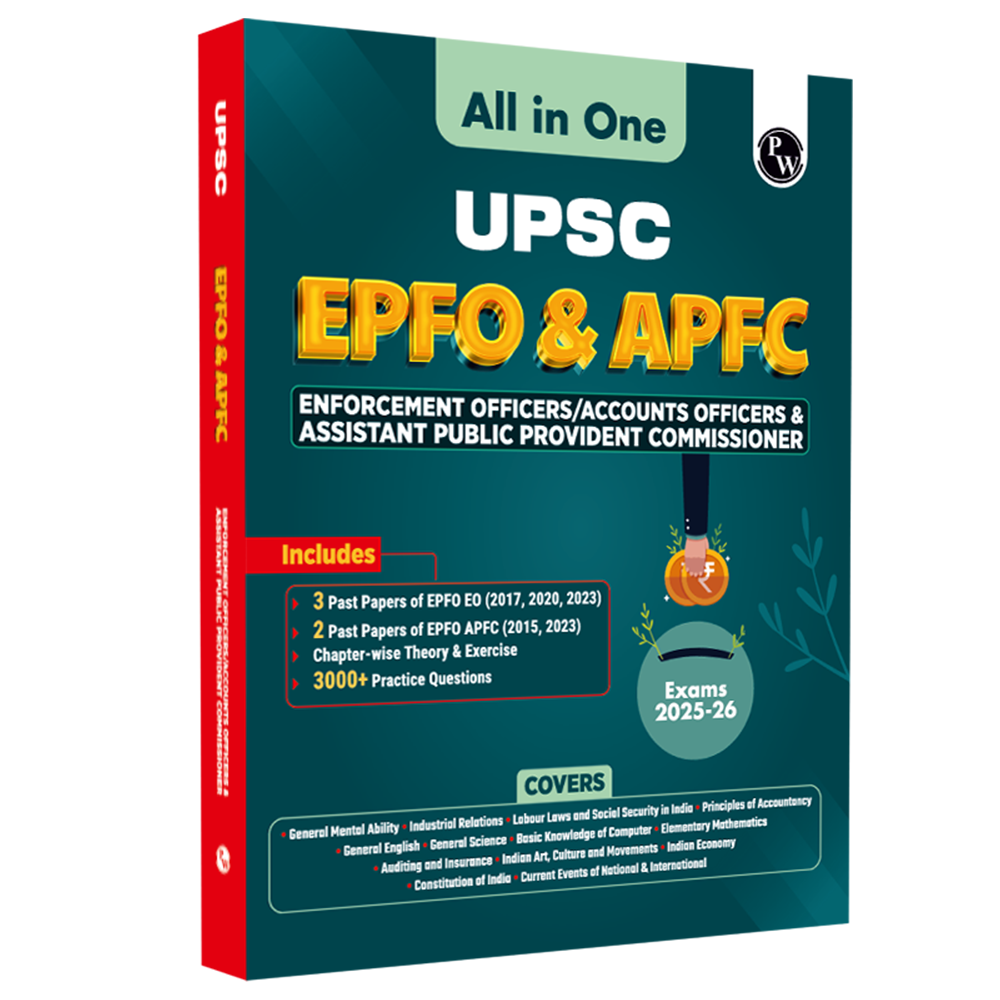
For focused UPSC EPFO preparation, using the right study materials is very important. You can use PW's All in One UPSC EPFO & APFC for 2025-26 exams. Here's what this book offers:
-
Learn from Past Papers: Gives step-by-step solutions for questions from 2015, 2017, 2020 & 2023 to help you understand important repeated topics.
-
Easy Chapter Explanations: Easy-to-understand explanations for each chapter make it easier for you to understand concepts.
-
Lots of Practice Questions: Over 3000 questions with detailed solutions cover the whole UPSC EPFO syllabus, so you can prepare effectively.
-
Clear Answer Explanations: Every solution is explained clearly, so you can improve your problem-solving and accuracy.
-
Stay Updated with Current Affairs: A monthly current affairs magazine (via QR code) keeps you informed for the General Awareness section.
Using such a comprehensive book can make UPSC EPFO preparation easier and more exam-focused, saving time while making sure you complete the syllabus efficiently.
Also Check, UPSC Question Banks
Work On Your Time Management Skills
Since you will get only two hours to complete the exam, it becomes even more important for you to manage your time smartly. So, practise answering questions using a timer during preparation without losing accuracy. Avoid spending too much time on a single question.
Give Mock Tests to Improve Your Speed and Accuracy
In order to improve your speed and accuracy, solve previous years’ papers and take mock tests every week or whenever you get enough time. This will help you understand the marking pattern, identify weak areas, and boost confidence for the real exam.
Stay Consistent and Balanced
Follow your study plan consistently. Take small breaks in between, but maintain a healthy routine to keep your mind fresh. Staying calm and confident is important during UPSC EPFO preparation and in the exam hall.
Read More: List of Important Articles in Indian Constitution for 2025
UPSC EPFO Syllabus 2025 FAQs
Q.1. What is the UPSC EPFO Syllabus 2025?
Ans. UPSC EPFO syllabus 2025 covers subjects like General English, the Indian Freedom Struggle, Current Affairs, Indian Polity and Economy, General Accounting Principles, Industrial Relations & Labour Laws, General Science & Knowledge of Computer Applications, Quantitative Aptitude, General Mental Ability, and Social Security in India.
Q.2. Is the UPSC EPFO syllabus the same for EO/AO and APFC?
Ans. The UPSC EPFO syllabus for both EO/AO and APFC posts is mostly the same. However, the EPFO APFC syllabus also includes a few extra topics specific to the APFC post.
Q.3. Can I cover the UPSC EPFO exam syllabus in one month?
Ans. Covering the complete UPSC EPFO exam syllabus in one month can be challenging. But by following a dedicated study plan with daily revision and practice of previous year papers and mock tests, you can cover most of the topics.
Q.4. Which book should I use for effective UPSC EPFO preparation?
Ans. For effective preparation, you can use the All in One UPSC EPFO & APFC for 2025-26 Exams book by PW. It covers the complete syllabus with simple explanations, previous years’ solved papers, and over 3000 practice questions.
Q.5. Is it possible to clear the UPSC EPFO exam on the first attempt?
Ans. In order to clear the UPSC EPFO exam on your first attempt, start by understanding the syllabus well, follow a proper preparation strategy, practise regularly, and focus on weak areas. Also, take mock tests from time to time to improve accuracy and speed.