UPSC Geography Syllabus 2026, Prelims and Optional Syllabus
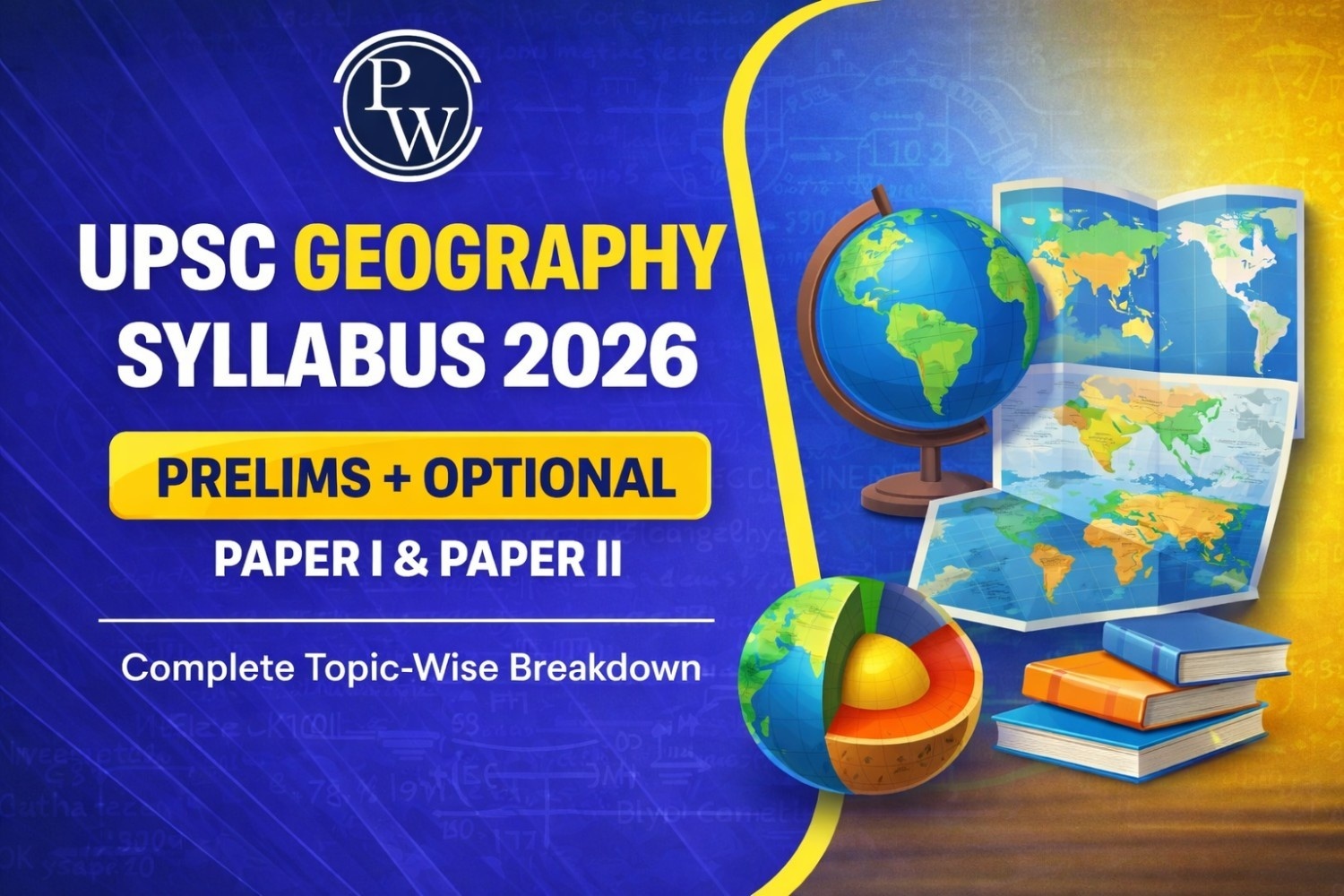
The geography syllabus for UPSC covers the physical, social, and economic geography of India and the world. It includes the preliminary test (General Studies I), the Mains (GS Paper I), and two optional exams. It covers landforms, climate, resources, and how people and the environment interact.
For many people who want to work in the public service, the first big challenge is understanding the UPSC geography syllabus. Many students feel like they have too much to learn, from how the Earth's crust cools to how modern cities work in complicated ways. Geography is different from other subjects since it connects scientific truths with real-life situations. This makes it a hard yet high-scoring part of the test. If you're taking the UPSC geography exam for the first time in 2026 or just want to improve your strategy, it's important to have a clear overview of the comprehensive curriculum, so you don't waste time on areas that don't matter.
Check out: UPSC Books
UPSC Geography Syllabus 2026 Overview
The Union Public Service Commission (UPSC) maintains a consistent structure for the Geography segment. It is integrated into every stage of the recruitment process.
Importance of Geography in the UPSC Exam
Geography is an important part of the Civil Services Examination. It is important since it is related to other fields, including economics, the environment, and disaster management. Geography questions make up a big part of the General Studies paper in the Prelims. It makes up a large part of General Studies Paper I in the Mains. The geography syllabus gives students who choose it as an elective an opportunity to get a high score with technical and map-based questions.
Civil Services Geography Syllabus Structure
The syllabus is divided into three distinct phases:
-
Preliminary Exam: Focuses on objective conceptual clarity and factual data about India and the world.
-
Mains Exam (General Studies I): Emphasizes descriptive responses regarding physical geography, natural resources, and industrial locations.
-
Optional Subject: Two separate papers (Paper I and Paper II) that explore advanced geographical concepts and their applications in different regions of India.
Key Topics Covered in the Geography Syllabus for UPSC
Across all levels, the main themes remain the same:
-
Geomorphology: The structure of the Earth and its landforms.
-
Climatology: The atmosphere, pressure bands, and cyclones.
-
Biogeography: Ecosystems, soils, and plants.
-
Human Geography: Population distribution and settlement patterns.
-
Economic Geography: Distribution of primary, secondary, and tertiary sectors.
Check out: UPSC Previous Year Papers
UPSC Geography Syllabus for Prelims
The preliminary stage tests your ability to identify locations and understand global natural phenomena.
Detailed Geography Syllabus for UPSC Prelims
The official notification defines the Prelims syllabus as "Indian and World Geography – Physical, Social, and Economic Geography of India and the World".
|
Segment |
Focus Areas |
|
Physical Geography |
Origin of Earth, Interior of Earth, Rocks, Volcanism, Earthquakes, and Plate Tectonics. |
|
Social Geography |
Population dynamics, migration, urbanisation, and tribal demographics. |
|
Economic Geography |
Agriculture, minerals, energy resources, and transport networks. |
Important Geography Topics for the UPSC Prelims Exam
To ace the prelims, candidates must focus on:
-
Major River Systems: Tributaries, origin points, and multipurpose projects.
-
Climate Regions: Characteristics of Mediterranean, Monsoon, and Equatorial Climates.
-
Mapping: Important straits, mountain passes, and border countries of seas (e.g., Caspian Sea, Red Sea).
-
Environmental Links: Biosphere reserves, national parks, and wetlands (Ramsar sites).
Key Areas to Focus on in Prelims Geography
-
Map-based questions: Identifying locations of recent international conflicts or environmental changes.
-
Indian Physical Map: The Himalayas, Peninsular Plateau, and Coastal Plains.
-
Atmospheric Circulation: Jet streams, El Niño, La Niña, and their impact on the Indian Monsoon.
Check Out: UPSC Revision Books
UPSC Geography Syllabus for Mains
The Mains exam requires a deeper analytical approach compared to the Prelims.
Civil Services Geography Syllabus for the Mains Exam
In General Studies Paper I, geography accounts for nearly 80-100 marks. The geography complete syllabus for UPSC Mains includes:
-
Salient features of the world's physical geography.
-
Distribution of key natural resources across the world (including South Asia and the Indian subcontinent).
-
Factors responsible for the location of industries (primary, secondary, and tertiary).
-
Important geophysical phenomena: tsunamis, volcanic activity, and cyclones.
-
Geographical features and their location: Changes in critical geographical features (including water bodies and ice caps).
Important Themes in the Geography Syllabus for UPSC Mains
Aspirants should prepare for "Why" and "How" questions. For example, instead of just knowing where iron ore is found, you must understand why steel industries are shifting from raw material sources to market-based locations. Global warming and its impact on flora/fauna are also recurring themes.
Weightage of Geography Topics in Mains
The weightage is generally balanced between Indian geography and world physical geography. However, there is an increasing trend of questions related to disaster management and climate change, which are rooted in geographical concepts.
Check Out: UPSC Textbooks
UPSC Geography Syllabus for Optional Subject
Choosing geography as an option is a popular choice due to the availability of resources. The syllabus is comprehensive and academic.
Paper 1 Topics
Paper 1 focuses on Principles of Geography:
-
Physical Geography: Geomorphology, Climatology, Oceanography, Biogeography, and Environmental Geography.
-
Human Geography: Perspectives in Human Geography, Economic Geography, Population and Settlement Geography, and Regional Planning.
-
Models and Theories: Central Place Theory, Malthusian Theory, and Rostow’s Stages of Growth.
Paper 2 Topics
Paper 2 is entirely focused on the geography of India:
-
Physical Setting: Structure, relief, and drainage.
-
Resources: Land, water, and energy.
-
Agriculture: Infrastructure and livestock resources.
-
Industry and Transport: Evolution of industries and trade patterns.
-
Contemporary Issues: Environmental hazards, floods, and droughts.
Key Areas in the Geography Syllabus
Candidates must master map marking in Paper 2, as it carries compulsory marks. Additionally, linking the theories of Paper 1 (like Weber’s Industrial Location) with Indian examples in Paper 2 is the secret to scoring high marks.
UPSC Geography Syllabus Topic-Wise Breakdown
Physical Geography Topics
-
Geomorphology: Factors controlling landform development; endogenetic and exogenetic forces.
-
Oceanography: Ocean bottom relief, temperature and salinity; tides and currents.
-
Climatology: Planetary winds; air masses; Köppen’s classification of climates.
Human Geography Topics
-
World Population: Growth, density, and demographic transition.
-
Settlements: Types of rural and urban settlements; problems of urbanisation.
-
Human Development Index: Indicators and global patterns.
Indian Geography Topics
-
Physiography: The Northern Mountains, Great Plains, and the Desert.
-
Monsoon: Mechanism and variability.
-
Natural Vegetation: Classification of forests and conservation efforts.
Read More: How to Prepare for UPSC Prelims 2026?
UPSC Geography Syllabus Preparation Tips
Best Strategy to Cover the Complete Syllabus for UPSC
-
Start with NCERTs: Read Class 6 to 12 NCERT books to build a solid foundation.
-
Use Atlases: Keep an Oxford or Orient Blackswan Atlas open while studying.
-
Link with Current Affairs: If a volcano erupts in Iceland, study the plate tectonics of that region immediately.
-
Diagram Practice: Learn to draw rough maps of India and the world in under 30 seconds.
Important Books for UPSC Geography Preparation
-
Certificate Physical and Human Geography by GC Leong.
-
India: A Comprehensive Geography by DR Khullar (optional).
-
Physical Geography by Savindra Singh.
Common Mistakes to Avoid While Studying Geography
-
Ignoring Maps: Many students study the theory but fail to identify places on a map.
-
Over-reliance on complex books: Stick to basics before moving to advanced texts.
-
Skipping Diagrams: In Mains, a simple diagram of a rain-shadow area can earn you an extra mark.
Also Check, UPSC PYQ Book
UPSC Geography Syllabus FAQs
What topics are included in the UPSC geography syllabus?
The syllabus includes the physical, social, and economic geography of both India and the world. Key topics cover landforms, climate, ocean currents, population distribution, and natural resources.
Is geography important for UPSC prelims and mains?
Yes, it is crucial. Geography accounts for a significant portion of the Prelims GS Paper I and is a core part of the Mains GS Paper I. It also helps in understanding the environment and international relations.
What is the UPSC geography optional syllabus?
It consists of two papers. Paper 1 deals with global geographical principles and theories, while Paper 2 focuses specifically on the regional and physical geography of India.
How to complete the geography syllabus for UPSC?
To finish the syllabus, start with NCERTs (Class 6–12), continue with standard reference books like GC Leong, and regularly practise map-pointing and previous-year
Is geography a good optional subject for UPSC?
Geography is popular because it is both semi-scientific and logical. It has a significant overlap with the General Studies papers, making it an efficient choice for many aspirants.