UPSC Prelims Preparation Strategy with 32 Years PYQ Book
Integrating structured solving of past papers provides clarity on the exact pattern and depth expected by the commission. Mastering UPSC Prelims PYQ transforms revision from passive reading into active recall, helping candidates identify core high-yielding themes, master option elimination, and build true exam-day confidence.
Importance of UPSC Prelims PYQ
Every candidate preparing for the Civil Services Examination has to study a large amount of material. However, reading standard books alone may not be enough for Prelims. The examination tests conceptual clarity, analytical thinking, current awareness, and the ability to select the right answer within a limited time.
Past questions act as a guide for your preparation. They reduce guesswork by showing the actual difficulty level, statement patterns, and types of options used by UPSC. A good UPSC previous year questions book can therefore help you connect your study material with the real demands of the examination.
Decoding the Examiner's Mindset
UPSC often tests important ideas from Polity, Economy, Environment, Modern History, Geography, and other areas. Studying past questions helps you find repeated concepts instead of reading every topic with the same level of attention.
-
Identifying high-yield topics: Areas such as Fundamental Rights, Monetary Policy, biodiversity, constitutional bodies, and environmental issues have been important across different years.
-
Understanding statement construction: UPSC often uses words such as "only", "all", "correct", and "incorrect" to make options confusing.
-
Linking static theory with current affairs: Previous questions show how basic concepts can be connected with current national and international developments.
Moving from Knowledge to Practice
Knowing a topic and applying it in the examination are two different things. Regular PYQ practice helps candidates make this transition.
-
Improving option elimination: Detailed solutions help you understand why an option is correct or incorrect. This also adds new information to your knowledge.
-
Reducing negative marking: Random guessing can reduce your score. Regular practice helps you understand when elimination can be trusted and when an answer should be left.
-
Building exam stamina: Solving complete papers helps you stay focused during the two-hour examination.
A strong UPSC prelims study plan should therefore include PYQ practice along with reading, revision, current affairs, and mock tests.
Explore UPSC Question Bank with comprehensive topic-wise questions, previous year questions, detailed solutions, and exam-oriented practice to strengthen concepts, improve accuracy, and boost preparation for Prelims and Mains.
Features of UPSC Prelims PYQ
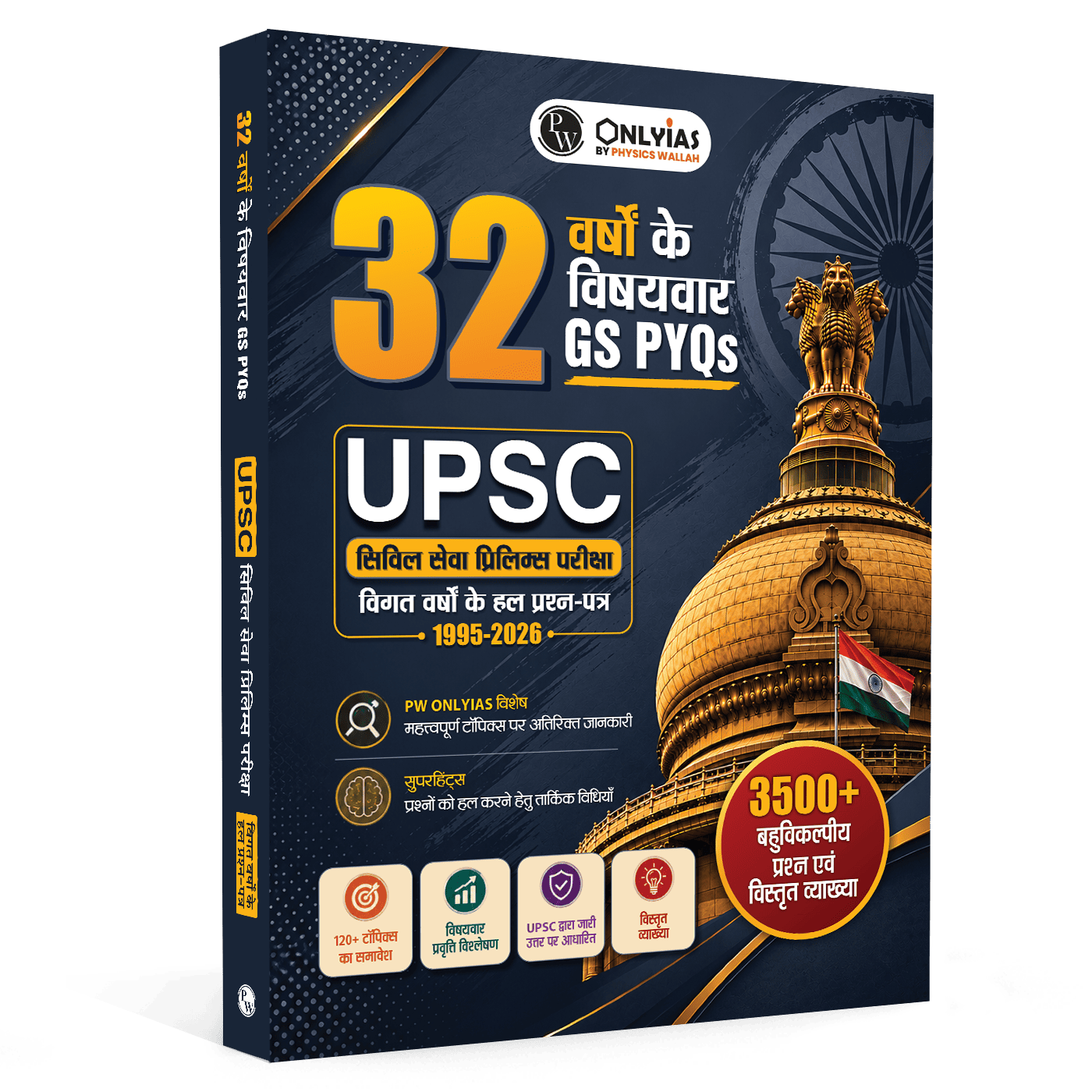
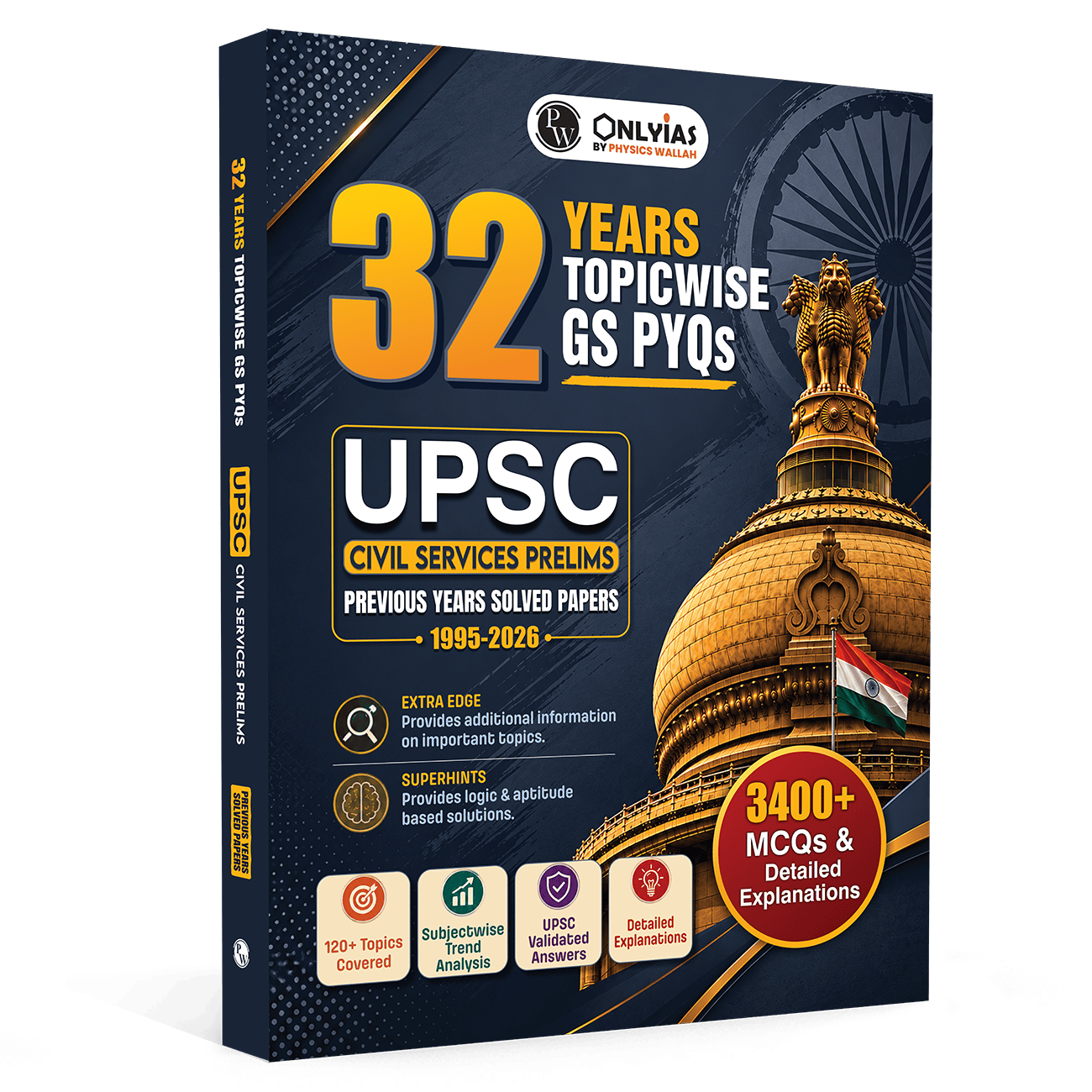
A well-organised PYQ resource can make previous paper practice easier. This 32 years UPSC PYQ book brings together previous questions, topic-wise practice, detailed solutions, and exam trend analysis to support systematic preparation.
32 Years of UPSC Prelims Papers (1995–2026): Practice 32 years of UPSC Prelims questions from 1995 to 2026, covering General Studies Paper 1 and CSAT Aptitude Paper 2. This long coverage helps you understand how the exam pattern and question styles have changed over time.
3400+ Solved MCQs: Practice more than 3400 authentic UPSC questions with detailed solutions. Regular practice can improve accuracy, strengthen concepts, and help you become more comfortable with the examination format.
Topicwise Segregation: Questions are arranged across 120+ topics, including Polity, Economy, History, Geography, Environment, Science & Technology, Current Affairs, and more. This makes it easier to practise one topic at a time.
Detailed Option-Wise Solutions: Learn the correct answer along with the reason behind each option. This is useful for learning elimination methods and understanding how UPSC creates confusing choices.
Trend & Pattern Analysis: Study repeated themes, important areas, and changes in question patterns. This can help you decide which topics need more time during revision.
PWOnlyIAS Extra Edge: Get expert insights, preparation tips, and special "Superhints" that can help improve accuracy and make better decisions when you are unsure of an answer.
Updated for UPSC 2027: The content is designed to support UPSC 2027 preparation according to the latest available UPSC Prelims pattern and syllabus expectations.
Visual Learning Support: Maps, diagrams, infographics, and other visual aids can make difficult concepts easier to understand and remember during revision.
Prelims + Mains Integration: PYQ explanations can support both Prelims and Mains by helping you understand concepts instead of only memorising answers. This also supports stronger UPSC gs preparation.
Strategic Preparation Framework: Topic-wise categories, question trends, and exam analysis help you identify important areas and set clear study priorities.
Stay updated with UPSC Current Affairs covering important national and international events, government schemes, economy, science, environment, and other exam-relevant topics for Prelims and Mains preparation.
How to Analyse UPSC Prelims PYQ Topic-Wise?
Solving papers randomly may not show which topics need more attention. Arranging questions by subject and topic helps you understand concepts in a better way.
Using topic wise UPSC PYQs allows you to finish a chapter and then immediately check how UPSC has tested that topic in previous examinations. This makes your preparation more focused and helps you find weak areas.
Subject-Wise Distribution and Weightage Analysis
Understanding the broad distribution of questions can help you divide your study time. The exact number of questions can change every year, so these ranges should be used only as a broad preparation guide.
|
Subject Area |
Typical Question Range |
Key Focus Areas to Prioritise |
|
Indian Polity & Governance |
12–18 Questions |
Constitutional Provisions, Judiciary, Preamble, Amendments, Rights |
|
Economy & Social Development |
15–20 Questions |
Banking, Inflation, Fiscal Policy, External Sector, Agriculture |
|
Environment & Ecology |
15–20 Questions |
National Parks, Species Status, Conventions, Climate Change |
|
History & Art & Culture |
14–18 Questions |
Modern Freedom Struggle, Ancient/Medieval Terminology, Architecture |
|
Geography & Mapping |
10–14 Questions |
Physical Features, Drainage Systems, World Regional Mapping |
|
Science & Technology |
10–15 Questions |
Emerging Tech, Biotechnology, Space, Basic Health Sciences |
Systematic Framework for Topic Analysis
To get better results from a topic wise UPSC PYQs approach, follow the same process during every practice session:
-
Complete the theoretical foundation: Read the standard reference material or core chapter before attempting related questions.
-
Attempt questions without help: Solve the questions without checking the answer key first. This shows your actual understanding.
-
Study every option: Check why the correct option is right and why the other options are wrong. This can reveal useful facts that may be asked later.
-
Maintain short notes: Write down important terms, laws, species, places, schemes, or concepts that you do not remember.
This process helps your UPSC prelims revision strategy focus on your weak areas while also strengthening topics you already know.
What is the Step-by-Step Strategy to Solve UPSC Prelims PYQs?
PYQs become more useful when they are solved with a fixed method. Instead of simply checking how many answers you got right, use every question to understand your strengths, mistakes, and preparation gaps.
Step 1: Follow a Topicwise Mastery Cycle
Start with one subject or topic, such as the Preamble and Fundamental Rights in Indian Polity. First study the topic from your standard reference material. Then use your PYQ resource to solve questions related to that topic.
Do not focus only on getting the correct answer. Try to understand why the statement is correct or incorrect. This approach makes UPSC prelims preparation tips more practical because every practice session gives you a clear lesson.
Step 2: Analyse Every Option
Do not stop once you find the correct answer. Read all the incorrect options carefully. UPSC can test related information in another question later.
Make short notes about unfamiliar terms, institutions, laws, places, species, or concepts. A good UPSC gs PYQ book can be useful for this because detailed explanations allow you to learn from both correct and incorrect options.
Step 3: Practise Full Papers Under Time
After completing topic-wise practice, start solving complete papers year-wise. Set a timer for 120 minutes and attempt the paper without distractions.
This practice gives you a better understanding of time management, question selection, and accuracy. It also helps you improve your UPSC exam strategy before the actual examination.
Step 4: Maintain an Error Ledger
Keep a physical notebook or digital file to record your mistakes. Divide your errors into three simple groups:
-
Knowledge Gaps: You missed the question because you did not know the fact or concept.
-
Misinterpretation: You misunderstood the question or missed words such as "not", "incorrect", or "only".
-
Over-thinking / Over-guessing: You selected an answer even when the available information did not support it.
Review this error log every week. It will help you identify repeated mistakes and make your UPSC prelims practice questions more useful.
How to Choose UPSC Prelims PYQ Books?
PYQs should be used along with standard study material rather than as a replacement for basic books. Candidates should select resources that cover the syllabus clearly and provide enough practice.
When comparing UPSC preparation books, check whether they provide authentic previous questions, clear explanations, topic-wise organisation, and useful exam analysis. A resource that combines these features can save time during practice and revision.
The best PYQ book for UPSC is not simply the one with the highest number of questions. It should help you understand why questions were asked, how options were framed, and what lessons can be taken from each paper.
Using structured PW UPSC books along with standard sources, current affairs, revision, and mock tests can help create a balanced preparation process.
How to Use UPSC Prelims PYQs?
PYQs should not be kept only for the final months. They can be used at different stages of preparation.
During the first stage, solve topic-wise questions after completing individual chapters. This helps you understand the level of knowledge required by UPSC.
During the second stage, revisit questions from subjects that you have already studied. Mark questions that you got wrong or found difficult. These questions can become part of your revision list.
During the final stage, solve complete year-wise papers under a time limit. Avoid checking the answers while solving. After completing the paper, analyse every question and record your mistakes.
This three-stage approach makes PYQs part of your regular UPSC prelims preparation strategy instead of treating them as a separate activity.
UPSC Prelims PYQ Revision Strategy with PYQs
Revision becomes more effective when it is based on your mistakes and important PYQ themes. Instead of reading the entire syllabus again and again, focus on areas where you made repeated errors.
You can divide revision into three parts:
-
First revision: Review basic concepts, important facts, and questions you got wrong.
-
Second revision: Revisit repeated themes, confusing concepts, and important current affairs connections.
-
Final revision: Focus on short notes, marked PYQs, important facts, maps, and common mistakes.
This UPSC prelims revision strategy saves time and keeps your preparation connected to actual examination questions.
Frequently Asked Questions
How many years of UPSC Prelims PYQ should I solve?
Try to solve at least 25 to 32 years of previous questions. A longer question history helps you understand changes in the exam, repeated themes, and different ways in which UPSC frames statements and options.
Are past questions repeated in the UPSC Prelims exam?
Exact questions are rarely repeated in the same form. However, concepts, themes, facts, and terms from previous questions can appear again. PYQ practice helps you understand these recurring areas.
Should I solve PYQs topicwise or yearwise?
Start with topic-wise practice while studying individual subjects. After completing the syllabus, move to year-wise papers under timed conditions. Both methods are useful at different stages of preparation.
How does a 32 years UPSC PYQ book help with option elimination?
A detailed PYQ resource explains why different options are right or wrong. By studying these explanations, you can learn common statement patterns, important qualifiers, and practical elimination methods.
Is solving PYQs enough for UPSC GS Paper 1 preparation?
No. PYQs are an important part of preparation, but they should be combined with standard books, current affairs, revision, and mock tests. Previous questions show what UPSC has asked, while study material gives you the knowledge needed to answer new questions.