From Beginner to IAS – UPSC Preparation Strategy Using PYQs
The journey from a beginner to an Indian Administrative Service (IAS) officer is often described as a marathon rather than a sprint. While the syllabus is vast, the most effective way to navigate this challenge is through a deep analysis of the UPSC Prelims PYQ.
Previous year questions act as a compass, showing you which areas the Union Public Service Commission (UPSC) prioritises. By integrating PYQs into your daily routine, you can transform your preparation from random reading to a targeted, result-oriented strategy that saves time and boosts confidence.
Check out: UPSC CSE Books
Importance of UPSC Prelims PYQ
Success in the Civil Services Examination depends largely on understanding the "mind of the examiner." Many aspirants spend years reading textbooks without ever grasping how those facts are tested. This is where the Prelims PYQ becomes indispensable.
Identifying High-Yield Topics
Not all chapters in a textbook hold the same weight. By reviewing the UPSC prelims previous year paper sets from the last decade, you will notice that certain themes, like Fundamental Rights in Polity or Modern Indian History, appear almost every year.
Understanding Question Patterns
The UPSC is known for its tricky phrasing. Using a dedicated UPSC PYQ book helps you get used to the "elimination method." You learn to spot distractor options and understand how statements are framed to test your conceptual depth rather than just rote memory.
Study Strategy to Use UPSC Prelims PYQ
For a beginner, the sheer volume of questions can be overwhelming. A systematic approach ensures you extract the maximum value from every UPSC previous year question.
Phase 1: The Initial Walkthrough
Before you even touch a standard textbook like Laxmikanth or NCERTs, spend three days just reading the PYQ of UPSC. Don’t try to solve them yet. Simply look at what is being asked. This builds a mental filter; when you eventually read your textbooks, your brain will automatically highlight information that matches the UPSC PYQ you saw earlier.
Phase 2: Subject-Wise Integration
As you complete a subject, solve the relevant questions from an UPSC PYQ book. For example, after finishing the "Economy" module, solve all Economy questions from the last 15 years. This reinforces your learning and reveals gaps in your knowledge.
Phase 3: Time-Bound Practice
In the final months before the exam, solve the UPSC prelims previous year paper in a simulated exam environment. Sit for two hours, use an OMR sheet, and avoid any distractions. This builds the mental stamina required for the actual exam day.
Benefits of Using UPSC Prelims PYQ
Generic practice is good, but topic-wise analysis is better. Breaking down the PYQ of UPSC prelims into specific categories like Geography, Science and Technology, and Environment provides several advantages:
-
Progress Tracking: You can clearly see which subjects you have mastered and which ones need more work.
-
Trend Analysis: You might notice that while History questions are becoming more factual, Environment questions are becoming more current-affairs oriented.
-
Efficient Revision: Instead of re-reading a 500-page book, you can quickly go through the UPSC PYQ of that subject to refresh your memory on key concepts.
How to Choose the Best UPSC Prelims PYQ
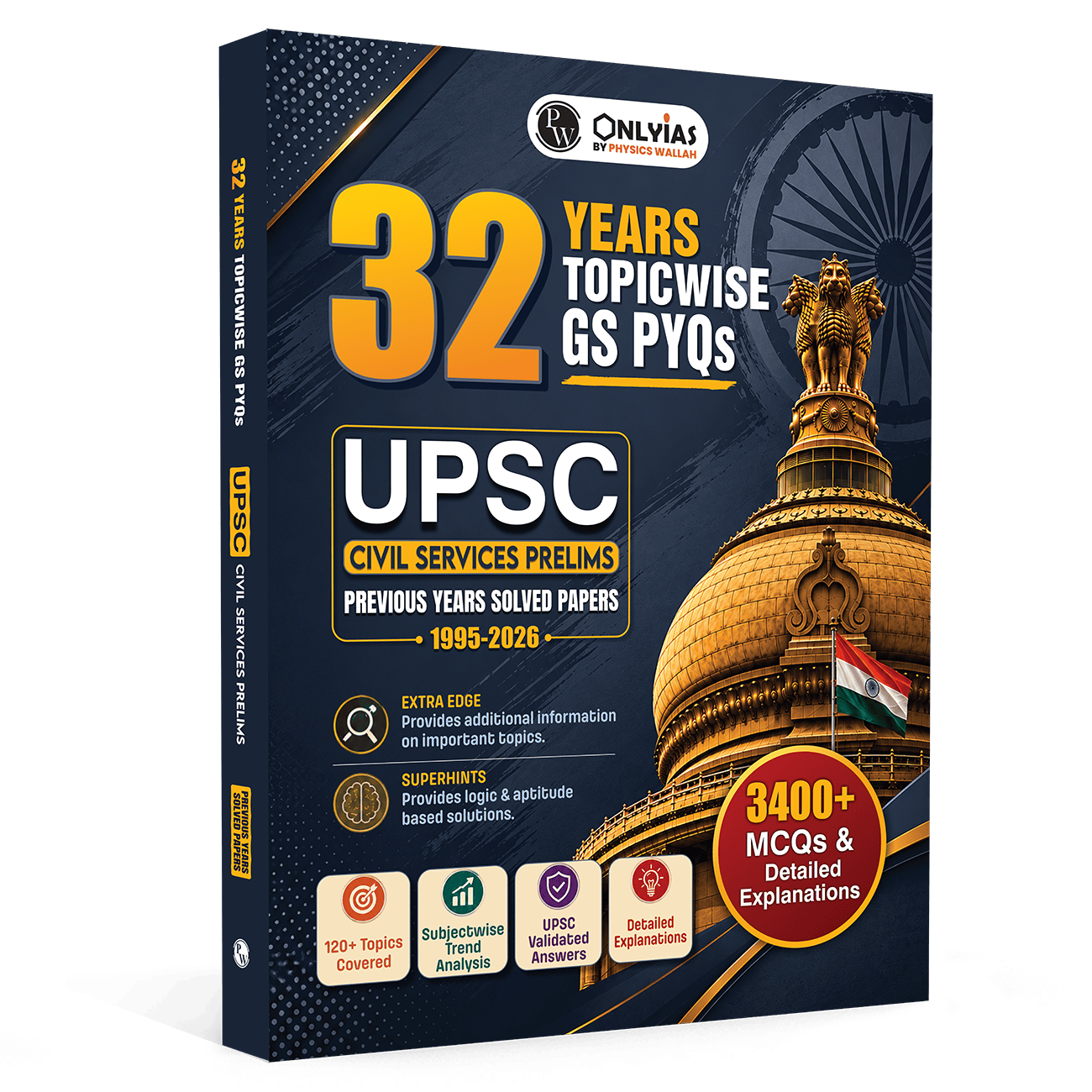
Not all resources are created equal. When looking for an UPSC PYQ book, ensure it has the following features:
-
Detailed Explanations: The book should not just give the correct option (A, B, or C) but explain why the other options are wrong.
-
Error-Free Content: Reliable data is crucial, especially in subjects like Economics and Geography, where facts can be specific.
-
Topic-Wise Categorisation: It is much easier to study when the UPSC prelims PYQ are sorted by theme rather than just by year.
-
Trend Analysis Charts: High-quality books provide a breakdown of how many questions were asked from each subject over the last few years.
UPSC Prelims PYQ for Elimination Technique
The UPSC Prelims is often an exam of elimination rather than selection. Out of 100 questions, an average topper might only be 100% sure about 35 to 40. The rest are solved using logical reasoning developed through UPSC prelims previous year paper practice.
By consistently solving PYQ of UPSC prelims, you begin to recognize patterns in how the Commission sets "extreme" statements (using words like 'only', 'all', or 'drastically') which are frequently incorrect. This "exam sense" is something no textbook can teach; it is only earned through the rigorous study of UPSC PYQ.
UPSC Prelims PYQ Subject-Wise Trends
The table below demonstrates the subject-wise distribution of the PYQ:
|
Subject |
Average Questions |
Focus Areas in UPSC prelims PYQ |
|
Polity |
12-15 |
Preamble, FRs, Parliament, Judiciary |
|
Economy |
15-18 |
Banking, Inflation, External Sector, Budget |
|
History |
15-17 |
Modern India, Art & Culture, Ancient Terms |
|
Environment |
15-20 |
Protected Areas, International Conventions, Species |
|
Geography |
10-12 |
Mapping (India & World), Physical Geography |
Check Out: UPSC Revision Books
Mistakes to Avoid with UPSC Prelims PYQ
Many students fail to use the UPSC prelims previous year paper sets effectively. Avoid these pitfalls:
-
Memorising Answers: The goal is to understand the logic, not just remember the answer. UPSC rarely repeats a question verbatim, but it frequently repeats the concept.
-
Ignoring the Explanations: Reading the solution is more important than solving the question. The explanation often contains the fodder for next year's questions.
-
Starting Too Late: Don’t wait until the last month to look at UPSC PYQs. They should be a part of your study plan from day one.
-
Only Focusing on Recent Years: While the last 5 years are critical, looking at UPSC previous year question sets from 20 or even 30 years ago can reveal fundamental concepts that UPSC still loves to test.
UPSC Prelims PYQ with Current Affairs
While UPSC prelims PYQ help with the static portion, they also show you how current affairs are linked to the syllabus. For instance, if a specific national park is in the news, the PYQs of UPSC will show you that the Commission usually asks about the river flowing through it or the specific species found there. Use the UPSC PYQs as a guide to filter the daily news, ensuring you only spend time on what is "UPSC-relevant."
UPSC Prelims PYQ Checklist
Below are the checklist for using the PYQ:
-
Purchase a high-quality PYQ book with topic-wise distribution.
-
Dedicate at least one hour daily to solving PYQs.
-
Create short notes on the "incorrect options" mentioned in the explanations.
-
Re-solve the last 10 years of previous year paper at least three times before the exam.
-
Map every UPSC previous year question to its specific syllabus sub-topic.
Read more: Hacks and Tricks for UPSC Prelims
UPSC Prelims PYQ FAQs
How many years of UPSC prelims PYQ should I solve?
It is highly recommended to solve at least the last 10 to 15 years of UPSC prelims PYQ. However, for static subjects like History and Geography, looking at the last 30 years of UPSC PYQs can be very beneficial.
Is an UPSC PYQ book enough for preparation?
While an UPSC PYQ book is essential for understanding the exam pattern and practicing, it must be supplemented with standard textbooks and current affairs to build a solid knowledge base.
Why are the PYQs of UPSC prelims so important?
The PYQs of UPSC prelims help candidates identify high-priority topics, understand the difficulty level, and master the art of eliminating wrong options, which is crucial for clearing the cutoff.
Can I find the UPSC prelims previous year paper online?
Yes, you can find the UPSC prelims previous year paper on the official UPSC website or through specialized portals, which offers organized and solved sets.
How do I use the UPSC previous year question for revision?
During revision, instead of reading entire chapters, go through the UPSC previous year question sets. If you can explain why an answer is correct and why others are wrong, your conceptual clarity is high.