How to Use UPSC Prelims Question Bank to Find Your Weak Subjects

You might feel confident after completing a heavy subject like Indian Polity or Modern History, only to realize during a mock test that simple factual nuances completely slipped past your memory. Passive reading often creates a false sense of security, leaving hidden weak spots untouched until exam day arrives.
Incorporating a structured UPSC prelims question bank into your daily routine solves this exact problem, transforming passive preparation into an active diagnostic tool that highlights precise learning gaps.
What Is a UPSC Prelims Question Bank?
A UPSC prelims question bank is a targeted collection of topic-wise and chapter-wise multiple-choice questions designed specifically for Civil Services exam preparation. Rather than presenting unstructured practice tests, a standard UPSC prelims PYQ book or question bank organizes practice items by domain and difficulty level.
Key characteristics include:
-
5020+ Handpicked Questions: A large volume of carefully selected items based on recent exam trends.
-
Chapter-Wise & Topic-Wise Segregation: Questions are grouped logically to enable focused revision after reading each textbook chapter.
-
Detailed Explanations: Every question includes a clear solution to clarify concepts and help you understand the logic behind correct choices.
-
Exam-Oriented Practice: Designed explicitly to enhance speed, accuracy, and overall problem-solving skills under test conditions.
By engaging in systematic UPSC Prelims question practice, candidates can move beyond passive reading and actively test their retrieval skills. Using a UPSC Question Bank alongside this practice can help reinforce concepts, identify knowledge gaps, and improve accuracy through regular question-solving.
Why Use UPSC Prelims Question Bank to Find Weak Subjects?
Attempting UPSC prelims MCQs from a comprehensive collection serves as a diagnostic tool for your preparation. Many candidates spend months re-reading textbooks without discovering that specific sub-topics—such as Medieval Indian Art or Modern Financial Instruments—are prone to simple errors.
-
Exposes Conceptual Gaps: Solving targeted items shows whether you truly understand a concept or merely recognize the terms.
-
Eliminates Overconfidence: High scores in one section can hide serious weaknesses in another. Topic-wise practice exposes areas that need work.
-
Refines Guessing & Elimination: Regular practice helps candidates hone educated guessing techniques while reading full-length explanatory notes.
-
Measures Accuracy Rates: Keeping track of correct versus incorrect responses helps calculate your accuracy ratio across various subjects.
Subjects Covered in UPSC Prelims Question Bank
A complete UPSC book setup or multi-volume set covers every major subject in the General Studies Paper 1 syllabus.
|
Subject |
Key Focus Areas |
Diagnostic Value |
|
Polity & Governance |
Preamble, Fundamental Rights, Judiciary, Constitutional Bodies |
Tests precise memory of legal provisions and Constitutional articles. |
|
History (Ancient, Medieval, Modern) |
Freedom Struggle, Art & Architecture, Dynastic Timelines |
Highlights memory retention issues regarding dates, events, and terminology. |
|
Geography |
Physical Geography, Indian Rivers, Maps, Climate Zones |
Identifies spatial awareness gaps and understanding of physical phenomena. |
|
Economy |
Banking, Inflation, Fiscal Policy, External Sector |
Pinpoints difficulty in applying economic concepts to practical scenarios. |
|
Environment & Ecology |
Protected Areas, Biodiversity, Conventions, Climate Change |
Measures awareness of environmental terminology, laws, and global initiatives. |
|
Science & Technology |
Emerging Tech, Biotechnology, Space, Everyday Science |
Reveals whether candidates keep up with fundamental scientific principles. |
When to Use UPSC Prelims Question Bank?
Timing your practice properly ensures maximum retention and minimal burnout. Incorporate UPSC prelims practice questions at strategic points throughout your study schedule:
-
Immediately After Finishing a Topic: Solve 20 to 30 topic-specific questions right after completing a chapter to lock in basic concepts.
-
During Weekly Revision Days: Reserve specific days to tackle mixed questions from chapters covered earlier in the week.
-
Mid-Way Through Syllabus Completion: Use full subject sets to gauge how well you retain information from earlier months.
-
In the Final 3 Months Before Prelims: Shift towards timed practice sessions to sharpen test-taking speed and decision-making confidence.
How to Use UPSC Prelims Question Bank to Find Weak Subjects?
To transform simple practice into a diagnostic asset, follow a structured process using a UPSC prelims question bank:
-
Attempt Questions Untimed First: Focus purely on conceptual understanding without stress. Mark options based on conviction rather than guessing.
-
Categorize Your Mistakes: Divide wrong answers into three categories: Conceptual Error (didn't understand the topic), Factual Error (forgot specific data), or Silly Mistake (misread the question).
-
Log Performance Metrics: Keep a physical notebook or spreadsheet recording your score, accuracy rate, and time taken per sub-topic.
-
Identify Recurring Patterns: If your accuracy drops below 60% in a given topic across multiple sessions, mark that subject as a high-priority weak area.
-
Review Explanations Thoroughly: Read the complete solution text for both incorrect and correct answers to gain extra context.
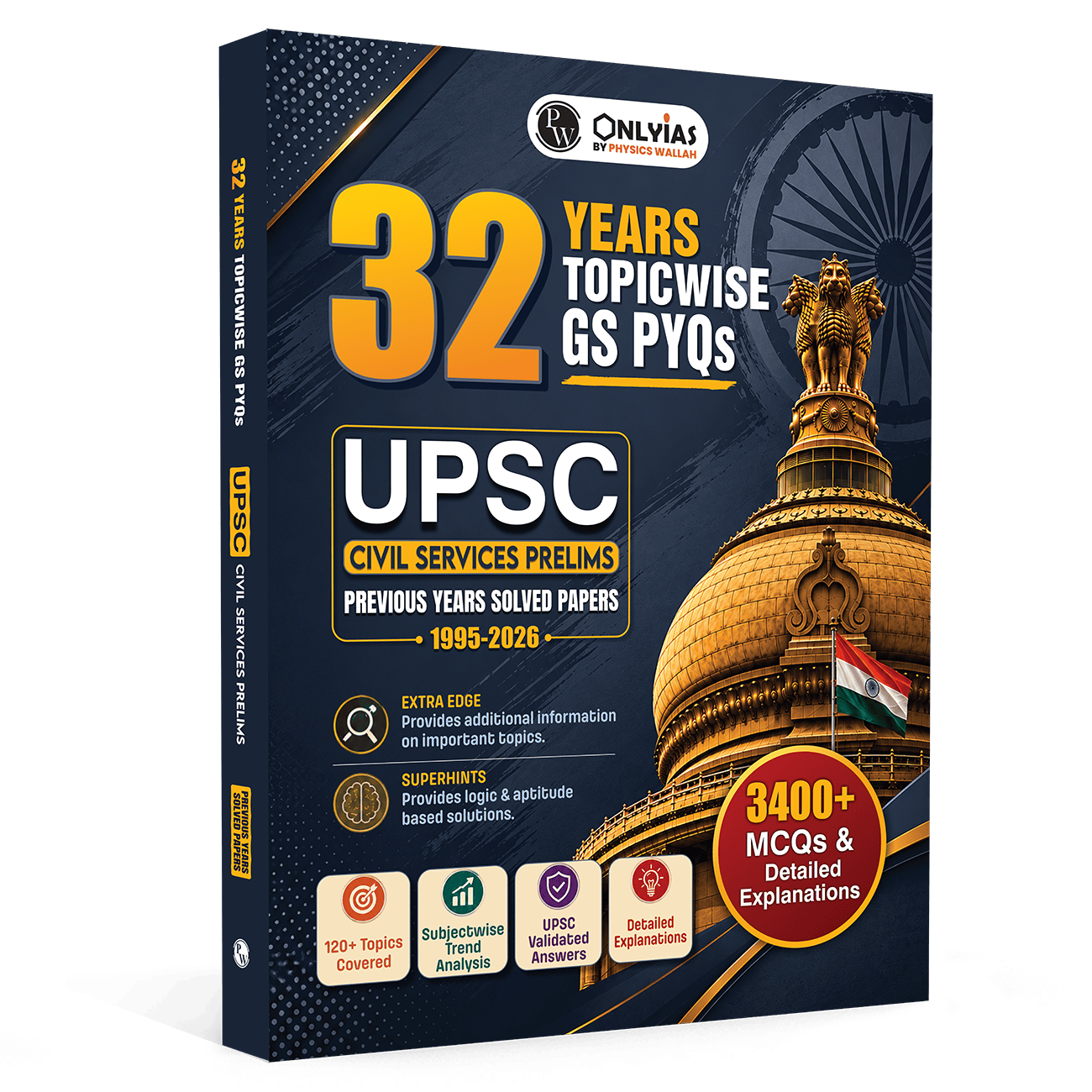
Take a more focused approach to UPSC Prelims preparation with the UPSC 32 Years GS PYQ Book. It helps you practise questions from previous years, understand changing question patterns, identify recurring themes, and strengthen your exam-oriented problem-solving skills.
How to Make a Study Plan With UPSC Prelims Question Bank?
Integrating a question collection into your daily schedule creates accountability and structure.
-
Phase 1: Dual-Track Daily Learning (Months 1–4)
-
Dedicate 70% of study time to reading core textbooks.
-
Spend 30% of study time attempting UPSC prelims questions related directly to that day's reading.
-
Phase 2: Weak Area Remediation (Months 5–6)
-
Analyze performance data gathered in Phase 1.
-
Schedule daily 2-hour correction blocks dedicated strictly to topics where accuracy stayed below 60%.
-
Re-attempt questions from those chapters after re-reading core text notes.
-
Phase 3: High-Volume Revision (Final 2 Months)
-
Solve mixed subject sets under exam-like conditions.
-
Maintain daily error logs to avoid repeating simple missteps.
Tips to Improve With UPSC Prelims Question Bank
Regular practice with a UPSC Prelims Question Bank can help you identify weak areas and improve your accuracy over time.
-
Never Skip Detailed Explanations: Even when you answer correctly, reading the full explanation offers extra context and reinforces key points.
-
Avoid Memorizing Question Answers: Focus on understanding underlying concepts rather than memorizing specific options.
-
Use Option Elimination Practice: Practice eliminating obviously false statements systematically before picking your answer.
-
Track Error Trends Over Time: Review your error log weekly to confirm that repeat mistakes are dropping.
Also check - UPSC Revision Books
Practice Sheets for UPSC Prelims Question Bank
Below is a diagnostic template you can replicate in your notebook to track subject strengths and pinpoint weak areas:
|
Subject / Topic |
Total Questions |
Correct |
Incorrect |
Accuracy % |
Weak Spot Identified |
Action Plan |
|
Polity: Judiciary |
20 |
14 |
6 |
70% |
Writ Jurisdiction |
Re-read Laxmikanth Ch. 26 |
|
Economy: Banking |
25 |
11 |
14 |
44% |
Monetary Policy Tools |
Watch foundational video & re-solve |
|
History: Bhakti Movement |
15 |
6 |
9 |
40% |
Saint Timelines & Texts |
Create a quick reference chart |
Read More: How Many Attempts for UPSC?
UPSC Prelims Question Bank FAQs
1. How often should I use a UPSC prelims question bank during initial preparation?
You should use a UPSC prelims question bank daily right after finishing a text chapter. Attempting 20–30 questions per day reinforces learning without overwhelming your study routine.
2. Is solving a UPSC prelims PYQ book enough to clear General Studies Paper 1?
While a UPSC prelims PYQ book is essential for understanding core trends, combining past papers with fresh UPSC prelims practice questions ensures complete coverage of new potential exam themes.
3. How do UPSC prelims MCQs help in identifying weak areas?
Solving targeted UPSC prelims MCQs provides immediate score feedback. If your accuracy drops below 60% on a specific topic, it highlights a clear conceptual gap that needs re-reading.
4. When should I start UPSC prelims question practice for the exam?
Start UPSC prelims question practice on day one of your preparation. Integrating question practice alongside textbook reading builds long-term retention far better than delaying practice until the end.
5. What makes a complete UPSC prelims preparation book useful for self-study?
A quality UPSC prelims preparation book offers structured chapter-wise organization and detailed explanations, allowing candidates to self-diagnose mistakes without needing constant external guidance.