Using Modern Indian History Question Bank for Timeline-Based Revision
Understanding the chronology of events is the biggest hurdle when preparing for civil services history exams. This article explains how a structured UPSC modern Indian question bank helps you decode the modern history timeline, excel at chronology questions, and streamline your entire preparation through smart, chapterwise practice.
Importance of Chronology in UPSC Modern Indian Question Bank
Modern Indian history is a complex web of interconnected events, policies, and movements. Remembering what happened is not enough; you must know exactly when and why it happened in that specific order.
Exam papers frequently feature complex chronology problems. These questions require you to arrange acts, treaties, and protests in their precise historical sequence. Missing a single year can cost you critical marks. Memorising isolated facts rarely works because the human brain retains information much better when it connects events like a story.
Structuring your study around a clear timeline turns scattered data points into a cohesive narrative. It allows you to see how a minor protest in one province eventually snowballed into a massive national campaign, making it far easier to recall details during the exam.
Benefits of an UPSC Modern Indian Question Bank
Relying solely on textbooks for preparation often leads to passive reading. You might feel like you understand a chapter, but you only truly learn when you force your brain to retrieve that information through active testing.
Using a high-quality UPSC modern indian question bank changes how you interact with the text. Instead of just reading about the past, you are forced to apply your knowledge to solve analytical problems, identify tricky distractors, and evaluate historical cause and effect.
A dedicated UPSC question bank provides three distinct operational advantages:
-
Exposes Hidden Gaps: It instantly highlights the specific decades or events where your memory of the sequence is blurry.
-
Teaches Elimination Skills: It trains you to use partial timeline knowledge to rule out incorrect options in multiple-choice questions.
-
Builds Exam Stamina: It familiarises you with the tricky, twisted framing often used in actual history papers.
Timeline-Based Revision with an UPSC Modern Indian Question Bank
To get the most out of your UPSC modern indian question bank, you cannot just answer questions randomly. You need a systematic workflow that links questions back to a main timeline.
Phase 1: Focused Chapterwise Practice
Do not attempt full-length tests immediately. Begin with chapterwise exercises to build a solid foundation. Focus on one specific block of time—such as the early tribal uprisings or the development of education under British rule—before moving forward. This method prevents your brain from mixing up events from different eras.
Phase 2: Build Your Own Summary Tables
Every time you finish a set of practice items, consolidate the core facts into a scannable table. This process reinforces your UPSC history revision by converting raw questions into structured memory aids.
|
Historical Period / Event |
Approximate Year |
Key Significance for Revision |
|
Early Regulating Acts |
Around 1773 – 1853 |
Established the structural foundation of British administrative control. |
|
1857 Revolt & Aftermath |
Estimated 1857 – 1858 |
Marked the formal end of East India Company rule and the start of the Crown Raj. |
|
Early Nationalist Phase |
Around 1885 – 1905 |
Focused on constitutional agitation, economic critiques, and moderate politics. |
|
Mass Movement Era |
Around 1915 – 1947 |
Launched large-scale, popular resistance campaigns across the entire subcontinent. |
Phase 3: Tackle Specific Chronology Questions
Once your chapter foundations are secure, specifically hunt for chronology-based questions within your question bank. Look for questions that combine minor regional events with major national movements to test whether you truly understand the sequence of historical developments.
To strengthen this stage of preparation, practise with an UPSC PYQ Book, which provides authentic previous year questions along with detailed explanations and topic-wise analysis. Regularly solving chronology-based PYQs helps you recognise recurring patterns, improve historical sequencing, and prepare effectively for the UPSC Prelims and Mains.
Freedom Movement Revision Using an UPSC Modern Indian Question Bank
The Indian national movement is the most heavily tested area of the syllabus. A single year in the 1920s or 1940s can contain multiple conferences, protests, and official reports that overlap with one another.
When conducting your freedom movement revision, use your question bank to untangle these dense periods. For example, the years between around 1919 and 1947 saw rapid shifts in political strategies. By solving targeted problems, you can map out how one campaign directly set the stage for the next.
Key Revision Insight: When practicing, pay close attention to the transition phases between major campaigns. Examiners love to test the minor events that occurred in the quiet years between large-scale national protests.
Make sure your practice session covers these critical thematic areas:
-
The precise evolution of civil disobedience and non-cooperation strategies.
-
The sequential introduction of British constitutional proposals from around 1909 to 1947.
-
The parallel growth of revolutionary nationalist movements alongside mainstream politics.
To strengthen your conceptual understanding further, complement your preparation with UPSC Books that provide comprehensive coverage of Modern Indian History, detailed explanations, practice questions, and revision material aligned with the latest UPSC syllabus. Combining quality reference books with a Modern Indian History question bank helps improve retention, analytical skills, and overall performance in both the UPSC Prelims and Mains examinations.
History Preparation Tips with an UPSC Modern Indian Question Bank
To ensure your preparation remains efficient, avoid the trap of simply counting how many questions you answer correctly each day. True progress happens during the review process.
When you get a timeline question wrong in your question bank, do not just read the correct option and move on. Open your notes and find out exactly what happened immediately before and immediately after that event. Pinpoint the missing link in your mental timeline and fix it before trying the next set.
-
Analyze Explanations: Treat the answer explanations as mini-revision notes that provide vital context.
-
Track Mistake Trends: Note down if you consistently mix up specific types of events, like land revenue systems or governor-generals.
-
Limit Your Sources: Stick to one high-quality question bank and revise it multiple times rather than hoarding multiple books.
How to Improve Retention Using an UPSC Modern Indian Question Bank
Use this structured four-step loop whenever you tackle a new historical theme in your syllabus:
-
Quick Review: Spend approximately 20 minutes scanning your basic notes or timeline charts for a specific era.
-
Active Testing: Solve around 25 to 30 themed problems in your question bank without looking at your notes.
-
Error Analysis: Thoroughly examine every wrong answer, focusing deeply on why you misplaced an event in time.
-
Update Timelines: Add any newly discovered minor events or crucial dates directly into your learn revision charts.
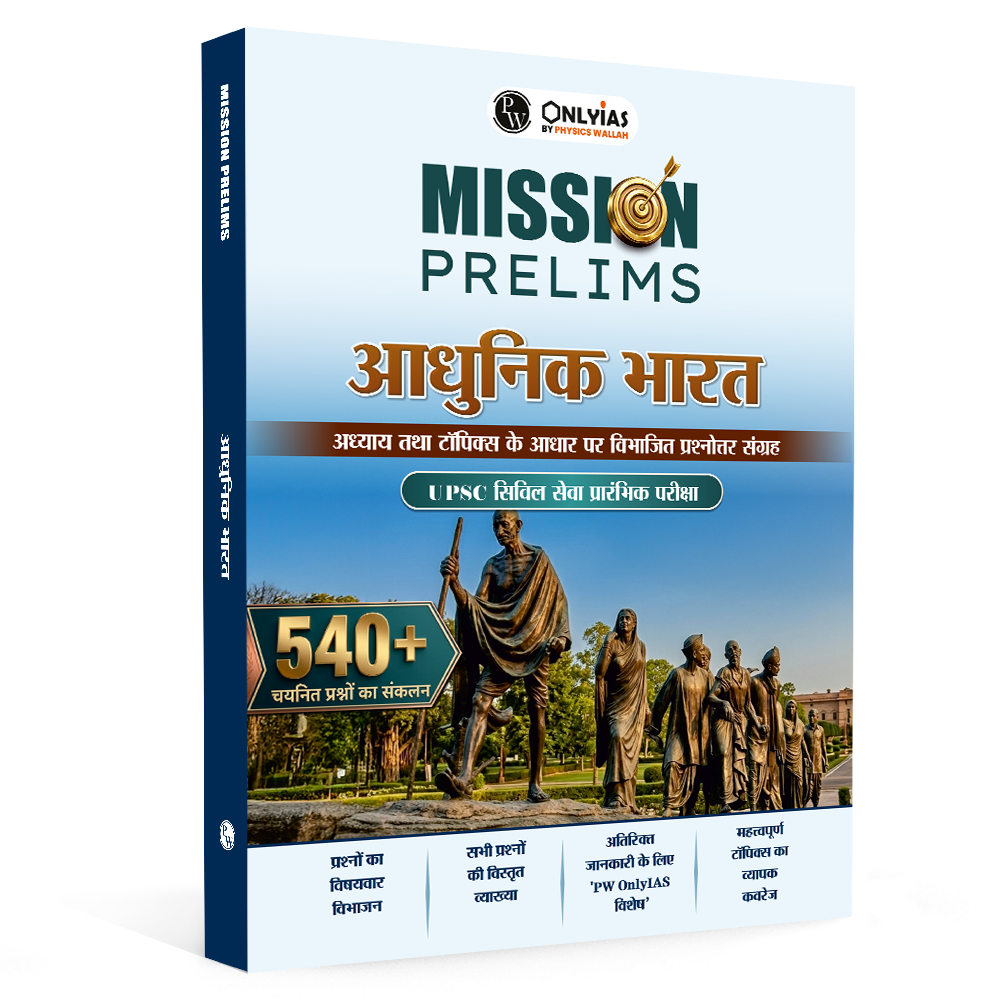
To strengthen your overall preparation, pair this approach with the UPSC Prelims Mission Prelims Combo Set. This comprehensive resource combines subject-wise study material, practice questions, revision content, and exam-oriented resources to help aspirants build conceptual clarity, improve accuracy, and prepare systematically for the UPSC Prelims examination.
Read More: UPSC Prelims History Questions for 2026 Preparation
UPSC Modern Indian Question Bank FAQs
How do I handle complex chronology problems in modern history?
The best approach is to identify the anchor events you are absolutely certain about. Use those anchors to eliminate options that place other events in the wrong sequence. Regular practice with a dedicated question bank will help you learn this elimination technique.
Why is chapterwise exercises better than mixed testing initially?
It allows you to isolate a specific historical period and understand its unique internal logic. Mixing all eras too early can confuse your memory of dates, which disrupts your modern history timeline and makes it harder to build a clear mental picture.
How often should I include timeline-based revision in my schedule?
You should ideally dedicate a portion of your weekly schedule to timeline review. Regular, short sessions focused on connecting historical events are far more effective for long-term retention than attempting to memorise hundreds of dates right before the exam.
Can a question bank replace reading standard textbooks for history preparation?
No, a question bank is designed to supplement your standard textbooks, not replace them. Textbooks provide the essential narrative and baseline details, while the question bank sharpens your analytical skills and fixes gaps in your historical memory.
What is the most effective way to revise the Indian freedom movement?
The most effective method is to combine reading with targeted revision questions on freedom movement. Focus heavily on the exact order of events, the changing objectives of nationalist leaders, and the shifting policies of the colonial administration over time.