What does the UPSC Indian Geography Mind Maps Book include — Regions, Rivers, Climate
For many aspirants, memorising the massive geographical data of India becomes an overwhelming task during exam preparation. The primary challenge lies in consolidating vast textbook paragraphs into actionable information that can be easily recalled during the high-pressure environment of the Prelims and Mains.
To address this exact problem, the UPSC geography mind maps book serves as a highly structured, visual revision resource that replaces lengthy notes with concise, interconnected branches.
Overview of the UPSC Geography Mind Maps Book
The UPSC geography mind maps book is an advanced learning tool designed specifically for Civil Services candidates who want to save time and boost retention. Instead of traditional narrative text, this resource employs a structured visual layout that maps out every major geographical theme into logical branches.
The content is carefully curated to align with the latest Civil Services Examination trends, focusing heavily on the critical terminology that examiners look for during evaluation.
By categorizing massive topics into distinct mental sections, the book ensures that students can connect physical features, economic resources, and environmental issues seamlessly. This comprehensive publication covers all vital dimensions of the syllabus, including geomorphology, agricultural patterns, mineral distributions, and transport networks.
It functions as a complete visual companion that bridges the gap between basic textbooks and actual exam requirements, making it an essential resource for last-minute revision.
Features of the UPSC Geography Mind Maps Book
The design of the UPSC geography mind maps book focuses entirely on providing high-yield, exam-oriented UPSC study material. Unlike standard reference materials that overwhelm readers with block text, this book incorporates specific elements tailored for visual learners.
-
Branch-Based Visual Layouts: Every chapter is broken down into thematic branches, allowing students to grasp the entire overview of a topic, such as the "Climate of India," at a single glance.
-
Integration of Tables and Data: Essential data regarding agricultural productivity, soil types like alluvial, black, and red soils, and irrigation patterns are compiled into clean, crisp tables.
-
Exam-Relevant Keywords: The content is curated to highlight specific technical terms and vocabulary that are crucial for scoring high marks in Mains answer writing.
-
Holistic Syllabus Coverage: It seamlessly integrates physical, economic, and social geography, covering topics like coal fields, oil refineries, national highways, and industrial locations.
How UPSC Geography Mind Maps Cover India's Physical Regions?
Understanding the physiography of India is essential for scoring well in both the Civil Services Prelims and General Studies Paper I. The UPSC geography mind maps book provides a highly organised layout of India's diverse physical terrains.
It maps out complex topics like the tectonic evolution of the Indian plate and the formation of the majestic Himalayan mountain ranges. Candidates can easily explore the breakdown of different mountain peaks, passes, and regional divisions without getting lost in dense geological descriptions.
-
Rock Systems: The book explicitly categorises the ancient rock systems of India, including the Archaean, Puranic, and Dravidian systems, detailing their geological significance.
-
The Deccan Plateau: It simplifies the structural divisions of the peninsular block, highlighting the Western Ghats, Eastern Ghats, and central highlands.
-
Coastal Plains and Islands: The visual layout traces the differences between the western and eastern coastlines, along with critical details regarding the Andaman, Nicobar, and Lakshadweep islands.
How UPSC Geography Mind Maps Explain Rivers and Drainage Systems?
Rivers and drainage basins are a recurring theme in competitive examinations, often featuring in tricky mapping questions. The UPSC geography mind maps book simplifies this intricate network by dividing the Indian drainage system into logical visual sub-branches.
This structure helps students memorise the origin points, courses, and termination points of major rivers without confusion.
-
Himalayan Rivers: The book maps out the complete networks of the Indus, Ganga, and Brahmaputra river systems. It clearly separates the crucial left-bank and right-bank tributaries, which are highly targeted in the Prelims.
-
Peninsular Rivers: Key southern and central rivers such as the Mahanadi, Godavari, Krishna, Kaveri, Narmada, and Tapi are laid out with their respective basin areas.
-
Associated Water Bodies: Important natural formations, such as the Jhelum passing through Wular Lake or the Gandak forming Kanwar Lake, are highlighted to ensure candidates catch every micro-detail. Using such visual resources together with UPSC Revision Books helps strengthen retention and makes last-minute revision faster and more structured.
How UPSC Geography Mind Maps Organise Climate and Monsoon Concepts
The Indian monsoon is undoubtedly one of the most complex atmospheric phenomena in the entire syllabus. The UPSC geography mind maps resource resolves this difficulty by breaking atmospheric dynamics down into sequential steps.
-
Monsoon Mechanisms: The branches systematically explain the "Onset" and "Withdrawal" phases of the monsoon, detailing the shifts in the Intertropical Convergence Zone (ITCZ).
-
Global Factors: It clearly links global atmospheric variations like El Niño, La Niña, and the Indian Ocean Dipole to their direct impacts on Indian rainfall.
-
Climatic Classification: The book organises the diverse climatic zones of India and pairs them with specific natural vegetation, running from Tropical Evergreen forests to Alpine regions.
Benefits of Using UPSC Geography Mind Maps
Using a dedicated visual resource offers distinct advantages over traditional study methods. When candidates incorporate the UPSC geography mind maps book into their daily routine, they notice a substantial improvement in their revision pace.
-
Faster Information Retention: The spatial arrangement of information mimics how the human brain naturally files data, making it easier to retain complex facts over a longer period.
-
Rapid Last-Minute Revision: Entire chapters can be reviewed in a matter of minutes, making it the most effective tool during the final stressful days leading up to the Prelims.
-
Enhanced Analytical Understanding: Because the topics are interconnected on a single page, students can easily see how physical features influence economic factors, such as why the mineral-rich Chota Nagpur Plateau hosts specific primary industries.
-
Streamlined Notes: It eliminates the need for candidates to spend hours creating their own micro-notes from bulky textbooks, saving valuable time during active preparation.
How to Use UPSC Geography Mind Maps?
To extract the maximum value from the UPSC geography mind maps publication, candidates must follow a structured approach rather than casually flipping through the pages.
-
Establish a Baseline First: Always begin your preparation by reading the foundational textbooks or NCERTs to build your basic conceptual understanding.
-
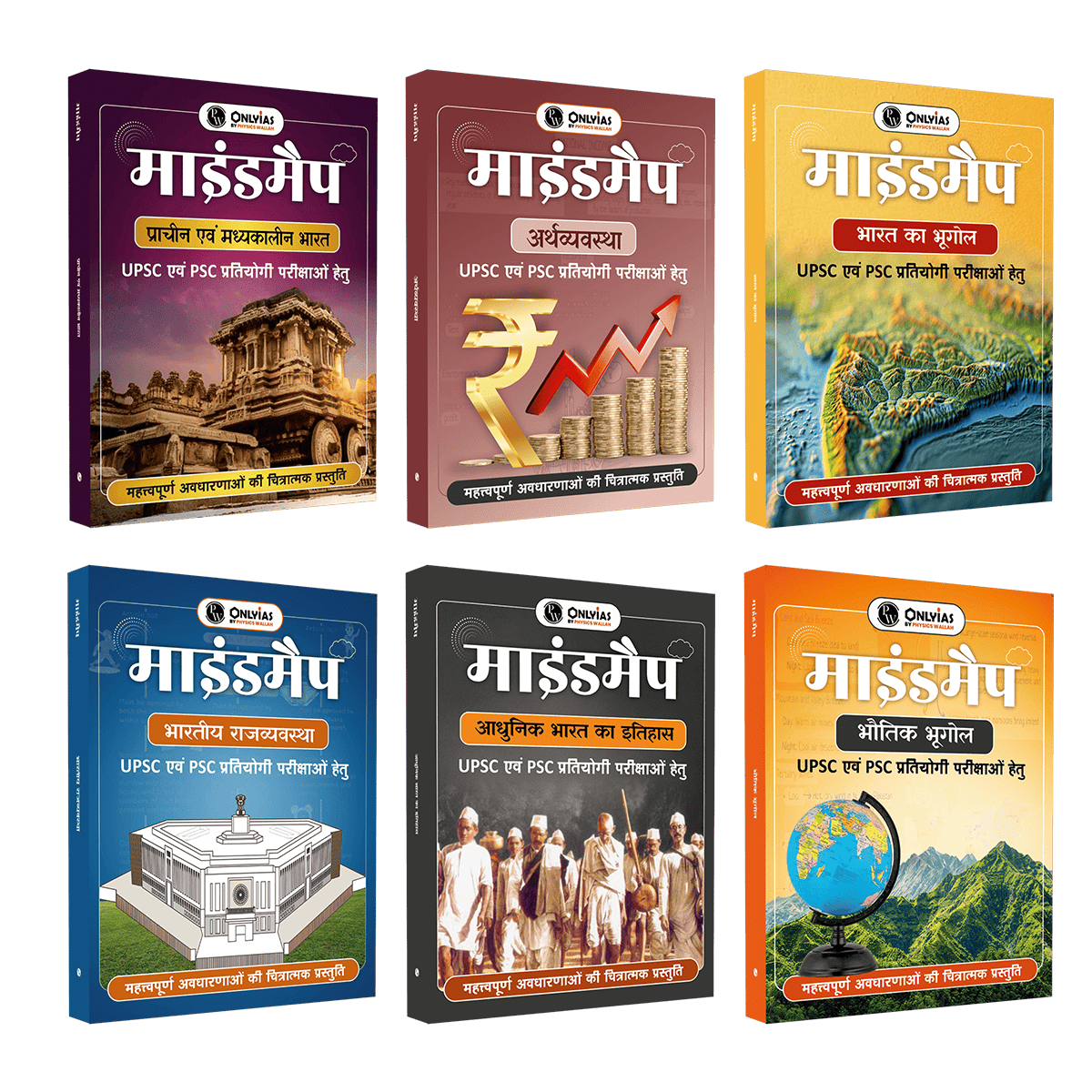
Use for Mental Filing: Once you finish a chapter, open the corresponding mind map to structure the information in your head. For example, after studying agriculture, use the mind map to organise crop requirements, like rice needing high rainfall and wheat needing a cool growing season. Resources such as the UPSC Mindmap Combo Set 6 can help present these interlinked concepts in a more visual and revision-friendly format.
-
Incorporate into Weekly Cycles: Set aside a fixed window every week to glance through the maps, keeping the spatial data and river tributaries fresh in your memory.
-
Active Recall Sessions: Close your eyes after looking at a branch and try to mentally redraw the connections to test your memory retention.
Study Plan for Using UPSC Geography Mind Maps
An effective strategy involving this indian geography book for IAS requires blending visual learning with active problem-solving. Candidates should use this tool as a revision anchor throughout their preparation journey.
-
Step 1: The Initial Reading: Complete a comprehensive read of your primary geographical topics to understand the underlying mechanisms and theories.
-
Step 2: The Filtered Map Drill: Open the mind maps alongside a blank mapping sheet. Practice marking the key locations, mineral belts, and river courses directly onto the sheet while referring to the visual branches.
-
Step 3: Previous Year Questions Integration: After reviewing a mind map, solve topic-wise previous year questions to see how the visual keywords match up with the actual exam patterns.
-
Step 4: Mains Answer Writing: Use the structured layouts to plan your Mains answers. The branches naturally provide a logical flow for introduction, categorization, and distribution, which can be directly replicated on the exam answer script.
Common Mistakes to Avoid While Using UPSC Geography Mind Maps
While the UPSC geography mind maps book is an exceptional tool, candidates often make specific errors that limit its overall effectiveness during their preparation.
-
Ignoring the Underlying "Why": Avoid using the maps for pure rote memorisation without understanding the core concepts. For instance, do not just memorise the location of oil refineries; understand the economic factors behind industrial placements.
-
Over-Reliance on Multiple Revision Resources: Hoarding too many different short notes and revision books leads to analysis paralysis. Stick to one solid primary textbook and one dedicated visual mind map resource.
-
Skipping the Economic and Social Dimensions: Many aspirants focus entirely on physical features and forget to study critical topics like agriculture, irrigation, and resource distribution, which are frequently tested.
-
Neglecting Active Mapping Practice: Reading a mind map is highly beneficial, but failing to physically practice drawing rough sketches or marking boundaries can hurt your performance in the geography section.
Read More: UPSC Prelims Geography Questions for 2026 Preparation
UPSC Geography Mind Maps FAQs
Q1: Is the UPSC geography mind maps book sufficient for the entire Civil Services exam?
A1: The mind maps book is an exceptional tool for rapid revision, organizing facts, and enhancing long-term memory retention. However, you should initially pair it with standard textbooks to build your core conceptual understanding before using the maps for active revision.
Q2: How does this Indian geography book for UPSC assist in Mains answer writing?
A2: The book structures information into logical branches and incorporates exam-relevant keywords. This layout helps candidates organize their thoughts quickly, allowing them to write structured answers and easily replicate clear flowcharts on their final answer scripts.
Q3: Can visual mind maps help in memorising river tributaries accurately?
A3: Yes, the book systematically divides major river networks like the Ganga and Indus into clear left-bank and right-bank branches. This visual separation makes it much simpler to differentiate and recall specific tributaries compared to reading them in plain text format.