What Made April 2026 Important for UPSC Current Affairs Preparation
Exceling the vast syllabus for civil services requires a strategic approach to tracking national and international events. For many candidates, managing the monthly influx of news creates significant overwhelm. This article breaks down why analyzing the UPSC monthly current affairs April edition is vital for your upcoming exam and how to streamline your study process.
Important Topics in UPSC Monthly Current Affairs April
The civil services examination demands a thorough knowledge of basic subjects mixed with current happenings. Looking back at the happenings of April 2026, there are important changes in government, economy and environmental protection which are very useful for applicants.
By focusing on this month, students are able to make connections between static syllabus topics and dynamic real-world updates. The monthly current affairs national landscape comprised of major policy discussions, legal reviews and infrastructure updates that are directly relevant to the analytical questions asked in the main examination.
Key Focus Areas for the Month
To structure your studies effectively, you need to divide the monthly news into distinct categories. Here is the primary breakdown of what stood out during this period:
-
Constitutional Amendments and Judgments: Key rulings that impact center-state relations and fundamental rights.
-
Economic Policy Shifts: Revisions in banking regulations and updates on bilateral trade agreements.
-
Environmental Conservation: New updates on international climate treaties and local wildlife conservation initiatives.
Importance of UPSC Monthly Current Affairs April for Prelims
The preliminary examination heavily tests a candidate's ability to recall specific facts, institutional frameworks, and global indices. The events of this month provided a substantial amount of material that fits the exact pattern of prelims current affairs questions.
Data shows that a significant percentage of factual questions are derived from international summits and bilateral treaties ratified during the spring months. Paying close attention to the April current affairs data ensures you do not miss scoring opportunities in the first stage of the exam.
International Relations and Science Updates
“Across the month, global geopolitics remained quite fluid. Candidates should be aware of the geographical location of international events as map questions are a regular feature of the preliminary paper.
Updates on space exploration missions and indigenous defence systems dominated the science and technology segment. These developments will make your current affairs notes for prelims comprehensive and updated.
To reinforce your learning, revise alongside an UPSC PYQ Book, which contains authentic previous year questions with detailed explanations and topic-wise analysis. Solving PYQs after completing monthly current affairs helps you understand how UPSC frames current affairs questions, identify recurring themes, and strengthen preparation for both the UPSC Prelims and Mains.
How to Use UPSC Monthly Current Affairs April for Better Preparation
Trying to keep up with reading several papers daily can lead to information overload. It is dedicated to this purpose organizes scattered news into structured modules aligned with the syllabus. This saves hundreds of person-hours of manual curation.
A wellcompiled magazine is a one-point source of truth which filters the political noise and retains only analytical facts required for the preparation of civil services. It bridges the gap between reading something one day and long-term remembering it.
Benefits of Consolidated Study Material
Using a dedicated monthly review offers distinct advantages for aspirants tracking the UPSC current affairs timeline:
-
Syllabus Mapping: Every news item is pre-classified under General Studies papers (GS I, II, III, or IV).
-
Time Conservation: Eliminates the need to browse multiple news websites daily.
-
Expert Curation: Complex bureaucratic updates are simplified into easy-to-digest summaries.
How to Build a Revision Plan with UPSC Monthly Current Affairs April
Retaining vast amounts of information over a year requires a systematic review process. Incorporating the April updates into your regular revision cycle ensures that you do not forget crucial data points when the exam approaches.
Experts suggest revisiting monthly notes at least three times before walking into the exam hall. The first reading should focus on understanding the core concept, the second on highlighting key facts, and the third on memorizing data points for active recall.
Effective Retention Techniques
To make your UPSC revision sessions more productive, consider using active learning strategies rather than passive reading:
-
Mind Mapping: Connect the April economic updates to standard macroeconomics concepts.
-
Flashcards: Use digital or physical cards to memorize names of international reports, regulatory bodies, and environmental schemes.
-
Answer Writing: Practice drafting answers by linking standard static topics to the month's highlights.
Key Highlights in UPSC Monthly Current Affairs April
A closer look at the UPSC current affairs books highlights from this period reveals a strong emphasis on sustainable development goals and digital governance infrastructure. The government introduced around three major digital initiatives aimed at improving rural delivery systems.
Understanding these highlights helps candidates formulate balanced arguments in the mains answer sheets. Examiners look for real-time examples to validate theoretical points, and the events of April 2026 provide excellent case studies.
|
GS Paper Category |
Key Focus Area from April 2026 |
Expected Question Type |
|
GS Paper II (Governance) |
Digital service delivery in rural sectors |
Analytical / Case Study |
|
GS Paper III (Economy) |
Trade pact updates and inflation targets |
Data-driven evaluation |
|
GS Paper III (Environment) |
Renewable energy targets and policy changes |
Critical assessment |
Last Minute Revision with UPSC Monthly Current Affairs April
Integrating daily newspaper reading with a comprehensive review of the UPSC monthly current affairs april cycle builds a solid foundation. Balancing both components ensures you develop the analytical mindset required for the interview stage as well.
Keep your UPSC books list minimal. Relying on one quality monthly magazine alongside your standard textbooks is far more effective than skimming through multiple sources without thorough revision.
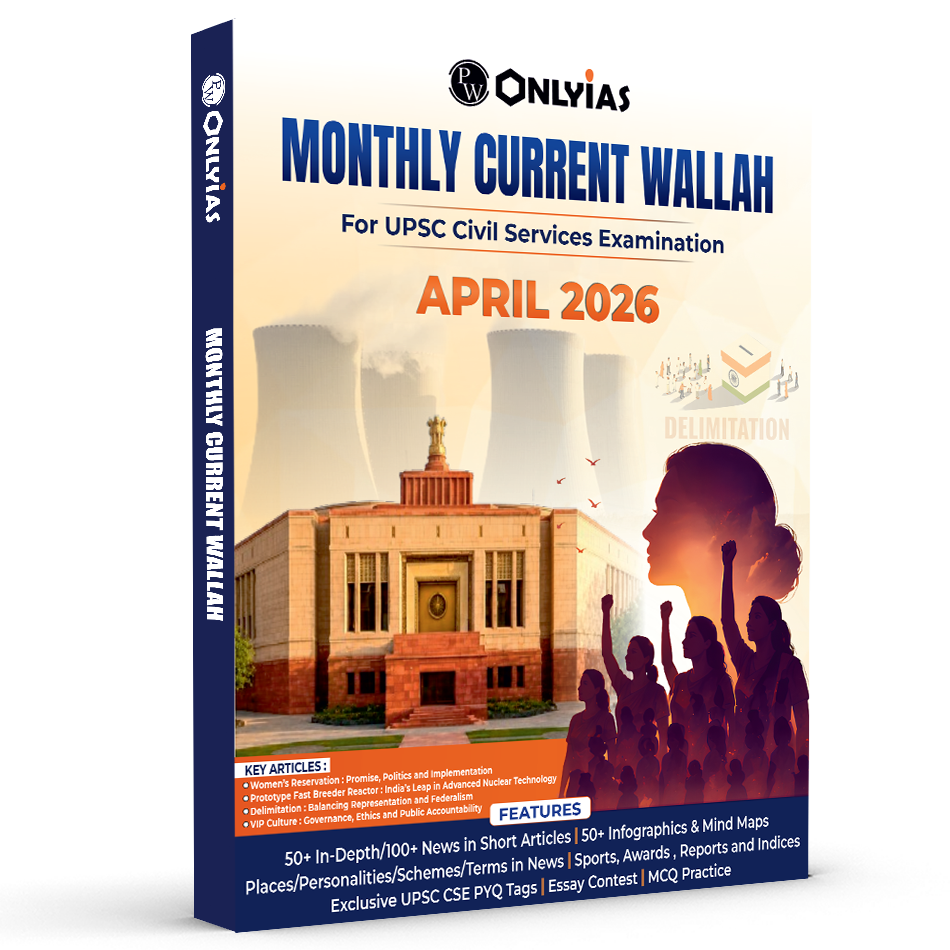
For candidates seeking a structured compilation of these specific events, the official product page provides a dedicated guide via the monthly current wallah april 2026 eng edition, ensuring all relevant syllabus topics are covered systematically.
Read More: Tips to Prepare UPSC Current Affairs - Prelims & Mains Exam
UPSC Monthly Current Affairs April FAQs
How many times should I revise the UPSC monthly current affairs april notes before the exam?
You should ideally complete at least three rounds of UPSC revision for any monthly module. The first round establishes conceptual clarity, the second focuses on key data points, and the final round ensures quick recall right before the exam date.
Why are the current affairs highlights of April crucial for the mains exam?
The developments during this period include significant policy decisions and legal reviews that serve as excellent real-world examples. Incorporating these recent updates into your answers demonstrates a strong command over dynamic syllabus topics.
Can I rely solely on a monthly magazine for my prelims current affairs preparation?
It is an exceptional tool for consolidation and revision. However, combining it with daily newspaper reading helps you build the initial context and analytical thinking required to understand complex issues deeply.
How do I filter out irrelevant news while studying the April 2026 current affairs?
Always keep the official syllabus copy next to your study table. If a news item does not directly relate to topics listed under the General Studies papers, it can generally be skipped to save time.
What is the right way to handle international relations updates for this month?
Focus on mapping the geographical areas mentioned in the news and understand the mandates of the international organizations involved. Tracking bilateral treaties signed during this period is highly beneficial for both stages of the examination.