How to Analyse CAT Previous Year Questions to Find Weak Areas?
Studying concepts in isolation rarely reveals how well you perform under real test conditions. When timer pressure builds up and multi-layered problems appear together, underlying skill gaps surface immediately.
Working through cat previous year questions systematically highlights these vulnerable areas. Identifying whether an error stems from weak foundational understanding, poor question selection, or calculation oversights is crucial.
A deliberate analysis process transforms raw practice scores into actionable insights, helping you refine your preparation strategy and approach every section with clarity.
Overview of CAT Previous Year Questions
The Common Admission Test evaluates candidates across three primary sections: Verbal Ability and Reading Comprehension (VARC), Data Interpretation and Logical Reasoning (DILR), and Quantitative Ability (QA).
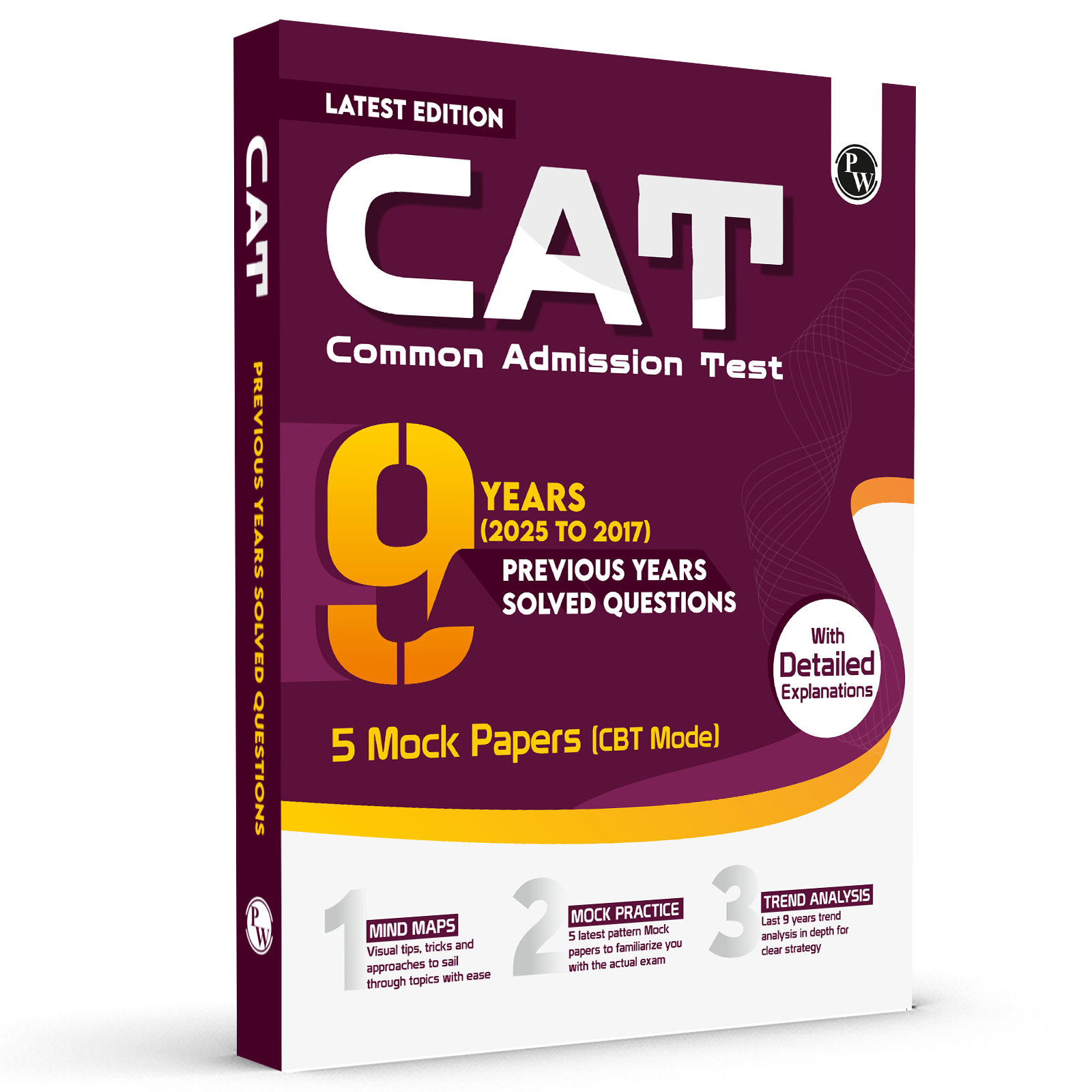
Past exam papers covering 9 years (2017 to 2025) reflect key structural shifts, such as changes in section lengths, time limits, and question counts.
Rather than relying solely on third-party mock tests that can be artificially difficult, past actual questions serve as the definitive standard for exam preparation.
|
Exam Section |
Standard Focus Areas |
Key Tested Skills |
|
VARC |
Reading Comprehension, Para Jumbles, Summary, Odd Sentence |
Inference drawing, context retention, structural logic |
|
DILR |
Arrangement Sets, Graphs, Logical Puzzles, Caselets |
Pattern recognition, data filtering, set selection |
|
QA |
Arithmetic, Algebra, Geometry, Number Systems |
Concept application, speed, algebraic manipulation |
How Do CAT Previous Year Questions Help Identify Weak Areas?
Engaging with CAT previous year questions offers a clear mirror of your true preparation level. Standard practice sets often focus on isolated formulas, whereas authentic past papers combine multiple concepts into a single problem.
Solving chapter-wise CAT PYQs from 2017–2025 exposes specific recurring weaknesses that might otherwise go unnoticed.
-
Conceptual Gaps: You understand the theory, but fail to execute the solution when formulas are framed in complex setups.
-
Speed and Pacing Bottlenecks: Spending excessive time on a single DILR set or QA problem reduces your total attempts.
-
Question Selection Errors: Choosing high-difficulty or time-consuming problems early in the section leads to panic and hasty mistakes.
-
Accuracy Fluctuations: Making simple calculation slips or misreading negative constraints under strict time pressure.
How to Analyse Your Performance in CAT Previous Year Questions?
A structured evaluation of CAT previous year questions requires more than checking whether an answer is right or wrong. Performing a thorough CAT PYQs analysis helps categorize errors into conceptual gaps, calculation slips, or time pressure mistakes.
1. Categorise Every Unattempted and Incorrect Response
Divide your wrong answers and skipped questions into three distinct categories:
-
Category A (Concept Deficit): Questions where you did not know the fundamental formula, rule, or logical step.
-
Category B (Execution Slip): Problems where your approach was correct, but a calculation mistake or reading oversight ruined the result.
-
Category C (Time Trap): Questions that took more than 3–4 minutes and still resulted in an incorrect answer.
2. Compare Time Spent Against Accuracy
Evaluate your time allocation for every section:
-
Identify questions where you spent over 2.5 minutes without making progress.
-
Note down sets in DILR where you spent 10 minutes before abandoning them.
-
Review correct answers to see if you relied on tedious methods instead of short-cut techniques or option elimination.
Practice Plan with CAT Previous Year Questions
Building a routine with CAT previous year questions ensures consistent skill development over time. A phase-wise breakdown helps balance concept learning with timed practice.
Phase 1: Topic-wise PYQs (2017–2025) ➔ Phase 2: Slot-wise Sectional Tests ➔ Phase 3: Full-Length CBT Practice
Phase 1: Topic-wise Solved Practice (Weeks 1–6)
-
Solve past questions arranged chapter-wise immediately after completing a topic.
-
Focus on understanding the step-by-step solutions and underlying logic.
-
Log tricky or unique question formats into an error journal for future review.
Phase 2: Sectional Timed Solving (Weeks 7–12)
-
Attempt individual 40-minute sectional tests using papers from recent years.
-
Practice real-time question selection by scanning the entire section during the first two minutes.
-
Build strict decision-making habits to skip lengthy questions quickly.
Phase 3: Full CBT Test Simulation (Weeks 13–16)
-
Take 120-minute full-length tests matching the exact Computer-Based Test (CBT) environment.
-
Use 5 mock tests based on recent exam patterns alongside past papers to test endurance.
-
Conduct a full 2-hour post-test analysis for every paper attempted.
Study Strategy Plan for Using CAT Previous Year Questions
A well-designed CAT preparation strategy focuses heavily on diagnostic testing and post-test review. Incorporating past papers into your weekly CAT study plan creates structured learning targets that drive continuous improvement. Alongside PYQ practice, MBA Books can help strengthen core concepts, provide topic-wise practice, and improve problem-solving skills across the key CAT sections.
-
Step 1: Diagnostic Baseline Assessment
Attempt a recent past slot (e.g., CAT 2025 Slot 1) without prior preparation to map your baseline accuracy in VARC, DILR, and QA. -
Step 2: Systematic Error Logging
Maintain a digital or physical error log detailing the chapter, question type, reason for failure, and correct approach for every wrong answer. -
Step 3: Targeted Remedial Practice
Spend 3–4 days revisiting basic concepts, visual mind maps, and solved examples for chapters with accuracy below 60%. -
Step 4: Retesting and Verification
Re-attempt missed questions after 10–14 days to confirm whether the conceptual gap is completely resolved.
Practice Sheet for Using CAT Previous Year Questions
Using a structured framework keeps your review session focused and productive. Track your attempt metrics using the model layout below:
|
Question / Set |
Topic / Chapter |
Time Spent |
Status (Correct/Wrong/Skipped) |
Primary Error Cause |
Action Item |
|
QA - Q1 |
Time & Work |
2.5 min |
Correct |
None |
Find shortcut method |
|
QA - Q2 |
Permutations |
3.5 min |
Wrong |
Conceptual gap |
Review basic counting principles |
|
DILR - Set 1 |
Matrix Arrangements |
11.0 min |
Skipped |
Misread clue 3 |
Practice 5 similar arrangement sets |
|
VARC - RC 1 |
Social Science Inference |
8.0 min |
Wrong |
Elimination trap |
Practice option negation techniques |
Tips for Using CAT Previous Year Questions
Applying smart practice habits maximizes the diagnostic value of past papers:
-
Use Trend-Based Question Analysis: Focus extra practice time on high-frequency topics like Arithmetic and Algebra in QA, or Arrangement and Matrix sets in DILR.
-
Simulate Real Exam Conditions: Solve full-length papers in a quiet space without pauses, external calculators, or reference materials.
-
Leverage Visual Mind Maps: Use visual summaries before practice sessions to quickly review key formulas and shortcuts.
-
Re-attempt Papers After a Gap: Solve papers from 2020–2022 again after a few weeks to verify if your accuracy and speed have improved.
-
Schedule Dedicated Review Hours: Allocate fixed time for CAT revision before starting new practice modules to reinforce weak areas.
Common Mistakes to Avoid While Solving CAT Previous Year Questions
Avoid these frequent pitfalls when evaluating past papers:
-
Solving Without a Timer: Working through problems in an un-timed environment builds a false sense of security regarding your actual solving speed.
-
Skipping Post-Test Evaluation: Jumping directly to the next paper without reviewing wrong answers defeats the diagnostic purpose of past papers.
-
Ignoring Option Elimination: Focusing solely on traditional step-by-step methods instead of using options to reach answers faster in Quantitative Ability.
-
Relying Only on Strong Sections: Spending most of your preparation time on comfortable subjects while ignoring persistent weak areas in other sections.
-
Memorising Specific Solutions: Learning steps by rote instead of mastering the broader problem-solving logic behind complex question types.
Read More: CAT Exam Syllabus for 2026 Exam
CAT PYQ FAQs
How many years of past papers should I analyse for CAT?
Analysing 9 years of past papers (2017 to 2025) provides complete coverage of current pattern shifts, difficulty variations, and topic weightages across all three test sections.
Are past questions enough to identify all weak areas in Quant?
Past questions highlight major weak areas in Quant, but combining them with structured topic tests and mock exams ensures comprehensive concept mastery.
How often should I re-solve past questions?
You should re-solve incorrect or skipped questions every 2–3 weeks to confirm that your conceptual understanding and speed have truly improved.
Should I practice past papers chapter-wise or full-length?
Start with chapter-wise practice during the early phase of preparation to build accuracy, then transition to full-length timed papers closer to the exam.
What accuracy rate should I target during past paper analysis?
Target an accuracy rate of 80% or higher on easy-to-moderate questions, while focusing on improving question selection to skip high-difficulty time traps.