CFA Level 1 Books: Which Books Should You Use for Preparation?
There is a high learning curve for many commerce graduates and financial professionals from university texts to global professional certifications. There are eleven subject areas. To navigate them, you need structured reading material that demystifies difficult quantitative methodologies, corporate finance, and economic frameworks without sacrificing technical precision. Choosing the right CFA level 1 books helps cut down your study time, so each hour you spend reading translates into better practice exam scores and better topic memory.
How to Choose CFA Level 1 Books
Success of any study strategy greatly depends on use of full CFA level 1 study material covering all the 10 subject weights assigned by the institute. The amount of content might be overwhelming for learners, which underlines the need to distinguish between primary textbooks and supplementary guides. The official syllabus is the final word, particularly on ethics and professional conduct, although a lot of candidates choose to go for shorter options to save time on initial reading.
-
Official Curriculum Volumes: Directly sourced from the governing body, these texts provide exhaustive explanations of every single Learning Outcome Statement.
-
Third-Party Summaries: Compact volumes condense heavy paragraphs into digestible bullet points, allowing faster navigation through dense corporate finance theories.
-
Practice-Oriented Workbooks: Dedicated problem books help bridge the gap between theoretical formulas and actual computer-based exam application.
When selecting between different CFA preparation books, candidates should first consider how each resource fits into their preparation stage. A detailed curriculum can be useful when learning a topic for the first time, while a concise review book may be more suitable for revision. It is also important to check whether the book includes practice questions, worked examples, formula summaries, and explanations of difficult concepts.
Candidates should avoid collecting too many books without a clear purpose. Using several resources for the same topic can create overlapping content and consume valuable study time. Instead, choose one primary source for learning, one question-focused resource for practice, and additional material only when a particular concept needs further explanation. This keeps the study process organised and makes revision easier as the exam approaches.
CFA Books: Explore concept-focused study material, practice questions, examples and revision resources to cover key topics and prepare effectively for the CFA Level 1 exam.
CFA Books for Beginners and First Time Candidates
Many people who are new to finance look for CFA books for beginners that cover the fundamentals, such as the time value of money, financial reporting requirements, and portfolio management from the ground up. Traditional academic literature sometimes get in the way, because of the dense vocabulary. So, structured review books have an important place in early-stage learning. Beginner friendly publications are publications where students who are not very math heavy can easily understand the introduction quantitative techniques.
-
Simplified Concept Breakdowns: Explanations avoid overly academic language, offering intuitive examples from real-world financial markets.
-
Chapter-End Concept Checkers: Short review questions immediately follow subtopics to confirm whether the reader has digested the core financial principle.
-
Formula Cheat Sheets: Compact summary pages compile crucial equations at the end of each section for rapid last-minute reviews.
Beginners should also pay attention to how a book introduces unfamiliar financial terminology. A good introductory resource should explain concepts gradually instead of assuming that the learner already understands accounting, investments, or financial markets. Examples and practical applications can make abstract topics easier to understand and help learners connect new ideas with concepts they may have studied previously.
Quantitative Methods is sometimes a particularly tough paper for applicants who have not previously studied maths or statistics. So a book for beginners should give a good number of worked examples before going on to practice questions. The candidates can first comprehend the process of calculation and then try comparable questions without resorting to the solution. You may do this over and over again and improve your confidence and accuracy with time.
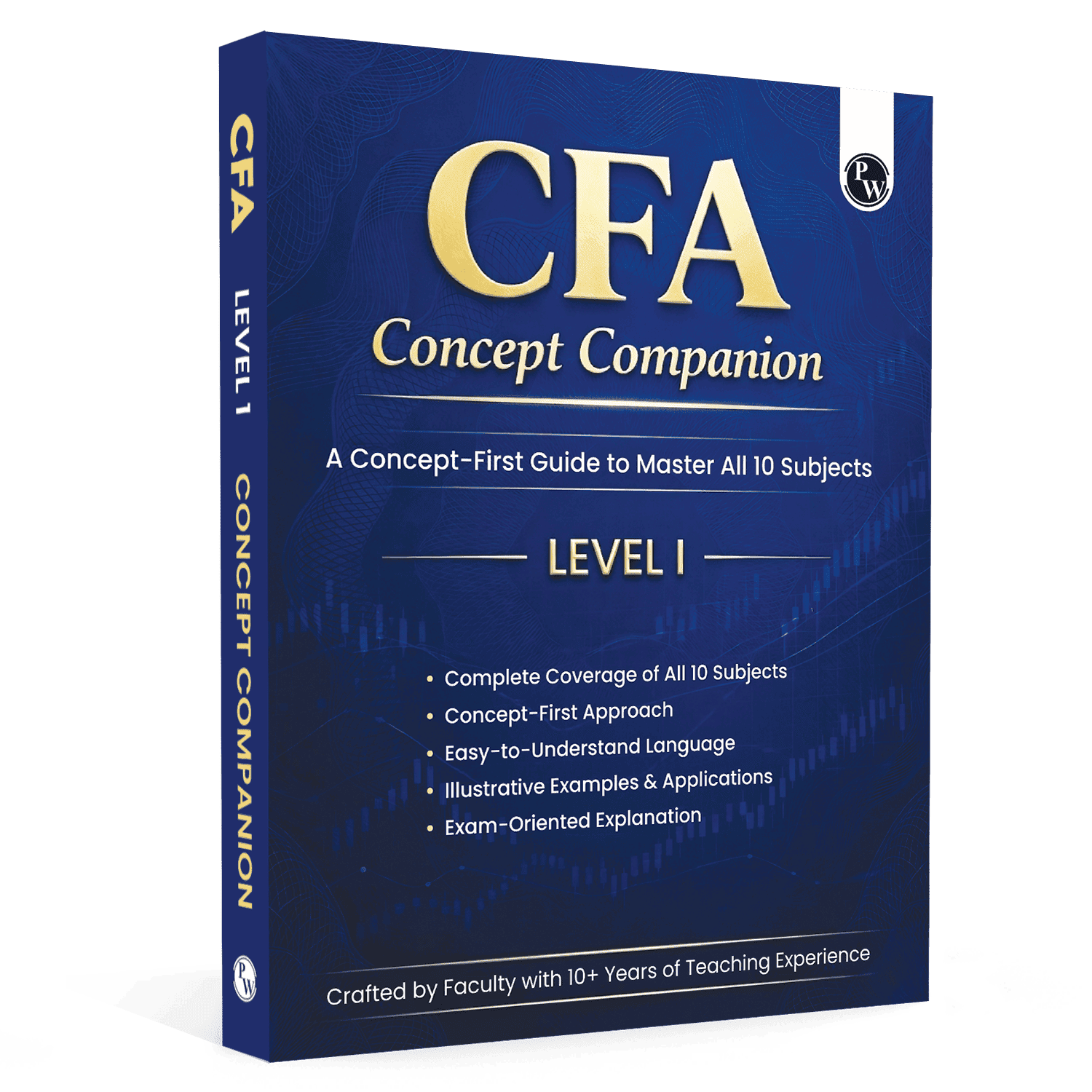
PW CFA Concept Companion Level 1 Book covers all 10 subjects with a concept-first approach, easy exam-oriented explanations and examples, crafted by experienced faculty for focused CFA preparation.
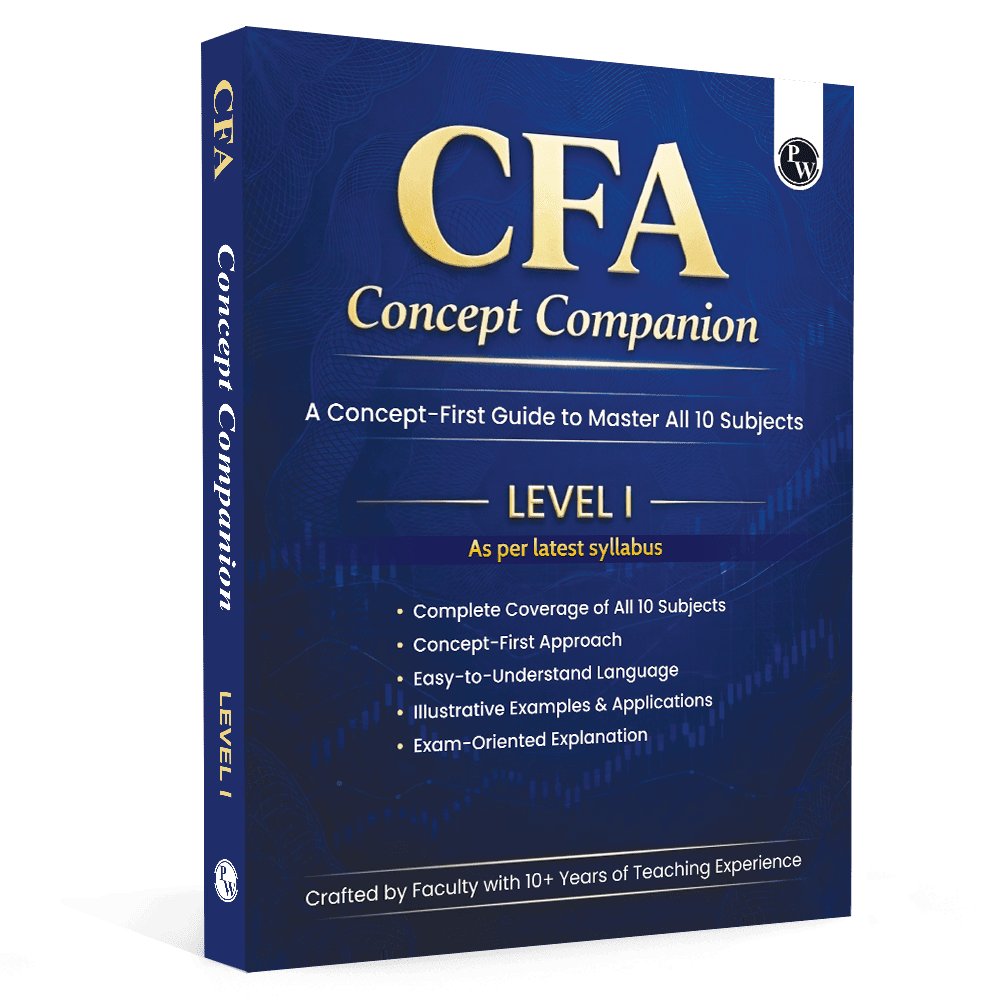
CFA Level 1 Book 2027 Edition covers all 10 subjects with a concept-first approach, easy exam-oriented explanations and examples, aligned with the latest syllabus for focused CFA Level 1 preparation.
CFA Level 1 Books and Study Plan
Accessing the best books for CFA level 1 is only half the battle. How well a candidate can withstand real testing pressure depends on how well these books are integrated with robust digital assessment tools. Passive reading produces a false sense of security; active problem solving reveals weaknesses in understanding of corporate issuers, derivatives and alternative investments. Textbook theory mixed with high volume question practice creates the speed and precision needed on exam day.
-
Phase One - Concept Absorption: Spend the initial months reading through comprehensive chapters and taking detailed handwritten summary notes.
-
Phase Two - Topic Testing: Immediately solve end-of-chapter practice problems to identify weak spots in quantitative methods or fixed income valuation.
-
Phase Three - Timed Simulation: Dedicate the final weeks entirely to full-length digital mock exams under strict time constraints.
A weekly schedule can make these phases easier to manage. Instead of setting a broad target such as completing an entire subject in one week, divide the material into smaller daily tasks. Allocate specific sessions for reading, question practice, revision, and error analysis. This gives candidates a clearer idea of whether they are progressing according to their planned timeline.
Candidates should also leave buffer days in their schedule. Unexpected work commitments, difficult chapters, or slower-than-expected practice sessions can affect the original plan. Having some flexibility prevents one missed study session from disrupting the entire preparation calendar. A weekly review can then be used to move unfinished topics into the following week without abandoning revision altogether.
Read More - CFA Level 1 Exam Pattern
Best CFA Level 1 Books and Question Banks
Accessing the best books for CFA level 1 is only half the battle; integrating them with robust digital assessment platforms determines how well a candidate handles actual testing pressure. Passive reading often creates a false sense of security, whereas active problem-solving exposes gaps in understanding corporate issuers, derivatives, and alternative investments. Balancing textbook theory with high-volume question practice builds the speed and accuracy required on test day.
-
Active Recall Techniques: Test memory by closing the textbook immediately after a chapter review and writing down key formulas from scratch.
-
Error Log Maintenance: Keep a separate register for incorrectly answered practice questions to review structural mistakes weekly.
-
Subject Weight Alignment: Allocate study hours proportionally, giving extra attention to heavily weighted topics like financial statement analysis.
Question banks become more useful when candidates analyse their incorrect answers instead of simply checking their scores. After completing a practice set, review every wrong answer and determine whether the issue was a forgotten formula, misunderstanding of a concept, calculation error, or incorrect interpretation of the question. This process turns each practice session into a targeted revision exercise.
The questions steadily get harder which is also beneficial. Start with topic-wise questions as soon as you finish a chapter and then progress to mixed-topic sets after covering a few subjects. Mixed practice encourages students to first identify the appropriate concept before completing the problem, which is important in checking if the material has been maintained beyond individual chapter borders.
FAQs
What subjects are covered in CFA level 1 books?
The curriculum covers ten core topics, including ethical and professional standards, quantitative methods, economics, financial statement analysis, corporate issuers, equity investments, fixed income, derivatives, alternative investments, and portfolio management.
Are third-party study guides enough to pass the exam?
While third-party condensed guides are excellent for saving time and clarifying difficult formulas, many successful candidates cross-verify complex ethical standards and professional guidelines directly from the official primary curriculum volumes.
How many months of preparation do these books require?
Most candidates require between three to six months of consistent studying, dedicating roughly twelve to fifteen hours per week to read chapters, make short notes, and solve practice questions.
Can beginners without a finance background use these books?
Yes, specially curated review books and beginner-friendly modules start from fundamental financial principles, making it easier for non-finance graduates to build a progressive understanding of capital markets.
How important are practice questions included in study books?
Chapter-end practice questions are critical because they mirror the actual exam format, helping candidates improve time management, enhance accuracy, and identify specific subtopics requiring revision.