CUET Maths Chapter Wise Weightage 2026
To do well on the 2026 exam, you need to know the CUET maths chapter wise weightage. There will be 10 to 12 questions on calculus and 7 to 9 questions on algebra. To get the best score, you need to answer all 15 questions in Section A and choose either Mathematics or Applied Mathematics for Section B.
Check out: CUET Books
CUET Maths Chapter Wise Weightage 2026 Overview
Introduction to CUET Maths Exam
The Common University Entrance Test (CUET) is now the main means for students to get into top central universities in India. For a lot of people, the mathematics exam is the hardest but most rewarding subject in the area. The CUET Maths exam pattern for 2026 is designed to test your conceptual clarity rather than just your ability to memorise formulas. Whether you are aiming for a B.Sc. Honours, Economics, or Engineering courses, performing well in this section is non-negotiable.
Importance of Knowing CUET Maths Weightage
To do well on a competitive exam, you need to do more than just study hard. You also need to study wisely. Knowing the weightage helps you figure out which chapters will help you get a higher score and which ones need more work. You can focus on the parts of the syllabus that come up most often in the paper instead of getting lost in the whole thing. This planned method makes sure you don't spend weeks researching a topic that might only lead to one inquiry.
How Chapter Wise Weightage Helps in Preparation
You can make a list of issues in order of importance after you know how much weight each one has. If you know that calculus is worth 25–30% of the marks, for example, you will naturally put it ahead of smaller chapters. This clarity lowers test anxiety and helps you manage your time better when you study every day. It also helps you choose which subjects to go over more than once before the big day.
CUET Maths Chapter Wise Weightage and Syllabus Breakdown
CUET Mathematics Syllabus Weightage
There are two main elements to the syllabus weightage: Section A and Section B. Everyone must take Section A, which has 15 questions in both fundamental and applied maths. There are two parts to Section B: B1 (Core Maths) and B2 (Applied Maths). Students pick one depending on what they already know. This structure ensures that students from different academic streams have a fair playing field.
Section-Wise Distribution of Topics
-
There are 15 questions in Section A (required). These include basic subjects that are common to both core and applied streams, including algebra, calculus, and integration.
-
There are 35 questions in Section B1 (Core Mathematics), and you can answer any 25 of them. This part is about the regular Class 12 NCERT syllabus, which includes vectors, calculus, and relations and functions.
-
There are 35 questions in Section B2 (Applied Mathematics), and you can answer any 25 of them. Some of these topics are linear programming, financial mathematics, and probability distributions.
Key Areas Covered in CUET Maths
The Class 12 NCERT curriculum is the main part of the syllabus. Some important areas are:
-
Relations and Functions: The foundation of advanced mathematics.
-
Algebra: specifically, matrices and determinants.
-
Calculus: The most significant portion involves derivatives and integrals.
-
Probability: A high-scoring area if concepts are clear.
Check out - CUET Question Bank
CUET Maths Chapter Wise Weightage for Important Topics
Algebra Chapter Weightage
In the CUET maths chapter wise weightage, algebra remains a steady favourite. You can expect around 7 to 9 questions from Matrices and Determinants. Most people think they are "easy to moderate" in terms of difficulty.
-
Matrices: Kinds, operations, and adjoints.
-
Determinants: How to get the inverse of a number and how to solve a system of linear equations.
-
Linear Programming: Usually gives you 2 to 3 simple questions.
Calculus Chapter Weightage
Calculus is the "heavyweight champion" of the CUET Maths weightage chapter wise. It normally has 10 to 12 questions.
-
Continuity and Differentiability: Concentrate on the chain rule and logarithmic differentiation.
-
Derivatives: are very important for things like tangents, normals, and maxima/minima.
-
Integrals: There are a lot of tests on both definite and indefinite integrals.
-
Differential Equations: Order, degree, and solving separable equations.
Probability and Statistics Weightage
Probability is a crucial CUET maths topic for preparation. You can expect 4 to 6 questions from this area.
-
Conditional Probability: A recurring theme in CUET.
-
Bayes' Theorem: Frequently asked in Section B1.
-
Random Variables: Understanding mean and variance is key for the Applied Maths section.
Vectors and 3D Geometry Weightage
This section is highly visual and formula-based. It carries a weightage of roughly 6 to 8 questions.
-
Vectors: Dot product and cross product are the most common question types.
-
3D Geometry: Focus on the distance between points, direction cosines, and equations of lines/planes in space.
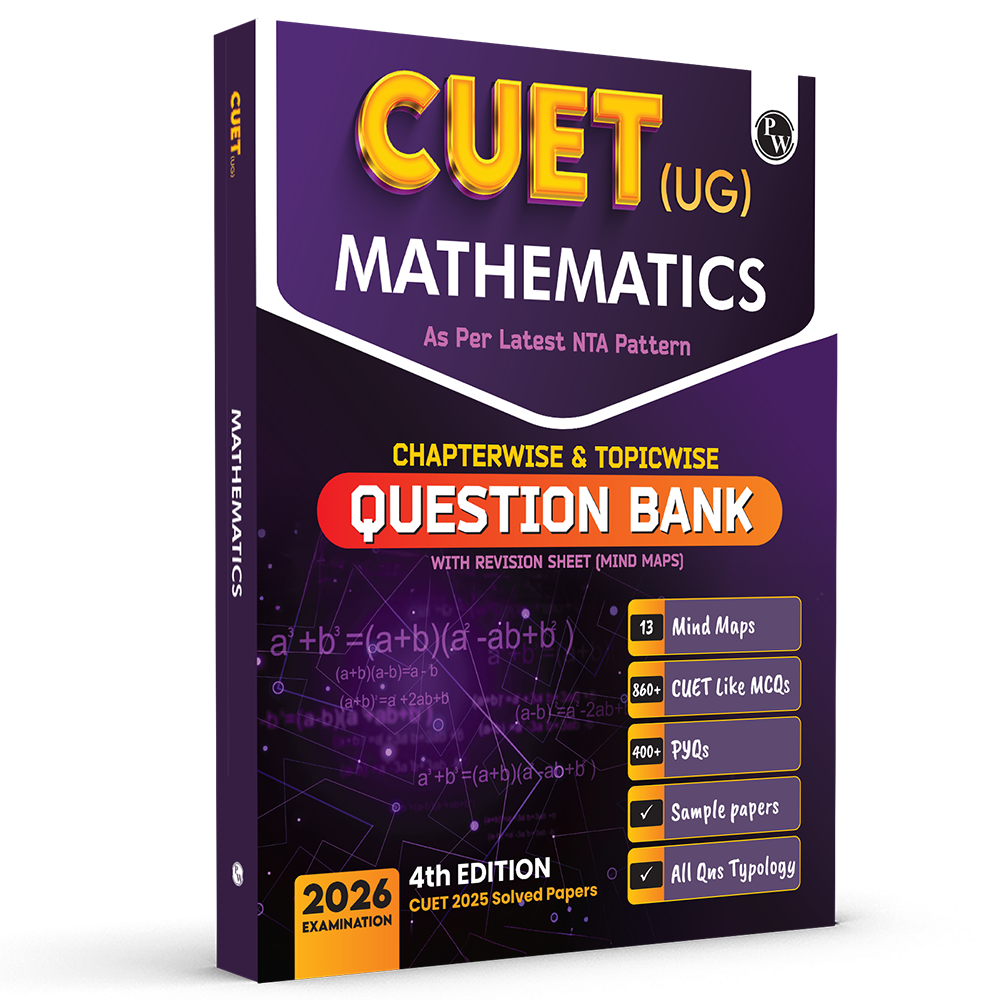
Check Out: CUET (UG) Mathematics Chapterwise & Topicwise Question Bank
CUET Maths Chapter Wise Weightage and Exam Pattern 2026
CUET Maths Exam Pattern 2026
There are 50 questions in the exam pattern. But you don't have to answer all of them.
-
Questions in Total: 50
-
Questions to Answer: 40
-
Time: 60 minutes (Math receives more time than some other subjects).
Marking Scheme and Question Format
The grading system is simple, however it does have negative marking, so be careful:
-
Correct Answer: +5 marks.
-
Incorrect Answer: -1 mark.
-
Unanswered: 0 marks.
The questions are all Multiple Choice Questions (MCQs), and they are usually of the match-the-following or assertion-reasoning kind.
Number of Questions from Each Section
The breakdown is designed to test breadth and depth:
-
Section A: 15 questions (all mandatory).
-
Section B1/B2: 35 questions (you choose only 25).
Total: You must solve 40 questions within the allotted hour.
CUET Maths Chapter Wise Weightage for Preparation Strategy
CUET Maths Important Topics for Preparation
To score high, you must master these important CUET Maths topics:
-
Matrices & Determinants: High reward, low effort.
-
Integration: Focus on properties of definite integrals.
-
Vector Algebra: Easy to visualise and solve quickly.
-
Probability: Essential for both core and applied students.
Tips to Prepare High-Weightage Chapters
-
NCERT is King: Most questions are derived directly from NCERT concepts. Solve every "Example" and "Miscellaneous Exercise".
-
Timed Practice: Since you have 60 minutes for 40 questions, you have roughly 1.5 minutes per question. Practise with a stopwatch.
-
Focus on Properties: In calculus and algebra, knowing the properties (like those of determinants or definite integrals) can save you from lengthy calculations.
How to Plan CUET Maths Study Schedule
Start by tackling calculus early, as it requires the most practice. Dedicate one week to algebra and one week to vectors. Keep the probability for the end, as it requires fresh logic. Ensure you take at least 10 full-length mock tests to get used to the CUET Maths exam pattern 2026.
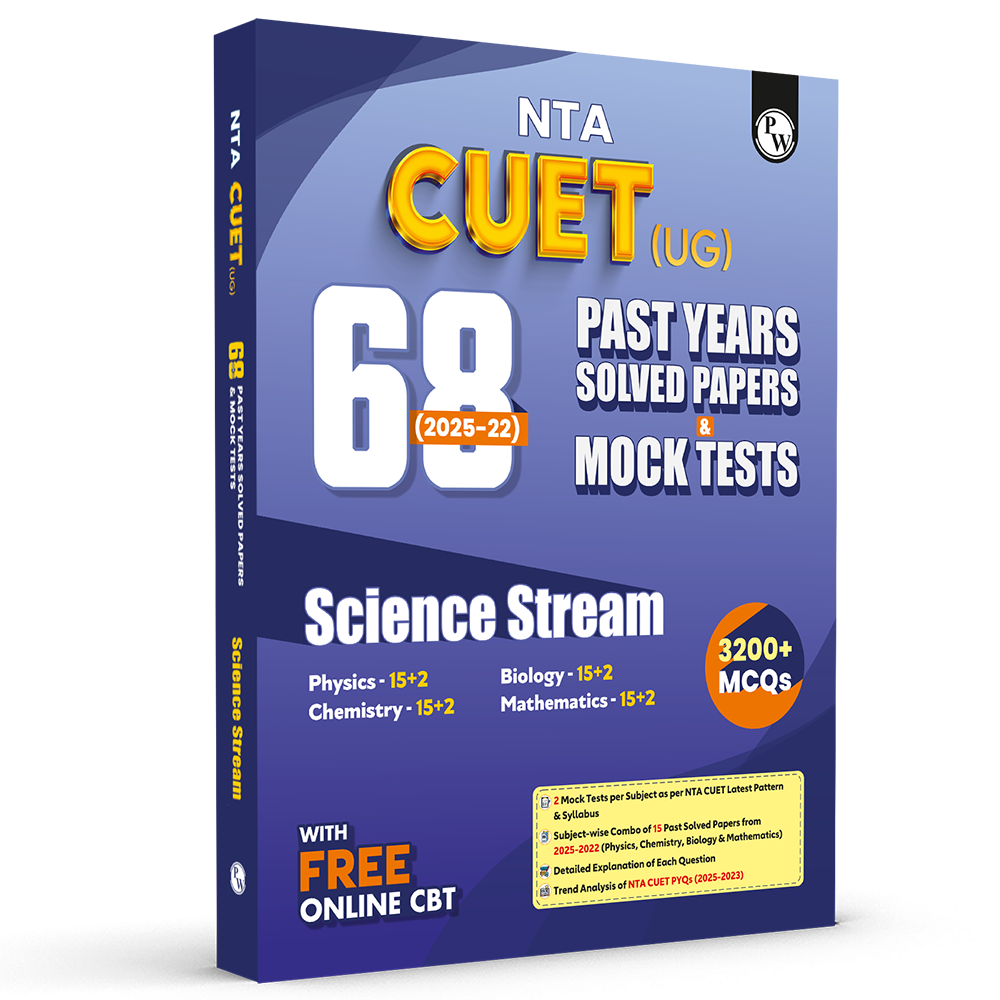
Check Out: CUET Mock Test + PYQs
CUET Maths Chapter Wise Weightage Table
The following table provides an estimated distribution of questions based on previous trends and the weightage.
|
Unit / Chapter |
Estimated Number of Questions |
Weightage (Approx) |
|
Algebra (Matrices & Determinants) |
7 - 9 |
18% - 22% |
|
Calculus (Differentiation & Integration) |
10 - 12 |
25% - 30% |
|
Relations and Functions |
4 - 5 |
10% - 12% |
|
Vectors and 3D Geometry |
6 - 8 |
15% - 20% |
|
Probability |
4 - 6 |
10% - 15% |
|
Linear Programming |
2 - 3 |
5% |
|
Applied Maths (Financial/Stats) |
5 - 7 |
12% - 15% |
Estimated Topic Wise Weightage for CUET Maths
Beyond just the chapters, the CUET maths topic wise weightage shows that "Applications" (like the application of integrals or derivatives) usually see 3-4 questions. This means the exam doesn't just want you to solve equations; it wants you to understand how those equations apply to real-world shapes and rates of change.
Read More: CUET Weightage Chapter Wise 2026
CUET Maths Chapter Wise Weightage FAQs
How many questions are asked in the CUET maths exam?
The paper contains 50 questions in total. Students are required to attempt 40 questions: 15 from the compulsory Section A and 25 from their chosen Section B (B1 or B2).
Which chapters carry the highest weightage in CUET Maths?
Calculus (differentiation and integration) and algebra (matrices and determinants) carry the highest weightage, accounting for nearly 50% of the total marks combined.
Is calculus necessary for getting ready for CUET maths?
Yes, calculus is the most important unit. It usually has 10 to 12 questions, therefore anyone who wants to score over the 95th percentile should pay close attention to this area.
How may students decide which chapters to study first for the CUET Maths exam?
Students should follow the chapter-wise weightage by first understanding algebra and vectors, which will give them the most points. Then they should go on to the big calculus unit, and ultimately they should work on probability and relations.
Does CUET use the same mathematical curriculum as NCERT?
Yes, for sure. The Class 12 NCERT curriculum is the only thing that the CUET syllabus is based on. The best method to get ready for the CUET Maths exam is to work on NCERT exercises and example questions.