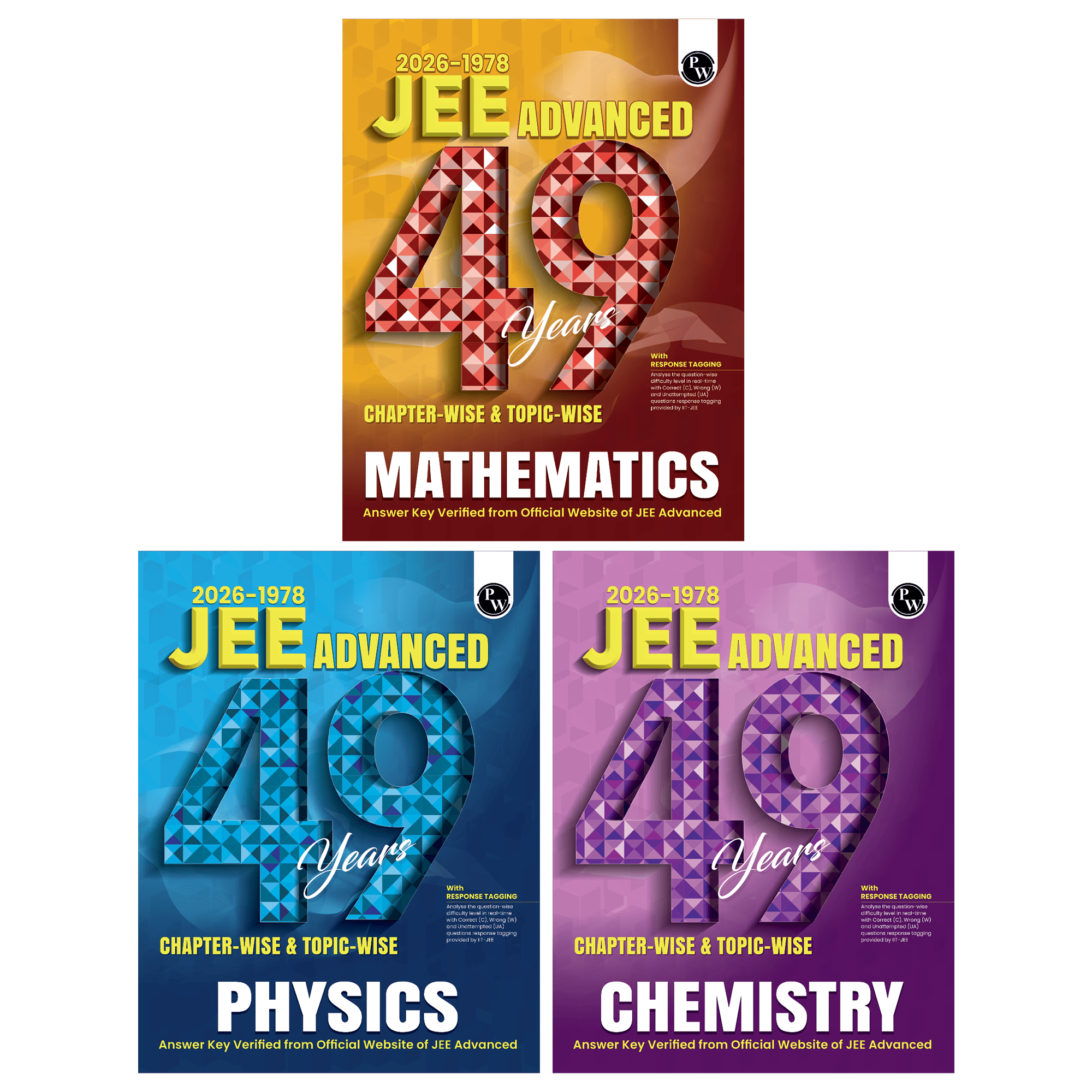
3 Months JEE Advanced 2027 Study Plan with PYQ Book

With roughly three months remaining, many aspirants hit a plateau where reading textbook theory no longer yields score improvements. The panic of unsolved advanced-level numericals begin to settle in as deadlines approach.
To bridge the gap between basic conceptual understanding and exam-level problem-solving, you need a structured strategy focused entirely on real past paper trends. Integrating a dedicated JEE advanced PYQ book into your daily routine allows you to test your application skills under timed conditions and refine your weak areas before the final examination.
Importance of JEE Advanced PYQ Book
Using a dedicated past year question compilation is essential during the final months of your preparation. Standard practice material often fails to replicate the exact depth, multi-concept integration, and analytical rigour demanded by the entrance exam.
-
Understanding Real Exam Rigour: Solving actual questions from 1978 through 2026 exposes you to authentic question structures rather than theoretical scenarios.
-
Tracking Trend Shifts: Evaluating past paper patterns over decades helps you identify how topic weightages and difficulty levels have evolved.
-
Eliminating Surprise Factors: Familiarity with multiple-correct, numerical-value, and matching-list format questions prevents panic on exam day.
-
Pinpointing Learning Gaps: Direct application reveals whether your conceptual understanding is sufficient for advanced multi-chapter problems.
Features of JEE Advanced PYQ Book
A complete standard resource provides structured learning tools designed to streamline revision across Physics, Chemistry, and Mathematics.
-
49 Years of Authentic Questions: Comprehensive coverage spanning solved papers from 1978 to 2026.
-
Chapterwise and Topicwise Sorting: Questions are systematically categorized to enable targeted practice alongside your daily revision syllabus.
-
Verified Answer Keys and Step-by-Step Solutions: Accurate solutions aligned with official answer keys help build problem-solving accuracy.
-
Trend Analysis of Last 7 Years: Dedicated analytical breakdowns highlight emerging question styles and subject-wise weightages.
-
Performance Data from Last 14 Papers: Structural insights covering correct, incorrect, unattempted, and partially correct response patterns help refine test-taking strategies.
Topics Covered with a JEE Advanced PYQ Book in 3 Months
A 3-month revision cycle requires systematic coverage across all three primary subjects. Utilizing JEE Previous Year Papers through a chapterwise compilation ensures balanced practice across the entire syllabus.
|
Subject |
Primary Focus Areas Covered |
|
Physics |
Mechanics, Electricity and Magnetism, Optics, Modern Physics, Thermodynamics |
|
Chemistry |
Physical Chemistry, Organic Reaction Mechanisms, Inorganic Coordination Compounds, Bonding |
|
Mathematics |
Calculus, Coordinate Geometry, Algebra, Vectors and 3D Geometry, Trigonometry |
How to Use a JEE Advanced PYQ Book in a 3-Month Study Plan
Integrating past papers effectively requires moving beyond passive reading. You must actively engage with every problem to build genuine analytical speed.
-
Solve Unassisted First: Spend at least 5 to 7 minutes attempting a problem independently before looking at the solution key.
-
Analyze Error Patterns: Categorize mistakes into conceptual gaps, calculation slips, or question misreadings.
-
Mark High-Difficulty Questions: Highlight complex multi-concept problems during your first pass so you can revisit them in the final two weeks.
-
Study the Solution Methodology: Compare your working method against the step-by-step solution to discover shorter analytical pathways.
When to Solve Questions from a JEE Advanced PYQ Book
Timing your practice sessions properly ensures maximum retention and prevents burnout during the crucial mid-term to final transition phase. Using JEE Books alongside a structured schedule can provide consistent practice and strengthen exam preparation.
-
Immediately After Chapter Revision: Complete topicwise questions right after finishing the theoretical summary of a chapter.
-
During Timed Morning Blocks: Allocate 2 to 3 hours in the morning strictly for uninterrupted problem-solving to build mental stamina.
-
During Weekly Self-Assessment Days: Use full chapter sets at the end of every week to test your overall speed and accuracy under simulated conditions.
Step-by-step Study Plan with a JEE Advanced PYQ Book
A structured 90-day timetable breaks down the overwhelming syllabus into manageable weekly targets.
Month 1: High-Weightage Foundations and Core Chapters
The first month focuses on establishing strong accuracy in high-yield topics across all three subjects.
-
Week 1 & 2: Dedicate time to Mechanics in Physics, Algebra and Calculus basics in Mathematics, and Physical Chemistry topics. Complete all relevant topicwise questions.
-
Week 3 & 4: Transition to Electricity, Magnetism, Organic Chemistry mechanisms, and Coordinate Geometry. Work through the past 14 years of questions for these specific chapters.
Month 2: Advanced Integration and Trend Analysis
The second month emphasizes multi-conceptual problems and speed optimization.
-
Week 5 & 6: Focus on Modern Physics, Optics, Inorganic Coordination Chemistry, and Vectors & 3D Geometry.
-
Week 7 & 8: Review performance data from the last 7 years of papers. Re-solve questions where partial marking rules apply to refine your option-elimination skills.
Month 3: Full Syllabus Revision and Speed Tuning
The final month transitions from chapter-based practice to full-length paper simulation.
-
Week 9 & 10: Re-attempt all bookmarked/highlighted difficult questions from earlier months.
-
Week 11 & 12: Solve complete previous year papers from 2020 through 2026 in strict 3-hour timed environments.
Tips to Get More from a JEE Advanced PYQ Book in 3 Months
-
Maintain an Error Log: Write down every formula or concept you missed during practice in a dedicated notebook.
-
Focus on Partial Marking Strategies: Practice multi-correct options carefully to learn when to lock in safe partial marks versus risking negative marks.
-
Avoid Memorising Answers: Focus entirely on the underlying principles rather than remembering specific numerical outcomes.
-
Utilize Trend Charts: Align your daily study order with the trend analysis section to prioritize high-yield chapters first.
Also Check - JEE Advanced Rankers Test Series 2026
Practice Sheet for a JEE Advanced PYQ Book During Final Preparation
Use this simple daily tracking framework to measure your progress throughout the 90-day preparation window:
-
Target Daily Question Count: 30 to 40 advanced-level problems across two subjects.
-
Time Target: 3 minutes per single-choice question; 5 minutes per multi-correct or numerical-value question.
-
Accuracy Threshold: Aim for greater than 75% accuracy on first attempt before reviewing solutions.
-
Weekly Review: Re-solve at least 15 incorrectly answered questions every Sunday.
Read More; How Much Score Is Good in JEE Advanced?
JEE Advanced PYQ Book FAQs
How many years of past papers are sufficient for the exam?
Practicing 40 to 49 years of past questions provides comprehensive coverage, but focusing intensely on the trend analysis of the last 14 years gives the most relevant insight into modern exam patterns.
Is a past year question compilation enough for high ranks?
A past paper compilation is essential for understanding question depth and application. However, it should be paired with strong conceptual theory and regular mock test practice.
Should I solve previous papers chapterwise or yearwise?
During the first two months of your final preparation, solve questions chapterwise and topicwise. In the final month, switch to solving full yearwise papers under timed exam conditions.
How do I manage negative marking using past papers?
Analyze performance statistics provided in standard solutions to track unattempted versus incorrect responses. Learn to skip uncertain options in multiple-correct questions where partial marks are available.
Can I rely solely on solutions when stuck on a question?
Try solving the problem independently for at least 5 minutes. If you remain stuck, review only the first step of the solution, then try to complete the remaining steps on your own.