How to Improve JEE Chemistry Score from 120 to 150+
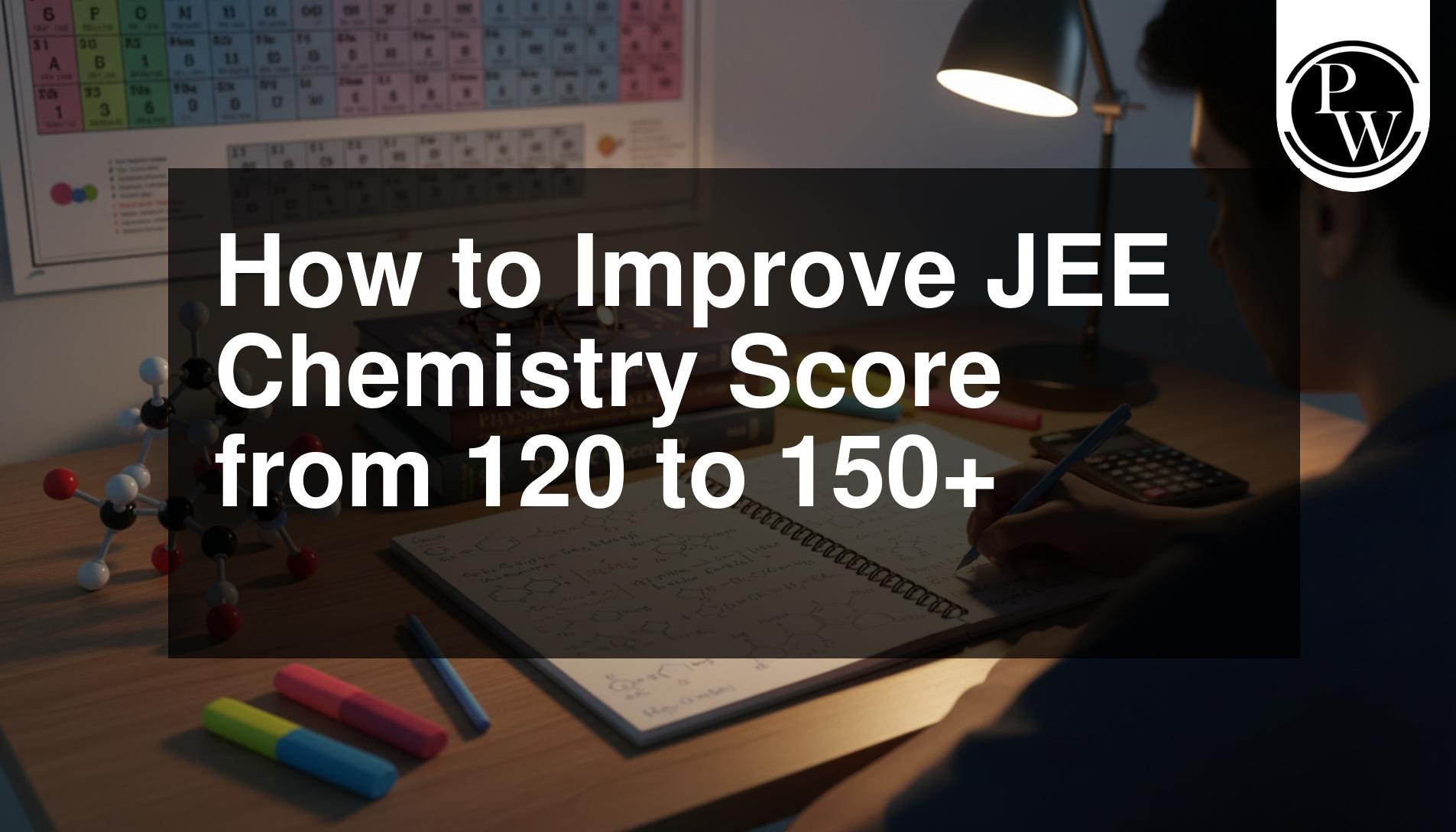
Many aspirants find themselves stuck around the 120-mark barrier, struggling to gain the extra points needed for a top percentile. Securing a higher JEE Chemistry score can improve your overall rank, especially because Chemistry often requires less calculation time than Mathematics or Physics. The right JEE Books can help you strengthen concepts and practise important questions.
By refining your study methods, following consistent daily revision routines, and eliminating calculation errors, you can improve your preparation and work towards crossing the 150-mark threshold.
Why Every Mark Counts for Your JEE Chemistry Score?
Your overall JEE chemistry score acts as a vital rank booster because chemistry papers generally demand less grueling calculation time compared to physics and mathematics. Securing extra marks here saves crucial minutes that you can reallocate to tougher numerical sections. When you push your total tally past the 150-mark barrier, your percentile jumps significantly, opening doors to top-tier technological institutes.
-
A higher subject score gives you a psychological advantage during the exam because solving chemistry questions quickly builds momentum and boosts your overall confidence.
-
Inorganic and organic sections allow you to verify answers in seconds, leaving ample time to double-check tricky physical chemistry calculations.
-
Small upward shifts in your sub-total compound rapidly, turning average percentile brackets into elite ranks suitable for competitive admissions.
-
JEE Books ensures your daily practice stays aligned with changing exam trends.
How to Analyse Your JEE Chemistry Score?
Unlocking higher grades starts with honest mock test analysis instead of simply tallying your correct answers. You need to review every test to identify where marks were lost due to conceptual gaps or calculation mistakes. Analysing JEE Previous Year Papers alongside mock tests can help you recognise recurring question patterns, identify weak areas, and improve your JEE Chemistry score through targeted practice.
-
Categorize your incorrect mock test responses into genuine conceptual gaps, misread statements, and calculation blunders to isolate your primary weakness.
-
Measure the exact time spent per question to ensure physical chemistry numericals do not eat up the minutes required for fast organic sections.
-
Maintain a dedicated error log notebook to record every failed question, reviewing them weekly to prevent repeating the exact same conceptual mistakes.
-
Compare your sectional accuracy against topper benchmarks to understand whether you are attempting too many speculative guesses or playing it too safe.
Which Topics Can Help JEE Chemistry preparation?
Strategic topic selection forms the backbone of any serious attempt to elevate your marks from a stagnant 120 baseline. While you should eventually study the full syllabus, certain high-yield chapters offer maximum return on investment for minimal time expenditure. Focusing your energy on these heavy-hitting areas during your JEE chemistry preparation guarantees quick point-scoring potential during the actual exam.
-
Prioritize high-weightage chapters like Coordination Compounds, Chemical Bonding, and GOC (General Organic Chemistry) because they form the base of multiple advanced questions.
-
Memorize periodic table trends, block chemistry properties, and metallurgical processes thoroughly to secure direct, uncompromised marks from inorganic segments.
-
Practice multi-concept physical chemistry problems covering Equilibrium and Electrochemistry to build robust computational speed and accuracy.
-
Review environmental chemistry and polymer chapters regularly, treating them as effortless scoring zones that many aspirants overlook due to complacency.
Refer to the official JEE (Main) Chemistry syllabus published by the National Testing Agency to review the prescribed topics before planning your study schedule.
How to Use NCERT and PYQs to Increase Your JEE Chemistry Questions?
Mastering the official textbook line-by-line alongside historical question archives creates an unstoppable loop for competitive success. Most direct theoretical queries originate verbatim from standard textbook paragraphs, while past papers expose the specific angles examiners favor year after year. Marrying these two resources bridges the gap between average preparation and top-tier execution when working through tough JEE chemistry questions.
-
Read every single line, footnote, and table inside your school textbooks, especially for inorganic and organic chemistry blocks, without skipping a single detail.
-
Solve at least past years' question papers chapter-wise to recognize recurring structural patterns and understand how twisty statements are framed.
-
Treat every previous year problem not just as a test, but as a learning template that reveals the exact depth expected by testing authorities.
-
Cross-verify textbook mechanisms with your class notes to ensure absolute clarity on reaction intermediates, reagents, and stereochemistry outcomes.
How to Improve Accuracy and Reduce Mistakes for Better JEE Chemistry Practice?
Gaining extra marks is rarely about learning brand-new complex theories; it is often about fixing gaps in your current performance. Silly calculation errors, misreading negative qualifiers like “incorrect,” and bubbling mistakes can instantly lower your score. Practising JEE Main Chemistry PYQ questions can help you identify recurring mistakes, improve accuracy, and strengthen your execution discipline during regular JEE Chemistry practice.
-
Practice regular timed problem-solving sessions to build mental stamina and eliminate careless transcription mistakes during high-pressure final minutes.
-
Train yourself to underline negative keywords in question stems, ensuring you never lose easy marks due to a simple reading oversight.
-
Perform dimensional analysis on physical chemistry calculations to catch unit mismatch errors before committing your final numerical answer.
-
Simulate strict exam-hall silence and pressure during weekly mock tests to condition your nervous system for optimal focus on exam day.
Study Strategy Plan to Raise Your JEE 2027 Chemistry
Achieving consistent progress requires a disciplined weekly timetable that balances learning new concepts with regular revision. Leaving revision until the final month can lead to panic and cognitive overload. Using JEE Handwritten Notes For Chemistry alongside structured daily goals can help you revise key concepts efficiently, improve retention, and stay on track with your JEE 2027 Chemistry preparation.
-
Dedicate your peak morning hours to solving complex physical chemistry numericals when your cognitive sharpness and concentration levels peak.
-
Reserve afternoon slots for reading heavy inorganic chemistry text blocks and revising reaction mechanisms through active self-testing.
-
Dedicate weekends exclusively to full-length mock testing followed by an exhaustive review of every single correct and incorrect response.
-
Adjust your study milestones dynamically based on your weekly mock test performance metrics rather than sticking blindly to rigid timelines.
Common Mistakes That Can Lower Your JEE Chemistry Score
Falling into predictable preparation traps can stall your progress and frustrate your hard work despite long hours spent at the desk. Recognizing these pitfalls early allows you to course-correct before bad habits become deeply ingrained in your routine. Awareness of what not to do is just as powerful as knowing what to study to protect your JEE chemistry score.
-
Avoiding difficult chapters out of fear leaves massive blind spots that frequently appear as high-weightage questions on exam day.
-
Relying solely on short summary notes without touching the primary textbook text leaves you vulnerable to conceptual trap questions.
-
Skipping regular revision cycles causes you to forget inorganic exceptions and organic name reactions learned weeks prior.
-
Analyzing mock tests superficially by looking only at the score rather than tracing the root cause of every single error.
Read More: JEE Important Questions Chemistry 2026 with Solutions
JEE Chemistry Score FAQs
Is NCERT enough to score 150+ in chemistry?
NCERT is absolute gold for inorganic and organic chemistry, but physical chemistry requires additional numerical practice from standard problem books to build advanced computational speed.
How many previous year papers should I solve?
You should ideally solve at least the last five to seven years of official question papers in a strict timed environment to master exam trends.
Why am I stuck at 120 marks in mock tests?
Stagnation at 120 usually points to unaddressed conceptual gaps in physical chemistry or repeated silly mistakes in reading questions; deep test analysis will reveal your exact leak.
How much time should I dedicate to chemistry daily?
Allocate roughly two to three hours daily, splitting your time evenly between conceptual reading, solving numerical practice sets, and revising old notes.
Should I attempt physical chemistry questions first?
It depends on your personal comfort, but many students prefer starting with inorganic and organic theory to save time for complex physical calculations later.