How JEE Advanced Maths PYQ Book Builds Advanced Problem-Solving Skills
Many students find that standard textbooks do not fully prepare them for the sudden leap in difficulty found in engineering entrance exams. This is where high-quality maths previous year questions become an invaluable asset to bridge the gap between basic theory and exam-level application.
Focusing on past papers helps you decode the actual trends, weightage, and subtle twists that examiners introduce each year. Using a structured JEE Advanced PYQ maths resource allows you to demystify complex patterns and develop the confidence needed to tackle the most demanding sections of the paper on exam day.
What Is the JEE Advanced PYQ Maths Book?
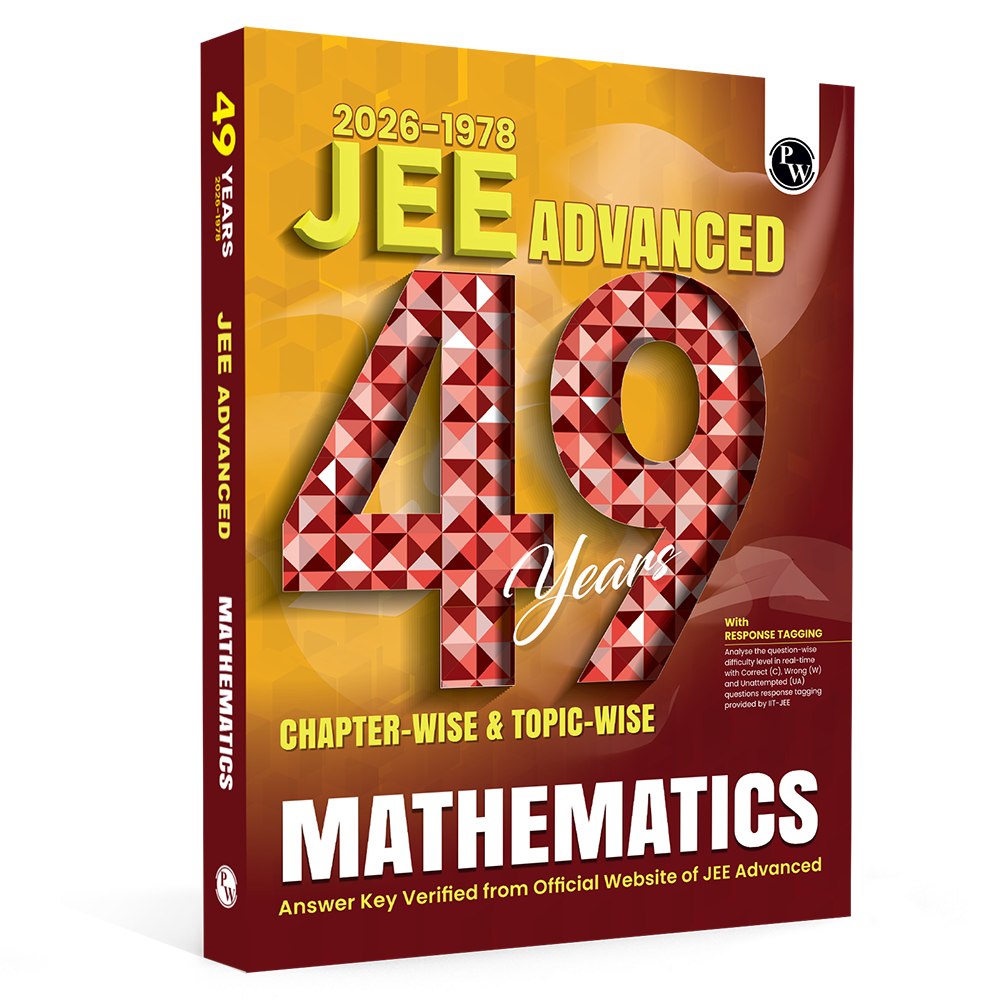
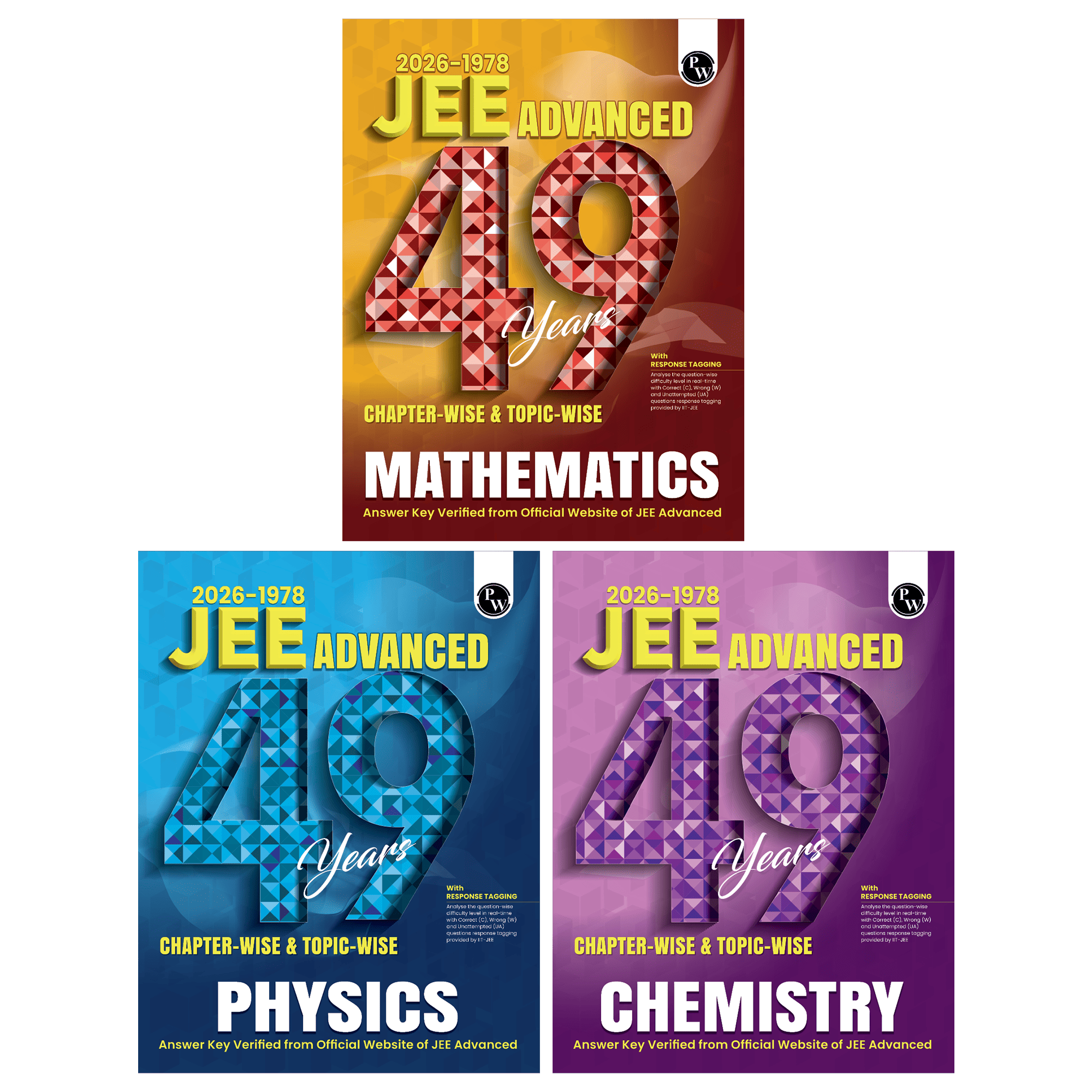
The JEE Advanced PYQ maths book is a structured collection of past exam questions spanning 49 years, from 1978 to 2026. This resource serves as a definitive archive of the actual questions asked in the examination over nearly five decades.
Unlike standard question banks, it organizes the content chapterwise and topicwise, allowing you to align your practice with your current study schedule.
Key elements included in this JEE Advanced PYQ book:
-
Chapterwise and Topicwise Layout: Questions are categorized systematically so you can focus on one mathematical area at a time.
-
Step-by-Step Solutions: Detailed, accurate explanations are aligned with official answer keys to verify your methods.
-
In-Depth Analysis: Trends from the last 7 years of papers help you identify evolving difficulty levels and weightage.
-
Performance Data: Statistical insights from the last 14 papers show common student behaviors, highlighting correct and incorrect responses.
Why Is JEE Advanced PYQ Maths Different from JEE Main?
The mathematical challenges presented in the Advanced exam differ significantly from those in the preliminary stage. JEE Main tends to focus on speed, direct formula application, and standard calculation steps. In contrast, solving JEE Advanced maths PYQs requires a deeper level of analytical thinking and multi-conceptual integration.
|
Feature |
JEE Main Mathematics |
JEE Advanced Mathematics |
|
Question Style |
Direct, formula-driven, and single-concept. |
Multi-concept, requiring integration of multiple topics. |
|
Focus Area |
Calculation speed and standard algebraic methods. |
Logical reasoning, structural comprehension, and deep analysis. |
|
Option Types |
Standard single-choice objective questions. |
Multiple-correct options, matrix matches, and numerical grids. |
|
Time Per Question |
Approximately 2 minutes. |
Often 4 to 6 minutes, reflecting the depth of each problem. |
Why Does JEE Advanced PYQ Maths Need Strong Concept Clarity?
You cannot clear this exam by simply memorising shortcuts or tricks. The examiners design questions to test whether you truly understand the mathematical foundations.
Each problem often blends concepts from different domains, such as combining probability with calculus or coordinate geometry with complex numbers.
A dedicated JEE advanced PYQ maths resource builds this clarity by:
-
Revealing Underlying Patterns: Seeing how a single theorem is tested in five different ways over the years develops your core understanding.
-
Encouraging First-Principle Thinking: Detailed solutions show you how to break a complex problem down to its fundamental definitions.
-
Developing Adaptability: Exposure to diverse questions teaches you to adapt when a problem does not fit standard textbook templates.
Which Topics are Covered in the JEE Advanced PYQ Maths?
A comprehensive JEE previous year paper resource covers the entire mathematics syllabus, ensuring no topic is left unpractised. The past 49 years of questions are systematically divided to help you build confidence across all key chapters.
The major modules included are:
-
Algebra: Matrices and determinants, probability, complex numbers, theory of equations, sequences and series, and combinatorics.
-
Calculus: Limits, continuity, differentiability, application of derivatives, definite and indefinite integrals, and differential equations.
-
Coordinate Geometry: Straight lines, circles, parabola, ellipse, and hyperbola.
-
Vectors and Three-Dimensional Geometry: Vector algebra and 3D coordinate geometry.
-
Trigonometry: Trigonometric ratios, inverse trigonometric functions, and trigonometric equations.
How to Use JEE Advanced PYQ Maths for Better Practice?
Having the right JEE books is only half the battle; how you use it determines your actual growth. To develop true problem-solving skills, you must approach past questions with a clear, disciplined methodology.
-
Avoid Looking at Solutions Immediately: When you encounter a challenging question, spend at least 10 to 15 minutes trying different approaches before checking the back of the book.
-
Practice with a Timer: Set a realistic time limit for a block of questions to simulate actual exam conditions and manage your time pressure.
-
Analyze the Explanations: Even if you get an answer correct, review the provided detailed solutions to see if there is a more elegant or quicker method.
-
Mark Challenging Problems: Highlight questions that you found difficult or those that used unique concepts, so you can easily return to them during revision.
Study Strategy for Using the JEE Advanced PYQ Maths
Integrating past papers into your weekly routine ensures structured progress. Here is a practical study plan designed to guide your maths practice using your PYQ book:
Step 1: Chapter-Level Integration
After finishing a chapter in your regular classes, open the chapter-wise section of your JEE Advanced PYQ maths book. Start with the older questions to understand the foundation, then gradually move to the recent papers.
Step 2: Trend Analysis
Study the trend-based learning charts provided in the book. Focus your energy on high-weightage topics identified in the last 7 years of papers to make your revision periods highly productive.
Step 3: Full-Length Paper Simulation
As the final exam approaches, transition from chapter-wise practice to solving complete, mixed-topic papers. Use the performance statistics from the last 14 papers to benchmark your accuracy, tracking your correct and incorrect responses to adjust your approach.
Tips to Solve JEE Advanced PYQ Maths
Approaching Advanced maths questions requires a calm and methodical mindset. Use JEE revision book to improve your accuracy when working through the past papers:
-
Read the Question Twice: Pay close attention to the constraints, such as whether a variable is a real number, an integer, or positive. Missing these details is a common source of errors.
-
Draw Diagrams Wherever Possible: Whether it is coordinate geometry, complex numbers, or definite integrals, a quick sketch can reveal geometric symmetries that make the algebra much simpler.
-
Use Elimination for Multiple-Choice Questions: Carefully analyze the options. Sometimes, substituting boundaries or checking extreme cases can help you rule out incorrect choices quickly.
-
Break Down Multi-Concept Problems: If a question involves both limits and probability, solve the limit portion first, and then apply the result to the probability framework.
Common Mistakes to Avoid While Solving JEE Advanced PYQ Maths
Learning what not to do is just as important as learning the correct methods. Keep an eye out for these common pitfalls during your JEE preparation:
-
Relying on Memorised Shortcuts: Relying on quick tricks instead of understanding the underlying concepts will leave you stuck when faced with a brand-new problem.
-
Ignoring the Detailed Solutions: Simply checking if your final answer matches without reviewing the structured step-by-step solution can cause you to miss crucial insights.
-
Neglecting Negative Marking: Practicing without considering the penalty for incorrect answers can lead to over-guessing on exam day. Use the book's performance data to practice restraint.
-
Leaving Revision to the Last Minute: Skipping regular reviews of marked questions means you may forget the unique problem-solving techniques you learned earlier in the year.
Read More: JEE Advanced Chapter Wise Weightage 2026
JEE Advanced PYQ Maths FAQs
1. How many years of past papers are covered in the JEE Advanced PYQ maths book?
The book includes a comprehensive collection of questions spanning 49 years, from 1978 to 2026, arranged chapter-wise and topic-wise.
2. Why are detailed solutions so important for JEE Advanced maths PYQs?
Detailed step-by-step solutions show you the correct mathematical structure, help verify your conceptual accuracy, and teach you how to write clear steps.
3. How does trend-based learning help during my JEE preparation?
Trend analysis highlights high-weightage chapters and frequently asked concepts from recent years, allowing you to plan your revision more effectively.