Why JEE Advanced Maths Questions Need Focused PYQ-Based Practice
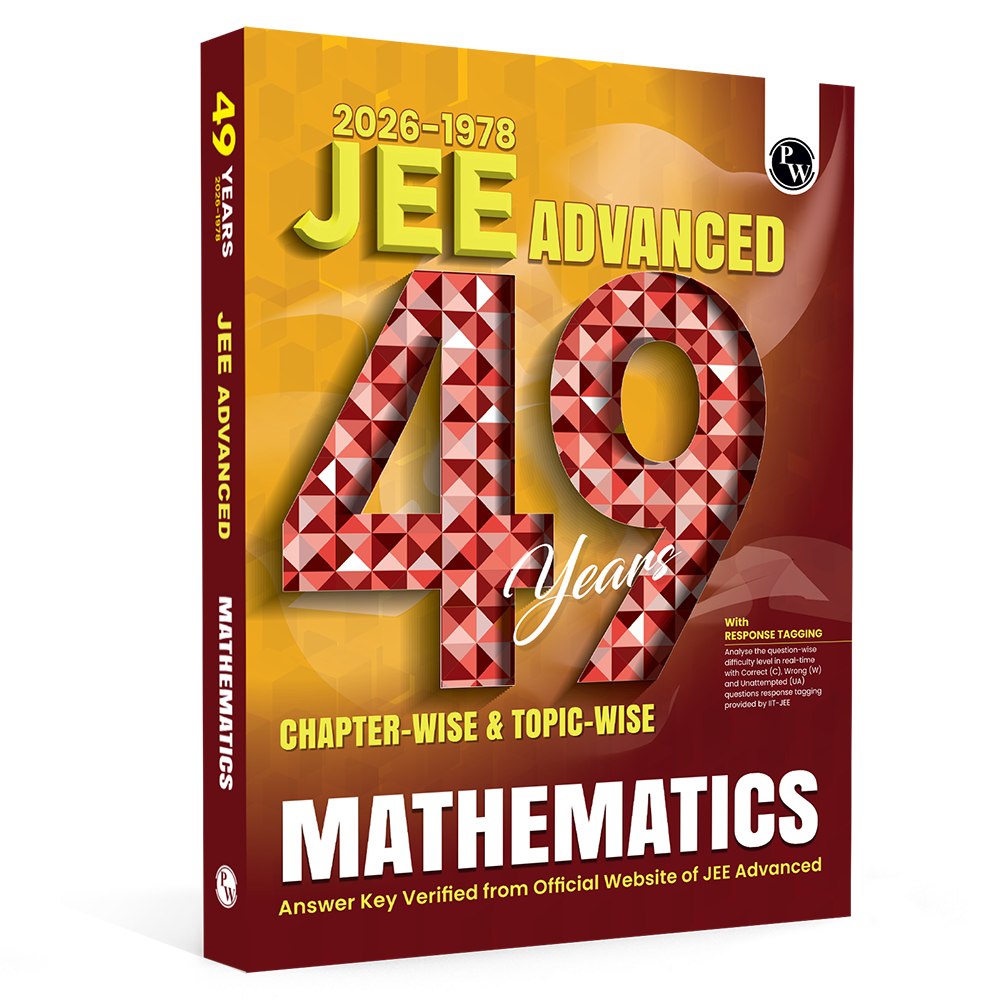
Many students struggle because they practice predictable questions, only to find the actual test papers completely different. To bridge this gap, you need a resource that mirrors the exact depth, phrasing, and multi-concept nature of the actual exam. This is where a dedicated compilation of JEE Advanced PYQ maths becomes indispensable.
Using previous papers is not just about solving old questions; it is about decoding the mindset of the paper setters. A comprehensive archive covering 49 years JEE Advanced PYQ (from 1978 to 2026) offers a goldmine of structured resources.
Rather than looking at these past papers as a random test of memory, treating them as your primary study guide ensures that your practice sessions align perfectly with the standard of the joint entrance examination.
Why Is JEE Advanced PYQ Maths Important for Exam Preparation?
Relying solely on mock tests or standard practice exercises often leaves gaps in your application skills. True Advanced preparation requires a deep dive into genuine past papers.
-
Understanding Evolving Trends: Working through 49 years of past papers allows you to see how the exam pattern has changed. You can easily spot the shift from subjective proofs to complex multiple-choice, numerical-value, and matrix-match questions.
-
In-Depth Analysis of Recent Papers: Paying close attention to the last 7 years of papers helps you understand current question trends, subject-weightage patterns, and the exact difficulty levels set by different organising IITs.
-
Performance Data Insights: Analyzing the last 14 years of papers provides useful benchmarks. Examining past trends shows where students typically make mistakes, which questions are often left unattempted, and how to balance speed with accuracy.
-
True Testing of Concepts: Unlike standard practice JEE books that often test a single formula, actual exam questions merge multiple topics (like probability with calculus, or matrices with complex numbers) into a single problem.
What are the Topics Covered in JEE Advanced PYQ Maths?
The syllabus is vast, but the exam consistently focuses on specific areas that test your logical thinking. A structured compilation of previous year maths questions helps you target these high-weightage sections.
|
Mathematics Section |
Key High-Weightage Chapters |
Style of Questions Asked |
|
Algebra |
Probability, Matrices & Determinants, Complex Numbers, Theory of Equations |
Multi-correct options, complex system of equations, and probability theorems mixed with combinatorics. |
|
Calculus |
Limits, Continuity & Differentiability, Definite Integration, Differential Equations |
Application of graphs, area under curves, and finding maximum/minimum values of complex functions. |
|
Coordinate Geometry |
Circles, Parabola, Ellipse, Hyperbola |
Finding tangents, normals, and common loci using clean algebraic manipulations. |
|
Vectors & 3D Geometry |
Vector Triple Product, Lines and Planes in 3D Space |
Shortest distance problems, coplanarity conditions, and geometrical projections. |
|
Trigonometry |
Inverse Trigonometric Functions, Trigonometric Equations |
Properties of triangles and simplifying complex trigonometric series. |
How to Use JEE Advanced PYQ Maths for Better Practice?
Just reading through solutions like a novel will not improve your problem-solving skills. To get the most out of your JEE Advanced PYQ maths books, you must adopt an active, hands-on learning strategy.
Step 1: Active Self-Attempt
Before looking at any provided solution, give yourself at least 10 to 15 minutes of uninterrupted time to solve the problem on your own. Write down every step, draw the coordinate graphs, or list the algebraic cases. Even if you do not get the correct answer, this struggle helps train your brain to think critically.
Step 2: Use Chapterwise Revision
Do not jump straight into full-length papers if your syllabus is incomplete. Use a chapterwise revision approach. Once you finish studying a topic like 'Definite Integration', solve all the past questions for that specific chapter. This reinforces your learning and highlights any weak areas immediately.
Step 3: Study Detailed Solutions
When you get stuck, refer to step-by-step, detailed solutions that match official answer keys. Do not just copy the final step. Analyze the logical path taken to solve the problem, note the initial substitution or algebraic setup, and learn how to simplify the calculations efficiently.
Study Plan for Using the JEE Advanced PYQ Maths
To balance your study schedule, you need a structured approach that blends learning new theory with focused concept based practice.
-
Phase 1: Foundation Building (Months 1-6): Focus on understanding core theories. After finishing each chapter, solve the corresponding past questions from the last 30 years to check your understanding.
-
Phase 2: Targeted Trend Analysis (Months 7-9): Focus closely on the papers from the last 14 years. Pay attention to how questions are framed and look for recurring themes, such as specific properties of determinants or limit formulations.
-
Phase 3: Real Exam Simulation (Months 10-12): Treat the papers from the last 7 years as full-length, timed mock tests. Sit in a quiet room, set a 3-hour timer, and solve the paper without any external help to build your exam stamina.
How to do Exam Practice with JEE Advanced PYQ Maths?
Achieving a rank requires consistent, daily effort. Use this structured weekly practice plan to keep your preparation on track.
1. Weekly Target Setup
Set a goal to solve at least 40 to 50 actual past exam questions every week, keeping a balanced mix of algebra, calculus, and geometry.
2. Timed Solving Sessions
Dedicate specific 2-hour blocks solely to solving past questions. During these blocks, do not refer to your notes or formula sheets. This helps build the mental stamina needed for the actual exam day.
3. Maintain an Error Log
Keep a dedicated notebook to record every mistake you make during practice. Note down whether the error was due to a calculation mistake, a misunderstood concept, or misreading the question. Review this notebook every Sunday to ensure you do not repeat those errors.
Common Mistakes to Avoid While Solving JEE Advanced PYQ Maths
Even highly dedicated students can fall into predictable traps when using JEE previous papers. Recognizing these pitfalls early will save you valuable preparation time.
-
Relying on Solution Keys Too Early: Looking at the answer after only a few minutes of trying prevents you from developing your own problem-solving skills.
-
Ignoring the Trend of Recent Papers: Spending weeks on outdated subjective patterns from the early 1980s while ignoring the multi-decimal and matrix styles of the 2020s can leave you unprepared for the modern exam format.
-
Failing to Analyse Mistakes: Simply ticking off correct answers without analyzing why you got other questions wrong makes your practice much less effective.
-
Neglecting a Complete Strategy: Focusing entirely on your favourite chapters while ignoring tougher, high-weightage topics like Probability or 3D Geometry can hurt your overall score.
Read More: How Much Score Is Good in JEE Advanced?
JEE Advanced PYQ Maths FAQs
1. How many years of past papers should I solve for the math section?
You should aim to practice with a comprehensive collection covering 49 years of past papers, spanning from 1978 to 2026. This wide range ensures you see every style of question ever asked. Focusing closely on the last 7 to 14 years is especially helpful for understanding current exam trends.
2. Why is chapter-wise revision better than solving full past papers early on?
Using a chapter-by-chapter approach allows you to focus on one topic at a time, making it easier to reinforce what you have just learned. It helps you find and fix weak spots in specific topics before you start taking full-length, timed mock exams.
3. How does solving maths PYQs help with time management during the actual exam?
Regular practice under timed conditions helps you learn how to quickly assess a question's difficulty. This training teaches you when to solve a problem systematically, when to use shortcut methods, and when it is wiser to skip a highly complex question to save time.