JEE Advanced PYQs for Beginners: When Should You Start?
Preparing for the Indian Institutes of Technology (IITs) is a journey that demands strategic planning, conceptual clarity, and rigorous application. Many aspirants struggle to decide when to transition from basic textbook problems to high-level entrance questions.
Starting your JEE advanced PYQ practice at the right time prevents last-minute overwhelm, builds analytical thinking, and bridges the gap between basic theory and multi-concept problem solving. Beginning chapterwise practice early during Class 11 guarantees long-term confidence and exam readiness.
Overview of JEE Advanced PYQ Summary
Preparing for JEE Advanced requires more than completing the syllabus. Success comes from understanding how concepts are tested in the actual examination. Regular practice with JEE advanced PYQ helps students move beyond theory and develop the analytical thinking needed to solve challenging, multi-concept questions
The most effective strategy is to solve previous years' questions topic by topic, immediately after finishing the fundamental theory of each chapter. Starting early in Class 11 allows you to align your thinking with the actual standard of the examination right from the beginning.
Phase 1: Topic-Wise Practice in Class 11
-
Immediate Application: As soon as a core concept (such as Newton's Laws of Motion or Chemical Bonding) is completed in class, attempt relevant past questions.
-
Building Pattern Recognition: Early exposure helps you recognise how simple theoretical formulas are combined into multi-step problems.
-
Gradual Confidence: Tackling 5 to 10 past questions per topic prevents the fear of difficult numerical problems.
Phase 2: Integrated Chapter Revision in Class 12
-
Cross-Topic Questions: JEE Advanced frequently tests multiple concepts in a single question. In Class 12, start solving questions that link Class 11 and Class 12 syllabus topics.
-
Time-Bound Solving: Shift from un-timed practice to speed-focused sessions to improve exam temperament.
Features of JEE Advanced PYQ
Preparing for JEE Advanced demands more than just solving questions—it requires understanding the exam's evolving trends, mastering concepts, and developing the right problem-solving approach. This JEE books combines authentic previous year questions with detailed analysis to help you prepare effectively.
-
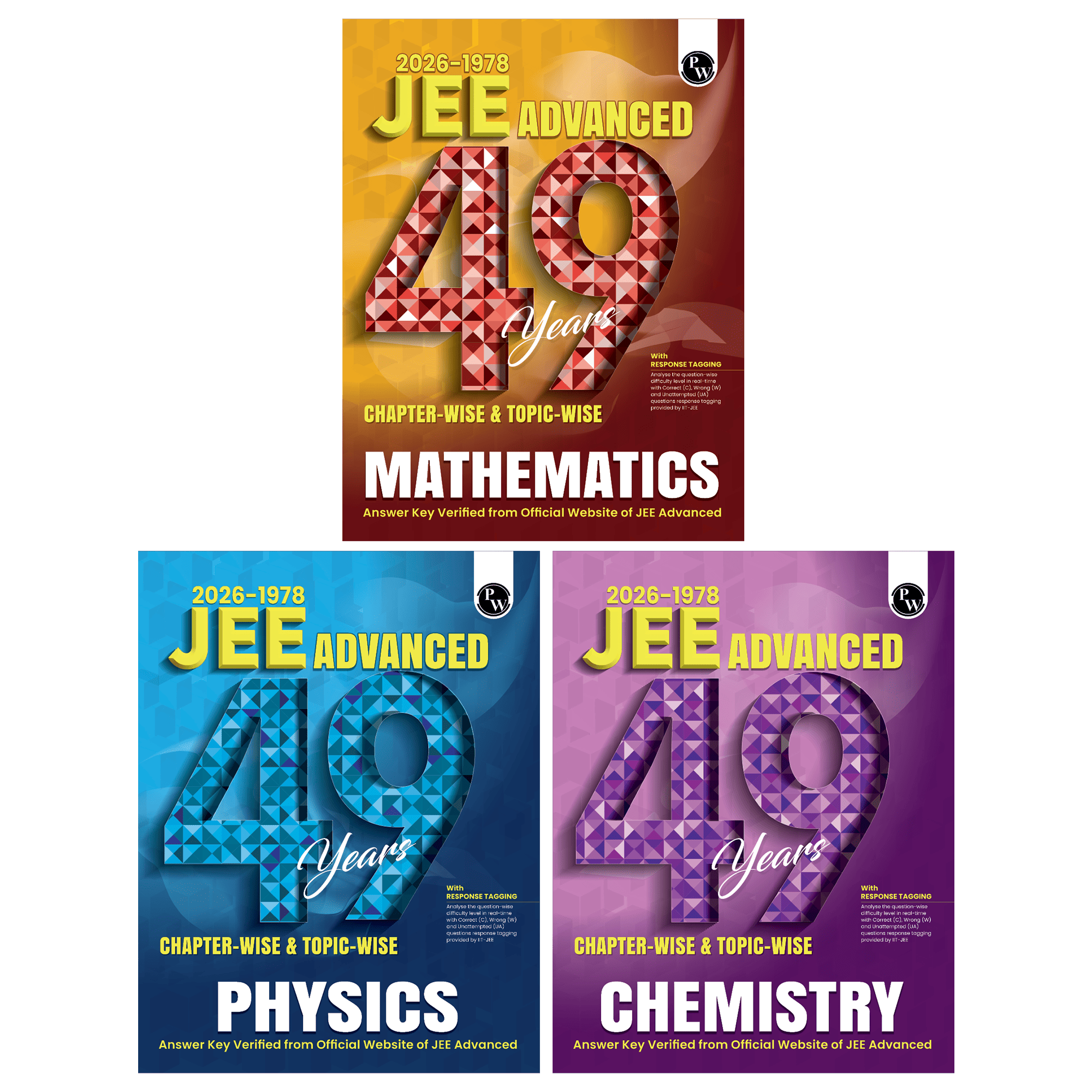
49 Years of JEE Advanced Questions (1978–2026): Practice an extensive collection of authentic Previous Year Questions from Physics, Chemistry, and Mathematics, covering nearly five decades of the examination.
-
Structured Chapterwise & Topicwise Coverage: Navigate the complete syllabus with questions organised by chapters and topics, making focused practice and revision simple and efficient.
-
Comprehensive Step-by-Step Solutions: Learn the correct approach to every question with detailed explanations that strengthen conceptual understanding and improve accuracy.
-
Analysis of the Latest 7 Years' Papers: Gain valuable insights into changing question patterns, chapter weightage, subject-wise trends, and difficulty levels to refine your preparation strategy.
-
Performance Breakdown of 14 Recent Papers: Study detailed statistics on correct, incorrect, partially correct, and unattempted responses to understand scoring patterns and optimise your exam strategy.
-
Chapter Weightage & Trend Insights: Prioritise your preparation by identifying frequently tested concepts and high-scoring chapters based on long-term exam analysis.
-
Develop Advanced Problem-Solving Skills: Strengthen analytical thinking and improve your ability to tackle complex, multi-concept questions through extensive practice.
-
Complete Resource for Revision & Assessment: Ideal for concept reinforcement, progress evaluation, and last-minute revision before the JEE Advanced examination.
Why Every Beginner Needs JEE Advanced PYQ Early?
Relying solely on standard coaching modules or basic textbook illustrations is rarely enough for top engineering entrance exams. Solving JEE previous year papers provides direct insights into examiner expectations.
|
Preparation Feature |
Standard Practice Questions |
Authentic Past Papers |
|
Focus Area |
Single-formula application |
Multi-concept integration |
|
Difficulty Level |
Predictable patterns |
Unpredictable, analytical depth |
|
Error Insights |
General conceptual mistakes |
Trap options and subtle tricks |
|
Relevance |
Practice routine |
Direct examination standard |
-
Understanding Depth: Past questions highlight which specific sub-topics require deeper mathematical or conceptual clarity.
-
Eliminating Exam Shock: Familiarity with original paper formats removes surprise elements on test day.
-
Targeted Effort: Helps prioritize high-weightage topics during daily JEE advanced revision.
What Approach Should Beginners Follow for Solving JEE Advanced PYQ?
To extract maximum value from past papers, beginners must follow a structured step-by-step workflow rather than jumping directly to solutions.
1. Master Chapter Fundamentals
Complete your NCERT textbooks, standard theory notes, and basic practice sheets before opening past paper sets. Ensure all formulas and derivations are clearly understood.
2. Attempt Single-Correct Questions First
Begin with single-choice objective questions from the past 10 years. These help verify fundamental clarity without complex marking schemes.
3. Progress to Complex Formats
Gradually move to multiple-correct options, numerical value questions, matrix matches, and comprehension passages to adapt to varied exam patterns.
4. Analyze Every Unsolved Question
If stuck, do not check answers immediately. Re-read the chapter notes, re-attempt after 24 hours, and analyze solution steps carefully to identify gaps.
Strengthen your JEE preparation with the JEE Main & Advanced PYQ Combo 2027, featuring 49 years of JEE Advanced PYQs (1978–2026) and 162 JEE Main sets (2019–2026). The chapter-wise and topic-wise solved papers help you understand exam trends, practise authentic questions, identify important concepts, and improve your problem-solving approach for JEE Main and JEE Advanced 2027.
How to Select the Right JEE Advanced PYQ Resource?
Having authentic questions with accurate, step-by-step solutions is essential. A reliable JEE practice book or combo set ensures you do not waste time on misprinted questions or incorrect answer keys.
-
Extensive Coverage: Look for collections offering comprehensive archives, such as 40+ years of authentic chapterwise and topicwise solved papers covering Physics, Chemistry, and Mathematics.
-
Detailed Explanations: Step-by-step solutions aligned with official answer keys help build logical thinking and accuracy.
-
Trend Analysis: Books featuring recent 7-year paper trend analysis and 14-paper performance data allow you to identify high-weightage chapters and evolving question patterns.
-
Structured Layout: Topic-wise segregation makes it effortless to integrate past questions into your daily JEE study plan.
Common Mistakes to Avoid When Solving JEE Advanced PYQ
Many students solve past questions without achieving the desired results due to flawed approaches. Avoid these frequent pitfalls:
-
Checking Solutions Instantly: Reading the answer key after a single failed attempt destroys the learning process. Spend at least 10–15 minutes analyzing the problem independently.
-
Memorising Answers: Focus on the underlying method, problem-solving technique, and concept application rather than memorising final answers.
-
Ignoring Failed Attempts: Maintain an error notebook to log every mistake made while solving a JEE advanced PYQ set. Revisit these notes regularly.
-
Irregular Practice: Solving 50 questions in one day and none for two weeks is inefficient. Consistency yields better long-term retention than sporadic cramming.
Read More: How Much Score Is Good in JEE Advanced?
JEE Advanced PYQ FAQs
When is the ideal time to start solving a JEE advanced PYQ?
The ideal time to start is right in Class 11, immediately after finishing the theoretical concepts of each chapter.
Can beginners solve iit JEE previous year questions directly?
Beginners should first cover basic theory and foundational textbook problems before attempting past entrance questions to avoid unnecessary frustration.
How many years of past papers are sufficient for beginner JEE preparation?
Practicing 30 to 45 years of chapterwise past papers provides comprehensive exposure to all historical question patterns and concept variations.
Should I solve past questions timed or untimed initially?
Initially, focus purely on conceptual accuracy and problem comprehension without time limits. Introduce timed conditions during final revision phases.
How does a chapterwise JEE practice book help in revision?
A chapterwise collection allows you to perform targeted JEE advanced revision for specific weak areas without searching through full-length paper archives.