JEE Main 2027 Maths Weightage: Important Topics to Practise with PW JEE Books
Many candidates feel overwhelmed by the sheer volume of chapters in Mathematics. Without a structured direction, valuable study hours often go towards low-priority topics, causing unnecessary anxiety and suboptimal practice.
Understanding the JEE Main maths weightage provides a clear roadmap to target high-yield areas first. By aligning daily schedules with proven exam trends and using structured JEE books, students can build conceptual strength, improve numerical speed, and consistently boost test performance.
Overview of JEE Main Maths Weightage
Understanding the term JEE Main maths weightage refers to analyzing the distribution of questions across different chapters in past examinations. The National Testing Agency (NTA) conducts JEE Main twice a year in January and April. Paper 1 (B.E./B.Tech) consists of three core subjects: Mathematics, Physics, and Chemistry. Each subject contains 25 questions, making up a 3-hour computer-based exam.
The primary purpose of analyzing chapter distributions is to allow students to separate high-yield topics from low-weightage chapters. Mathematics is a subject where regular practice directly correlates with problem-solving speed and accuracy. When you know precisely which topics yield frequent questions, you spend your time on actual problem-solving rather than guessing what might appear on exam day.
What is the JEE Main Maths Weightage of Important Chapters?
A smart study strategy begins with chapters that carry high weightage in the exam syllabus. When starting the JEE Main Maths 2027 preparation journey early, mastering fundamental areas provides an immediate confidence boost.
High-Priority Mathematical Units
-
Calculus: Includes differential calculus, integral calculus, and differential equations.
-
Algebra: Covers matrices, determinants, complex numbers, sequence and series, quadratic equations, and probability.
-
Coordinate Geometry: Features straight lines, circles, parabola, ellipse, and hyperbola.
-
Vector and 3D Geometry: Focuses on 3D coordinate systems, vector algebra, and spatial geometry.
-
Trigonometric Functions: Forms the foundation for calculus and coordinate transformations.
Prioritising these units ensures that learners cover a major portion of the syllabus early in their routine. Building strong concepts in these primary segments and practising JEE Previous Year Papers makes solving advanced problems significantly easier down the line.
Which Topics Matter Most Based on JEE Main Maths Weightage?
Identifying JEE Main maths important topics allows students to target high-yield areas directly. While all topics in the syllabus carry potential questions, historical trends show that certain mathematical domains yield multiple questions every session.
-
Algebra (Very High Weightage): Matrices, Determinants, Sequence & Series, Quadratic Equations, Complex Numbers, and Permutations & Combinations. Questions from matrices and determinants are often direct and scoring if the fundamental properties are well understood.
-
Vector and 3D Geometry (Very High Weightage): Vector algebra and three-dimensional coordinate geometry consistently contribute multiple straightforward questions. Practice in visualization and vector equations pays off heavily here.
-
Calculus (High Weightage): Definite integrals, application of derivatives, limit, continuity, and differential equations. These topics test analytical thinking and step-by-step application.
-
Coordinate Geometry (High Weightage): Circles, conic sections (parabola, ellipse, hyperbola), and straight lines. Understanding standard forms and geometric properties is crucial for solving these numerical problems quickly.
-
Trigonometry (Moderate Weightage): Trigonometric identities, equations, and inverse trigonometric functions. While fewer direct questions appear, these concepts serve as mandatory tools across calculus and coordinate geometry.
How to Use JEE Main Maths Weightage to Plan Practice?
A comprehensive study plan requires reliable reference materials tailored to current exam patterns. Quality JEE Main maths books provide structured practice, chapter-wise previous year questions (PYQs), and step-by-step solved examples.
-
Complete JEE Syllabus Coverage: Books cover the entire JEE Main and Advanced syllabus in a detailed and structured way.
-
Clear and Simple Explanations: Concepts are explained in an easy-to-understand language for better conceptual clarity.
-
Large Number of Practice Questions: Provide basic to advanced level questions to improve problem-solving skills.
-
Step-by-Step Solved Examples: Help students understand how to apply theoretical concepts correctly to numerical problems.
-
Well-Organized Structure: Content is arranged chapter-wise and topic-wise for easy revision.
-
Updated Content: Books follow the latest NTA JEE Main exam pattern and syllabus.
-
Experienced Authors: Written by subject experts who understand exam trends deeply.
Chapter-wise Practice Strategy Based on JEE Main Maths Weightage
To achieve high scores, dedicated preparation must be methodical and balanced. Students should follow a progressive strategy that moves from core principles to multi-concept problem solving.
Step 1: Master the Fundamental Theory
Before jumping into complex numerical questions, ensure that your basic concepts are completely clear. Read through chapter summaries in your reference books to understand definitions, properties, and standard mathematical formulas.
Step 2: Study Step-by-Step Solved Examples
Analyze how formulas are applied in solved examples. Pay attention to the step-by-step breakdowns provided in quality study materials. This step trains your brain to recognize patterns and choose the shortest valid path to a solution.
Step 3: Solve Topic-Wise Basic Exercises
Begin your practice with basic and intermediate questions. This reinforces theoretical knowledge and helps build initial problem-solving speed without causing frustration.
Step 4: Solve Chapter-Wise Previous Year Questions (PYQs)
Previous year questions are the most authentic gauge of exam difficulty. Practice with books that offer extensive PYQ collections:
-
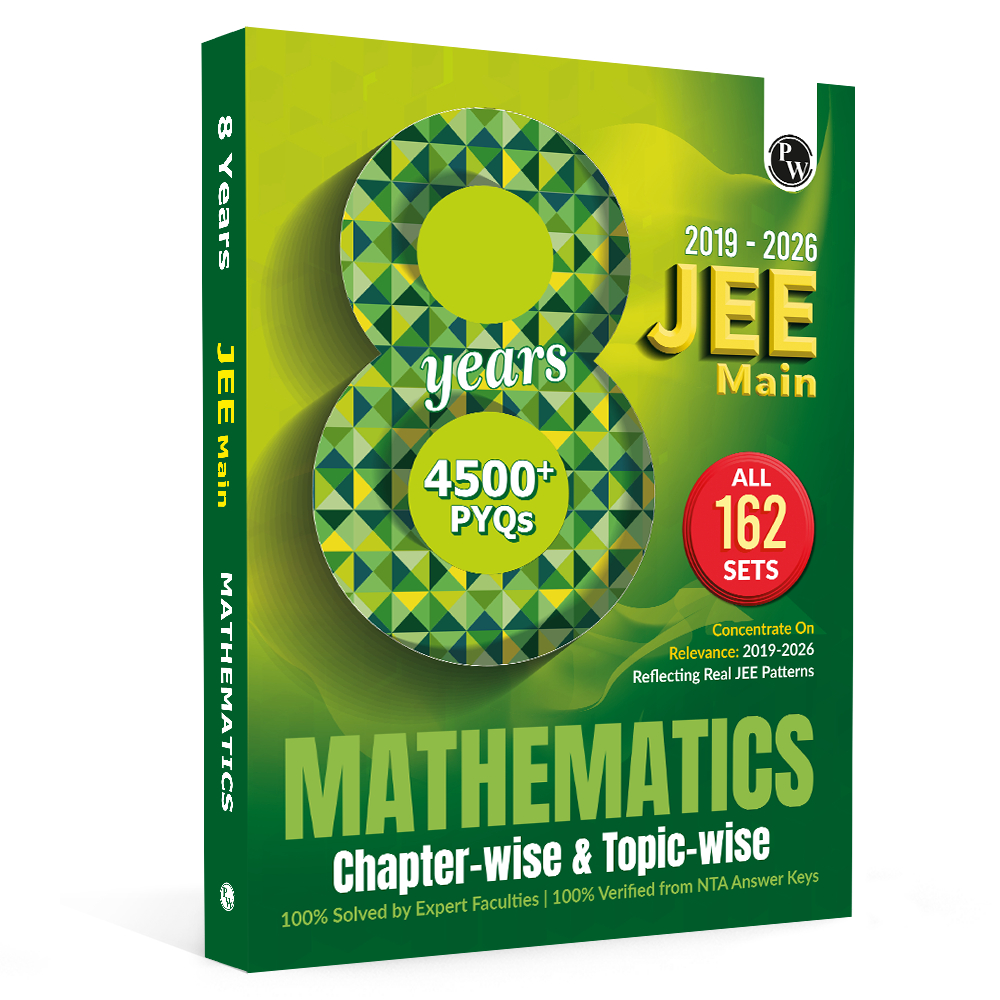
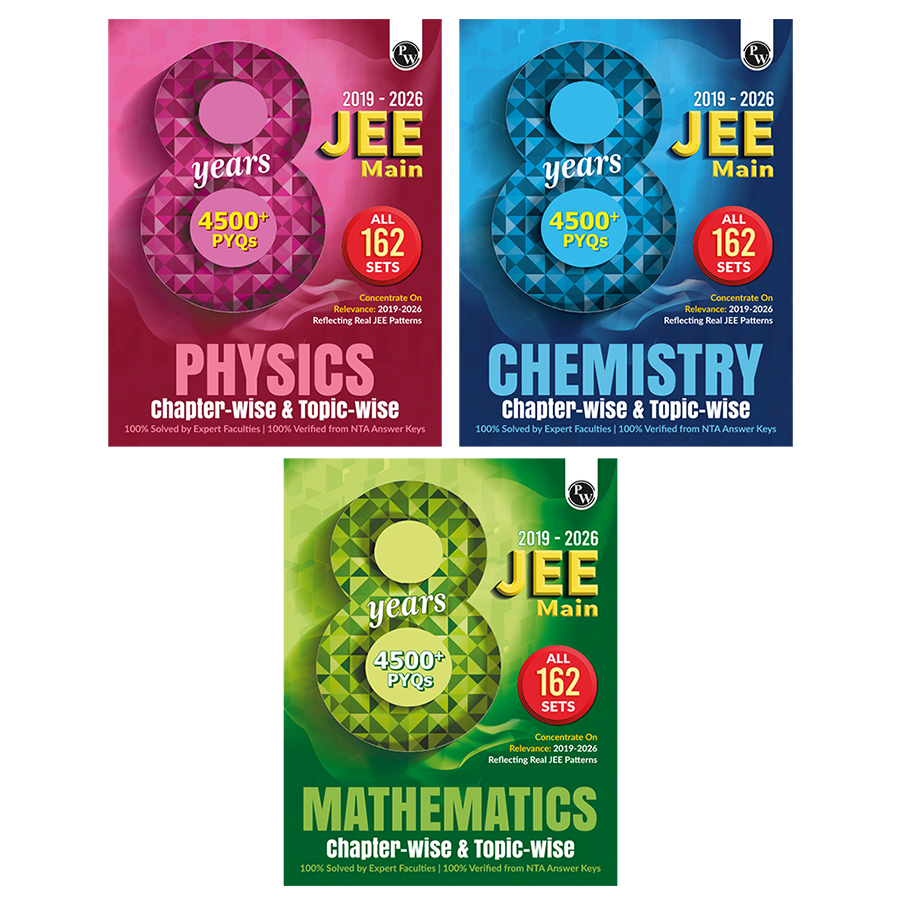
8 Years JEE Main PYQ: Includes detailed solutions to help students understand question patterns and important concepts.
-
49 Years JEE Advanced PYQ: Contains comprehensive solutions to develop advanced problem-solving skills and handle multi-concept questions.
Step 5: Conduct Time-Bound Practice and Mock Tests
Simulate real exam conditions by solving full-length practice tests or chapter-wise timed sets. Regular mock tests improve time management, reduce test anxiety, and highlight specific areas that require further practice.
Tips to Prepare High-Weightage Topics Using JEE Main Maths Weightage
Focusing on the JEE Main maths weightage requires consistent discipline and well-organized study habits. Here are essential execution steps for candidates starting early:
-
Start Early: Begin preparation at least one year before the exam to build strong fundamentals and cover the full syllabus comfortably.
-
Create a JEE Study Plan: Make a daily and weekly schedule covering all three subjects—Mathematics, Physics, and Chemistry—to maintain balanced progress.
-
Choose the Right JEE Books: Stick to trusted reference books that offer structured theory and PYQs, avoiding the trap of cluttering your desk with too many conflicting resources.
-
Focus on Weak Areas: Regularly identify difficult topics through practice tests and allocate extra study time to strengthen those specific concepts.
-
Solve JEE Previous Year Papers: Practice previous year question papers consistently to track changing question trends and refine test-taking strategies.
-
Take Regular Mock Tests: Test-taking under timed conditions directly improves your speed and accuracy during the actual computer-based test.
-
Maintain Good Health: Sleep 7–8 hours daily and eat healthy food to stay energetic and sharp throughout your preparation journey.
-
Stay Positive: Consistency and confidence are key to success in competitive exams. Keep a positive mindset even when encountering difficult practice sets.
Practice Plan for JEE Main Maths Weightage and Important Topics
A well-structured weekly schedule helps students balance high-weightage practice with continuous revision. Below is a practical blueprint designed for early aspirants:
Day 1–Day 2: Concept Building and Theory Review
-
Dedicate 2 hours each day to reading theory from primary study modules.
-
Focus on high-priority units such as Algebra or Calculus.
-
Review 15–20 step-by-step solved examples to understand practical formula application.
Day 3–Day 4: Basic to Intermediate Problem Solving
-
Work through 30–40 practice problems per day categorized by topic.
-
Highlight questions where you make computational errors or conceptual missteps.
-
Refer back to theory notes immediately to correct any misunderstandings.
Day 5: Chapter-Wise PYQ Solving
-
Solve 20–25 PYQs from recent JEE Main sessions under untimed conditions to build deep comprehension.
-
Study the provided step-by-step solutions for any questions you get wrong.
Day 6: Timed Practice and Weak Area Analysis
-
Attempt a 1-hour timed topic test containing 25 mixed questions.
-
Analyze your performance: identify whether errors were due to speed, calculation mistakes, or conceptual gaps.
-
Spend 1 hour reviewing those specific weak points.
Day 7: Revision and Rest
-
Revise all key formulas, theorems, and shortcut techniques noted during the week.
-
Ensure adequate rest and recreation to maintain mental clarity for the upcoming week.
Adhering to a systematic schedule ensures complete syllabus coverage without burnout, leading to success in both January and April sessions.
Read More: JEE Syllabus And Exam Pattern
JEE Main 2027 Maths Weightage FAQs
What is the significance of understanding JEE Main maths weightage?
Knowing the JEE Main maths weightage helps candidates prioritize high-yield chapters, allocate study time effectively, and focus on topics that carry maximum marks in the exam.
How many questions are asked in the Mathematics section of JEE Main?
The Mathematics section of Paper 1 contains 25 questions, as part of a 3-hour computer-based examination.
Why are previous year questions important for high weightage chapters?
Solving PYQs helps candidates understand question trends, difficulty levels, and practical application patterns while building required accuracy and speed.
How can structured study books help in exam preparation?
Quality books offer clear theory, step-by-step solved examples, basic to advanced practice problems, and chapter-wise PYQs updated according to the latest NTA exam pattern.
How often should mock tests be attempted during preparation?
Regular mock tests should be taken weekly or bi-weekly to evaluate performance, manage exam time effectively, and improve problem-solving speed under real test conditions.