Why JEE Toppers Never Skip PW Previous Year Questions
JEE toppers prioritize JEE Previous Year Questions to understand exam trends, master difficulty variations, and improve problem-solving speed. Studying structured past papers gives candidates a competitive edge by revealing core concepts that appear consistently year after year.
Importance of JEE Previous Year Questions
Practicing past papers is an indispensable part of preparing for engineering entrance tests. Every year, lakhs of aspirants compete for a limited number of seats in premier institutes. Understanding the structural pattern of the paper becomes a deciding factor for success.
-
Reveals Exam Trends: Direct experience with past exams shows which sub-topics carry higher weightage.
-
Improves Question Selection: Aspirants learn to identify quick-solve problems versus time-consuming ones.
-
Enhances Accuracy: Solving real questions repeatedly reduces silly mistakes under timed conditions.
-
Builds Exam Temperament: Familiarity with question wording lowers anxiety on exam day.
Working through authentic Previous Year Questions allows students to shift from passive reading to active application. Merely memorising formulas will not yield a top percentile. You must know how examiners frame complex scenarios around simple concepts.
Features of JEE Previous Year Questions
The right practice material can make a significant difference in your JEE Main preparation. This JEE books is designed to help you build confidence through authentic previous year questions, structured practice, detailed solutions, and insights into the latest exam trends.
-
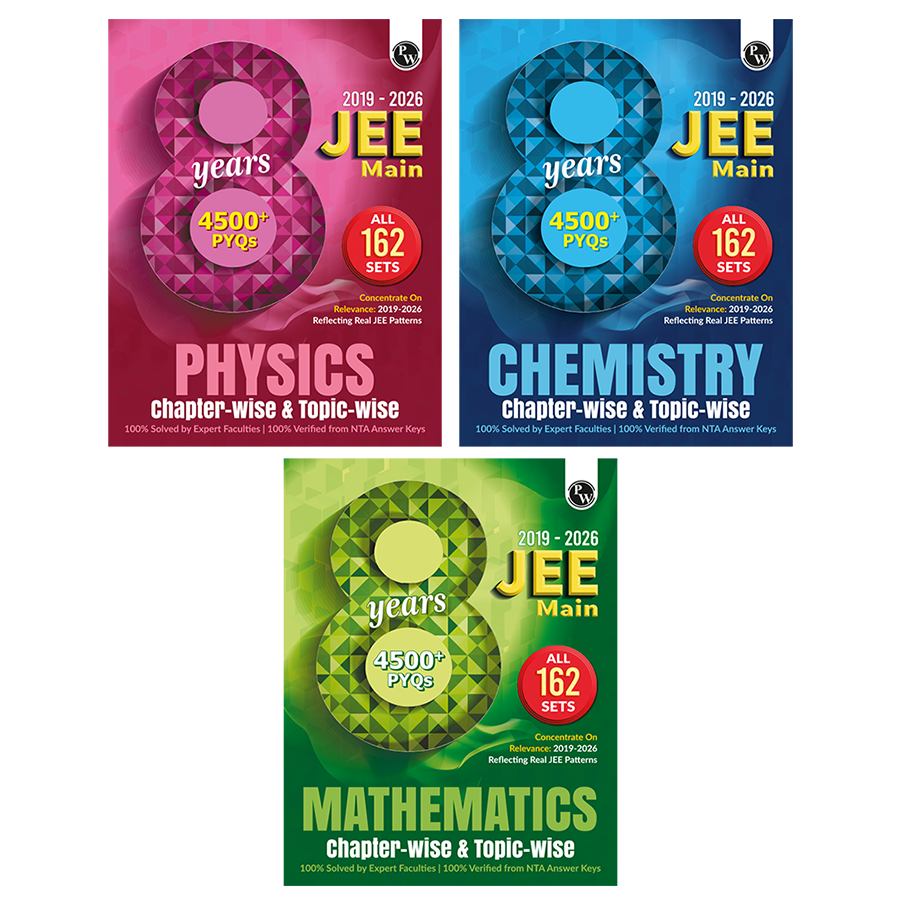
Comprehensive PYQ Coverage (2019–2026): Practice the latest JEE Main Previous Year Questions to understand the current exam pattern and question trends.
-
13,500+ Authentic Solved Questions: Strengthen your preparation with a vast collection of solved questions, supported by clear and accurate explanations.
-
All 162 Official Shift Papers: Access every shift-wise JEE Main question paper in one place for complete and realistic exam practice.
-
Systematic Chapterwise & Topicwise Practice: Revise every subject with questions arranged by chapters and topics, making learning more focused and organised.
-
Aligned with the Latest Exam Standard: Solve questions that reflect the actual level, format, and style of the JEE Main examination.
-
Chapter Weightage & Trend Analysis: Understand which topics are asked most frequently and plan your study schedule based on past exam patterns.
-
Step-by-Step Explanations: Learn the correct approach to every question with detailed solutions that strengthen concepts and reduce common mistakes.
-
Coverage of All Question Formats: Prepare thoroughly with Multiple Choice Questions (MCQs) and Numerical Value Questions (NVQs) included throughout the book.
-
Enhances Accuracy and Speed: Build better analytical skills, improve time management, and develop the confidence needed to perform well in the exam.
How JEE Previous Year Questions Helps in JEE Main Preparations?
Understanding the structural differences between stages is critical for effective preparation. Aspirants must tailor their approach depending on whether they are solving preliminary screening papers or high-level analytical papers.
Focus Areas for Preliminary Stage
-
Direct formula applications requiring quick mathematical calculations.
-
High emphasis on speed and broad coverage of the entire syllabus.
-
Frequent repetition of standard numerical types across shifts.
Focus Areas for Advanced Stage
-
Multi-concept questions combining topics from different chapters.
-
Emphasis on deep conceptual clarity rather than straightforward memory.
-
Variable marking schemes including partial marking, integer types, and multiple-correct options.
Mastering both levels requires dedicated practice. Utilizing authentic JEE advanced PYQs allows candidates to adapt seamlessly to high-difficulty problem sets after securing a strong foundation through preliminary tests.
How to Use JEE Previous Year Questions?
Integrating JEE Main Previous Year Questions practice into your routine requires a clear methodology. Simply reading through solutions will not yield meaningful improvement in speed or accuracy.
1.Complete the Theoretical Chapter
Ensure you have thoroughly read the theory, memorised formulas, and solved basic practice problems before touching past papers.
2.Attempt Questions Unassisted
Set a timer and attempt a set of 20 to 30 past questions without looking at hints or solution keys.
3.Analyze Incorrect Answers
Identify whether mistakes stemmed from calculation errors, conceptual gaps, or misreading the question prompt.
4.Maintain an Error Notebook
Document challenging problems and re-attempt them after 7 to 10 days to ensure long-term retention.
Following this structured loop builds genuine confidence. Regular exposure to quality JEE practice questions creates a strong feedback mechanism that continually highlights areas requiring extra attention.
How Does Chapter-Wise JEE Previous Year Questions Make Revision Easier?
Randomly solving questions from mixed papers can feel overwhelming during initial preparation phases. Chapter-wise division allows students to master one topic completely before moving on to the next.
When you solve JEE Previous Year Questions sorted by chapter, you quickly identify core patterns. For instance, in Physics, topics like Mechanics and Electrodynamics consistently feature specific problem frameworks. In Chemistry, reaction mechanisms in Organic Chemistry often build on repeating principles. In Mathematics, Calculus problems frequently test predictable property combinations.
Focused topic-wise practice prevents cognitive overload. Instead of jumping between unrelated subjects, you build deep, domain-specific intuition. This systematic method ensures complete coverage without leaving strategic gaps in your preparation.
Also Check - JEE Main Rankers Test Series
Common Mistakes to Avoid While Solving JEE Previous Year Questions
Many aspirants fail to maximize the benefit of past paper practice due to inefficient habits. Recognizing these mistakes early saves valuable time during crucial revision months.
-
Looking at Solutions Immediately: Giving up too quickly prevents your brain from developing critical analytical pathways.
-
Ignoring Timed Conditions: Solving questions without a clock creates a false sense of security regarding speed.
-
Skipping Tough Topics: Avoiding difficult chapters in past papers leads to knowledge gaps that examiners easily exploit.
-
Neglecting Chemistry: Assuming Chemistry requires less practice often results in lost marks on straightforward, high-yield questions.
By avoiding these missteps and maintaining a disciplined routine with JEE main preparation resources, candidates can steadily elevate their performance metrics over time.
Read More: JEE Main Chapterwise PYQs
JEE PYQ FAQs
Why are JEE Previous Year Questions essential for preparation?
Solving JEE Previous Year Questions helps you understand the actual exam pattern, question style, and difficulty level. They show which concepts are tested repeatedly and help you identify important topics. Regular practice also improves problem-solving speed, accuracy, and confidence, making it easier to perform well on the final exam.
How many years of past papers should I solve for JEE?
It is recommended to solve the last 8 to 10 years of JEE past papers. This gives you a clear understanding of the latest exam pattern, syllabus changes, question trends, and difficulty level. Focusing on recent papers also helps you prepare for the type of questions that are more likely to appear in the upcoming exam.
Can I clear the exam by only solving past papers?
No. While previous year questions are an important part of preparation, they should not be your only study material. First, build a strong understanding of concepts through NCERT books and standard reference books. Then use past papers to test your knowledge, improve speed, identify weak areas, and strengthen your exam strategy. Regular mock tests are also essential for complete preparation.
How does a dedicated JEE pyq book help during revision?
A dedicated JEE pyq book organizes previous year questions chapter-wise and topic-wise, making revision much more effective. Instead of searching through multiple papers, you can quickly practice questions from a specific chapter. Most books also include detailed step-by-step solutions, helping you understand the correct approach, avoid common mistakes, and revise important concepts in less time.
What is the best time to start practicing past papers?
The best time to begin solving previous year questions is immediately after completing the theory of each chapter. Practicing chapter-wise questions alongside your regular studies strengthens concept clarity and improves retention. Once the entire syllabus is complete, switch to solving full-length JEE papers under timed conditions to build exam stamina, improve time management, and evaluate your overall preparation.