What Are JEE Modules? Complete Guide for Beginners
Preparing for the IIT-JEE exam can feel really crazy. This stage is where JEE modules are really helpful. The main problem is that we have a lot of information. It is challenging to put it all together. Using modules you can make a difference in how you do. It can be the difference between someone who's perplexed and someone who gets a top rank in JEE.
This will tell you everything you need to know about these study tools that are critical.
What are JEE Modules?
A module is basically a book that focuses on specific chapters or units. It is not like the textbooks we use in school. The people who make these modules are experts in their subjects. These modules help us connect what we learn in school to the tough thinking we need to do for the JEE Main and Advanced exams.
When you look at PW modules for JEE, for instance, you notice they aren't just collections of theory. They are engineered to build muscle memory for problem-solving. Each unit typically contains:
-
Micro-Concept Breakdowns: Complex theories are divided into bite-sized pieces.
-
Topic-wise Solved Examples: Demonstrations of how to apply a formula immediately after learning it.
-
Exercise Sheets: Divided by difficulty levels (Level 1 for basics, Level 2 for mains, and Level 3 for advanced).
-
Previous Year Questions (PYQs): Direct exposure to what has been asked in the last decade.
JEE Modules Class 11
The transition from Class 10 to Class 11 is notoriously difficult. The jump in difficulty is steep, particularly in physics and mathematics. Using modules helps in smoothing this transition.
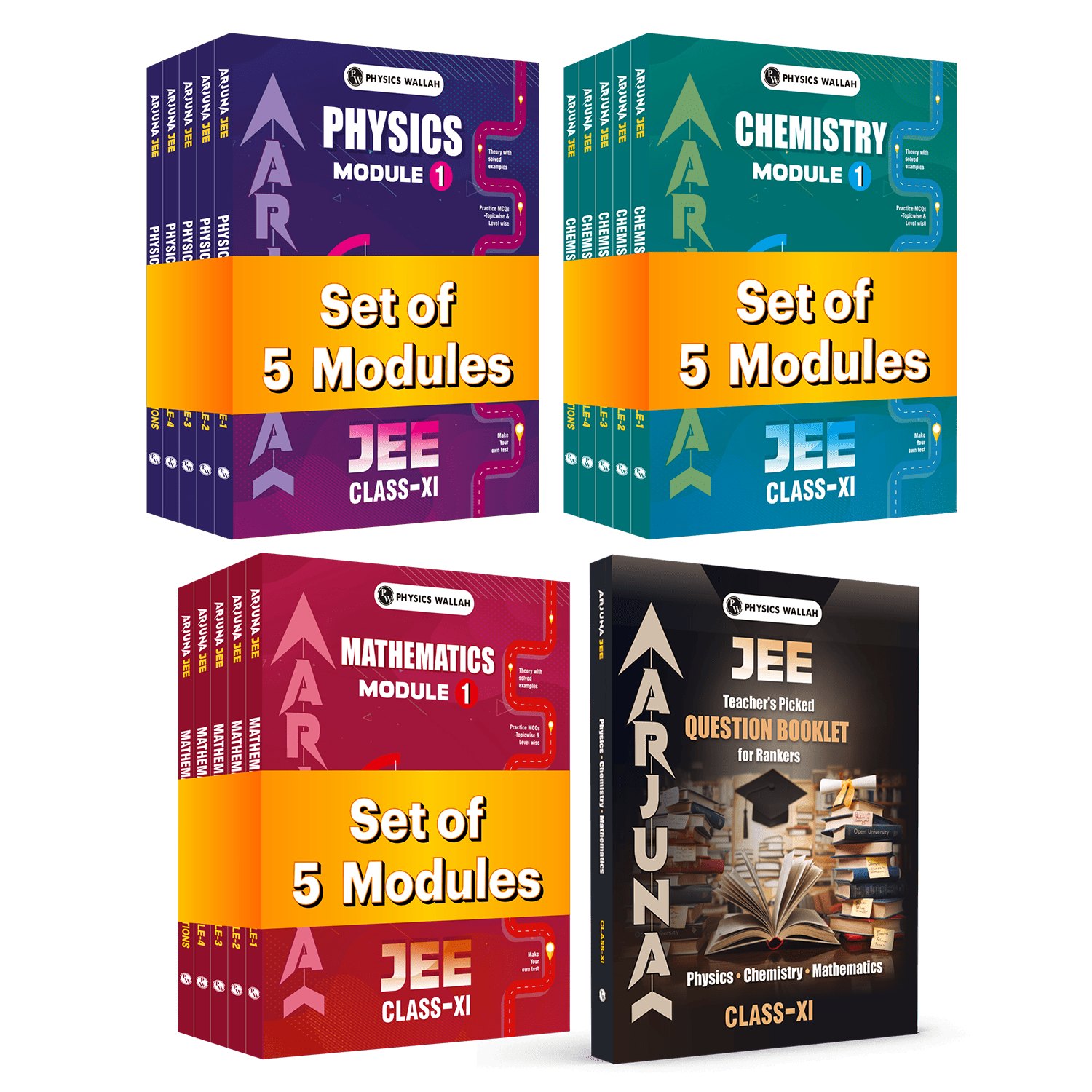
For students who are just starting the Arjuna JEE Module class 11 is made for students who're beginners. The Arjuna JEE module, in class 11, prioritises establishing a solid foundation for its students.
Why Foundation Modules Matter
-
Syllabus Alignment: The coaching classes have a schedule, and the self-study work is planned to fit in with the lectures. This way the self-study and the coaching classes match up perfectly, so the self-study and coaching classes are in sync.
-
Focus on Fundamentals: These booklets place extra emphasis on derivation and conceptual clarity, which are vital for Class 11.
-
Time Management: Instead of searching through five different books, a student finds everything in one place.
Check Out: IIT JEE Books
Weightage Topics Covered in JEE Modules
To get the most out of your PW JEE modules you need to figure out which parts are really tough and need a lot of thinking. Some topics are more important than others and are the main focus of the PW JEE exam.
1. Mathematics: The Logic Pillar
Mathematics in JEE is about application rather than just formulas. Your Arjuna Jee module class 11 will focus heavily on the following:
-
Calculus: Functions, Limits, Continuity, and Integrations (the most scoring section).
-
Coordinate Geometry: Circles, Parabola, and Hyperbola.
-
Algebra: Complex Numbers, Quadratic Equations, and Probability.
-
Vectors & 3D Geometry: Often considered easy scoring if concepts are clear.
2. Physics: The Concept Pillar
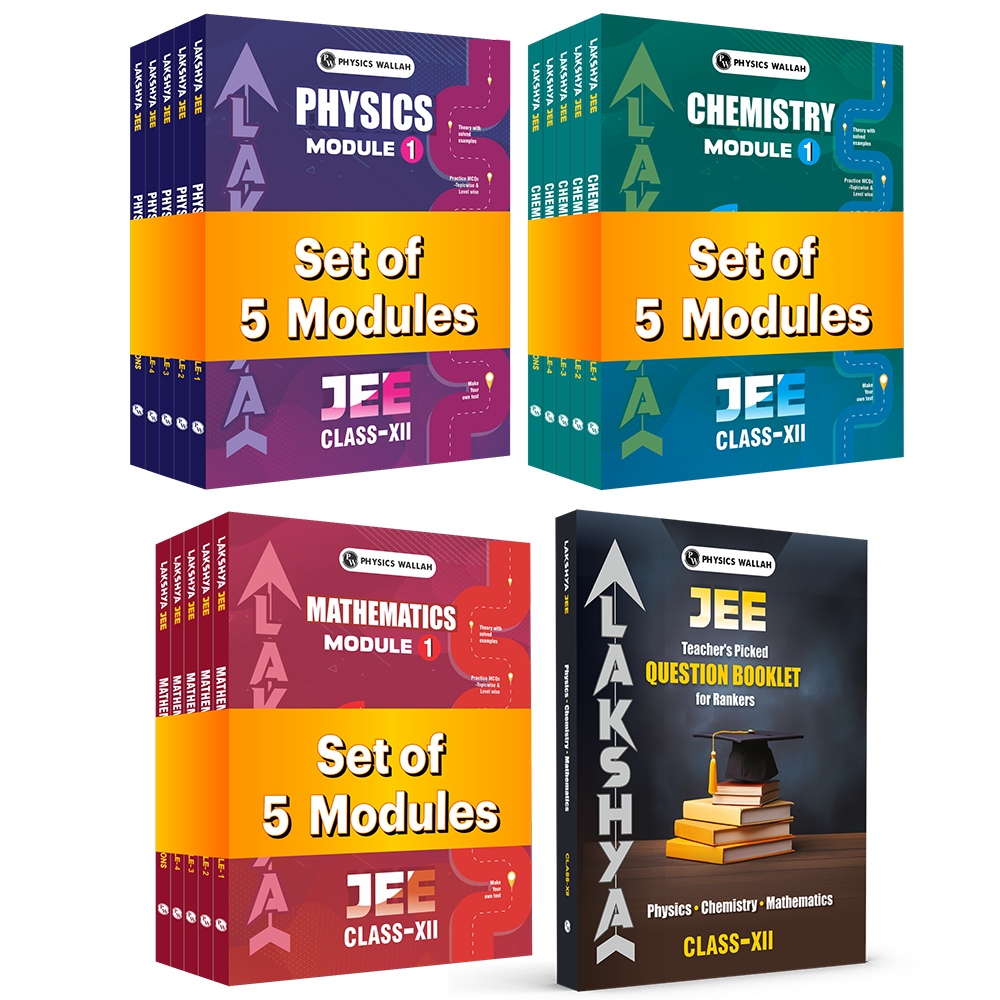
Physics requires a blend of theoretical understanding and mathematical skill. The Lakshya JEE module emphasises the following:
-
Mechanics: Kinematics, Newton’s Laws, and Rotational Motion (the foundation of Class 11).
-
Electrodynamics: Electrostatics, Current Electricity, and Magnetic Effects.
-
Modern Physics: Atomic Structure and Nuclear Physics (High weightage, relatively easier).
-
Thermodynamics: Vital for both physics and chemistry.
3. Chemistry: The Memory & Logic Pillar
Chemistry is often a "rank booster.". The Prayas Jee module breaks it down into three digestible parts:
-
Organic Chemistry: General Organic Chemistry (GOC), Hydrocarbons, and Reaction Mechanisms.
-
Inorganic Chemistry: Chemical Bonding, Periodic Table, and Coordination Compounds.
-
Physical Chemistry: Mole Concept, Thermodynamics, and Chemical Kinetics.
Check Out: JEE Test Series
How to Prepare With PW JEE Modules ?
Merely possessing the modules is insufficient. Knowing how to use these JEE modules is what truly leads to success with them.
The Theory-First Approach
Never jump straight to the questions. Read the "Concept Map" provided at the beginning of the module. This gives you a mental framework of how the chapter is structured. Highlight the "Note" sections and "Warning" boxes—these usually point out common mistakes students make.
The Three-Step Exercise Rule
-
Warm-up: Solve the solved examples without looking at the solutions. This confirms if you actually understood the theory.
-
Drill: Complete the Level 1 exercises to build confidence.
-
Challenge: Tackle the Level 2 and Level 3 questions. It is okay if you can't solve these on the first try. The goal is to spend at least 10 minutes thinking about a single problem before checking the hint.
Revision Cycles
Modules are excellent for revision. Instead of re-reading the whole chapter, look at the "Formula Sheets" usually found at the back of the module. Solve only the "starred" questions, the ones you found difficult during your first attempt.
Check Out: JEE Previous Year Papers
Benefits of Using JEE Modules
-
Structured preparation from day one
JEE modules give students a clear path to follow. Instead of jumping between random books, notes, and PDFs, they get chapter-wise material arranged in a logical order. This makes preparation feel more organised and less overwhelming. -
Complete syllabus coverage in one place
One of the biggest benefits of JEE modules is that they bring theory, examples, and practice together in a single resource. Students do not have to keep switching between multiple sources to study one chapter properly. -
Better concept clarity
Good modules are designed to simplify difficult topics. They break large concepts into smaller parts, which helps students understand the topic before moving to questions. This is especially useful in subjects like Physics and Mathematics, where clarity matters more than memorisation. -
Smooth shift from learning to application
JEE is not just about knowing formulas. It is about knowing where, when, and how to apply them. Modules help students move from concept learning to actual problem-solving in a step-by-step way. -
Practice that builds confidence gradually
Most JEE modules include questions from basic to advanced level. This helps students begin with easier problems, strengthen their grip on the chapter, and then slowly move towards tougher questions without losing confidence. -
Closer alignment with exam needs
Modules are prepared with competitive exam requirements in mind. They usually focus on concept application, question variety, and exam-level practice, which makes them more useful than general school material alone. -
Helpful for regular revision
Since the content is already sorted chapter-wise, revision becomes faster and more focused. Students can go back to formulas, examples, and important questions without wasting time searching through scattered material. -
Better time management
When students have one organised source for theory and practice, they spend less time deciding what to study next. That saved time can be used for revision, mock tests, and doubt-solving. -
Useful for self-study
JEE modules are especially helpful for students who want to study independently after classes. They provide enough direction to continue practice on their own and maintain consistency at home. -
Supports disciplined preparation
Using modules regularly creates a study rhythm. When students follow chapter-wise learning, practice, and revision in a fixed pattern, their preparation becomes more stable over time. -
Makes weak areas easier to identify
While solving module exercises, students can quickly spot which topics are taking more time, where mistakes are happening, and which chapters need extra revision. This helps them improve in a more focused way. -
Reduces dependence on too many resources
A common mistake in JEE prep is collecting too much material and finishing too little. Modules reduce that confusion by giving students one dependable framework they can follow consistently.
Read More: Why PW JEE Modules Are Helpful for Repeaters
JEE Modules FAQs
1. Are JEE modules enough for clearing JEE Advanced?
Yes, excellent JEE study materials, like the Lakshya JEE module, are really helpful. They cover everything from ideas to tough questions like those in JEE Advanced. If you do all the exercises and old questions, in these modules you will do well.
2. Should I start with the JEE modules for class 11 or with NCERT?
It is best to use them side by side. For chemistry, NCERT is excellent for reading. For physics and maths I would rely on my Arjuna JEE module for class 11. NCERT does not have practice problems for JEE, which is a competitive exam.
3. What makes PW modules for JEE different from other coaching material?
The PW modules are really cheap. They still offer excellent education. The PW modules have some things like Concept Application Quests. They also have detailed video solutions. This arrangement means you get to learn in two ways with the PW modules. On a computer and with things.
4. Can a dropper use the JEE module?
A dropper can use the Prayas JEE module. It is really better for them. The Prayas series is made for people who want to go over everything they learned in classes 11 and 12 in one year. The Prayas JEE module is a choice for droppers because it helps them review the Prayas JEE module material.
5. How many hours should I spend on modules daily?
After your lectures, you should try to spend three to four hours a day solving questions from your modules. It is essential to be consistent. Consistency is more important for JEE than the number of hours you spend. For JEE, you should try to solve at least thirty-to-forty quality questions every day across all your subjects.