What Does the 8 Years JEE Chemistry PYQ Book Cover Across Organic, Inorganic and Physical
Achieving a high percentile in the engineering entrance test requires a smart strategy, especially in scoring subjects like chemistry. Many students struggle to balance the vast syllabus and understand how concepts turn into actual exam questions. This article bridges that gap by offering a complete collection of JEE Main Chemistry PYQ. Studying with this targeted resource allows aspirants to grasp the actual difficulty levels and master the question trends across all major branches.
Overview of JEE Main Chemistry PYQ Book
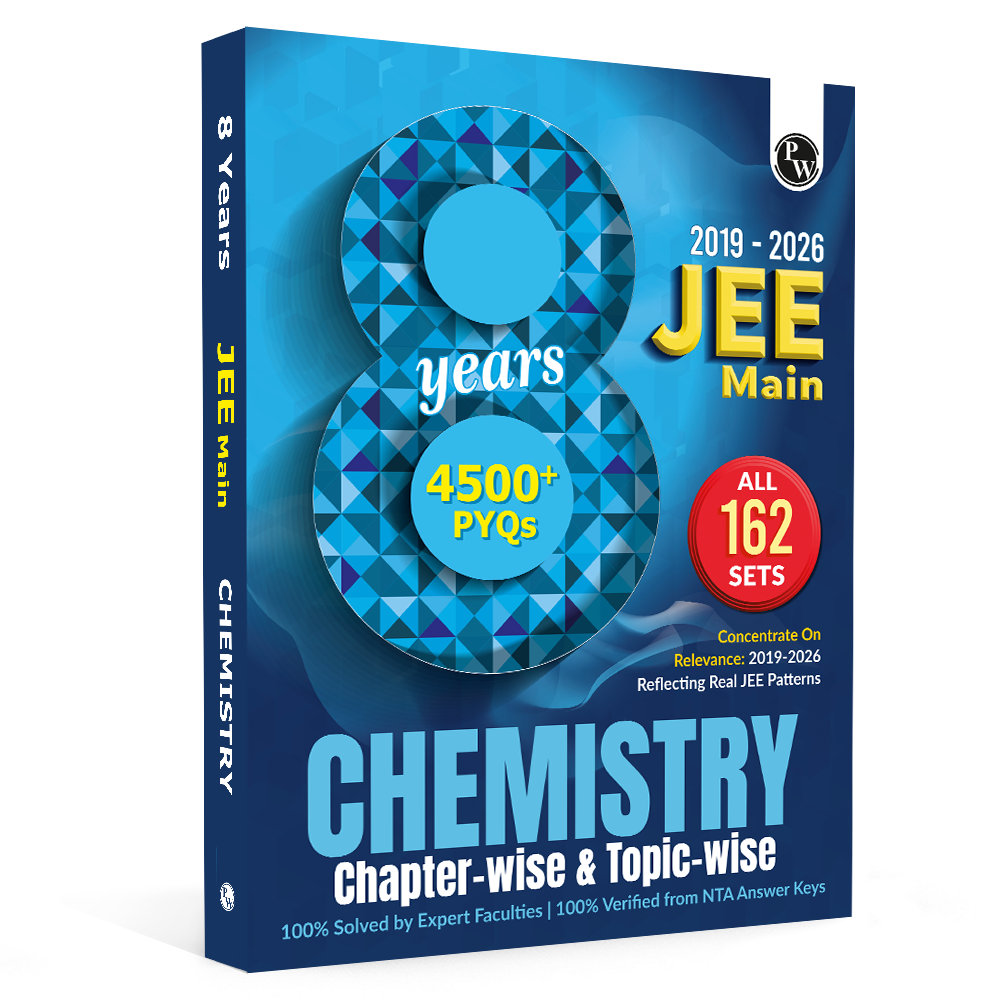
The book provides complete coverage of chemistry past papers, specifically tracking the contemporary patterns established over recent examination cycles. This guide is curated from around 162 sets of authentic question papers from recent years. It contains more than 4500 solved questions, making it an essential companion for engineering aspirants.
The structure of the book systematically distributes questions across the primary branches of chemistry. This ensures that students can practice in a structured, chapterwise, and topic-wise manner.
-
Time Period Covered: This resource compiles all necessary shift papers from recent years up to the latest sessions.
-
Format Layout: Every chapter contains a segregated analysis of topics, dividing problems based on specific sub-concepts.
-
Question Variations: The compilation covers both Multiple Choice Questions (MCQs) and Numerical Value Questions.
-
Solution Accuracy: Students get access to verified, step-by-step solutions designed to eliminate errors and clarify doubts during self-study.
Features of JEE Main Chemistry PYQ
This physical textbook eliminates the need to look for unverified PDFs or disorganized online sources. By bringing all exam papers into one place, it streamlines self-study sessions significantly.
-
Contemporary Relevance: The content is strictly limited to recent examination cycles, saving students from practicing outdated styles.
-
Authentic Shift Data: Includes the complete set of papers, ensuring students get a realistic view of the exam landscape.
-
Clear Typography and Layout: Designed with clear headings, clean tables, and scannable lists to make reading hassle-free.
Utilising this JEE book systematically helps students transition smoothly from basic concept reading to advanced-level application. It gives you a clear view of the exam, building the confidence needed to score well in the actual test.
Organic Chemistry Content in JEE Main Chemistry PYQ Book
Organic chemistry requires a fine balance between understanding reaction mechanisms and applying logical deductions. The JEE Main Chemistry PYQ book helps students identify structural patterns and sequential transformations that frequently appear in the national-level exam.
General Organic Chemistry (GOC) and Isomerism
The book dedicates substantial sections to GOC, which forms the backbone of organic transformations. Students will find numerous problems testing electronic effects, acidity, basicity, and stability of intermediates. Isomerism questions cover structural variations and stereochemical nuances like optical activity and conformations.
Named Reactions and Core Mechanisms
A significant trend in the exam is the emphasis on specific named transformations. The book systematically arranges questions based on preparation methods and chemical properties of organic compounds.
-
Hydrocarbons and Halogen Derivatives: Includes standard substitution and elimination mechanisms like SN1, SN2, E1, and E2.
-
Oxygen and Nitrogen Compounds: Contains extensive problems covering Aldehydes, Ketones, Carboxylic acids, Alcohols, and Amines.
-
Multi-Step Synthesis: Focuses heavily on sequence-based problems where multiple reagents are used consecutively to form a final product.
Bio-organic and Practical Chemistry
Apart from core reactions, questions from chapters like Biomolecules and Polymers are thoroughly included. JEE previous year papers provides a clear view of how questions are framed around structure, linkages, and classification. It also provides authentic questions based on the purification and qualitative or quantitative analysis of organic modules.
Inorganic Chemistry Content in JEE Main Chemistry PYQ Book
Success in inorganic chemistry depends heavily on mastering trends and memorising key facts from standard textbooks. Practising with the chemistry JEE main PYQ resource allows aspirants to pinpoint the exact lines and exceptions from which the questions are regularly extracted.
Chemical Bonding and Periodicity
The book categorises questions into foundational topics such as periodic properties and molecular structures. Students can practice a wide array of problems focusing on electronic configurations, atomic size variations, and electron gain enthalpy trends. In chemical bonding, special focus is placed on molecular orbital theory, bond order calculations, and dipole moments.
Coordination Compounds and d-Block Elements
Coordination chemistry is a staple topic in nearly every examination shift. The book features a vast question bank addressing crystal field theory, hybridization, magnetic moments, and structural isomerism. Additionally, transition element trends, oxidation states, and properties of lanthanides are thoroughly covered.
Physical Chemistry Content in JEE Main Chemistry PYQ Book
Physical chemistry demands exceptional formula application and calculation accuracy. The collection of chemistry JEE PYQ items shows that the National Testing Agency prefers testing physical chemistry concepts predominantly in the numerical value section.
Stoichiometry and Atomic Structure
Basic concepts such as the mole concept, molarity, normality, and empirical formula calculations are arranged topic-wise. The atomic structure section includes problems on quantum numbers, Bohr’s atomic model, de Broglie relationships, and the photoelectric effect.
Chemical Thermodynamics and Energetics
The thermodynamics questions in this book cover extensive conceptual ground, including work done, enthalpy changes, and entropy evaluations.
-
First and Second Laws: Problems test internal energy changes, heat capacities, and state functions under varying conditions.
-
Gibbs Free Energy: Focuses on predicting reaction spontaneity and relating cell potentials or equilibrium parameters.
-
Thermochemistry: Contains standard enthalpy of formation, combustion, and bond dissociation energy calculations.
Chemical Kinetics and Solutions
The book offers a wide collection of questions concerning rates of reactions, order determination, and integrated rate laws. The Arrhenius equation and collision theory are also highlighted. For liquid solutions, problems cover colligative properties, Raoult's law, and van't Hoff factor corrections for abnormal molecular masses.
Chemical and Ionic Equilibrium
Equilibrium problems are structured to help students tackle both simple gaseous reactions and complex ionic systems. This section incorporates questions dealing with equilibrium constants, Le Chatelier’s principle, pH calculations, solubility products, and buffer solutions.
Why Practice with the JEE Main Chemistry PYQ Book?
Using JEE mains PYQs collection provides a distinct edge to serious candidates. It completely changes how students approach their weekly schedules and final revisions.
Decoding Exam Difficulty and Weightage
Reviewing the trends from recent years provides students with an accurate understanding of which topics carry the highest scoring weight. For instance, chapters like coordination compounds and general organic chemistry consistently show a high presence across shifts.
Developing Speed and Accuracy
Solving authentic questions in a timed environment simulates the computer-based test scenario perfectly. It teaches students how to select manageable questions, avoid lengthy calculations, and eliminate negative marks in numerical segments.
Understanding Shift-Wise Variations
Since the engineering entrance exam is conducted in multiple sessions, the difficulty level can vary between shifts. Practising with all the sets present in this book allows candidates to understand how different versions of the same concept can be tested.
How to Use the JEE Main Chemistry PYQ Book?
To maximise the benefits of the chemistry PYQs JEE textbook, a systematic study approach should be maintained throughout the preparation period.
-
Topic Synchronization: As soon as you finish a chapter from your standard study material, immediately solve the past years' questions related to that specific topic.
-
Marking Challenging Problems: Use a marker or make margin notes near complex questions or unique tricks inside the book for quick subsequent revisions.
-
Timed Sectional Tests: Convert a cluster of thirty mixed questions into a mini practice test to evaluate your conceptual retention.
-
Error Analysis: Regularly review the step-by-step solutions provided in the book to check for alternative problem-solving paths and mathematical shortcuts.
Read More: JEE Important Questions Chemistry 2026 with Solutions
JEE Main Chemistry PYQ FAQs
Which editions are included in the 8-year chemistry question bank?
The resource incorporates all question papers from the past eight years up to the latest shifts. This compilation includes every single online exam session, giving students a complete view of modern exam patterns.
Are physical chemistry questions mostly numerical in this resource?
Yes, the compilation aligns perfectly with real test trends. It demonstrates that a significant portion of physical chemistry questions are placed in the numerical value or integer-type section.
Does the book provide answers along with step-by-step methods?
Every question in this compilation includes verified and detailed explanations. The step-by-step methods are framed to enhance concept clarity and help students learn the exact logic behind each answer.
Can I find topic-wise segregation for inorganic chemistry exceptions?
The chapters are systematically arranged both chapterwise and topic-wise. This means that trends, chemical properties, and exceptional behaviors are separated into structured sections for targeted practice.
Is this book sufficient for covering the latest exam patterns?
Practising these specific past papers is highly sufficient because it tracks the entire era of computer-based testing. It covers the transition and framing styles used currently, making it highly relevant for upcoming examinations.