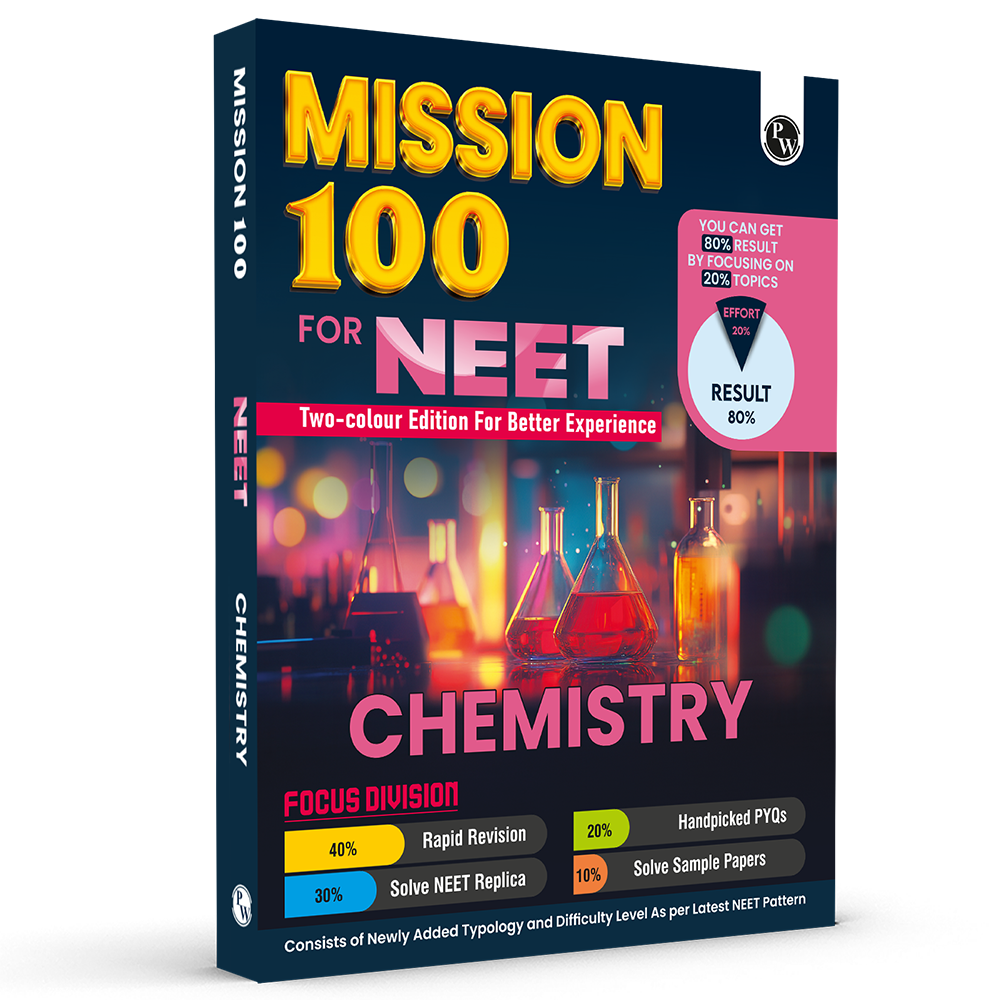
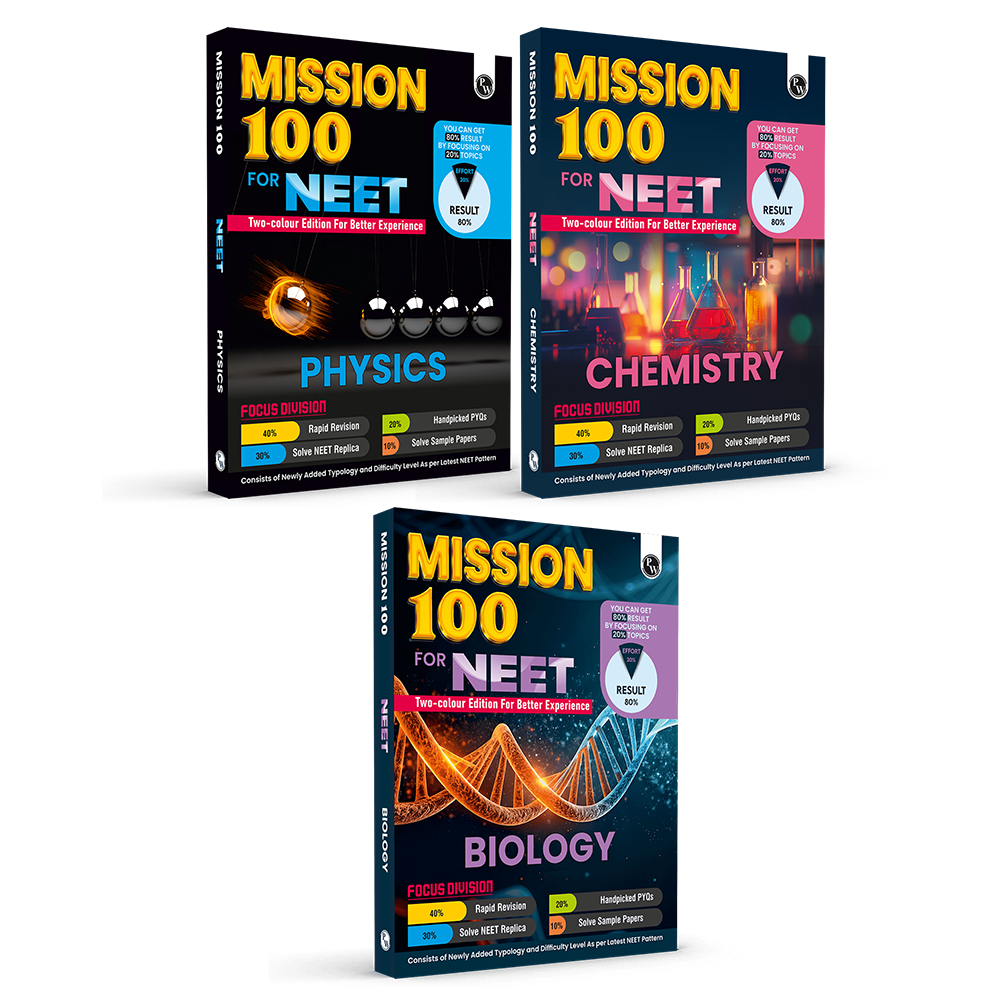
Features of PW Mission 100 Chemistry Book for NEET Exam
Staring at a mountain of textbooks during the mid-term season often leads to a specific kind of panic. You know you need to cover Physical, Organic, and Inorganic Chemistry, but the sheer volume of the syllabus makes it hard to know where to begin.
Most students spend hours highlighting pages without actually mastering the concepts that carry the most weight. This lack of direction is exactly why many feel unprepared despite working hard. The NEET Mission 100 Chemistry book is built to eliminate this confusion.
By focusing on high-yield topics and the 80/20 principle, it streamlines your revisions, ensuring you spend your energy on the areas that actually determine your rank in the 2026 exam.
Check Out: NEET Books
Overview of NEET Mission 100 Chemistry Book
The NEET Mission 100 Chemistry book serves as a specialised toolkit for aspirants who want to maximise their scores without wasting time on irrelevant details. Chemistry is a scoring subject, but only if you know where to focus your energy. This book identifies the 20% of topics that historically account for 80% of the marks in the NEET exam.
It is not just another textbook; it is a revision-centric guide. It combines concise theory with high-probability questions, making it a reliable companion for your mid-term preparation and final sprint. Integrating past-year analysis with modern question patterns ensures your study sessions are efficient and results-oriented.
Features of NEET Mission 100 Chemistry Book
When you are looking for the right NEET Mission 100 Chemistry Book, you need features that actually simplify your life. This book offers a structured approach to the syllabus through several key components:
80/20 Smart Focus Strategy
The book is built on the Pareto Principle. It highlights the most critical 20% of the Chemistry syllabus. These are the "must-know" areas that consistently appear in the exam, ensuring you spend your time where it matters most.
Data-Driven Topic Selection
Rather than guessing which chapters are important, this book uses data from previous NEET papers. Topics are prioritised based on their frequency and weightage, allowing for maximum scoring efficiency.
SCAN (Special Cases Asked in NEET)
One of the unique aspects of the NEET Mission 100 Chemistry book is the SCAN section. It covers those tricky, "out-of-the-box" cases and exceptional chemical properties that NTA often uses to test a student's depth of knowledge.
Concise and Result-Oriented Theory
Mid-term revision requires speed. The theory in this book is crisp and exam-focused. It skips the fluff and goes straight to the core concepts, making it easier to refresh your memory during a tight schedule.
Benefits of Using NEET Mission 100 Chemistry Book
Choosing the right NEET Chemistry revision tool can change your entire preparation trajectory. Here is how this book benefits your daily study routine:
-
Reduces Overwhelm: It breaks down the massive Chemistry syllabus into manageable, high-priority chunks.
-
Improves Retention: With summarised key notes and solved examples, you remember concepts longer.
-
Time Management: By focusing on the 80/20 rule, you finish your revision cycles faster than your peers.
-
Clarity on Exam Patterns: Through the NEET Chemistry PYQ sections, you learn exactly how examiners frame questions from specific topics.
-
Boosts Confidence: Successfully solving the 3 full-length mock tests included in the book provides a psychological edge.
How to Improve Scores with NEET Mission 100 Chemistry Book
To improve your marks in Chemistry, there needs to be a change in mindset from 'reading' to 'solving'. You can use the NEET Mission 100 Chemistry book for this purpose. Begin by analysing your weaknesses through the weightage distribution of topics.
Concentrate on the solved questions in the book first, as these are carefully selected to guide you through some of the most effective ways of tackling numericals in Physical Chemistry and mechanisms in Organic Chemistry.
Once you have got a good grasp of how to apply it, try the replica questions. This way, you get a steady improvement from easy questions to the full-fledged NEET Chemistry sample paper.
Apart from that, there is another trick for improving your scores in Chemistry. Try to give special importance to the SCAN boxes, as these are the questions where the difference between a good score and a very good one lies.
When to Start Your Revision for NEET Mission 100 Chemistry book
Timing is everything in competitive exams. Ideally, you should start using the NEET Mission 100 Chemistry book during your midterms. This is the period when you have completed a significant portion of the syllabus but need to consolidate your knowledge.
Using it during the mid-term phase allows you to:
-
Identify gaps in your understanding early.
-
Practice the PYQs while the concepts are still fresh.
-
Avoid the last-minute panic that happens in the final two months before NEET.
Even if you are behind schedule, this book acts as a "fast-track" guide. Because it prioritises the most important topics, you can use it to cover the essential syllabus in a fraction of the time it would take to read traditional NEET Chemistry books.
Check Out: NEET Previous Year Paper
Study Plan with NEET Mission 100 Chemistry Book
To get the most out of this resource, follow this structured 4-step plan for your NEET Chemistry revision:
Step 1: Concept Refresh
Read the crisp theory and key notes for a specific chapter. Do not spend more than 30–45 minutes on this. The goal is to recall, not to learn from scratch.
Step 2: Analyse Previous Trends
Go through the PYQ for that chapter. Look at the language of the questions. Are they asking for direct facts, or are they multi-concept problems? Use the data-driven insights in the book to spot these trends.
Step 3: Targeted Practice
Solve the "NEET Replica" questions. These are focused on the most probable questions for the 2026 exam. If you get a question wrong, go back to the "SCAN" or theory section to see what you missed.
Step 4: Simulated Testing
Every weekend, take one of the NEET Chemistry sample paper tests included in the book. Sit in a quiet room, set a timer, and treat it like the actual NEET exam. This builds the mental discipline required for the 180-minute marathon.
Read More: NEET Chemistry Chapter Wise Weightage 2026
NEET Mission 100 Chemistry Book FAQs
What is the 80/20 rule in the NEET Mission 100 Chemistry book?
The 80/20 rule, also known as the Pareto Principle, suggests that 80% of exam questions come from 20% of the most important topics. This book identifies and focuses on that crucial 20% to save you time.
Does this book include the latest NEET Chemistry PYQ?
Yes, the book includes topic-wise past-year questions, including the most recent papers, to help you understand the evolving trends in the NEET exam.
Can I use this book for my final revision for NEET Chemistry?
Absolutely. The book is specifically designed for "Smart Revision." Its concise theory and key notes make it the ideal tool for the final weeks leading up to the exam.
How many mock tests are in the sample paper section?
The book includes 3 full-length mock test papers that closely match the NTA NEET pattern, allowing you to assess your readiness and time management.
Is the NEET Mission 100 Chemistry book enough for organic Chemistry?
The book covers all branches of Chemistry, including Organic. It highlights special cases and frequently asked mechanisms, ensuring you are prepared for the most probable question patterns.