How to use the 39 Years NEET PYQ Chemistry to master Organic and Inorganic sections
Medical aspirants, often suffering from exam anxiety, have to memorize so many periodic properties and complex reaction mechanisms. The solution to this dilemma is deliberate practice with actual exam questions.
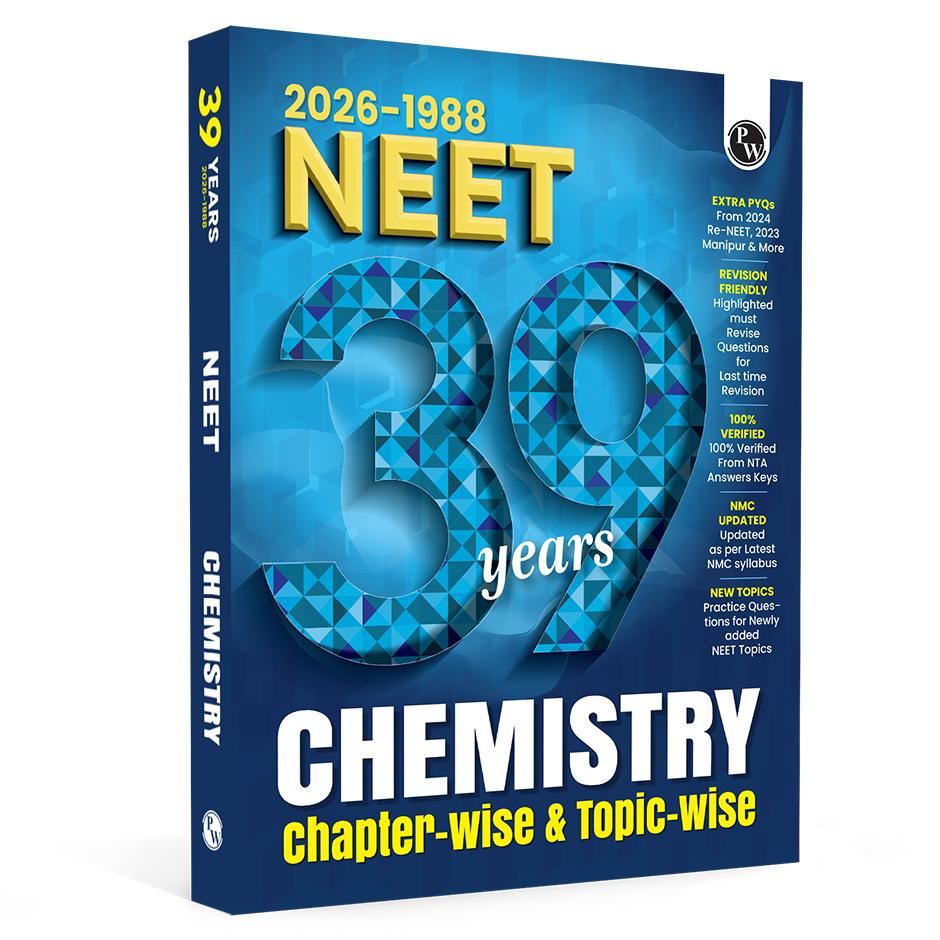
A NEET PYQ chemistry book helps you understand the actual exam pattern, identify important topics, and helps you to develop the speed to get top marks.
Check Out: NEET Books
Importance of NEET PYQ Chemistry
Studying textbook theory gives you conceptual clarity, but practicing past papers shows you how to apply that theory under exam pressure. Past question papers serve as a blueprint of the actual test, removing the guesswork from your preparation strategy.
Using a comprehensive chemistry PYQ NEET book provides several key structural benefits:
-
Identifying recurring themes: You learn which chapters carry the maximum weightage every single year.
-
Understanding question framing: You get familiar with how examiners twist simple theoretical statements into tricky analytical questions.
-
Improving accuracy: Regular practice helps you minimize minor calculation mistakes and conceptual misinterpretations.
-
Developing time management: It teaches you how much time to allocate to theoretical questions versus numerical problems.
How to Learn Organic Chemistry with the NEET PYQ Chemistry Book?
Organic Chemistry is highly logical and relies heavily on structural understanding. Many students make the mistake of blindly memorizing reactions instead of understanding the underlying electronic movements and stability principles.
Master named reactions systematically
Named reactions form the backbone of the Organic section in medical entrance tests. When working through a quality NEET chemistry PYQ guide, you will observe that specific reactions appear consistently across different years.
-
Compile an active checklist of every named reaction found in the past papers.
-
Write down the specific reagents, catalyst conditions, and major intermediates for each.
-
Practice multi-step conversions, as modern papers frequently chain three or four named reactions together.
-
Pay attention to specific test reactions like the Iodoform test, Tollens' test, and Fehling's test.
Strengthen your General Organic Chemistry foundation
General Organic Chemistry governs how molecules behave during a chemical transformation. If your core concepts are weak, advanced chapters like Aldehydes, Ketones, and Amines will feel impossible to master.
-
Use previous papers to practice questions on inductive, electromeric, resonance, and hyperconjugation effects.
-
Learn to rank various organic molecules based on their acidic and basic strengths.
-
Work extensively on carbocation, carbanion, and free radical stability problems, as these dictate reaction products.
How to Learn Inorganic Chemistry with NEET PYQ Chemistry Book?
Inorganic Chemistry is often misjudged as a pure memorization section, but it requires a highly structured, structural, and analytical approach to score full marks.
Track periodic trends and chemical exceptions
The periodic table follows general rules, but the entrance test almost always focuses on where those rules break down. Analyzing a reliable chemistry PYQ NEET resource allows you to map out these anomalies clearly.
-
Ionization Enthalpy: Focus on irregularities across the second period, especially involving nitrogen, oxygen, beryllium, and boron.
-
Electron Gain Enthalpy: Study why halogens show unexpected behavior, particularly the comparison between fluorine and chlorine.
-
Atomic and Ionic Radii: Pay close attention to variations caused by lanthanide contraction in the d-block elements.
Memorize chemical structures and hybridization states
Questions regarding chemical bonding, molecular geometry, and lone pair counts are highly scoring and predictable.
-
Ensure you can draw exact structures for all xenon fluorides, phosphorus oxoacids, and sulfur oxoacids.
-
Practice finding the hybridization state of central atoms in complex coordination compounds.
-
Note down the specific colors of different chemical precipitates and gases that appear regularly in analytical questions.
How to Use the NEET PYQ Chemistry Book?
Simply owning a past papers compilation will not guarantee success; you need a proper framework to integrate it into your daily study routine.
|
Practice Step |
Execution Strategy |
Target Learning Outcome |
|
Phase 1 |
Complete a textbook chapter thoroughly |
Establishes core conceptual clarity |
|
Phase 2 |
Solve topic-wise past questions |
Pinpoints immediate weak areas |
|
Phase 3 |
Flag difficult or incorrect questions |
Builds a personalized revision roadmap |
|
Phase 4 |
Re-attempt flagged items after one week |
Ensures permanent memory retention |
Practice with a strict topic-wise division
Do not attempt to solve several decades of past exam papers all at once. Instead, finish a single chapter from your core study material and immediately open the corresponding NEET previous year question paper chemistry section. This immediate application reinforces the formulas and chemical laws you have just read, preventing information loss.
Maintain a detailed mistake journal
Every time you mark an answer incorrectly, avoid the temptation to just read the correct option and move on. Investigate the root cause of your error.
-
Note down if it was a silly mathematical error, a misread question statement, or a total conceptual gap.
-
Write down the correct chemical logic or formula in a dedicated notebook.
-
Review this notebook before starting any new chapter to ensure you do not repeat the same mistakes.
Mistakes to Avoid While Preparing with the NEET PYQ Chemistry Book
Being aware of what not to do is just as important as knowing what to do when preparing for highly competitive medical entrance exams.
Memorizing questions instead of understanding concepts
Some students treat NEET previous year papers like a question bank to be memorized. The exact questions rarely repeat word-for-word, but the fundamental concepts and reaction mechanisms are used repeatedly. Always prioritize understanding why an option is correct over simply remembering the answer key.
Studying outdated syllabus topics
The entrance exam syllabus undergoes periodic modifications to stay relevant. If you encounter a complex question from approximately twenty years ago that deals with topics completely omitted from the modern curriculum, do not waste days trying to master it. Keep your preparation strictly aligned with the current examination guidelines.
Practicing without keeping track of time
Solving past questions at a leisurely pace helps when you are learning a concept for the first time. However, as the exam day approaches, you must introduce a strict timer. Aim to solve each chemistry question in around fifty to sixty seconds to replicate real test environment conditions.
Tips for Using NEET PYQ Chemistry
Your study methodology should evolve from expansive learning to targeted consolidation during the final months of your preparation.
-
Review your error log daily: Spend around thirty minutes every morning reading through your compiled mistakes to keep them fresh in your mind.
-
Prioritize high-yield chapters: Allocate extra revision time to chapters like Chemical Bonding, Coordination Compounds, and Carbonyl Compounds.
-
Utilize full-length papers: Use your NEET PYQ book chemistry resources to solve complete, un-segregated question papers to build the mental stamina needed to sit through the actual exam.
-
Practice active recall: Instead of just re-reading notes, look at a past question and try to sketch out the reaction mechanism or periodic trend on a blank piece of paper from memory.
Read More: Features of PW Mission 100 Chemistry Book for NEET Exam
NEET PYQ Chemistry Book FAQs
How many years of past papers should I practice for the medical entrance exam?
Practicing 30 to 39 past papers is highly recommended. This comprehensive timeframe exposes you to every possible question variation, structural shift, and difficulty level introduced over the decades.
Is reading the standard textbook enough if I also use a NEET PYQ chemistry book?
Yes, thoroughly analyzing your standard textbooks alongside a dedicated past papers book is generally sufficient. This combination ensures your theoretical foundation is sound while giving you ample exposure to practical applications.
How do I handle complex reaction mechanisms in Organic Chemistry?
Break down the mechanism into smaller steps, track the movement of nucleophiles and electrophiles, and then practice related questions from past papers to see how those specific intermediates are tested.
Should I practice past papers chapter-wise or year-wise?
You should start with a chapter-wise approach while covering the syllabus to consolidate individual topics. Switch to solving year-wise papers during the final two months of preparation to master overall time management.
What is the best way to remember all the exceptions in Inorganic Chemistry?
Create a concise summary chart of all anomalous electronic configurations, periodic trends, and chemical structures. Review this chart at least twice a week and solve past questions related to those specific exceptions to fix them in your memory.