Kinematics NEET Questions Preparation with PW Objective NCERT Physics Book
To understand mechanics, you need to solve accurate kinematics NEET questions efficiently. A lot of students find it hard to apply formulas under timed conditions in graphical or numerical problems. Often, this challenge arises from the absence of a structured source of practice, and NEET Books can provide syllabus-aligned concepts, examples, and practice questions to strengthen preparation.
Importance of Daily Practice of Kinematics NEET Questions
Consistent daily practice helps students build the calculation speed and problem-solving skills required for medical entrance examinations. Kinematics questions for NEET often require students to convert a given situation into equations, graphs, or motion-based concepts within a limited time. Regularly solving these questions improves familiarity with common problem patterns and helps students apply formulas more confidently during the exam.
-
Daily problem sets prevent conceptual gaps from becoming difficult to manage later.
-
Regular exposure to different question formats improves graphical and numerical analysis skills.
-
Timed practice sessions help students become comfortable with examination pressure.
-
Reviewing incorrect answers helps identify weak concepts and calculation mistakes.
-
Practising different motion scenarios improves formula selection and application.
-
Identifying recurring question patterns makes revision more focused and organised.
How PW Objective NCERT Physics Book Helps with Kinematics NEET Questions
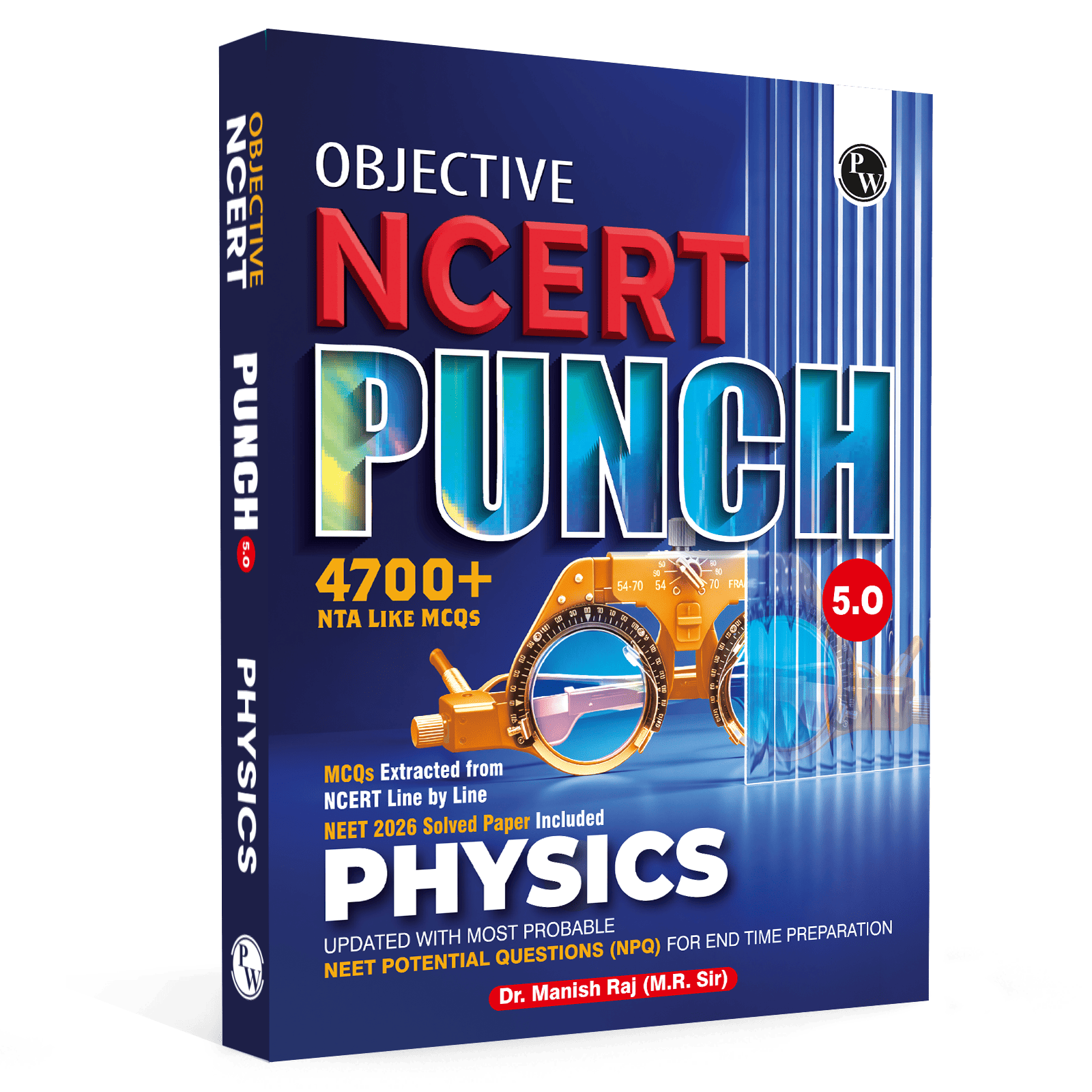
The right study material turns erratic study habits into a disciplined routine. The PW Objective NCERT Physics book includes more than 4700 NTA level multiple choice questions in line with the modern examination trends.
-
Built entirely on NCERT frameworks to ensure board and entrance alignment.
-
Features chapter-wise short notes for rapid pre-test revisions.
-
Includes Most Probable NEET Potential Questions for end-stage preparation.
-
Targets high-order thinking skills through structured numerical profiles.
Types of Kinematics Questions to Practise for the Exam
Entrance examinations test analytical depth across several distinct formats. Preparing for diverse item styles prevents panic when encountering unfamiliar layouts on test day.
-
Statement-based items test conceptual clarity rather than direct formula application.
-
Assertion and reason problems check fundamental theoretical boundaries.
-
Match-the-column formats evaluate multiple parameters simultaneously.
-
Multi-correct choices eliminate blind guessing strategies completely.
One-Dimensional Motion Practice with Kinematics NEET Questions
Straight-line motion forms the foundation of all mechanics problems. Students must understand acceleration, velocity-time graphs, and relative speed calculations.
-
Constant acceleration equations apply directly to free-fall scenarios.
-
Slope calculations on velocity-time graphs yield instantaneous acceleration values.
-
Area under velocity curves represents total displacement accurately.
-
Sign conventions must remain consistent throughout every calculation step.
Two-Dimensional Motion and Kinematics NEET Questions Practice
Projectile motion and relative velocity introduce vector components into spatial problems. Visualizing trajectories helps separate horizontal and vertical motion variables.
-
Horizontal velocity remains constant assuming negligible air resistance.
-
Vertical motion operates under constant gravitational acceleration downwards.
-
Maximum height formulas depend entirely on initial vertical velocity components.
-
Range calculations require precise angle and initial speed values.
How to Improve Time Management While Solving Kinematics Questions
Speed and accuracy both play an important role in performing well in medical entrance examinations. Students often lose valuable time when they spend too long on a single numerical problem or repeat lengthy calculations unnecessarily. Regularly practising NEET kinematics questions from a structured NEET Question Bank helps students recognise common problem patterns, select the right formula faster, and avoid calculation traps during timed practice sessions.
-
Recognising standard quadratic roots can reduce calculation time in numerical problems.
-
Remembering standard projectile motion relationships can avoid unnecessary derivation steps.
-
Moving past lengthy questions when the approach is unclear helps preserve time for easier problems.
-
Checking units and dimensions quickly can help identify calculation errors.
-
Practising under a timer improves familiarity with solving questions within limited time.
-
Reviewing the time taken for each practice set helps identify areas where students need to improve their speed.
Kinematics NEET Questions Topic-Wise Practice Plan
Practising these questions topic-wise helps students build a clear understanding of motion before attempting mixed or difficult problems. Instead of solving questions randomly, aspirants can divide preparation into one-dimensional motion, graphs, relative motion, and projectile motion. This makes it easier to identify weak areas and revise specific concepts when needed.
|
Kinematics Topic |
Core Focus Areas |
Strategic Practice Approach |
|
One-Dimensional Motion |
Uniform acceleration, displacement, velocity, and equations of motion |
Formula-based numerical questions and direct substitution practice |
|
Motion Graphs |
Position-time (x-t) and velocity-time (v-t) curve interpretation |
Slope-based analysis (for velocity/acceleration) and area-based calculations (for displacement) |
|
Relative Motion |
Relative velocity vectors, moving frames, and classic river-boat/rain-man problems |
Conceptual scenario breakdown combined with multi-step numerical problem solving |
|
Projectile Motion |
Horizontal and vertical components, time of flight, horizontal range, and maximum height |
Application-based formula manipulation and trajectory analysis |
|
Free Fall |
Vertical motion under gravity, initial velocity conditions, and symmetry of ascent/descent |
Numerical computation and statement-based conceptual verification |
After completing each topic, students should review incorrect answers and note the formulas or concepts that caused difficulty. Once individual topics become comfortable, mixed questions can be attempted under timed conditions to check overall preparation.
How to Analyse Mistakes in Kinematics NEET Questions
Simply checking the correct answer is not enough to improve performance. Analysing these questions after every practice session helps students understand whether an error occurred because of a wrong formula, calculation, graph interpretation, or sign convention. This process can prevent the same mistakes from appearing repeatedly in mock tests.
-
Separate conceptual mistakes from calculation errors.
-
Recheck the given values and units before reviewing the solution.
-
Identify whether the correct equation of motion was selected.
-
Review graphs carefully when the question involves displacement or velocity.
-
Check positive and negative directions in one-dimensional problems.
-
Reattempt incorrect questions without looking at the solution.
-
Maintain an error log for formulas and concepts that cause repeated mistakes.
Regular mistake analysis makes practice more useful and helps students improve accuracy along with speed. Using Objective NCERT Punch Books alongside regular practice can further strengthen concept clarity, reinforce important topics, and support effective revision.
Kinematics NEET Questions Mock Practice for Better Speed and Accuracy
Timed practice can help aspirants become comfortable with solving physics questions under exam pressure. After completing topic-wise preparation, students can use mixed questions as short mock tests. This allows them to practise selecting the right approach quickly instead of spending too much time on a single numerical problem.
-
Start with a small timed set and gradually increase the number of questions.
-
Identify direct formula-based questions before attempting lengthy problems.
-
Use units and dimensions to check calculations where possible.
-
Don’t spend too much time on a tricky question.
-
Review the unanswered questions after finishing the timed set.
-
Compare accuracy and time of completion in different practice sessions.
-
Keep repeating the weak question types until you are more comfortable with them.
Combining timed practice with regular error analysis can help students develop better question-selection skills and improve their overall performance in the NEET Physics section.
Read More: NEET Previous Year Question Papers with Solutions PDF
Kinematics NEET Questions Preparatio FAQs
How many kinematics questions should I practice daily?
Solving twenty to thirty targeted problems daily builds steady momentum without causing burnout. Consistent engagement ensures long-term retention of core formulas and graphical shortcuts.
Are NCERT textbooks enough for solving kinematics questions?
NCERTs are the conceptual baseline but for speed you need additional practice books. Students will be exposed to a variety of numerical and statement variations through dedicated question banks.
What is the best way to revise kinematics NEET preparation before exams?
Utilize chapter-wise short notes and review previously marked challenging numerical problems. Focus heavily on graphical interpretations and recurring patterns found in previous year archives.
How does the PW Objective NCERT Physics book help with NEET physics questions?
It offers over 4700 NTA-level questions, assertion-reason sets, and most probable potential problems. This extensive structural variety trains candidates to handle unexpected twists in exam formats.
Why do students struggle with kinematics objective questions during tests?
The sign conventions of coordinates are misunderstood, and the components of vectors are not isolated, causing major errors. You can avoid these recurrent calculation mistakes by practicing rigorously with the help of structured modules.