Laws of Motion Important Questions for NEET Exam

Laws of motion neet important questions are basic physics problems that teach you how things move when we push or pull them. These questions focus on three simple rules made by a scientist named Newton. They also talk about why things stop and how ropes pull on objects. In the exam, solving laws of motion neet important questions is a great way to start because these rules help you understand everything else in science. Most students find that once they understand these rules, they can see physics happening everywhere, from a ball rolling on the ground to a giant plane taking off into the sky.
Check out: PW NEET Books
What Is This Chapter About?
The laws of motion neet syllabus is all about why things move or stay still. It starts with a simple idea: objects are "lazy." If a ball is sitting on the grass, it wants to stay there forever. If it is rolling, it wants to keep rolling. When you look at laws of motion neet questions, you will see many problems about balls being hit, cars stopping, or even rockets going up into the sky. This "laziness" is a core concept that you must know if you want to score well. It is the reason we need force to change anything in the physical world.
Studying laws of motion class 11 important questions neet helps you see physics in your own life. For example, why do you fall back when a car suddenly starts moving? This happens because your body wants to stay still. These are the kinds of fun puzzles you will find in your practice papers. The NCERT book explains these rules using simple examples from our daily world, like pushing a swing or sliding a book across a desk. Understanding these basics is the first step toward doing well in the laws of motion neet syllabus.
-
Rule 1 (Inertia): Things are lazy and don't change what they are doing unless you push them with a net force.
-
Rule 2 (F = ma): If you push something harder, it will speed up faster. The heavier it is, the more push you need.
-
Rule 3 (Action-Reaction): If you push a wall, the wall pushes you back just as hard. You can't touch something without it touching you back!
Check out: NEET Previous Year Papers
Practice Questions for Laws of Motion for NEET
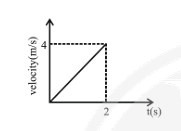
Q1. For a body of 25 kg mass, the velocity-time graph is shown in the figure. The force acting on the body is:
- 25 N
- 50 N
- 12.5 N
- 100 N
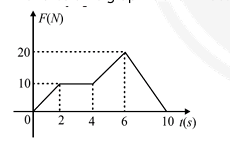
Q2. A particle of mass 2 kg is initially at rest. A force acts on it whose magnitude changes with time. The force-time graph is shown below:The velocity of the particle after 10 s is:
- 20 ms⁻¹
- 10 ms⁻¹
- 75 ms⁻¹
- 50 ms⁻¹
Q3. The linear momentum p of a body moving in one dimension varies with time according to the equation p = a + bt², where a and b are positive constants. The net force acting on the body is:
- a constant
- proportional to t²
- inversely proportional to t
- proportional to t
Q4. A body of mass 2 kg moving on a horizontal surface with an initial velocity of 4 m/s comes to rest after 2 seconds. If one wants to keep this body moving on the same surface with a velocity of 4 m/s, the force required is:
- 8 N
- 4 N
- Zero
- 2 N
Q5. What is the acceleration of 5 kg mass?F = 16 N
- 2 m/s²
- 4 m/s²
- 1 m/s²
- 3 m/s²

Q6. When a train stops suddenly, passengers in the running train feel an instant jerk in the forward direction because:
- The back of the seat suddenly pushes the passengers forward
- Inertia of rest stops the train and takes the body forward
- Upper part of the body continues to be in the state of motion whereas the lower part of the body in contact with the seat remains at rest
- Nothing can be said due to insufficient data
Q7. A block of mass m is released on a smooth inclined plane of inclination θ with the horizontal. The force exerted by the plane on the block has a magnitude:
- mg
- mg/cosθ
- mg tanθ
- mgcosθ
Check Out: NEET Revision Books
Important Rules
To do well, you need to look at laws of motion important questions for neet that use "Box Drawings." This just means drawing a simple box to represent a car or a block and using arrows to show which way you are pulling it. Scientists call these "Free Body Diagrams," but you can just think of them as maps of pushes and pulls. If you can draw these arrows correctly, most laws of motion neet questions become very easy to solve because you can see exactly which force is winning the tug-of-war.
Another big part of the laws of motion neet syllabus is "The Big Hit." This is when you push something very hard for a tiny bit of time, like hitting a nail with a hammer or a cricket bat hitting a ball. In laws of motion neet important questions, you will often have to find out how much the speed changed after a big hit. This is known as Impulse. It is just like counting how much a ball speeds up after you kick it. The faster the hit and the stronger the force, the more the object will move.
Check Out: NEET Test Series
Tips For Success In Exams
To score high marks, you should always spend time drawing a Free Body Diagram (a box with arrows) before you start any math. Use the laws of motion neet questions to learn how to split forces into two parts—the ones going up-down and left-right. This helps you deal with slanted surfaces or ramps. A smart tip is to remember that friction always tries to stop the slide, so draw its arrow in the opposite direction of the movement.
Practicing laws of motion neet important questions about lifts and pulleys every day will make you very fast. Always follow the NCERT examples to keep your basics strong. When you solve laws of motion class 11 important questions neet, try to explain the answer to a friend. If you can explain why a person feels heavier in a lift that is speeding up, you truly understand the concept. Keeping a list of laws of motion important questions for neet and solving them twice will ensure you don't forget the formulas during the actual exam.
Friction and Road Safety
Friction is like "sticky air" or "sticky floors" in the laws of motion neet syllabus. It is the force that tries to stop things from sliding. You will often see questions asking why it is hard to push a heavy box on a carpet but easy on ice. Practicing laws of motion neet important questions will teach you that friction always tries to stop things from moving. Without friction, we wouldn't be able to walk or even hold a pencil! It is a very important force that appears in many laws of motion neet questions.
Why Roads are Tilted
A very popular topic in laws of motion important questions for neet is why roads are tilted at the corners.
-
Stay Safe: The tilt helps cars stay on the road without sliding off when they are going fast.
-
Extra Push: The tilt gives the car an extra push toward the center of the turn, so the tires don't have to do all the work.
-
Speed Limits: Most laws of motion neet questions asking how fast a car can go on these tilted roads before it starts to skid.
-
Angle of the Road: You will often need to find the "angle" of the tilt in your laws of motion neet important questions.
Read More: Easiest vs Toughest Topics for NEET Exam Preparation
Laws of Motion Important Questions FAQs
1. Which rule of Newton is used the most?
The second rule (Push = Weight x Speeding up) is the heart of most laws of motion neet questions because it connects force to motion.
2. What is friction?
Friction is the "stickiness" or resistance between two things that stops them from sliding, which is a major part of laws of motion neet important questions.
3. Why do we study tilted roads?
We study them because they help us understand how to design safe turns for cars and bikes, which is a frequent topic in the laws of motion neet syllabus.
4. What is a "lazy" object in physics?
In laws of motion class 11 important questions neet, "lazy" refers to inertia, which means an object resists changing its current state of rest or motion.
5. How do I solve rope problems?
Just remember the rope is like a bridge that carries the same force (tension) to both sides. This is a common trick in laws of motion neet questions.