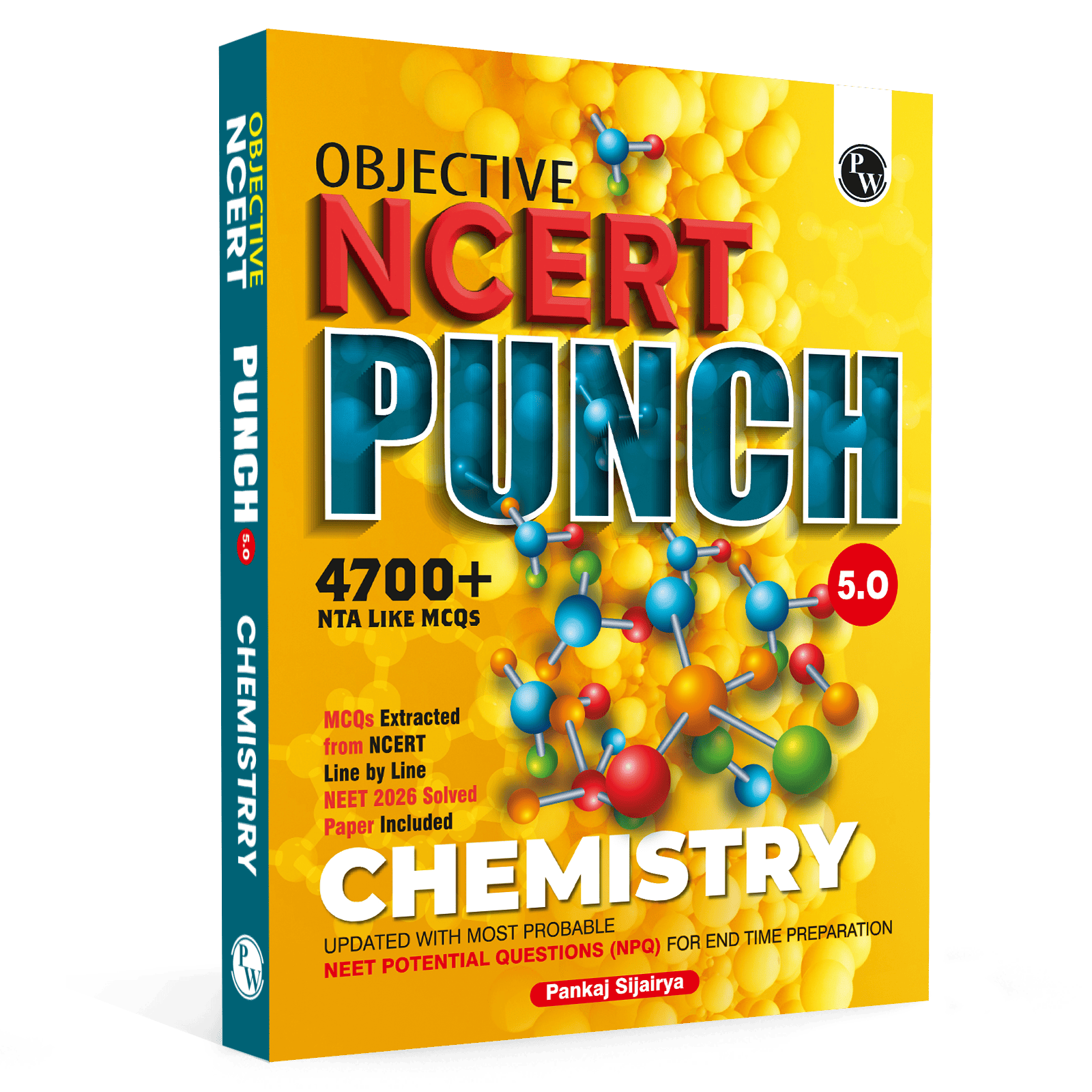
What Topics does the Objective NCERT Punch Chemistry Cover for NEET 2027

Theoretical texts are difficult to memorise complex chemical reactions, periodic trends and numerical formulas for many medical aspirants. Without systematic, goal-oriented practice, it is very difficult to find high yield regions. This article explains the systematic bridging between theoretical reading and practical practice of NEET objective punch chemistry edition.
NEET Objective Punch Chemistry Overview
These modules are one stop preparation modules especially for medical undergraduates. It is a systematic workbook that takes passive reading and makes it active learning. The main objective of this textbook is to provide a focused setting for students to test their knowledge immediately after each chapter.
The volume is supplemented with high order time consuming multiple choice questions to suit the current pattern of assessment. It takes the guesswork out of the situation by providing selected questions that simulate the official national exam atmosphere.
The resource is designed around strengthening basic principles. It helps in breaking down each main topic of class 11 and class 12 sub disciplines into bite-sized objective judgements. This way you will spend less time going through unimportant topics and more time focusing on content that has greatest weight in the actual test.
NEET Objective Punch Chemistry Topics
A balanced knowledge of the three branches of Chemistry is required to achieve a strong rank. The goal-based punch chemistry syllabus ensures that no topic is left untouched. This gives students clear topic segregation so they can build proficiency across different problem types. Combining preparation with a structured NEET Question Bank can further strengthen application skills and improve exam readiness.
Physical Chemistry
Physical Chemistry demands mathematical accuracy and strong formula application. The textbook tackles this segment by providing intensive numerical problems and conceptual fill-ups.
-
Formula Application: Dedicated question sets focus on applying thermodynamic equations, equilibrium constants, and electrochemistry variables.
-
Calculation Speed: High-order time-intensive problems help you find faster paths to answers, minimizing calculation errors under exam pressure.
-
Graphical Analysis: Includes data-driven questions that require accurate interpretation of rate curves, vapor pressure diagrams, and atomic structures.
Organic Chemistry
Organic Chemistry centers heavily on reaction mechanisms, named transformations, and structural identifications. This module simplifies memorization through highly structured problem variations.
-
Mechanism Breakdown: Questions test your understanding of intermediates, nucleophilic substitutions, and electrophilic additions step-by-step.
-
Name Reactions: Separate matching exercises and assertion-reason items ensure you remember reagents, substrates, and final products easily.
-
Conversion Pathways: Multi-step conversion questions teach you how to link different functional groups together efficiently.
Inorganic Chemistry
Inorganic Chemistry is notorious for its vast factual details, periodic trends, and chemical anomalies. The workbook converts these dry facts into active recall exercises.
-
Line-by-Line Mastery: Extracted directly from official textbook statements, ensuring you memorize precise electronic configurations, structures, and oxidation states.
-
Trend Analysis: Dedicated exercises cover periodic variations, anomaly justifications, and comparative properties of elements.
-
Coordination Compounds: Focuses heavily on isomerism, bonding theories, and IUPAC nomenclature rules.
Features of NEET Objective Punch Chemistry
The unique layout of the objective punch chemistry edition sets it apart from traditional question banks. NEET Objective Punch book incorporates a variety of pedagogy tools to enhance your daily self-study sessions.
NCERT-Picks
Every single chapter opens with a dedicated segment known as NCERT-Picks. This section ensures that all core concepts are simplified and fully explained right at the start.
-
Visual Aids: Uses highly colorful diagrams, structural flowcharts, and memory maps to make complex trends easily scannable.
-
Concept Retention: Summarizes critical definitions and exceptions so you have a quick reference point before attempting the actual practice questions.
1500+ Question Typology
Monotonous question patterns can lead to passive guessing. This book fixes that by introducing an extremely diverse range of question formats.
-
Statement-Based Items: Tests your absolute factual accuracy by forcing you to analyze multiple statements simultaneously.
-
Assertion & Reason: Evaluates your deeper analytical thinking and checks whether you truly understand the "why" behind chemical phenomena.
-
Matching Type Questions: Excellent for reviewing reactions, chemical formulas, and structural uses in a highly interactive format.
-
Correct & Incorrect Identification: Enhances your attention to detail by asking you to locate subtle errors within complex academic descriptions.
Advanced Practice Elements
To score exceptionally well, you must be prepared for unexpected difficulty shifts. The manual includes specialized practice tiers for this exact reason.
-
High-Order Time Intensive MCQs: These complex, multi-step problems are designed to challenge your logical reasoning and improve time-allocation habits.
-
Exemplar MCQs: Includes selected questions from official national exemplar archives, complete with detailed explanations to boost conceptual application.
-
Rationalised Content (RC): Explicitly highlights revised areas to ensure your preparation stays completely aligned with the latest official undergraduate syllabus.
Benefits of NEET Objective Punch Chemistry
Integrating this workbook into your routine offers distinct competitive advantages. It changes how you process information, moving your strategy from simple rote memorization to true conceptual mastery.
Elimination of AI-Style Errors
The chemistry textbook is written by a professional. You are learning from real academics.
Many digital platforms or unverified online test banks generate questions using automated algorithms that do not provide contextual nuance or include factual inaccuracies. This printed guide gives you 100% human checked explanations to ensure your learning error free and extremely accurate.
Targeted Revision
The structured format allows you to run highly specific revision cycles without flipping through hundreds of theoretical pages.
-
Error Tracking: Because the questions are categorized chapter by chapter, you can instantly pinpoint your exact weak areas.
-
Data-Driven Practice: You save hours of study time by working through pre-filtered questions that map perfectly to historical exam trends.
Exam Realism
Practicing with authentic materials builds the exact mental stamina needed on the big day.
-
Past Paper Coverage: Includes genuine national examination past papers along with AIIMS questions to give you real-time feedback on your performance levels.
-
Line-by-Line Tracking: Teaches you how examiners turn standard textbook lines into tricky, confusing multiple-choice options.
How to Use NEET Objective Punch Chemistry
A superb resource is only half the battle; how correctly you use it decides your final score. Here is a stepwise approach to make the most out of this PW NEET book in your everyday studies.
Step 1: Read the Base Theory First
Don’t go into question solving without cracking open your textbook. Read your main chapter carefully paying special attention to shaded boxes, summary points and structural formulas.
Step 2: Review the NCERT-Picks
Spend 10 minutes studying the NCERT-Picks section at the beginning of the chapter before flipping to the question pages. Use the flow charts and colour representations to jog your memory and remind you of important exceptions.
Step 3: Solve the Fill-Ups and True/False Modules
Start with simple foundational questions in your practice. The fill-in-the-blanks and true/false questions are great for gauging your absolute baseline memory and board-level understanding.
Step 4: Attempt the Topic-Wise MCQs
Move systematically through the standard multiple-choice section. Try to solve at least 40 to 50 questions in a single sitting without checking the answers halfway through. This builds independent problem-solving skills.
Step 5: Understand the Advanced Tiers
Conclude your chapter work by tackling the High-Order Time Intensive MCQs and Assertion-Reason blocks. Read the detailed explanations carefully for any question you answer incorrectly or guess blindly.
When to Start Solving NEET Objective Punch Chemistry
Timing your preparation correctly prevents burnouts and keeps your momentum steady. The NCERT Punch Chemistry 2026 updates are structured to support long-term preparation timelines effectively.
|
Preparation Phase |
Recommended Usage Strategy |
Primary Focus Area |
|
Early Preparation |
Solve topic-wise questions concurrently with your weekly school lectures. |
Foundation building and line-by-line concept clarity. |
|
Mid-Term Phase |
Re-attempt incorrect questions and solve the advanced High-Order blocks. |
Improving analytical thinking and problem-solving speed. |
|
Final Three Months |
Treat past papers and exemplar sections as timed, mock examinations. |
Enhancing mental stamina and fine-tuning time management. |
Study Plan with NEET Objective Punch Chemistry
To finish the entire national syllabus well before your final test date, you need a disciplined, actionable schedule. Incorporating this specialized PW NEET chemistry book layout into a weekly workflow ensures consistent, balanced progress.
Weekly Routine Example
-
Monday & Tuesday: Complete the theoretical reading of a chapter. Take detailed notes on reactions or numerical formulas.
-
Wednesday: Read the NCERT-Picks section. Complete all the line-by-line fill-up questions to check your basic structural retention.
-
Thursday: Set a timer and solve 50 Topic-wise MCQs. Mark every question that takes you longer than one minute to complete.
-
Friday: Dive into the advanced Assertion-Reason and High-Order Time Intensive sections. Read the answer keys to correct your logic.
-
Saturday: Review your accumulated mistakes from the week. Re-solve those specific problems without looking at the solutions.
Common Mistakes While Using NEET Objective Punch Chemistry
Even when using the highest quality NEET NCERT punch chemistry preparation books, poor study habits can limit your final score. Avoid these frequent missteps to keep your progress on track.
-
Skipping the Explanations: A lot of students just mark a question as wrong, check the letter of the correct answer, and move on. Always, be sure to carefully study the written explanation to comprehend the idea behind it fully.
-
Using the Book as an Open-Book Quiz: Looking at the answer key while actively solving a problem creates a false sense of security. Always simulate real testing conditions by hiding the solutions until your entire set is done.
-
Ignoring the Rationalised Marks: Make sure you pay close attention to the explicitly marked rationalized content notifications. Spending hours on officially deleted topics wastes valuable energy that could be used on high-yield sections.
-
Neglecting Past Exam Papers: Do not save the past NEET and national exam questions for the final week of your preparation. Integrating them into your regular chapter cycles helps you stay grounded regarding actual exam difficulty levels. Consistent practice with NEET Previous Year Papers allows students to understand recurring concepts, improve question selection strategies, and develop stronger exam awareness. Solving previous year papers alongside chapter completion also helps connect theory with application, making revision more effective and performance more consistent over time.
NEET Objective Punch Chemistry FAQs
1. Does the objective punch chemistry book for NEET cover both class 11 and class 12 topics?
Yes, this textbook is a thorough overview of class 11 as well as class 12 topics, systematically divided into Physical, Organic and Inorganic sub-disciplines to exactly match the national undergraduate entrance criteria.
2. How many practice questions are available in this chemistry book?
The volume contains more than 1500 high quality multiple choice questions chapter-wise. This comprises specialised modules such as line by line fills, true/false exercises, exemplar puzzles, and high order time consuming things.
3. Are past examination papers included in this PW NEET chemistry book?
Yes, the workbook includes authentic past years' multiple-choice questions from national exams and AIIMS, alongside recent examination papers to help students understand changing test trends and topic weight distribution.