Nursing Study Material: Books, PYQs & Mock Tests Explained

Many learners struggle to find the right balance between theoretical concepts and application-based questions as the mid-term session approaches. Having access to reliable nursing study material transforms this chaotic phase into an organised journey.
Structured resources bring clarity, ensuring that every hour spent at the desk yields maximum retention and measurable progress toward cracking major healthcare examinations.
What is Nursing Study Material
Quality nursing study material encompasses all the essential textbooks, revision guides, practice papers, and digital assets required to conquer national-level healthcare entrance evaluations. It bridges the gap between classroom teaching and competitive examination demands by breaking down complex medical science topics into digestible modules.
-
Concept Clarity: Complex physiological and clinical topics are explained in simple language to help students understand every concept with ease.
-
Updated Content: Resources are structured according to the latest syllabus and exam patterns of major nursing examinations.
-
Structured Learning: Organised notes and chapter outlines prevent learners from feeling lost during mid-term preparation schedules.
-
Academic Alignment: Standardised definitions and evidence-based practices are integrated to maintain uniformity across all biological and medical subjects.
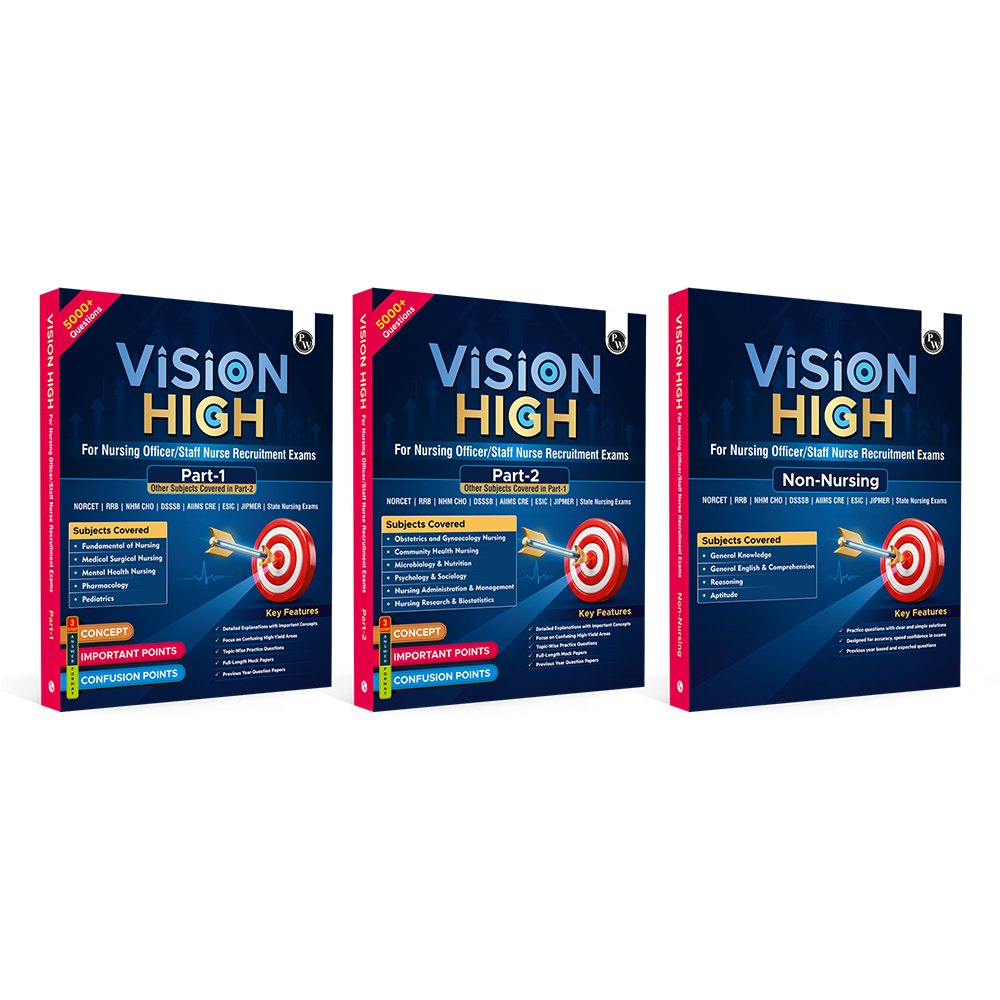
Explore Nursing Books with PYQs, question banks, practice questions, detailed solutions and exam-focused content for NORCET, RRB, NHM CHO, AIIMS CRE, ESIC and other nursing exams.
Nursing Study Material You Need for Complete Syllabus Coverage
Achieving complete syllabus coverage requires a balanced mix of foundational textbooks and specialised nursing preparation books that address every single subject tested in entrance exams.
Relying on fragmented notes often leaves dangerous gaps in clinical knowledge. Comprehensive packages ensure that subjects like medical-surgical nursing, pharmacology, and community health nursing receive equal, dedicated attention.
-
Subject-Wise Depth: Comprehensive books cover all important topics required for major nursing entrance and recruitment exams, ensuring students complete their preparation without missing essential concepts.
-
Standardised Frameworks: Quality volumes align with standard clinical guidelines to maintain accuracy across all topics.
-
Integrated Summaries: Quick revision notes and high-yield tables help learners recall critical pharmacological dosages and anatomical structures instantly.
-
Clinical Vignettes: Scenario-based questions embedded within chapters train students to apply theoretical knowledge directly to patient care environments.
-
Multidisciplinary Scope: Nutritional science, microbiology, and mental health nursing are integrated to provide a well-rounded foundation for national tests.
How to Use Nursing Books as Part of Your Nursing Study Material
Owning the best nursing preparation books is only half the battle; knowing how to extract maximum value from them defines successful candidates. During mid-term revisions, students must transition from passive reading to active, question-driven study sessions. This shift ensures that theoretical knowledge transforms smoothly into high exam scores.
-
Build Strong Concepts: Always build strong concepts before solving practice questions to ensure long-term retention.
-
Chapter-Wise Practice: Practice chapter-wise questions regularly to test your understanding of newly read topics.
-
Systematic Revision: Revise important topics consistently before the examination to keep clinical facts fresh in your mind.
-
Active Annotation: Highlight key terms, contraindications, and normal laboratory values directly in the margins to facilitate rapid final-week reviews.
-
Diagrammatic Mapping: Translate lengthy procedural descriptions into flowcharts to improve visual memory during high-pressure examinations.
-
Peer Discussions: Form small study circles to debate complex pathophysiological mechanisms found in reference textbooks, deepening individual comprehension.
PW Nursing Books Vision High Combo Set of 3 Books with 5000+ Questions, PYQs and Detailed Explanations for NORCET, RRB, NHM CHO, DSSSB, AIIMS CRE, ESIC and JIPMER Exams.
How to Use PYQs to Strengthen Your Nursing Study Material
Solving previous years' papers is non-negotiable for anyone aiming to crack competitive healthcare assessments. Integrating nursing PYQs into your daily routine exposes the recurring patterns, weightage distribution, and trick questions favoured by exam boards. It shifts your perspective from a general reader to a strategic test-taker.
-
Pattern Recognition: Previous year questions help students understand the exam pattern, identify important topics, and improve confidence.
-
Detailed Explanations: Reviewing solutions attached to past papers clarifies why specific clinical interventions are chosen over others.
-
Time Management Insights: Analysing past trends teaches you how to allocate time wisely across different sections of the actual exam paper.
-
High-Yield Focus: Spotting recurring themes allows candidates to prioritise high-frequency topics over obscure low-yield study areas.
-
Difficulty Calibration: Matching your practice performance against historical cut-offs provides an accurate measure of your current competitive standing.
-
Error Tracking: Maintaining a log of mistakes made in past papers prevents repeated misinterpretations of tricky clinical questions.
How Mock Tests Complete Your Nursing Study Material
Completing your preparation cycle requires rigorous self-assessment through nursing mock tests. These simulated exams replicate the pressure, time constraints, and environment of the actual testing centre. They act as a mirror, reflecting your strong suits and exposing hidden weaknesses before it is too late.
-
Speed and Accuracy: Attempt mock tests to improve speed and accuracy under strict time limits.
-
Performance Evaluation: Regular practice papers and mock tests help students evaluate their preparation and revise effectively before the examination.
-
Anxiety Reduction: Familiarity with the online or offline test interface significantly calms nerves on the actual exam day.
-
Endurance Building: Sitting through multi-hour simulations trains mental stamina required for demanding professional entrance exams.
Read More - Nursing Syllabus: How to Cover All Subjects With PW Books?
Study Strategy to Use Nursing Study Material in the Right Order
Following a logical sequence prevents cognitive overload and ensures steady academic momentum during the mid-term session. Jumping straight into mock tests without clearing fundamentals leads to frustration, while reading textbooks indefinitely wastes precious time. A phased approach guarantees balanced, stress-free progression.
-
Phase One - Foundation: Spend the initial weeks reading core textbooks and clearing basic anatomical and clinical concepts.
-
Phase Two - Application: Solve chapter-wise exercises and bsc nursing study material questions to test theoretical retention.
-
Phase Three - Evaluation: Introduce nursing exam preparation mock tests and past papers during the final weeks to build stamina and speed.
-
Phase Four - Micro-Revision: Dedicate the final days exclusively to reviewing high-yield tables, formula sheets, and flagged error logs.
-
Phase Five - Rest Management: Balance intensive study blocks with adequate sleep to optimize cognitive processing and memory consolidation.
-
Phase Six - Final Simulation: Complete one comprehensive timed assessment forty-eight hours before the exam to build supreme self-assurance.
Tips to Choose and Organise Nursing Study Material
Clutter leads to confusion, especially when managing multiple reference volumes and clinical notes. Organising your workspace and selecting authentic resources creates an environment conducive to deep focus. Quality trumps quantity every single time when preparing for competitive healthcare tests.
-
Syllabus Alignment: Always verify that your chosen resources match the latest guidelines issued by official examination authorities.
-
Digital and Physical Balance: Combine physical textbooks for deep reading with digital flashcards for quick mobile revisions.
-
Dedicated Study Space: Keep your desk free from unrelated clutter so you can access necessary texts instantly during tight study blocks.
-
Modular Categorisation: Arrange folders and books by specific clinical specialities to reduce time wasted searching for references.
-
Wearable Summaries: Keep pocket-sized revision cards handy during clinical postings to maximise idle transit hours.
-
Edition Check: Ensure all study volumes are recent editions to capture any newly updated pharmacological protocols or health policies.
Common Mistakes to Avoid While Using Nursing Study Material
Even dedicated students sometimes fall into traps that stall their progress and dent their confidence. Recognising these common pitfalls helps you course-correct early and protect your valuable study hours from unproductive habits.
-
Rushing Through Theory: Skipping foundational chapters to jump straight into practice questions creates fragile conceptual clarity.
-
Ignoring Regular Revision: Studying a topic once and never revisiting it leads to rapid memory decay.
-
Neglecting Weak Areas: Spending all your time on favourite subjects while ignoring difficult clinical modules invites low overall scores.
-
Over-Collecting Resources: Acquiring too many competing books creates decision fatigue and leaves every volume half-read.
-
Skipping Post-Test Analysis: Taking mock tests without reviewing incorrect answers repeats identical conceptual errors in future exams.
-
Disregarding Health: Sacrificing sleep and physical well-being severely impairs clinical reasoning and test-day concentration.
Frequently Asked Questions
Which exams can I prepare for using standard nursing study material?
Standard resources are useful for AIIMS NORCET, RRB Nursing, NHM CHO, DSSSB, ESIC, JIPMER, and other major nursing entrance and recruitment examinations.
Are standard nursing preparation books based on the latest syllabus?
Yes, quality preparation books are prepared according to the latest syllabus and exam pattern of major nursing examinations.
Do nursing books include previous year questions?
Yes, many standard guides include previous year questions with detailed solutions to help students understand the exam pattern and improve their preparation.
Can beginners prepare for nursing exams using these study resources?
Yes, the books are designed with simple explanations, structured content, and practice exercises, making them suitable for both beginners and repeat aspirants.
How do mock tests improve nursing exam preparation?
Mock tests improve time management, boost accuracy, reduce exam anxiety, and help students evaluate their overall readiness before the final test.