How to Prepare Physics for Olympiad Exams in Class 11?
Starting your Olympiad Physics Class 11 journey can feel overwhelming due to the sheer depth of advanced problem-solving required. Many students struggle to transition from regular school boards to competitive conceptual frameworks.
This comprehensive article simplifies the exact strategy, structured steps, and premium resources needed to master the syllabus and build high-level analytical thinking skills.
Check Out: Olympiad Books
Overview of Olympiad Physics Class 11
Cracking national and international competitions requires a clear view of what you are up against. The National Standard Examination in Physics (NSEP) serves as the primary stepping stone in India, leading to the Indian National Physics Olympiad (INPhO) and ultimately the International Physics Olympiad (IPhO).
Unlike traditional school tests, an Olympiad Physics Class 11 paper does not ask for direct formula substitutions. Instead, it features complex, calculus-based conceptual questions, multiple-correct options, and intensive numerical evaluations.
-
Primary Screening (NSEP): Focuses heavily on objective-type application questions where speed and accuracy are vital.
-
Subsequent Stages (INPhO): Shifts completely to descriptive, multi-step analytical problems that test deep theoretical foundations.
-
Target Level: You must approach the Class 11 topics with an outlook that aligns with top-tier engineering entrances and global scientific standards.
Check Out: Class 11th Olympiads
Important Topics for Olympiad Physics Class 11
You cannot study randomly when dealing with elite national competitions. Prioritising highly weighted areas ensures that your efforts bring maximum results during your class 11 physics olympiad preparation. The Class 11 syllabus forms the absolute bedrock of mechanical logic and classical physical laws.
Mechanics and Rigid Body Dynamics
Mechanics is the most critical domain for any competitive physics aspirant. It forms more than half of the foundational questions in national screening rounds.
-
Kinematics and Projectile Motion: Understanding relative motion in two dimensions and constrained motion.
-
Newton’s Laws and Friction: Mastering non-inertial frames of reference, pseudo forces, and complex pulley-block systems.
-
Work, Power, and Energy: Applying the work-energy theorem and conserving mechanical energy in varying fields.
-
System of Particles and Rotational Motion: Solving problems involving torque, angular momentum conservation, rolling without slipping, and moment of inertia matrices.
Gravitation and Properties of Matter
These areas bridge macro-level mechanics with micro-level physical properties, requiring sound mathematical processing.
-
Kepler’s Laws and Planetary Orbits: Calculating escape velocities, binding energy, and elliptical path mechanics.
-
Elasticity and Hydrodynamics: Fluid kinematics, Bernoulli's equation, viscosity, surface tension, and capillary action mechanics.
Thermodynamics and Kinetic Theory
Thermal physics requires a clean conceptual interpretation regarding energy transfers and molecular behaviors.
-
Laws of Thermodynamics: Analysing cyclic processes, heat engines, and entropy changes.
-
Kinetic Theory of Gases: Real vs ideal gas equations, degrees of freedom, and specific heat capacities.
Oscillations and Waves
Wave mechanics requires a strong grasp of trigonometric identities and differential equations.
-
Simple Harmonic Motion (SHM): Finding time periods of complex oscillating systems and combinations of springs.
-
Wave Motion and Sound: Superposition of waves, standing waves in strings/pipes, and the Doppler Effect under moving conditions.
|
Core Domain |
High-Yield Topics to Master |
Typical Question Style |
|
Classical Mechanics |
Rotational dynamics, variable mass systems, constrained motion |
Multi-variable calculus-based calculus problems |
|
Fluid Mechanics |
Surface tension, dynamic viscosity, Bernoulli applications |
Continuity equations mixed with mechanical forces |
|
Thermodynamics |
Indicator diagrams, polytropic processes, thermal efficiency |
Graphical interpretation and state-change tracking |
|
Waves & SHM |
Damped oscillations, Doppler shift, acoustic resonance |
Differential equation setup and phase analysis |
Check Out: Olympiad NSEP Class 11 Advanced Physics For 2026 PYQ
How To Prepare For Olympiad Physics Class 11?
Balancing regular school terms, competitive preparation, and olympiads requires a highly structured, disciplined routine. Use these proven operational steps to optimise your learning workflow:
-
Integrate Calculus Early: You cannot manage an advanced Olympiad Physics class 11 curriculum without a strong command of basic differentiation, integration, and vector algebra. Learn these mathematical tools before diving into kinematics.
-
Utilise Structured Digital Resources: Access authentic physics olympiad notes PDF files, recorded video analyses, and chapter-wise daily practice problem sets to clarify complex doubts.
-
Maintain a Dedicated Error Log: Keep a notebook exclusively for tough problems you could not solve on your first attempt. Write down the core concept you missed so you can review it before your exams.
-
Take Timed Mock Tests: Standing exams demand swift mental processing. Sit for full-length mock examinations in a timed setting to manage your pacing and reduce silly errors under pressure.
How To Solve Olympiad Physics Class 11 Problems?
True competence comes from tackling unseen, non-routine problems. Theoretical reading is useless if you cannot translate physical laws into mathematical frameworks.
-
Solve Topic-Wise Past Papers: As soon as you finish a chapter like Rotational Motion, look up historical NSEP and INPhO questions from that specific topic.
-
Avoid Looking at Solutions Too Quickly: Spend at least 20 to 30 minutes wrestling with a single hard problem. Analyse the system from different perspectives, such as using energy conservation instead of force balancing.
-
Deconstruct Multi-Concept Challenges: High-level competitive papers often blend multiple topics. For example, a question might combine fluid buoyancy with simple harmonic motion. Break the problem into separate parts, write out the governing equations, and then solve them systematically.
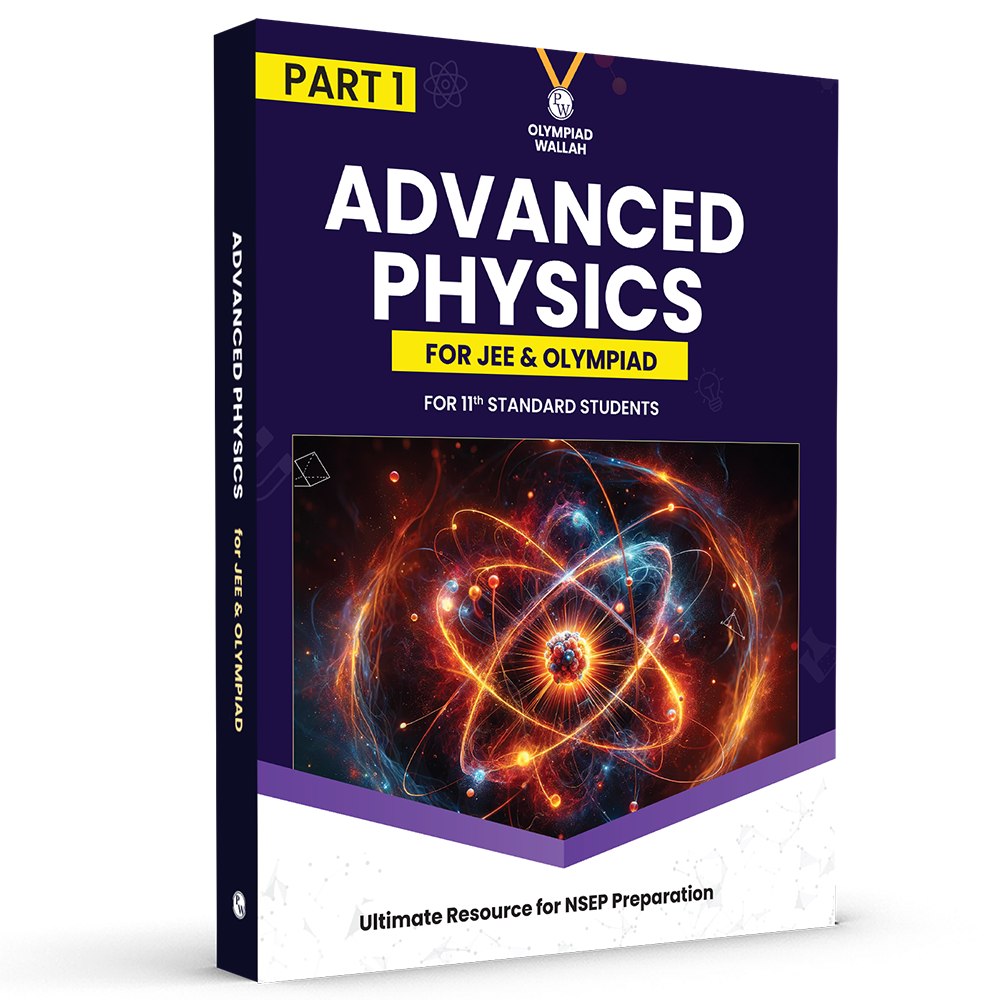
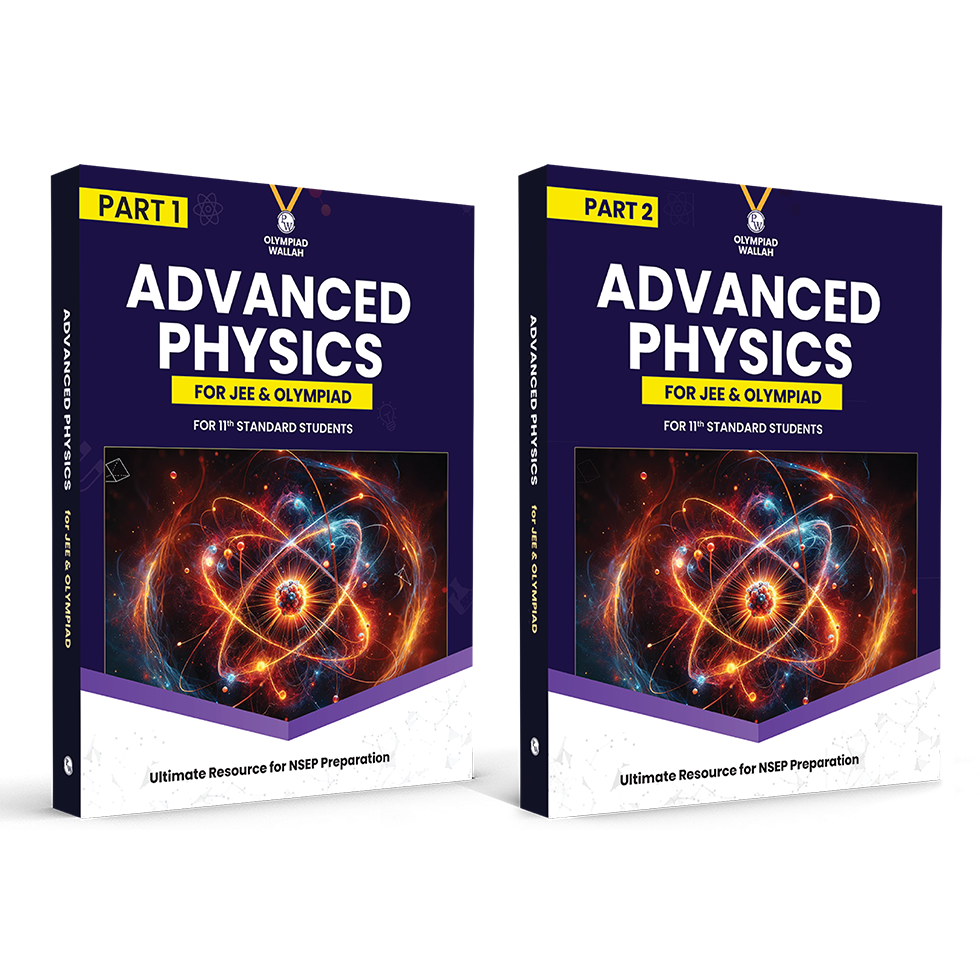
Also Check, Olympiad NSEP Class 11 Advanced Physics (Part 1 & 2) For JEE & Olympiad Exam
Tips for Olympiad Physics Class 11
While national olympiads like NSEP focus on core physics, many students also target the National Science Olympiad (NSO) conducted by Science Olympiad Foundation (SOF). Managing your NSO physics preparation class 11 alongside core physics exams requires a slightly adjusted strategy.
-
Understand the NSO Blueprint: The NSO exam features multiple-choice questions split into an Achievers Section and a Science Section. The Achievers Section carries higher marks and demands superior analytical skill.
-
Develop High Processing Speed: While exams like NSEP require long, deep derivations, NSO requires quick mental calculations and rapid elimination of wrong choices.
-
Focus on Applied Science: NSO questions frequently emphasise everyday applications of physical principles, such as modern instruments, dimensional errors, and practical laboratory mechanisms.
Read More: NSEP Syllabus, Exam Pattern, and Books
Prepare Physics for Olympiad Exams in Class 11 FAQs
Q1: Can I start my Class 11 Physics Olympiad preparation without any prior background in Classes 9 or 10?
Yes, you can absolutely begin your preparation in Class 11. While a prior foundation helps, the Class 11 curriculum revisits mechanics and properties of matter from the ground up. Focusing on advanced problem-solving methodologies and mastering calculus early will bridge any existing gaps.
Q2: What are the most critical Olympiad Physics topics that I must master first?
The highest-priority domain is Classical Mechanics, which includes Newton's Laws, Work-Energy theorems, and Rotational Dynamics. Once you build a strong foundation here, focus on Fluid Mechanics, Waves, and Thermodynamics, as these areas appear frequently in competitive papers.
Q3: Where can I find authentic Class 11 physics Olympiad questions for daily practice?
You can access high-quality problem sets through chapter-wise Daily Practice Problems (DPPs) provided in targeted online courses, standard reference books like Irodov, and specialized preparation modules available on the official website.
Q4: Is the syllabus for the NSO physics preparation class 11 different from the NSEP exam?
The fundamental physics concepts remain identical, but the exam formats differ. NSEP focuses deeply on advanced mathematical derivations and multi-step problems. NSO emphasises application-based multiple-choice questions, speed, and logical reasoning, especially in its high-weightage Achievers Section.